Lead Bank · Study
Lead Bank Interview Process & Questions
TrueInterview
September 4, 2026 · 9 min read
Lead Bank's coding rounds are miniature product systems, not algorithm puzzles: a table of rows, an interface to build over it, and later parts that extend the API from the part before. The loop is short, one technical screen and a virtual on-site of four to five rounds, and it ends with a hiring manager conversation that has decided outcomes on its own after strong technical rounds.
This guide breaks down each stage of the Lead Bank interview, what interviewers evaluate in each round, and how to prepare, with questions candidates were actually asked.
Verified: Based on 4 candidate-reported interview experiences, cross-checked against recent public accounts.
Lead Bank interview process
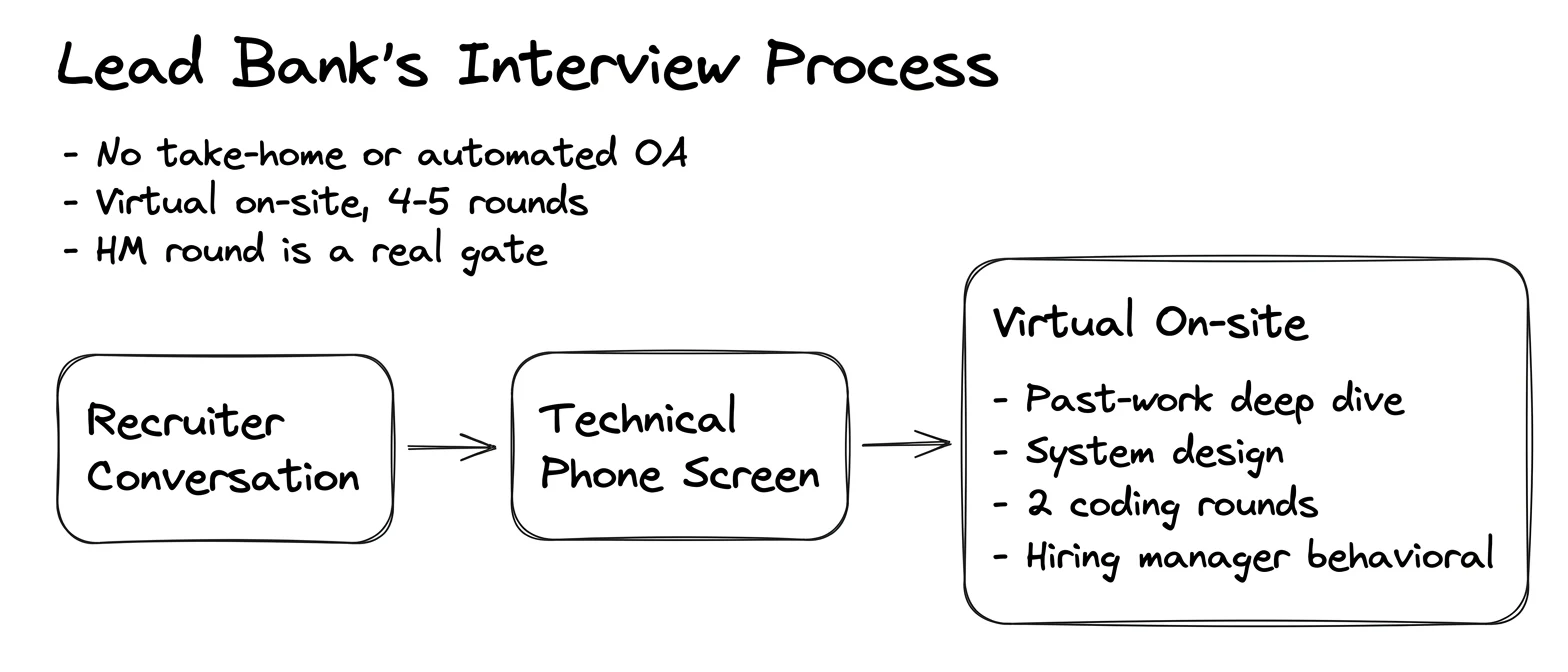
Engineers join a single backend-heavy engineering organization, and the reported loops, from early 2025 to mid-2026, barely varied: a technical screen, then an on-site with a past-work deep dive, system design, two coding rounds and a hiring manager round. The order moves. One loop opened with the deep dive as its own round; another folded it into the closing hiring manager conversation. No candidate reported an online assessment or take-home. Postings run from Software Engineer II (2+ years) to Software Engineer V (15+ years), and the design and project rounds typically weigh more for senior candidates.
Here's what the interview process can look like:
- Recruiter screen: A short, typically non-technical call on background, level and logistics.
- Technical phone screen: One live problem, usually a small data store with two or three parts.
- Coding interviews (two on-site rounds): Multi-part problems where each part extends the code you already wrote.
- System design interview: A hotel reservation system in every reported loop, pushed on failures and concurrent holds.
- Project deep dive and hiring manager interview: Your proudest project in depth plus behavioral questions, sometimes split into two rounds.
Tip: Write every coding answer as a class with an ingest method, accessors and a mutation path. Part one is rarely hard; a representation that only answers part one forces a rewrite once part two arrives.
Technical phone screen
The screen is one problem stated as data plus an interface. In the most reported version, you get a table of user pairs with directed like counts and store it so that "how many times did A like B" is a cheap lookup. The follow-up turns the same structure into a recommendation: find the person a user liked most, then return who that person liked most. A 2026 screen used an event store instead: CRUD over a list kept sorted by start time, binary-searched inserts, and an offset/limit read.
Interviewers asked for the complexity of every method, not of the solution as a whole. Ties, unknown users and the direction of the relationship are left unstated on purpose.
Interviewers evaluate:
- Representation choice: A nested map from user to liked users and counts serves both parts; a flat list of raw rows does not.
- Per-method complexity: The cost of insert, delete and paginated read, each stated on its own.
- Clarifying questions: Settling tie-breaks and unknown-user behavior before coding.
- Extensibility: Part two reuses the part-one structure without starting over.
Practice building small in-memory stores from a sample table against a timer, stating each method's complexity as you finish it.
Sample questions for the technical phone screen
Here are some questions reported by recent candidates:
-
Store a table of mutual like counts so you can return how many times any user liked another, then recommend to each user the people their most-liked user liked most.
-
Implement CRUD over events kept sorted by start time, with binary-searched inserts and an offset/limit read, and give each method's complexity.
-
Design an Event Store with CRUD and Sorted Insert (Binary Search) + Pagination
Coding interviews
The two on-site coding rounds follow the screen's style with more parts. One prompt is a stock tick log keyed by ticker and date, with get, update, a percentage change between two dates and the same change for two tickers; one version ran to four parts, the last flagged as a bonus to discuss rather than code. A calendar prompt asked for sorted insert, delete by event name, page-number pagination, chunked loading when the list does not fit in memory, and an interval-overlap check. The social likes problem also reappears on-site, ending in a best-friend-of-best-friend recommendation.
Interviewers co-drive: two candidates were guided step by step, including one who found the opening statement unclear and still finished smoothly after asking questions.
Interviewers evaluate:
- Update semantics: Separating an update that creates an entry from one that overwrites a value; one stock prompt expected later reads to flag overwritten prices.
- Output precision: Percentage changes with a sign and two decimals, exactly as specified.
- Edge handling: Missing tickers and dates handled before any arithmetic.
- Scaling the read path: How pagination and interval queries change once events no longer fit in memory.
Drill multi-part class problems where part three reuses part one's data structure, and keep a working version after every part.
Note: The bonus part is not free. In the four-part stock problem the candidate was still expected to explain the last part out loud, so budget time for it instead of polishing earlier parts.
Sample questions for the coding interviews
Here are some questions reported by recent candidates:
-
Build a stock tick store with lookups by ticker and date, updates that mark changed values, a formatted percentage change, and a two-ticker comparison.
-
Maintain a calendar with sorted insert, delete by name, page-number pagination and a query for events overlapping an interval.
-
Write
IngestDataandGetLikesCountover a likes table, thenGetFriendRecommendation, returning a user's best friend's best friend.
System design interview
Both on-site reports had the same prompt: a hotel reservation system. One interviewer required booking a specific room number rather than a room type, which turns availability into a per-room calendar. Most of the round is follow-ups: failure scenarios one after another, and how to stop two users searching the same room from colliding. One candidate proposed database locking plus an in-memory store of held rooms to show holds in real time, then felt that piling on edge cases had hurt them.
Interviewers evaluate:
- Data model: Room, reservation and hold entities, per room and per night when room numbers are required.
- Concurrency control: A clear, justified choice among locks, conditional writes or expiring holds.
- Failure handling: A failed payment mid-booking, an expired hold, a component going down.
- Scope discipline: Stopping once the requirement is met.
Prepare one reservation design end to end, including hold expiry and recovery, without components you don't need.
Sample questions for the system design interview
Here are some questions reported by recent candidates:
- Design a hotel reservation system, then remodel it so guests book a specific room number.
- Two users view the same room at once: how do you prevent a double booking and show that the room is held?
- Walk through what breaks when each component fails and how booking recovers.
Project deep dive and hiring manager interview
Every reported on-site examined past work in depth, either as a separate opening round or as the start of the hiring manager round, which then moved to standard behavioral questions. This round is a real gate: one candidate who felt the technical rounds went well believed the loop ended here, and another named an under-prepared backend project discussion as their weakest round.
Interviewers look for:
- Depth of ownership: Specific decisions, the tradeoffs you rejected, and why.
- Backend fundamentals in your own work: Data model, failure modes and scaling choices of the system you describe.
- Autonomy: Postings ask for comfort in a fluid, high-autonomy environment.
- Team fit: A working style that suits a small engineering team working with product, finance and compliance.
Pick one backend project you can defend down to its schema and failure modes, plus two or three stories about ambiguity and cross-team work.
Tip: Rehearse the walkthrough with someone who keeps asking why. What caught candidates were routine backend choices they had never had to justify.
How Lead Bank makes hiring decisions
The hiring manager round comes last and appears to carry the final say; no report mentions a separate committee. The one reported rejection followed that round, and the candidate attributed it to fit or a stronger applicant pool. Postings separate Software Engineer II through V by years and scope, which typically sets the target level. Reports do not describe down-leveling, cooldowns or decision timelines.
How to prepare for the Lead Bank interview
- Build classes, not functions: Turn a sample table into an ingest method, accessors and a mutation path, and agree the interface before typing.
- Drill sorted insert and pagination: Binary-searched inserts and offset or page-number reads appeared in separate rounds and years.
- State complexity per method: Give each operation's cost as you finish it.
- Decide write semantics up front: Create versus overwrite, how reads reflect it, and exact output format.
- Prepare one hotel reservation design: Per-room availability, expiring holds, locking against double booking and failure recovery, then stop adding parts.
- Defend one project in depth: The deep dive and hiring manager round decide close loops.
- Ask clarifying questions early: Interviewers reveal constraints when asked, not in the opening statement.
About working at Lead Bank
Lead Bank is a Kansas City–chartered, FDIC-insured bank, relaunched under new ownership in 2022, that sells API-based banking infrastructure to fintechs. Engineering builds the backend behind that platform and works with product, finance and compliance; roles are posted as hybrid in San Francisco, Sunnyvale and New York. A $70 million Series B in September 2025 was earmarked partly for the technology stack.
| Level | Primary focus | Impact scope |
|---|---|---|
| Software Engineer II | Building and maintaining backend features | Features within a team |
| Software Engineer III | Designing large-scale backend systems, mentoring | Systems; full-stack variants exist |
| Software Engineer IV | Architecting new systems in ambiguous areas | Team roadmap with product partners |
| Software Engineer V | Technical design and large cross-team releases | Principal-level, multi-team |
Lead Bank hires Software Engineers across product lines that include:
- Deposits and accounts: Accounts partners embed in their own products.
- Payments: Money movement, including real-time payments.
- Card issuing: Partner card programs, including a stablecoin-linked card platform with Stripe and Visa announced in 2025.
- Lending: Credit products partners launch on the bank's charter.
Experience and education requirements
Postings ask for 2+ years at Software Engineer II, 7+ at III, 10+ at IV and 15+ at V, cloud-native experience (preferably AWS) and strong Go or Java; full-stack roles add TypeScript, and the senior-most posting also accepts Ruby. Fintech experience is preferred, not required. Only the Software Engineer V posting mentions a degree (an advanced CS degree or equivalent experience).
FAQs about the Lead Bank interview
How long does the Lead Bank interview process take?
Reports give no firm timelines. With one screen and a single on-site day, most of the elapsed time is scheduling.
What is the hardest round of the Lead Bank interview?
Coding prompts are moderate one part at a time; the rounds that ended loops were the design follow-ups and the hiring manager conversation.
Is there an online assessment?
No reported loop had one. The first technical step is a live screen with an interviewer.
What language should I use?
One reported solution was in Python. Postings favor Go and Java for the job, but any language you can write classes in quickly works.
How much does a Lead Bank software engineer make?
Posted base ranges for San Francisco and New York are about $150K–$175K at Software Engineer II, $180K–$210K at III, $210K–$240K at IV and $224K–$280K at V, with equity on top and a cash bonus mentioned at the senior-most level.