JPMorgan · Study
JPMorgan Chase Interview Process & Questions
TrueInterview
July 24, 2026 · 12 min read
JPMorgan Chase grades engineers on reading code as much as writing it. Most final loops include a code review or debugging segment on an unfamiliar Java class, and the defects that recur are concurrency ones: misused volatile, unsynchronized shared state, global variables. Coding is mostly easy to medium, and design follow-ups push on overselling, duplicate submissions and failure paths. Passing the final round is not the end: candidates are approved for hire first and matched to a team afterward, and the matching step is the least predictable part.
This guide breaks down each stage of the JPMorgan Chase interview, what interviewers evaluate in each round, and how to prepare, with questions candidates were actually asked.
Verified: Based on 18 candidate-reported interview experiences, cross-checked against recent public accounts.
JPMorgan Chase interview process
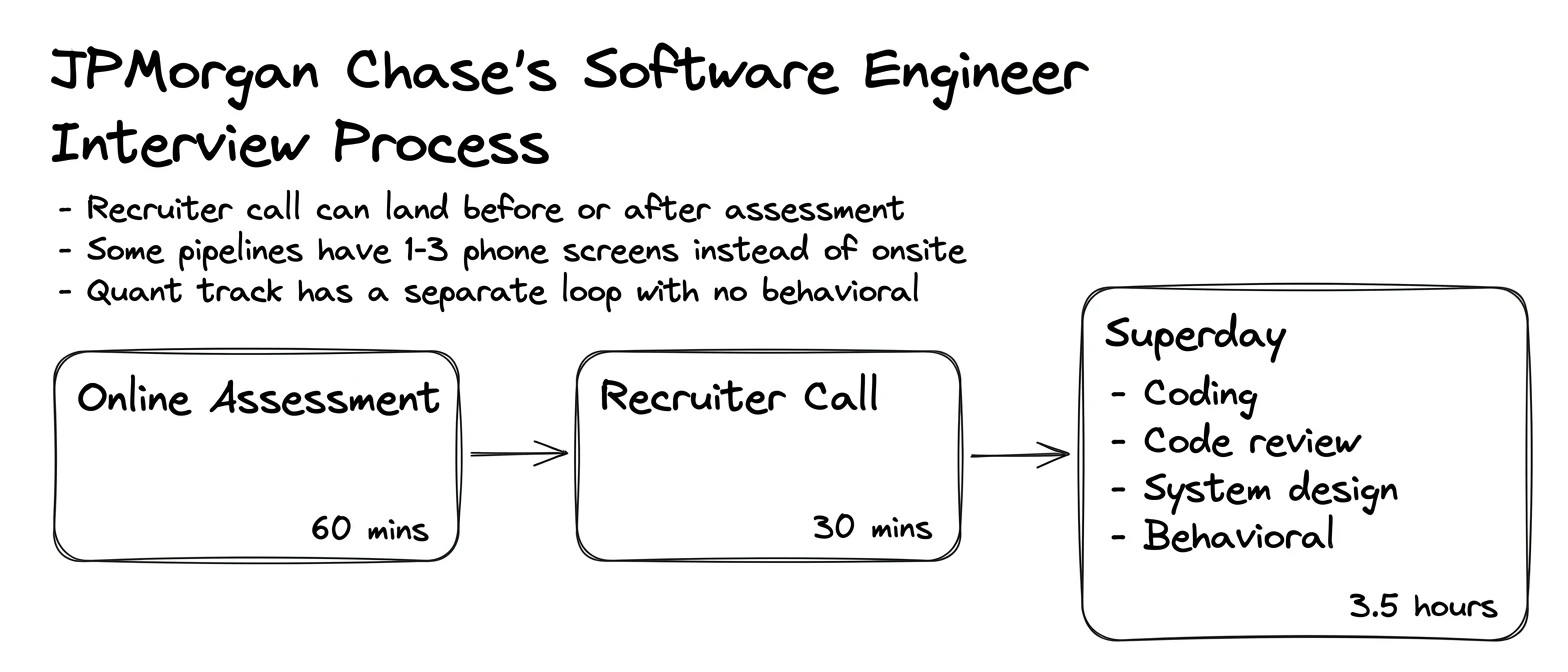
The loop varies little by team. Software engineers usually take an online assessment and have a recruiter call (in either order), then a final round called a Superday. The Superday is three or four 45-minute sessions run back to back, about 3.5 hours in total. Some pipelines add technical phone screens first, or run the whole loop as three phone calls.
Early-career applicants to the Software Engineer Program must pass the coding assessment before anyone reviews the application, and may also record a video interview. The quantitative track runs a separate, fully technical loop.
Here's what the interview process can look like:
- Online assessment: Two coding problems in about 60 minutes, easy to medium, with no camera required.
- Recruiter screen: A non-technical call of about 30 minutes covering background, motivation, work authorization and pay expectations.
- Technical phone screens (some pipelines): About 45 minutes in a shared editor, usually two problems, sometimes with a code critique or a full design discussion.
- Code review and coding interview: Critiquing or debugging an existing class, then one or two easy problems dry-run by hand.
- System design interview: A 45-minute high-level design, usually a URL shortener or a commerce flow with concurrency follow-ups.
- Behavioral interview: A project deep dive with a manager, covering conflict, ambiguity, leadership and deadlines.
- Team matching: Placement on a team after the Superday is passed.
Tip: Superdays are often group days, with several candidates rotating through interviewers in parallel and 15-minute breaks between sessions. The round order is not fixed, so prepare a short checklist for each round type and you can switch between them without warming up again.
Online assessment
The assessment runs on HackerRank and usually arrives within days of applying. Candidates consistently report two problems in about 60 minutes, with no webcam. Some problems are warm-ups: validate an alphanumeric string and count its vowels and consonants, or flag local peaks and valleys across consecutive triples. Others are classic patterns: minimum meeting rooms, a task scheduler with cooldown, course ordering from prerequisites, merging intervals and grouped binary substrings.
Recent variants included building a numbered table of contents from # and ## heading lines. Another split a numeric string into halves and counted the fewest digit changes needed to make the halves anagrams. Inputs can reach 10^5 characters, so enumerating every substring will time out. Prepared candidates report finishing in 10–15 minutes.
Interviewers evaluate:
- Hidden-case correctness: Grading is automated, and passing every case beats elegance.
- Linear-time instincts: For grouped binary substrings, compress the string into runs and sum the minimum of each adjacent pair.
- Parsing discipline: Reset the sub-counter at each new top-level heading and skip unmarked lines.
- Boundaries: Off-by-one errors on interval ends and empty inputs are the usual way to lose cases.
Practice two-problem sets against a 60-minute timer, and save ten minutes for edge cases you construct yourself.
Sample questions for the online assessment
Here are some questions reported by recent candidates:
-
Validate that a string is strictly alphanumeric, then count its vowels and consonants case-insensitively.
-
Turn a document's
#and##heading lines into a numbered table of contents (1, 1.1, 1.2, 2…). -
Return a valid task order from prerequisite pairs, or report the cycle that makes ordering impossible.
Recruiter screen
The recruiter call lasts about 30 minutes and has no technical content. It checks that your resume holds up: work history, specific projects, career transitions. Some recruiters had studied the candidate's profile entry by entry. It also covers why you want to work at JPMorgan Chase, your immigration status, your pay expectations and the remaining stages.
Interviewers evaluate:
- Narrative consistency: Whether your account of each role and each move matches the resume.
- Motivation: A specific reason to build technology inside a bank.
- Logistics: Work authorization and pay. One candidate felt that settling authorization early kept the process moving.
Prepare a two-minute career walkthrough that explains each transition.
Note: Several candidates reported that recruiters worked almost entirely through unscheduled phone calls and rarely answered email. Ask for a short written recap after each call so that you have a record of dates and next steps.
Sample questions for the recruiter screen
Here are some questions reported by recent candidates:
- Walk me through your experience and the projects on your resume.
- Why JPMorgan Chase, and what is your work authorization status and expected pay?
Technical phone screens
Where a pipeline includes a technical phone screen, it runs about 45 minutes in a shared editor, sometimes without syntax highlighting, and usually has two problems back to back: a circular sliding window with a one-character-deletion string match, a greedy suffix bit-flip problem with an anagram-conversion count, or grouped binary substrings with minimum swaps to sort. Some screens go further. One sliding-window call ended with a short code critique, and the second call in that pipeline was a full flash-sale design.
Interviewers evaluate:
- Narrated reasoning: How you break the problem down counts as much as the final code.
- Wrap-around correctness: On circular inputs, test the case where the best block crosses the end of the array.
- Complexity: Explaining why the naive deletion check is O(n²) and how to reach O(n).
- Clean syntax without tooling: Careless syntax shows in a bare editor.
Practice explaining your code out loud in a plain text editor.
Sample questions for the technical phone screens
Here are some questions reported by recent candidates:
-
In a circular row of computers, open at most k adjacent closed ones to get the longest contiguous run of open machines.
-
Find the minimum swaps to sort distinct integers into decreasing order.
Code review and coding interview
This is the round that sets the JPMorgan Chase loop apart. You get an existing class, sometimes printed on paper, and are asked to read it aloud, explain what it does and critique it. Reported defects include misuse of volatile that leaves a race condition, global or wrongly scoped variables, single-responsibility violations, hard-coded configuration, weak exception handling, inefficient string handling and off-by-one errors. In one debugging variant, the candidate had to fix a customer-request class that made an external call. The interviewer stressed reaching for standard, well-tested libraries before low-level concurrency primitives.
The coding half is deliberately easy: move zeroes in place, asteroid collision with changed tie rules, recovering a password from decryption rules, or a short loop-based function, sometimes on a whiteboard.
Interviewers evaluate:
- Why each issue matters: Name the failure mode, such as two threads both passing a check, not just the label.
- Proportionate fixes: The smallest sensible refactor for each defect.
- Concurrency literacy: The difference between visibility and atomicity, and when
volatileis not enough. - Self-testing: Building your own inputs and tracing them without being asked.
Practice critiquing unfamiliar Java aloud for 15 minutes at a time.
Note: Candidates who prepared only for algorithms were caught out here. Reading a printed Java class aloud, with no compiler and no hints, is a different skill from solving a problem.
Sample questions for the code review and coding interview
Here are some questions reported by recent candidates:
-
Critique a Java class that uses
volatilefor shared mutable state, mixes unrelated responsibilities and hard-codes its configuration. -
Simulate asteroid collisions with a stack under modified collision rules.
System design interview
The URL shortener is the most commonly reported prompt by a wide margin. Follow-ups add click analytics, key collisions, pre-generated keys, caching and partitioning for read-heavy traffic. Other prompts include a distributed rate limiter, a flash sale for millions of users, an existing shopping cart improved for latency and real-time out-of-stock alerts, and an e-commerce checkout that must block double-clicked orders and overselling. Another was a global property-rental search platform, framed as migrating a monolith to cloud services. Most candidates found the depth high level, but the follow-ups almost always turn to concurrency.
Interviewers evaluate:
- Driving the session: Gathering requirements and estimating scale before drawing anything.
- Concurrency safety: Idempotency keys, atomic inventory decrements, locking choices and queues to absorb bursts.
- Unhappy paths: What happens when stock runs out mid-request or a payment times out, and what the user sees.
- Operability: High availability and observability, which the migration prompts raise explicitly.
Practice building a URL shortener from scratch and one commerce flow, each traced from request to database.
Tip: One flash-sale interviewer asked for the happy path and then for each unhappy path in turn. What carried that round was a step-by-step account of how the system degrades and what it tells the user, so rehearse that part out loud.
Sample questions for the system design interview
Here are some questions reported by recent candidates:
-
Design a URL shortener, then add per-link click tracking without slowing redirects.
-
Design a flash sale for millions of concurrent users without overselling scarce stock.
Behavioral interview
A manager or senior manager usually runs this round, and it centers on your projects: the one you are proudest of, its hardest blocker, and the team dynamics around it. Recurring themes are a conflict with a colleague, ambiguous requirements, influencing without authority, tight deadlines and mentoring. One candidate was asked directly about working extra hours when a deadline requires it.
Interviewers evaluate:
- Personal ownership: What you decided and built, not what the team did.
- Conflict maturity: How you repaired the working relationship, not only how the disagreement ended.
- Delivery under pressure: Getting a struggling project over the line, and your attitude toward crunch periods.
- Resume truthfulness: Follow-ups go deep enough to expose inflated scope.
Prepare five stories, each detailed enough to hold up under three rounds of follow-up questions.
Sample questions for the behavioral interview
Here are some questions reported by recent candidates:
-
Describe the project you are proudest of and how you resolved its hardest blocker.
-
How do you feel about working extra hours when a deadline requires it?
Quantitative track interviews
The only quantitative loop in the reports had a phone screen that mixed coding with a brainteaser, followed by three purely technical onsite interviews with no behavioral questions. The phone screen asked for the number of domino tilings of a 2×N board and why the count follows the Fibonacci sequence. The onsite came back to the same problem on a 3×N board, which the candidate did not finish. Other onsite topics were an infinitely nested square root, a couples probability problem, C++ virtual dispatch and dangling pointers, and choosing a goodness-of-fit test for a binomial sample.
Interviewers evaluate:
- Intuition, not just recurrences: Explaining why a pattern holds.
- Language internals: C++ object lifetime, and the difference between a pointer and a reference.
Review tiling recurrences, counting arguments and C++ object lifetime together.
Sample questions for the quantitative track interviews
Here are some questions reported by recent candidates:
-
Count the domino tilings of a 2×N board, explain the Fibonacci intuition, then solve the 3×N case.
-
Choose four people at random from five couples. What is the probability that exactly one couple is chosen?
How JPMorgan Chase makes hiring decisions
The Superday result typically arrives within a few days. One candidate heard they had passed two days later. Passing makes you eligible for hire, and team matching follows: you discuss your preferences and strengths with prospective teams. Matching is slow and opaque. One candidate was still waiting nearly a month after passing. Another received a rejection on the same day they sent their availability for a matching call, and later emails went unanswered. The target level comes from the posting's title rather than from a separate leveling interview. None of the reports mention a cooldown period after a rejection.
Tip: A passed Superday is not an offer. Keep other processes running until a team match is confirmed in writing.
How to prepare for the JPMorgan Chase interview
- Drill two-problem sprints: Solve easy and medium array, string and interval problems in pairs in under 60 minutes, testing wrap-around and empty inputs yourself.
- Rehearse Java code review aloud: For each defect, give the failure it causes and the minimal fix, especially for
volatile, global state and hard-coded configuration. - Know concurrency cold: Explain a race condition in two sentences and know when to use the standard concurrent libraries.
- Build the URL shortener from scratch: Then add click tracking, collision handling, caching and partitioning.
- Prepare one commerce design end to end: Idempotent orders, atomic stock decrements, burst queues and a clear message to the user on failure.
- Bank five project stories: Conflict, ambiguity, influence, a deadline and a hard blocker, each with your own decisions and a measurable result.
- Code without tooling: Practice on a whiteboard or in an editor without highlighting, dry-running your own inputs.
About working at JPMorgan Chase
JPMorgan Chase runs one of the largest technology organizations in finance. Its postings describe tens of thousands of technologists, and its annual technology budget is in the high teens of billions of dollars. The code base is mostly Java, with growing Python and public-cloud work. Engineers hold both a functional title and a corporate title.
| Level | Primary focus | Impact scope |
|---|---|---|
| Analyst (Software Engineer I) | Program graduates delivering defined features with mentorship | Tasks within one team |
| Associate (Software Engineer II) | Owning features and services end to end | One team's applications |
| Senior Associate (Software Engineer III) | Designing components and guiding junior engineers | A product area |
| Vice President (Lead Software Engineer) | Technical leadership or team management | Several applications or teams |
| Executive Director | Architecture and engineering leadership for a platform | A line of business |
JPMorgan Chase hires engineers across its lines of business and central technology groups. Teams include:
- Commercial & Investment Bank: Markets trading platforms, payments and treasury services.
- Consumer & Community Banking: Chase digital banking, cards, lending and mobile apps.
- Asset & Wealth Management: Portfolio, advisory and client platforms, including AI engineering.
- Global Technology Infrastructure: Data centers, networks, cloud and platform reliability.
- Cybersecurity & Technology Controls: Security engineering and controls across the firm.
- Chief Technology Office: Shared platforms, developer tooling and firm-wide AI initiatives.
Experience and education requirements
The Software Engineer Program is a two-year development program for graduating students in computer science and related fields. Places are filled on a rolling basis, and the program does not sponsor OPT or CPT work authorization. Lateral postings ask for formal training in software engineering concepts plus applied experience: typically three or more years for Software Engineer III and five or more for lead roles, usually in Java or Python, with cloud experience preferred.
FAQs about the JPMorgan Chase interview
How long does the JPMorgan Chase interview process take?
The interviews themselves typically take a few weeks: the assessment arrives within days of applying, followed by a recruiter call and one Superday. Team matching after the Superday can add a month or more.
What is the hardest round of the JPMorgan Chase interview?
For most engineers it is the code review round, which tests critiquing code aloud rather than solving a problem. On the quantitative track, the escalated tiling and probability problems are the hardest part.
What language should I use?
Any mainstream language works for the assessment and the coding problems. The code under review is usually Java, so practice reading Java concurrency code. Quantitative roles test C++ internals.
How much does a JPMorgan Chase software engineer make?
Recent Software Engineer III postings list base pay of about $133K–$185K in New York and Jersey City and $114K–$155K in Boston and Atlanta. Total compensation adds a discretionary annual bonus.
Is the JPMorgan Chase interview remote?
Both formats occur. Some Superdays are virtual, with candidates in parallel breakout rooms. Others are in-office group days with printed code and whiteboards, where arriving 15 minutes early is advised.