IBM · Study
IBM Interview Process & Questions
TrueInterview
July 24, 2026 · 14 min read
IBM's engineering loop is shorter and less algorithm-heavy than most large tech companies' processes, but it is far less standardized. The hiring team, not a central committee, decides what you face: a timed two-problem assessment, a rapid-fire Kubernetes and Linux quiz, or a convolution kernel you must then parallelize. For most early-career and cold applicants, the online assessment is the real filter. It often arrives automatically within days of applying, and many candidates hear nothing afterward.
This guide breaks down each stage of the IBM interview, what interviewers evaluate in each round, and how to prepare, with questions candidates were actually asked.
Verified: Based on 27 candidate-reported interview experiences, cross-checked against recent public accounts.
IBM interview process
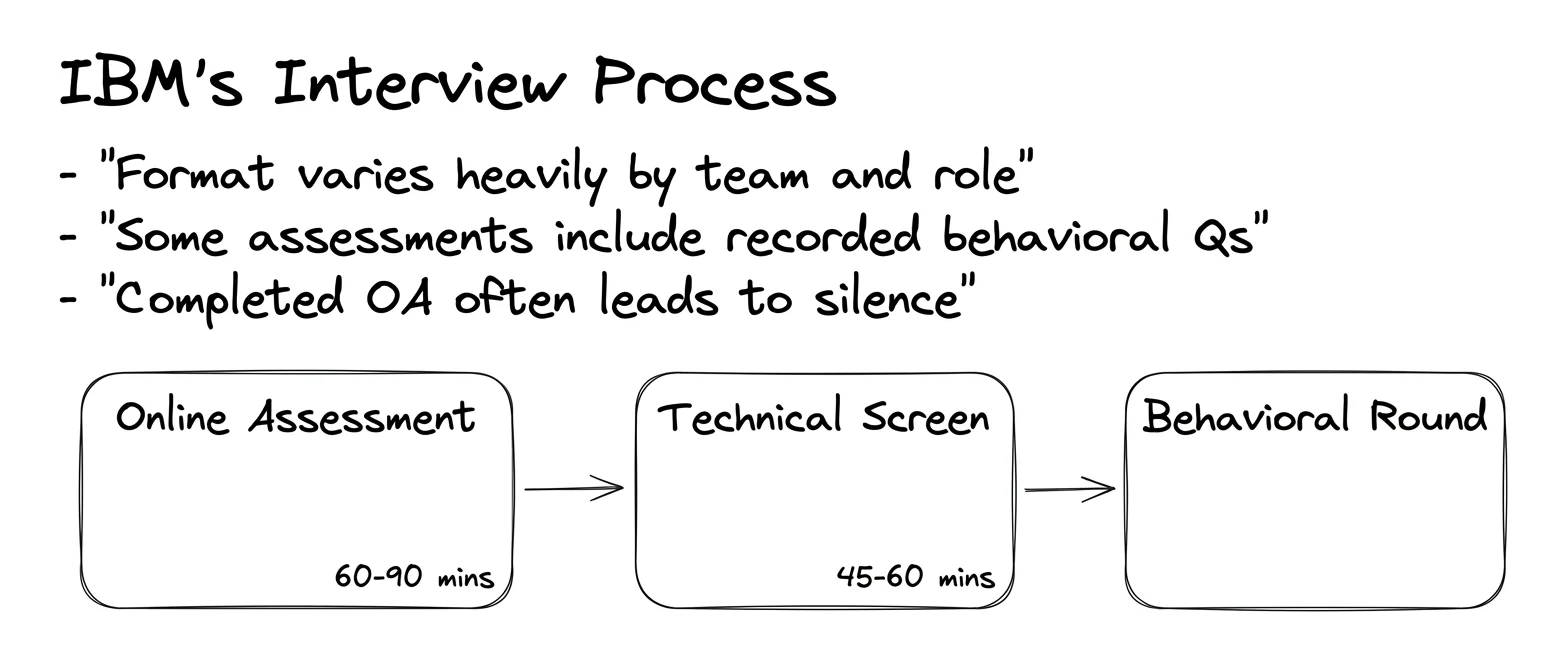
Each team runs its own hiring, so the technical content follows the team's domain rather than the job title. Most reported pipelines have two to four stages: an assessment, one or two live technical rounds of 45–60 minutes, and a behavioral or manager conversation. From application to decision, the process typically takes two to six weeks when every stage happens.
Early-career and intern candidates usually start with the automated assessment. Several reported pipelines skipped it and began with a live round, where depth in the team's stack outweighs puzzle speed. At senior and advisory bands, expect design discussion tied to the team's product rather than a generic system design prompt.
Here's what the interview process can look like:
- Online coding assessment (most early-career and cold applicants): Two problems in 60–90 minutes, sometimes paired with a CSS task or a full-stack debugging exercise.
- Recorded behavioral assessment (some pipelines): Five pre-recorded competency questions with one minute to prepare and three to answer each, about 20 minutes in total.
- Technical interview (one or two rounds): A 45–60 minute live session, usually two moderate coding problems with escalating follow-ups.
- Infrastructure and DevOps screen (cloud and platform teams): A breadth check on CI/CD, Kubernetes, Helm, Linux and network troubleshooting in place of algorithms.
- ML and systems design round (AI, inference and platform teams): Implement a numerical primitive and parallelize it, or design a Kubernetes controller that survives failures.
- Behavioral and hiring manager interview: A calm conversation about strengths, a missed deadline, motivation for IBM and a deep walk through your projects.
Tip: Prepare for the team, not the title. An AI research intern applicant got a CSS layout task, and an infrastructure candidate got a Kubernetes quiz instead of a coding problem. Read the posting's technology list and ask the recruiter which stack the team runs.
Online coding assessment
The assessment is usually sent automatically shortly after an online application, before any recruiter contact. The common format is two coding problems in 60 minutes. Some sessions run 80–90 minutes, and one pipeline split the two problems into two separate assessments. Difficulty is easy to medium, and the problems lean practical: merge inclusive time intervals and sum the total execution time, find the maximum number of concurrent processes, split an array to maximize distinct counts on both sides, find the shortest subarray with exactly k distinct values, or count the minimum insertions needed to turn a string into repeated "abc." Simulations driven by removal rules, move strings or heap-based pricing recur.
The format is changing. In 2026, two candidates got a version (80 minutes in one case) that opened with a choice of Django, Spring Boot or Node.js. One problem was algorithmic or a token manager with expiry; the other was debugging a ticket-booking web app built on Django and Redis, where only about 50 lines across dozens of files needed changes. The bugs were query filters not chained into the queryset, a pagination crash on non-positive page sizes, and a cache that was never invalidated after an event changed. Other variants pair an algorithm problem with a CSS layout task. Proctoring varies: one session required full-screen mode and banned extra monitors, and another was unproctored.
Interviewers evaluate:
- Hidden test cases: Solving every problem but missing edge inputs (empty arrays, single elements, touching intervals) earns only partial credit.
- Boundary arithmetic: Inclusive intervals such as [4, 5] and [5, 7] must merge, and the duration is end minus start plus one. Off-by-one errors here are the most common reported bug.
- Complexity fit: Distinct-count splits and dictionary-substring checks pass only with O(n) prefix and suffix counts or a trie, not with quadratic recomputation.
- Pacing: One candidate overran on the first problem and had to rush the harder second one.
- Codebase navigation: In the debugging variant, searching the URL routes and tracing the request flow beats reading files from the top.
Practice timed pairs of interval, sliding-window and heap-simulation problems, and do one small web-app bug hunt under a clock.
Note: A completed assessment is often the last contact. Several candidates who finished both problems, some with time to spare, received no further communication. Some US postings also offer no visa sponsorship, and one pipeline required an accommodation form before the assessment could start.
Sample questions for the online coding assessment
Here are some questions reported by recent candidates:
-
Given inclusive run intervals for a process, merge overlapping and touching blocks and return the total execution time.
-
Each of m customers rents the VM type with the most remaining stock and pays that stock count. Compute total revenue.
-
Given a move string of U, D, L and R that must be processed in order but where any move may be skipped, find the fewest moves needed to reach a target coordinate.
-
Pool all characters across a list of strings, keep each string's length, and maximize how many strings can become palindromes.
Recorded behavioral assessment
Some pipelines, especially for AI and early-career roles, add or substitute a recorded competency assessment with no live interviewer. For one AI engineer intern it was the only stage: five questions, one minute to prepare and three to record each, about 20 minutes, and no technical content despite the AI title. Questions cover teamwork, preparation, initiative, closing a skill gap and explaining technical work to non-specialists.
Interviewers evaluate:
- Structure under a clock: A clear situation, action and result that fits in three minutes without trailing off.
- Personal contribution: What you did on a team project, separated from what the team did.
- Communication range: Explaining a technical concept so a non-technical listener could follow it.
- Self-direction: Evidence of initiative beyond the assignment and a concrete plan for closing a gap.
Rehearse five stories aloud with a three-minute timer, recording yourself at least once.
Sample questions for the recorded behavioral assessment
Here are some questions reported by recent candidates:
-
Describe a team project that succeeded and what you personally contributed.
-
Tell me about a time preparation made an execution go smoothly.
-
Explain a technical concept you know well to someone without a technical background.
Technical interview
The live technical round is typically 45–60 minutes with an engineer or the hiring manager, usually two moderate problems rather than one hard one. After a clean baseline, the interviewer changes a constraint: unsorted timestamps that must be answered in the original order, a window too large to hold comfortably, a command string millions of characters long, or a real-time stream instead of a fixed input. One candidate's grid simulation ended with a request to design an asynchronous queue-based processor for incoming commands.
Ambiguity is sometimes deliberate. One interviewer presented an array problem with an unstated rule and invited the candidate to ask about it. The interviewer stayed vague, and the round graded how the candidate clarified, chose the simplest consistent interpretation and explained how the answer would change under the alternatives. Frontend candidates may get one easy array problem paired with a flexbox positioning exercise. Data and AI candidates may get statistics questions such as detecting multicollinearity. One rejected candidate got a sliding-window rate limiter and then a combinatorial team-formation problem.
Interviewers evaluate:
- Clarifying behavior: Targeted questions and stated assumptions before coding, especially when the prompt is visibly underspecified.
- Adapting the baseline: How naturally the first solution bends to unsorted input, streaming or scale, rather than being thrown away.
- Greedy insight with proof: For problems like the minimum number of contiguous hammer hits, stating why the first height plus all positive rises is optimal.
- Edge cases and complexity: Walking through empty inputs and all-zero arrays and naming time and space without being asked.
For every practice problem, rehearse a follow-up ladder: baseline, bottleneck, better structure, then huge input, streaming and failure.
Sample questions for the technical interview
Here are some questions reported by recent candidates:
-
For each event timestamp, count events in the trailing W seconds when the input is unsorted and output must keep the input order.
-
Find the minimum number of hits, each lowering a contiguous segment by one, to reduce all heights to zero.
-
Make an array strictly increasing with unit increments under an adjacency rule you must ask the interviewer to define.
-
Implement a sliding-window rate limiter and compare it with a token bucket.
Infrastructure and DevOps screen
Cloud, platform and DevSecOps teams often replace the coding round with one discussion of rapid-fire concept and troubleshooting questions. One 2026 session covered CI/CD tools, deploying with ArgoCD, Helm chart structure, a pod in CrashLoopBackOff because of a database dependency, StatefulSet versus Deployment, HPC versus VPC, why teams containerize, Linux commands to find a process by PID or a file by name, network troubleshooting, and a zero-downtime database rollout. It closed with the candidate's view on generative AI at work.
Interviewers evaluate:
- Mechanisms over tool names: Explaining what ArgoCD reconciles or what a StatefulSet guarantees, not just naming the tools.
- Troubleshooting order: For a crashing pod, checking events, logs, probes and the failing dependency in a sensible sequence.
- Command fluency: Producing the actual Linux and networking commands quickly.
- Safe change management: Migrations, backward compatibility and rollback for database deployments.
Build a one-page drill of Kubernetes objects, failure states and Linux commands, and answer each item aloud in under a minute.
Sample questions for the infrastructure and DevOps screen
Here are some questions reported by recent candidates:
-
A JDBC-dependent pod is in CrashLoopBackOff. Walk through how you diagnose and fix it.
-
When would you choose a StatefulSet over a Deployment?
-
How would you deploy a database change safely, with zero downtime and a rollback plan?
ML and systems design round
AI-inference and platform teams, including Red Hat's AI inference group, add an implementation-and-systems layer. One 50-minute inference screen opened with valid-mode 1-D convolution plus a bias (output length is input length minus kernel length plus one), then asked for a parallel version when input and kernel sizes vary at runtime. The discussion covered chunking the output across a thread pool, chunk sizing, and skipping threads for small workloads, then moved to SIMD, loop unrolling and cache blocking.
Platform teams use design prompts grounded in their own stack. One round asked for a Kubernetes controller that keeps pod counts balanced across nodes. It covered watching pod events, deciding placement, reconciling toward balance over time, and catching API-server timeouts and network errors so the loop retries instead of crashing. Both teams asked about open-source contributions and how the candidate collaborated.
Interviewers evaluate:
- Correct baseline first: Output sizing, indexing and edge cases in the sequential version before any optimization.
- Adaptive parallelism: Work partitioning that responds to input size, not a fixed thread count.
- Hardware awareness: Justifying when SIMD and blocking help rather than listing techniques.
- Reconciliation and resilience: A loop that converges on the desired state and retries API-server errors instead of crashing.
- Open-source substance: Visible pull requests and a specific account of your role in them.
Implement convolution from scratch in C++ or Python, parallelize it, and practice explaining a controller's watch-and-reconcile loop.
Tip: Platform and inference candidates report that visible pull requests carry real weight. Have one contribution ready in detail: the problem, your change, the review and the outcome.
Sample questions for the ML and systems design round
Here are some questions reported by recent candidates:
-
Implement valid 1-D convolution with a scalar bias, then parallelize it for runtime-varying input and kernel sizes.
-
How would SIMD, loop unrolling and cache blocking speed up the convolution on a modern CPU?
-
Design a Kubernetes controller that keeps pods balanced across nodes and survives API-server failures.
Behavioral and hiring manager interview
The final conversation is usually with the hiring manager, sometimes alongside a technical lead or HR. Candidates consistently describe the tone as relaxed: the interviewer is trying to understand you rather than pressure-test you. Expect your biggest strength, a missed deadline and how you handled it, why IBM, why this role, a few resume questions and a walk through your side projects. One candidate found the resume barely examined while the projects drew most of the time. For 2026, IBM has rewritten many entry-level job descriptions to emphasize client engagement and judgment, so consulting-adjacent and client-facing teams weigh structured communication and professionalism heavily.
Interviewers evaluate:
- Honest accountability: A missed deadline told with the moment you noticed, who you informed and what changed afterward.
- Motivation specific to the team: Why this product or client area, not a generic answer about IBM's size or history.
- Project ownership: Explaining your own design decisions and trade-offs in work you list.
- Client-facing communication: Clear, structured answers a non-engineer stakeholder could follow.
Prepare six to eight concise stories and a two-minute walkthrough of each project on your resume.
Sample questions for the behavioral and hiring manager interview
Here are some questions reported by recent candidates:
-
Tell me about a time you missed a deadline and how you handled it.
-
Why IBM, and what attracted you to this particular role?
-
Walk through a side project: what motivated it, how you built it and why you chose that stack.
How IBM makes hiring decisions
IBM does not use a central hiring committee for most engineering roles. The hiring manager makes or endorses the final decision, informed by the technical interviewers and often after running the last round personally. Level is expressed as a band, and candidates report little about how it is set, so confirm the band with the recruiter before the final round. Decisions typically arrive within a few weeks of the last round, and some candidates waited a month or more. Silence after the online assessment is common enough that it should be treated as a likely rejection after a few weeks. A background check follows acceptance. IBM publishes no fixed cooldown, and each requisition is screened independently.
Tip: A silent assessment for one posting does not block another. Target postings whose stack matches yours instead of re-applying cold to the same one.
How to prepare for the IBM interview
- Run timed two-problem sessions: Read both prompts first, start with the surer one, and keep ten minutes for edge cases.
- Drill IBM's recurring families: Inclusive interval merging, sweep-line concurrency, prefix and suffix distinct counts, k-distinct windows and max-heap simulations.
- Rehearse a web-app bug hunt: Fix filters, pagination guards and cache invalidation in a small Django, Spring Boot or Node.js app under a clock.
- Practice clarifying out loud: On a vague prompt, ask, pick the simplest interpretation, and say how the others would change the answer.
- Prepare a follow-up ladder: Know the next step for unsorted input, streaming data, parallel execution and a failing dependency.
- Match the team's domain: Kubernetes and Linux commands for cloud teams, threading and SIMD for inference teams, flexbox for frontend.
- Prepare five three-minute stories: A team success, a missed deadline, initiative, a skill gap and explaining technical work simply.
- Polish project narratives: Defend motivation, design and stack choices, and your exact role in any pull request you cite.
About working at IBM
IBM sells enterprise software, hybrid cloud, consulting and infrastructure to large organizations, so most engineering work serves long-lived, regulated client systems rather than consumer products. Red Hat operates as a largely independent subsidiary with its own hiring. IBM uses numbered bands rather than tech-industry level names, and its titles can mislead: a Staff Software Engineer sits below a Senior Software Engineer.
| Level | Primary focus | Impact scope |
|---|---|---|
| Band 6 (Associate / entry-level Software Engineer) | Delivering well-defined tasks with guidance | Features within one team |
| Band 7 (Staff Software Engineer) | Owning components and features independently | One team's codebase |
| Band 8 (Advisory Software Engineer) | Leading designs and mentoring; team lead on the management track | A product area |
| Band 9 (Senior Software Engineer) | Technical leadership across teams | Several teams or a product |
| Band 10 (Senior Technical Staff Member) | Architecture and technical strategy | A product line or business unit |
IBM hires engineers across its software, infrastructure, consulting and research businesses. Teams include:
- IBM Software: The watsonx AI and data platform, automation, security and HashiCorp products.
- IBM Infrastructure: IBM Z mainframes, Power systems and storage, including firmware and systems software.
- Red Hat: OpenShift, Enterprise Linux and AI inference, built largely in the open.
- IBM Consulting: Client-facing engineering, cloud migration and application modernization.
- IBM Research: AI, hybrid cloud, semiconductors and quantum computing.
Experience and education requirements
Entry-level postings vary. Some require only a high school diploma and prefer a bachelor's degree, while infrastructure and internship postings require a bachelor's or master's in computer science, engineering or a related field. Common languages are Java, Python, Go and C++. Mainframe roles add C, Assembler and PL/I, and postings commonly ask for Git, Agile practice and public-cloud exposure. Some US postings require independent work authorization.
FAQs about the IBM interview
How long does the IBM interview process take?
Typically two to six weeks. The assessment often arrives within days of applying, and the final decision can take a further week to a month.
What is the hardest round of the IBM interview?
For early-career candidates, the online assessment, because pacing and hidden edge cases end more pipelines than difficulty does. For experienced hires, the team-specific round is hardest, whether that is the infrastructure breadth check or the parallelization and hardware discussion.
Is there an online assessment?
Most early-career and cold applicants get one: two coding problems in about 60–90 minutes, sometimes paired with CSS or a full-stack debugging task. Some pipelines use a recorded behavioral assessment instead, and several reported pipelines started directly with a live technical round.
What language should I use?
Use any mainstream language for algorithm problems, but check the job posting. One 2026 invitation urged a language from the description, yet the assessment offered only one of the three listed.
Is the IBM interview remote?
Mostly. Assessments and early rounds are remote, and some teams hold a final technical round on site.