Study
Are Hash Map Interview Questions Fading in 2026?
TrueInterview
October 19, 2026 · 17 min read
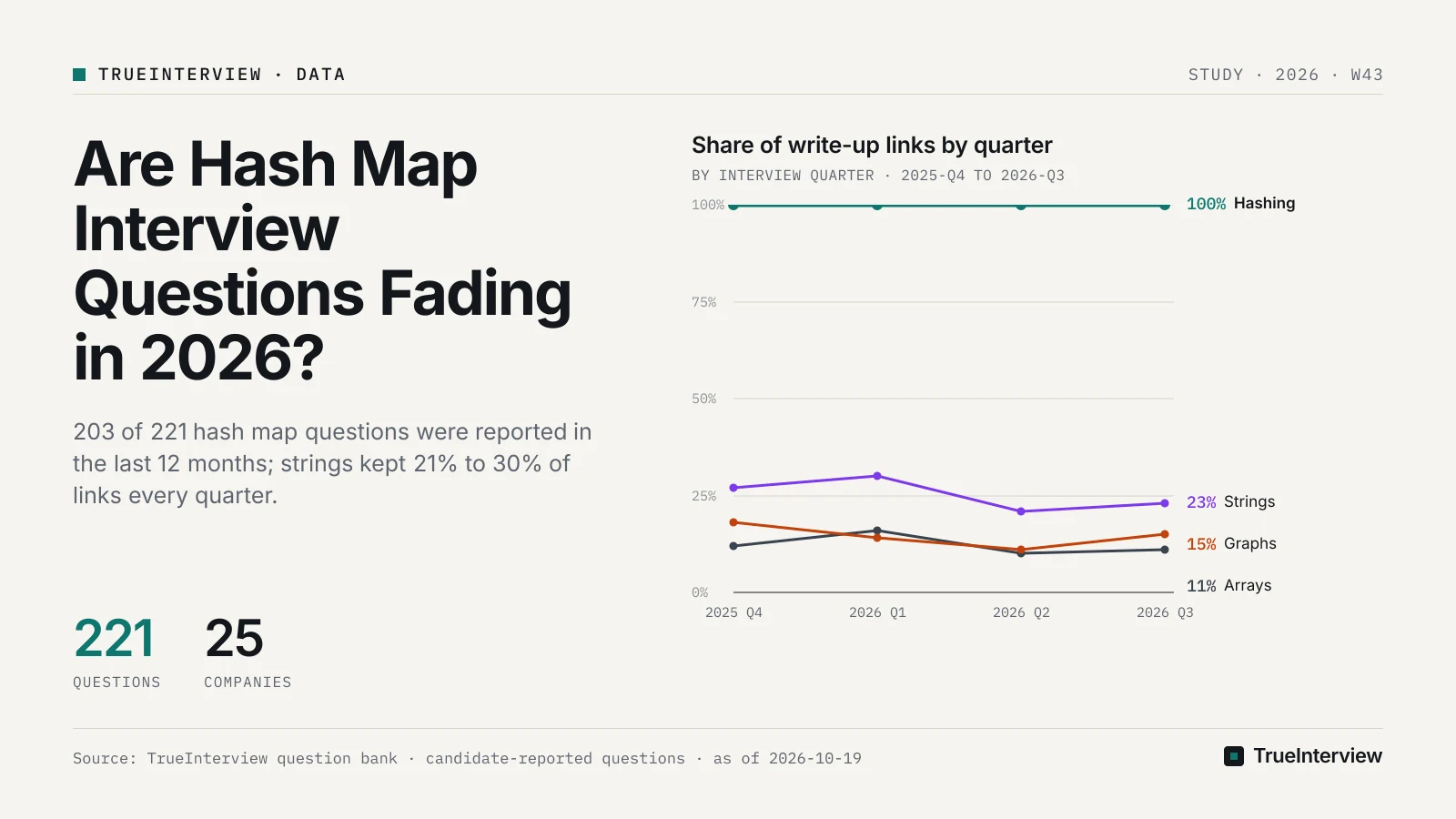
They are still asked. As of 2026-10-19, TrueInterview's bank holds 221 candidate-reported hash map coding questions from 25 big-tech companies, and 203 were last reported in the 12 months before that date. The bank cannot show whether the topic's share of all interviews is rising or falling, only that it is current. Two of the three most-linked titles, GPU Credits II at OpenAI and File Deduplication at Anthropic, are named after a small system rather than a lookup trick. Prepare by choosing the key and value shape for a stateful API, and treat the nested-loop-to-set trick as the warm-up.
Disclosure: TrueInterview is an interview-preparation product and publishes this article. Facts about other products come from their public pages on the dates listed under Sources.
Are hash map questions fading in 2026?
They are still being reported, though the bank cannot say whether their share of all questions is rising or falling. Of the 221 hash map questions in the bank, 203 were last reported in the 12 months before 2026-10-19, and write-up links to them were recorded in every quarter from 2025-Q4 to 2026-Q3, though totals grew mainly because more write-ups were collected. The table below is not a demand measure: it shows which topics travel with hash map questions, as shares of each quarter's links.
| Co-topic on hash map questions, share of the quarter's links | 2025-Q4 | 2026-Q1 | 2026-Q2 | 2026-Q3 |
|---|---|---|---|---|
| Strings | 27% (13 links) | 30% (33) | 21% (20) | 23% (26) |
| Graphs | 18% (9) | 14% (15) | 11% (10) | 15% (17) |
| Arrays | 12% (6) | 16% (17) | 10% (9) | 11% (12) |
Read the table as a stable mix, not as a trend in either direction, and not as evidence about demand. Strings eased after 2026-Q1 and settled near a quarter of the links, and graphs dipped to 11% before returning to 15% in 2026-Q3. For your plan, that means the pairings below can keep roughly their current weight; the recent-report count above, not this table, is what says the topic is still live.
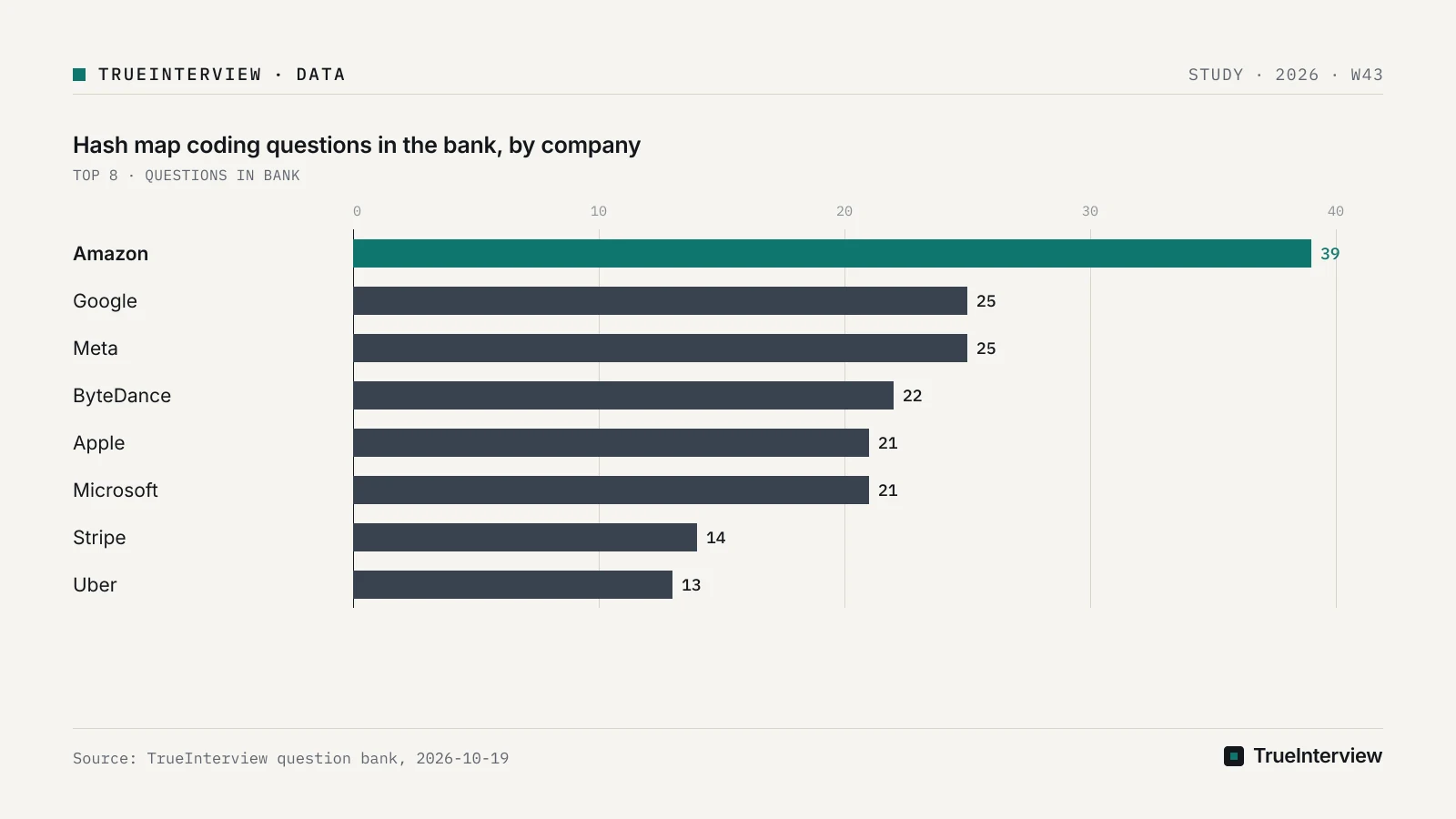
The demand is also spread across employers. The bank files 39 hash map questions under Amazon, 25 each under Google and Meta, 22 under ByteDance, 21 each under Apple and Microsoft, then 14 under Stripe, 13 under Uber, 12 under Netflix and 9 under Snowflake. These are counts of what candidates reported, not how often any company asks, and they are not any company's official question list.
Our take: stop asking whether to prepare hash maps and start asking which variant your loop reports. Generic advice treats the topic as a box ticked in the first week. The bank files hash map questions under 25 big-tech companies, so the variant, not the topic, should decide where your hours go.
Which hash map questions do candidates report most?
Nine titles lead the write-up links, with four of them tied at 8. Three titles read as stateful systems (GPU Credits II, File Deduplication and Timed Cache), and most of the rest are window, frequency, prefix or complement-lookup classics. The table ranks them by the number of candidate write-ups that link to each, with the level split where the data has one.
| Question | Companies in the linked write-ups | Write-up links | Senior-or-above vs junior-or-below links | A dated report | Practise |
|---|---|---|---|---|---|
| GPU Credits II | OpenAI | 14 | 11 vs 3 | OpenAI phone screen, 2026-09 | GPU Credits II |
| File Deduplication | Anthropic | 13 | 8 vs 5 | Anthropic OA, 2026-09 | File Deduplication |
| Longest Substring Without Repeating Characters II | ByteDance, Microsoft, Meta, Amazon | 11 | 5 vs 6 | Apple phone screen, 2026-09 | Longest Substring II |
| Trie Autocomplete / Prefix Search | Google, Pinterest | 9 | not split in the data | Pinterest phone screen, 2026-08 | Trie Autocomplete |
| Timed Cache / Expiring Key-Value Cache | Netflix, Meta | 9 | 8 vs 1 | Meta phone screen, 2026-09 | Timed Cache |
| Top K Frequent Elements | Amazon, LinkedIn, Microsoft, Uber, Google, Apple | 8 | 4 senior-or-above | Top K Frequent Elements | |
| In-Flight Movie Pair (Two Sum Variant) | Amazon, Meta | 8 | not split in the data | Amazon onsite, 2026-08 | In-Flight Movie Pair |
| Minimum Window Substring | Lyft, Meta, ByteDance | 8 | 4 vs 4 | Lyft phone screen, 2026-08 | Minimum Window Substring |
| Distributed Mode and Median | not given in the data | 8 | 8 vs 0 | Distributed Mode and Median |
Two notes on reading it. The bank holds a second Top K Frequent Elements entry, filed under 6 companies and linked from 1 write-up, which is a separate question and is not part of the 8 links above. And a link count says how many candidates wrote about a question, not what its prompt contains: the bank records titles, companies, rounds and levels, so read each practice page's spec before you plan an approach.
For the window classics, the move worth owning is a lookup table from character to its last index or its count, which lets the left edge of the window jump instead of crawl. That move carries Longest Substring Without Repeating Characters II, which the bank files under 7 companies including Apple, NVIDIA and Snapchat, and the classic Minimum Window Substring, where a count of characters still needed tells you when the window is valid. Learn the move once on these two, then spend the saved time on the stateful titles.
Why treat the hash map as the storage layer, not the question?
Because the titles at the top of the table suggest state you have to keep: credits, duplicate files, cache entries that expire and values that change over time. Time Based Key-Value Store fits the same mould; the bank files it under Uber, Amazon, ByteDance, Microsoft and Oracle, and one report places it in an Uber onsite in 2026-09. If the specs match their titles, reaching for a dictionary will be the easy part, and designing what sits inside it is where you should expect the round to be decided.
The bank does not record what GPU Credits II or File Deduplication asks, so read their specs on the practice pages rather than guessing. What carries across every map-backed API is the order of decisions:
- Operations first. Write the method signatures and what each returns before you pick a structure.
- The key. Decide what identifies one record and whether it is composite.
- The value shape. Choose between a single value, a list kept sorted by timestamp, a value stored with its expiry time, or a group of items that share a content hash.
- Update and delete. Decide whether a write overwrites, appends a version or leaves a tombstone, and when stale entries leave memory.
- Cost per operation, stated after the design, not before it.
In our view, a senior candidate should prepare one or two decisions per design that an interviewer is likely to probe. For any expiring cache, the pressure points to prepare are lazy removal on read versus a periodic sweep, and how memory stays bounded for keys nobody reads again. For a versioned store, they are how a read at a timestamp finds the latest value at or before it (binary search over a per-key list appended in time order) and what breaks if writes arrive out of order. For content-based deduplication in general, they are grouping by a cheap signature such as file size before computing a full hash, and confirming a match when two hashes collide.
Our take: pattern lists are a good start and a poor finish. One Medium author describes a curated list of "must-do LeetCode questions that target all core HashMap patterns" and includes design problems built on custom HashMap logic. Keep that design category, but pick its problems from the reported titles for your company and round rather than from any author's list.
Which structure decides the solution in each round?
The second structure decides the solution, and it shifts by round. Strings lead the co-tags in the OA, the phone screen and the onsite, graphs climb in phone screens and onsites, and trees join the leading onsite tags. Match the pairing to your next round before you choose problems.
| Round | Hash map questions reported | Leading co-tags after hashing | Pairing to drill (our view) |
|---|---|---|---|
| Online assessment | 44 | strings 11, arrays 5, graphs 3 | Lookup table plus sliding window over strings; read the full spec |
| Phone screen | 130 | strings 27, arrays 17, graphs 16 | A window or frequency classic, or a small stateful API |
| Onsite | 76 | strings 19, graphs 12, trees 10 | Map plus BFS or DFS, map plus tree traversal, and a versioned store |
A question can be reported in more than one round, so these figures count questions, not reports, and they overlap. Phone screens carry the most, which is why they deserve the first slot in your plan.
The decision rule follows. If your next round is an OA, drill a lookup table plus a window over strings, the leading OA pairing, and practise reading a long spec before coding; for an Anthropic OA specifically, rehearse File Deduplication, the title reported there. If it is a phone screen, expect either a window classic or a small stateful API: Timed Cache was reported in a Meta phone screen and GPU Credits II in an OpenAI phone screen, both in 2026-09. If it is an onsite, add a graph problem built on a lookup table, such as Bus Routes (LC 815), where a map from each stop to its routes turns the input into a graph you can search breadth-first. For top-K titles in any round, pair a count table with a heap or a sort; heap is the second co-tag on Google's hash map questions, at 3.
What should you prepare for your target company?
Use your company's filings as a tiebreaker after the round pairing, because the per-company co-tag counts are small. Amazon's 39 hash map questions carry strings and sorting tags on 7 each, while ByteDance's 22 carry strings on 7 and arrays on 5 and no graph tags at all.
| Company | Leading co-tags after hashing | First drill (our view) |
|---|---|---|
| Amazon | strings 7, sorting 7 | Count table then sort: Top K Frequent Elements, Group Anagrams |
| strings 5, heap 3 | Count table plus heap | |
| Meta | arrays 4, strings 4 | Complement lookup and windows |
| ByteDance | strings 7, arrays 5, graphs 0 | Window over strings; graphs last |
| Apple | arrays 4, graphs 4 | Lookup table plus BFS |
| Microsoft | strings 4, sliding window 4 | Lookup table plus sliding window |
These differences rest on a few questions per tag, so do not rebuild your plan around them: start from the round pairing, then use your company's row to choose between problems of similar value. Apple is the case where the two agree: its filings put graphs level with arrays, and onsites lean on graphs too, so an Apple onsite candidate should move graph traversal to the front.
Worked example: a senior candidate with a Meta phone screen
Meta's 25 hash map questions lean on arrays and strings, at 4 each. Start with Timed Cache / Expiring Key-Value Cache: one report places it in a Meta phone screen in 2026-09, and 8 of its 9 linked write-ups come from senior-or-above candidates. Read the practice page for the exact operations, then design from them: where the expiry time lives, whether expired entries go on read or by a sweep, and what bounds memory.
Then take In-Flight Movie Pair (Two Sum Variant), which Amazon and Meta write-ups link 8 times, as the complement-lookup warm-up. Close with Minimum Window Substring, linked from Lyft, Meta and ByteDance write-ups, as the timed window problem. That is three sessions, each covering one of Meta's leading pairings, with the senior-leaning design title first because it carries the most signal.
When is a hash map the intended answer, and when is it a trap?
A hash map is intended when the prompt makes you look something up repeatedly, count occurrences or group items by a derived key. The LeetCopilot guide on dev.to says "The clearest signal for using a hash map is repeated lookups" and that a question about how many times something appears almost certainly needs one. It is a trap when the keys fit a small fixed range, where the same guide says to use an array.
| Signal in the prompt | What the table holds | Reported title to practise |
|---|---|---|
| Find a partner value for each element | value to index or count | In-Flight Movie Pair (Two Sum Variant) |
| How many times, or the most frequent items | item to count, then a heap or a sort | Top K Frequent Elements |
| Longest or shortest window under a condition | character to last index or count | Longest Substring Without Repeating Characters II, Minimum Window Substring |
| Items equal under a transformation | canonical form to group | Group Anagrams |
| Values that change or expire over time | key to timestamped versions, or value plus expiry | Time Based Key-Value Store, Timed Cache |
| Duplicates by content | content hash to group of items | File Deduplication (matched by title only; read the spec) |
The guide's case for the structure is that a hash map gives O(1) average-case lookup, insertion and deletion, which "turns O(n²) brute-force solutions into O(n) optimal solutions". The guide's worked case is Subarray Sum Equals K, where it stores prefix sums and checks whether current_sum - k has been seen instead of re-summing with nested loops. For the moment you catch yourself writing a nested loop, the guide's question is "Can a hash map eliminate the inner loop?"
The guide is equally direct about overuse: "Not every problem needs a hash map." If simple variables or one array index solve the problem, say so and use them.
In Python, the tools you reach for are hash maps underneath. The Python documentation describes Counter as a "dict subclass for counting hashable objects" and defaultdict as a subclass "that calls a factory function to supply missing values". Use Counter for tallies and defaultdict of lists for grouping, and name the structure aloud so the interviewer hears the design, not just the syntax.
Our take: the ranking pages stop at the signal, and the signal is the first minute of the round. Recognising that a dictionary fits is expected at every level; the remaining time goes to the follow-up in the next section.
What follow-ups come after the first working solution?
In our view, prepare for the interviewer to change a constraint once your solution works: bound the key range, require order, add expiry or move the state off one machine. As an illustration only, one candidate's report on TrueInterview's comparison page, which does not name the round or tag it as a hash map question, says the interviewer accepted a sliding-window approach, then asked what happens across three app servers and had the candidate redo it with a shared store.
Rehearse these follow-ups out loud before any hash map round:
- Bounded keys. If the keys fit a small fixed range, say you would switch to an array, and why it is cheaper.
- Order. Java's documentation says HashMap "makes no guarantees as to the order of the map". If the output needs sorted or insertion order, name the structure that keeps it; the Python docs describe OrderedDict as remembering the order entries were added.
- Expiry and versions. Say when stale entries are removed and what a read returns at a past timestamp.
- Shared state. Java's documentation notes that HashMap is not synchronized. Across threads or servers, the questions become who owns a key, what happens when two writers race and what a reader may see in between.
- Space. The LeetCopilot guide says the space-for-speed trade "is almost always worth it in interviews unless space complexity is explicitly constrained". State the trade before the interviewer asks.
Our take: rehearse the second question, not the first. The one illustration above shows the kind of scale follow-up worth rehearsing, and that move is easier to answer when you have said it aloud before.
What changes at senior and staff level?
Hash map questions are not a junior warm-up. Write-ups from candidates who reported a senior, staff-plus or manager level link these questions 194 times, against 187 from junior, new-grad or intern candidates. The overall split is even; the stateful and graph titles are where it tilts toward senior.
GPU Credits II splits 11 senior-or-above links to 3 junior-or-below, and Bus Routes splits 5 to 1. Distributed Mode and Median is linked from 8 write-ups, all senior-or-above, and Tree-Encoded Subtree Deletion and Stable Compaction and Debug a Random Dasher Registry (3 each) also have no junior-or-below links. By tag, sorting leans senior at 25 to 15 links and binary search at 6 to 2, while strings (40 to 55) and trees (14 to 22) lean junior. Levels are what candidates reported on their own write-ups, so read this as the shape of the reports.
Staff-plus or manager write-ups link File Profiler, Morse Code Encoder / Decoder with Word-Break, Minimum Window Substring, Time Based Key-Value Store, Find the Top 10 Most Frequent IP Addresses and Find Values Unique to the Current User, one link each. That is too few links to show a staff pattern. Our advice for staff candidates is to prepare familiar structures as if the data could outgrow one process, since that is the follow-up a senior bar invites.
Our take: at senior level the dictionary is assumed. The signal is how you shape state, handle expiry and versions, and answer the scale follow-up. For a frequency problem, that means saying what changes when counts no longer fit on one machine, such as partitioning by key so each key's full count lives on one shard, then merging the shards' top results.
Down-leveling note (our view): in a hash map round, the level signal sits in the state design and the follow-up, not in the first solution. If you solve Timed Cache but cannot explain how memory stays bounded or what changes with several servers, expect that round to read as mid-level, so practise the follow-ups until you can answer them without prompting.
How we counted
Counts come from TrueInterview's question bank as of 2026-10-19 and cover hashing-tagged coding questions at 25 big-tech companies. A question can be filed under several companies and reported in several rounds, so company and round tallies overlap and count questions, not reports. Write-up links count candidate write-ups that point to a question, split by the quarter, level and role each candidate reported. Quarterly figures are shares because totals track how many write-ups were collected, and the hashing share is 100% in every quarter by construction, since every question here was selected by that tag.
FAQ
Do I need to know HashMap internals for a coding interview?
Know enough to defend the constant-time assumption. Java's documentation says HashMap gives constant-time get and put assuming the hash function spreads elements properly among the buckets, and warns that many keys with the same hashCode() are "a sure way to slow down performance of any hash table". Load factor and default capacity matter only if the interviewer asks about collisions or worst cases. One Medium author's deep-dive describes sections on buckets, collisions and load factor; in our view that prepares a Java trivia round, not the coding questions candidates report.
Which classic problems should I practise first?
Start with the classics filed under several companies: the bank files Top K Frequent Elements under 7 big-tech companies and Group Anagrams under 5. Add the two window problems from the ranked table, then move to a stateful title as soon as the classics feel routine. A list of famous easy problems is a fine warm-up, but the two most-linked titles, GPU Credits II and File Deduplication, are not textbook problems, so a classics-only plan misses them.
What are the common mistakes with hash maps in interviews?
The LeetCopilot guide lists overcomplicating as one: using a table where simple variables or one array index would do. Two others come up in follow-ups. Candidates assume iteration order that the structure does not promise, or modify a map while iterating it; Java's documentation says fail-fast iterator behaviour "should be used only to detect bugs". In Python, the Python documentation notes that a Counter returns a count for missing items instead of raising a KeyError, which removes a class of missing-key bugs from tallies.
Do companies publish their hash map interview questions?
No. The counts on this page are candidate-reported questions reconstructed for practice, and they are not any company's official question list. TrueInterview says each report is checked against other reports of the same round and stamped with the month it was asked when the report gives one. Treat every list, including this one, as evidence of what candidates saw, and re-check dates before you build a plan around a single title.
Can I prepare hash map questions in three weeks while working full time?
Yes, if you prepare the reported variants rather than every problem with the tag. The ranked table gives you a concentrated starting point, and a few pairings cover most of its titles. On TrueInterview, every question has a reference solution and coding answers are judged on hidden tests that show the case you failed, according to its comparison page. The plan below fits about an hour on weekdays, and it cannot promise an outcome, only coverage of what candidates report.
Your practice plan
A three-week plan for someone working full time, about an hour on weekdays:
- Week one, classics. Solve In-Flight Movie Pair (Two Sum Variant), Top K Frequent Elements and Group Anagrams. Before coding each one, write a line naming what the table holds as key and value.
- Week one, windows. Solve Minimum Window Substring and Longest Substring Without Repeating Characters II under a timer, then redo one assuming a fixed alphabet and explain why an array now wins.
- Week two, map-backed designs. Build Time Based Key-Value Store and Timed Cache / Expiring Key-Value Cache end to end: operations first, then key, value shape, update and delete rules, then cost per operation.
- Week two, the most-linked titles. Read the specs for GPU Credits II and File Deduplication, write down the state you keep, and solve each as a timed phone screen or OA.
- Week three, round and level stretch. For an onsite, add a graph problem built on a lookup table such as Bus Routes. If you are senior or above, add Distributed Mode and Median and explain aloud what changes when the data is split across machines.
- Week three, follow-up rehearsal. Take two earlier solutions and answer the follow-ups out loud: bounded keys, order, expiry and shared state across servers. Then filter the question bank by your target company and round, and practise the hash map titles filed there that you have not solved yet.
Sources
- TrueInterview question bank — hash map coding at big-tech companies — counted 2026-10-19
- Medium — checked 2026-10-19
- How to Know When to Use a Hash Map in Coding Interviews: A Pattern Recognition Guide - DEV Community — checked 2026-10-19
- collections — Container datatypes — Python 3.15.0 documentation — checked 2026-10-19
- Interview prep compared: your application, end to end · TrueInterview — checked 2026-10-19
- HashMap (Java SE 21 & JDK 21) — checked 2026-10-19
- Medium — checked 2026-10-19
Last reviewed: 2026-10-19.