Gusto · Study
Gusto Interview Process & Questions
TrueInterview
October 13, 2026 · 8 min read
Gusto's coding rounds are payroll logic in miniature: progressive tax brackets, splitting money under per-person caps, and turning logs into statistics. Code must run and get rounding right. The design round is mostly a data-modeling exercise, and the loop includes a values conversation that may be led by someone outside engineering; in one recent loop it was a member of the legal team.
This guide breaks down each stage of the Gusto interview, what interviewers evaluate in each round, and how to prepare, with questions candidates were actually asked.
Verified: Based on 3 candidate-reported interview experiences, cross-checked against recent public accounts.
Gusto interview process
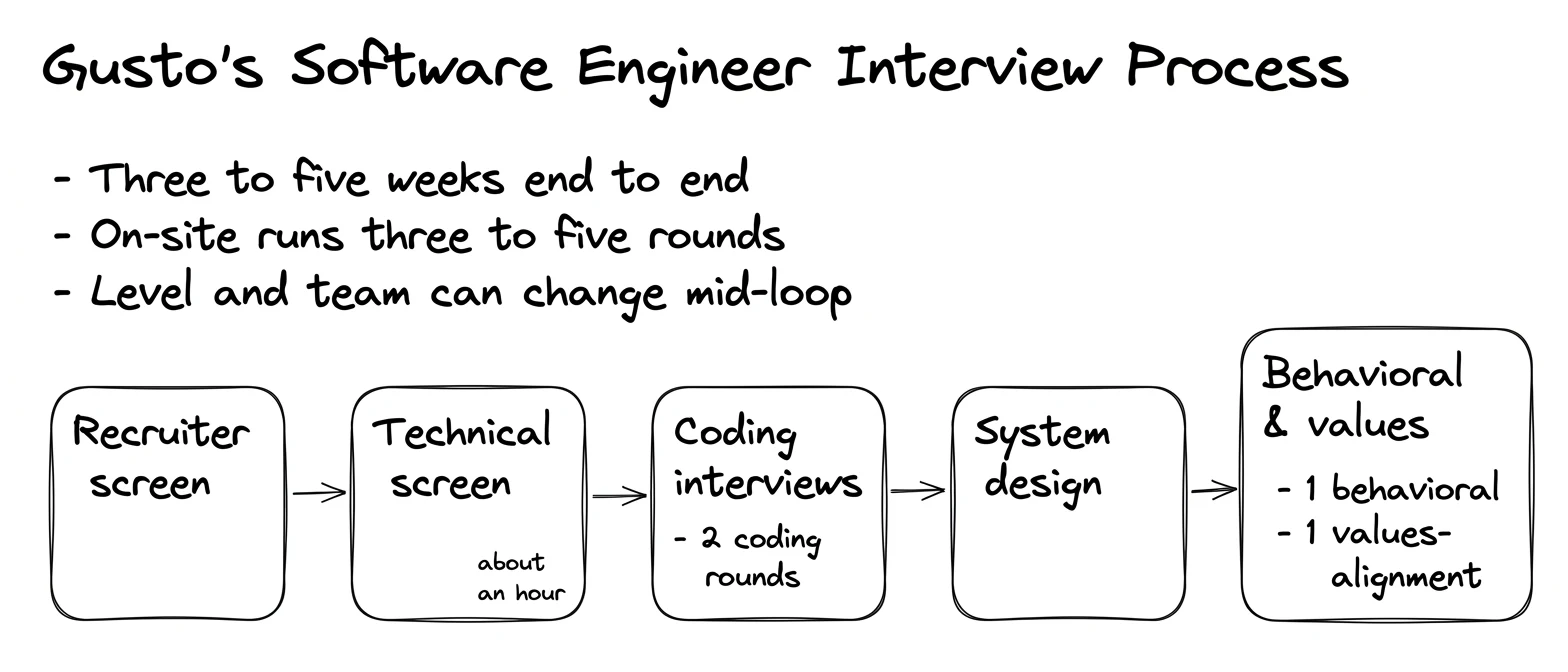
The loop typically runs a recruiter or hiring-manager screen, a live technical screen, then an on-site of three to five rounds; one recent Software Engineer on-site ran five rounds over two days. The process typically takes three to five weeks.
Mid-level loops center on two coding rounds plus one design round. Staff loops open with a manager screen on past projects and push the design round toward architecture and scale.
Here's what the interview process can look like:
- Recruiter or manager screen: A short call on background and level; at staff level a hiring manager runs it as a project deep dive.
- Technical screen: A live coding exercise of about an hour, usually a practical parsing or aggregation problem.
- Coding interviews (on-site): Two rounds of money-flavored problems such as tax calculation and money distribution, extended with follow-ups.
- System design interview: A scheduling system judged mostly on its data model, with architecture and scale added at senior levels.
- Behavioral and values interviews: An engineering-manager behavioral round plus a separate values-alignment conversation.
Tip: Confirm your level and team in writing after every stage. One staff candidate applied for a senior staff role on one team and found out mid-loop that both the level and the team had been changed without notice.
Recruiter or manager screen
The first call usually covers background, level and location. At staff level a hiring manager may run it instead, entirely on past projects and behavioral questions, with no coding.
Interviewers evaluate:
- Scope of past work: Whether your projects match the level you applied for.
- Ownership: Your own decisions separated clearly from the team's.
Prepare two project walkthroughs at manager depth: the problem, your design choices, and what you would change.
Sample questions for the recruiter or manager screen
Here are some questions reported by recent candidates:
- Tell me about yourself, and why Gusto?
- Walk through a past project you led, then answer standard behavioral follow-ups about it.
Technical screen
The screen is a live exercise of about an hour with the input format and expected output fully specified. One 2026 candidate parsed router log lines and, for six user-API endpoint patterns with the numeric user ID as a wildcard, reported the call count and the mean and median response time. Response time was connect time plus service time, and non-matching lines were ignored. Difficulty is moderate; the challenge is exactness. Data science candidates typically get a statistics screen instead, such as p-values for two experiment variants against a control.
Interviewers look for:
- Correct parsing: Normalizing paths so different user IDs share a bucket while longer paths do not.
- Spec precision: Even-length medians (the average of the two middle values) and exact output field names.
- Running code: Output produced end to end on the sample, not pseudocode.
Practice turning a text file into per-key statistics in under 40 minutes.
Note: Endpoint matching is the usual trap. The pattern for a bare user path must not swallow the same path with
/get_messagesappended, so match the full pattern, not a prefix.
Sample questions for the technical screen
Here are some questions reported by recent candidates:
-
Parse router log lines and report call count, mean and median response time for six endpoint patterns, ignoring all other requests.
-
Compute p-values for two test variants against a control group (data science track).
Coding interviews
The on-site usually has two coding rounds, both about money. In the tax round you compute tax from progressive brackets, and the interviewer then adds tax years, filing statuses and custom rules such as a flat rate. In the money distribution round you split a pool among recipients who are each owed an amount: nobody gets more than they are owed, shares are as even as possible, and as much of the pool as possible is paid out. One staff loop had a time-based key-value store instead. Follow-ups test whether your first design survives new rules.
Interviewers evaluate:
- Extensible modeling: Brackets and filing statuses stored as data, so a new tax year is configuration, not new branches.
- Money correctness: Integer cents or decimals, explicit rounding, and leftover cents assigned deterministically.
- Constraint handling: Capped recipients' surplus redistributed until the pool or the debts run out.
- Testing habits: An empty pool, more money than is owed in total, and income exactly on a bracket boundary.
Solve each problem once, then re-implement it under a new rule within 15 minutes.
Tip: For money distribution, sort recipients by amount owed and fill the smallest first. Each capped recipient frees part of the even share for the rest, which avoids repeated passes over leftover fractions.
Sample questions for the coding interviews
Here are some questions reported by recent candidates:
-
Calculate tax from progressive brackets, then support multiple tax years, filing statuses and a flat-rate override.
-
Distribute an amount among recipients so no one exceeds what they are owed and shares are as even as possible.
-
Implement a time-based key-value store that returns the latest value at or before a timestamp.
-
Efficient Key-Value Store with Insert, Retrieve, Delete Operations
System design interview
The reported prompt recurs: a company owns several restaurants with employees and managers, and managers publish a weekly shift schedule every Friday. The round concentrates on the data model. A staff candidate who saw the same prompt two years apart found the bar had moved: the earlier round wanted only the data model, the later one added an architecture diagram and scalability. The same candidate felt the interviewer struggled to follow a design that differed from a reference model, and blamed this round for the rejection.
Interviewers evaluate:
- Entity modeling: Employees at several restaurants, managers scoped to locations, and schedules versioned from draft to published.
- Workflow rules: What publishing locks, how later edits are handled, and who is notified.
- Communication: Walking the interviewer through the schema with example rows until they accept it.
- Scale at senior levels: Service boundaries, schedule read paths and notification fan-out.
Practice the scheduling schema, then extend it to a service diagram in ten minutes.
Note: If your model differs from the one the interviewer expects, prove it with a concrete scenario, such as an employee at two locations or a shift swap after publication, rather than defending it in the abstract.
Sample questions for the system design interview
Here are some questions reported by recent candidates:
- Design shift scheduling for a company with multiple restaurants, where managers publish each week's schedule on Friday.
- Add an architecture diagram to the scheduling design and explain how it scales.
Behavioral and values interviews
An engineering manager runs a standard behavioral round. A separate values-alignment round tests fit with Gusto's customer-focused culture; in one 2026 loop a member of the legal team led it, covering customer-centric principles and behavioral questions about AI. Public accounts typically describe this round as a real filter rather than a formality.
Interviewers evaluate:
- Customer focus: Decisions driven by end-user impact, especially where correctness or trust was at stake.
- Responsible AI use: How you use AI tools and where you check their output.
- Candor: Mistakes stated plainly, with what changed afterward.
Prepare six to eight plain-language stories, including one about protecting customers from a calculation error.
Sample questions for the behavioral and values interviews
Here are some questions reported by recent candidates:
- Questions on customer-centric principles and how they shaped your past decisions.
- Behavioral questions about how you use AI in your work.
How Gusto makes hiring decisions
Feedback is typically combined in a debrief with the hiring manager, and level is set by comparing your project scope and design depth with the target role. Level and team can change during the process: one staff applicant was moved down from senior staff and onto a different team without being told. Gusto does not publish a cooldown or decision timeline, so ask your recruiter for both.
How to prepare for the Gusto interview
- Model money exactly: Use integer cents or decimals and decide who gets leftover cents.
- Make rules data-driven: Store brackets, years and filing statuses as tables so follow-ups are configuration.
- Drill capped redistribution: Sort by amount owed and redistribute the surplus from capped recipients.
- Parse logs to statistics: Practice full-pattern matching and even-length medians against a fixed output spec.
- Design the restaurant scheduler: Prepare the data model, publish workflow, architecture diagram and scale story.
- Defend designs with examples: Use concrete rows to win over an interviewer who expects a different model.
- Confirm level and team in writing: Re-check both before the on-site.
About working at Gusto
Gusto builds payroll, benefits and HR software for small businesses, and the work is correctness-heavy: tax rules change yearly and mistakes reach paychecks. Backends are Ruby on Rails, modularized over recent years, and product engineers own features from spec through post-launch iteration. Hubs include San Francisco, Denver and New York.
Gusto hires engineers across its product lines. Teams include:
- Payroll and tax: Payroll runs, tax calculation and filing, and payments.
- Benefits: Health insurance, retirement and benefits administration.
- Embedded payroll: APIs that let other platforms offer Gusto payroll.
- Gusto Pro: Tools for accounting firms that manage many clients.
- Developer productivity: Rails upgrades, shared libraries, modularity and CI.
Experience and education requirements
Postings typically ask for professional web-application experience, with Ruby on Rails a plus rather than a requirement. Senior roles expect end-to-end ownership; staff roles add cross-team leadership and mentoring. A degree is common but not usually required.
FAQs about the Gusto interview
How long does the Gusto interview process take?
Typically three to five weeks from first call to decision. The on-site may be split across two days.
What is the hardest round of the Gusto interview?
System design: it turns on a data model the interviewer may already have in mind, and it is the round most often blamed for rejection. The coding rounds are moderate but leave no room for rounding mistakes.
Is there a take-home or online assessment?
It varies. Recent loops used a live screen; some accounts describe a take-home followed by a live extension, so confirm with your recruiter.
How much does a Gusto software engineer make?
Postings list cash targets by location, with stock equity on top. Recent posted ranges:
- Software Engineer: $170K–$210K in San Francisco and New York; $140K–$174K in Denver and most remote locations
- Senior Software Engineer (Product): $174K–$244K in San Francisco and New York