Google · Study
Google Machine Learning Engineer Interview Process
TrueInterview
July 24, 2026 · 12 min read
Google hires Machine Learning Engineers as software engineers with an ML specialization, so the loop grades algorithm coding to the full software engineering bar and adds ML depth on top. The clearest rejection in recent reports came from a single unfinished coding problem after the ML domain, behavioral and ML system design rounds had all drawn positive feedback. The ML content itself is shaped by the individual interviewer's specialty, and the loop format varies by requisition: some candidates choose between three coding rounds and two coding rounds plus an ML domain round, while research-leaning roles add a talk.
This guide breaks down each stage of the Google Machine Learning Engineer interview, what interviewers evaluate in each round, and how to prepare, with questions candidates were actually asked.
Verified: Based on 13 candidate-reported interview experiences, primarily from 2025 Q4 through 2026 Q3, cross-checked against recent public accounts.
Google Machine Learning Engineer interview process
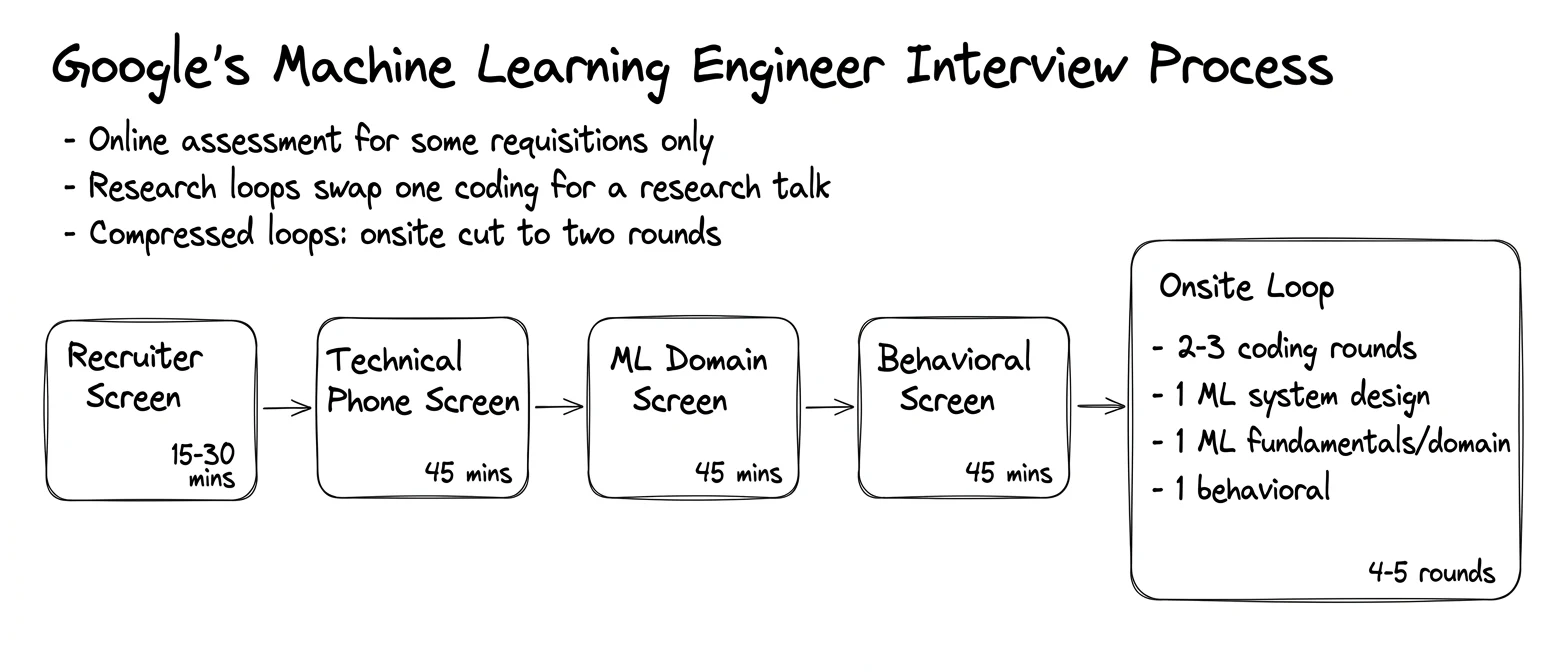
The loop is assembled per requisition. Reported shapes range from two virtual rounds to five onsite sessions, and the same title produced an all-algorithm loop for one candidate and a SQL-plus-Python data round for another. The whole process typically takes six to ten weeks with a referral or recruiter outreach; one PhD new graduate who applied cold reached team match after about 135 days.
New graduates and PhD candidates see more ML fundamentals and fewer design questions; experienced hires almost always get an ML system design round, and coding is graded just as strictly. Since 2025 Google has required at least one in-person round for many engineering roles, and in-person onsites include an unscored lunch with travel covered.
Here's what the interview process can look like:
- Recruiter screen: A 15 to 30 minute call on background, loop format and scheduling, sometimes preceded by a no-code hiring assessment.
- Technical phone screens (one or two): 45 minutes each, either ML fundamentals or a medium coding problem, often paired with a behavioral screen.
- Coding interviews (two or three): 45-minute algorithm rounds in a shared document where code cannot be run.
- ML domain interview (usually one): First-principles ML theory in a domain the candidate picks, or an LLM-focused round.
- ML system design interview (experienced hires, usually one): An end-to-end recommender, chatbot or training pipeline.
- Research talk (research-leaning roles): A presentation of past work followed by hard questions on motivation.
- Googleyness and leadership interview: Behavioral stories on collaboration, conflict and failure.
Tip: Ask the recruiter which loop variant you have before planning preparation. Candidates for this title have been offered behavioral plus three coding rounds, behavioral plus ML domain plus two coding rounds, or two algorithm rounds plus an ML quiz with no ML coding at all.
Recruiter screen
The recruiter call covers research background, the role, the loop structure and availability. Transcripts are requested from early-career and PhD candidates. Outreach can compress the process: one L5 candidate who mentioned an upcoming team match at another company went straight to a virtual onsite. Cold applications move slowly; one candidate waited about two months for a first screen, and scheduling slipped another two weeks. Some AI and ML requisitions also send the Google Hiring Assessment, a questionnaire of forced-choice triples (pick the statement most and least like you) and workplace scenarios with no coding.
Interviewers evaluate:
- Fit to the requisition: Whether your modeling area (ranking, NLP, vision, LLM post-training) matches the hiring team's work.
- Motivation: Clear reasons for Google and, for experienced hires, for leaving your current role.
- Consistency in the assessment: Forced-choice answers that describe one coherent work style rather than whichever option sounds best.
Prepare a two-minute summary of your strongest ML project and confirm the loop variant in writing.
Sample questions for the recruiter screen
Here are some questions reported by recent candidates:
-
Why Google, and why leave your current company now?
-
Walk through your research background and which ML area you want to work in.
Technical phone screens
Screens run about 45 minutes, and for this track the technical one is often pure ML rather than coding. Reported ML screens covered LLM fine-tuning trade-offs, autoencoders against VAEs and VQ-VAEs, and, for a recommendation specialist role, cold start, ranking features and a Google generative-retrieval paper. Other candidates got a coding screen instead: a binary-search variant on a sorted array where edge cases were the point. A separate behavioral screen often follows; it feels relaxed but is scored.
Interviewers evaluate:
- Depth beyond definitions: Explaining why a VQ-VAE uses a discrete codebook, not only what it is.
- Translating research to products: One L5 screen asked how the candidate's research could improve existing Google products.
- Clean edge cases in code: Insertion points, empty arrays and duplicates handled without prompting.
Review the generative-model and recommendation fundamentals your resume claims, then rehearse one medium binary-search problem with edge cases.
Sample questions for the technical phone screens
Here are some questions reported by recent candidates:
-
Compare LLM fine-tuning methods and explain when each is the wrong choice.
-
How would you handle cold start in a recommender, and how do content-based embeddings compare with collaborative signals?
Coding interviews
Every reported loop includes coding, usually two or three rounds of about 45 minutes, some 30 to 40 minutes in person. Problems are medium with a twist or an optimal-complexity follow-up: grid BFS with a bidirectional-search follow-up, an LRU cache with one extra operation, KMP followed by Rabin-Karp collisions, weighted random selection, Dijkstra through a mandatory waypoint, topological sort with cycles, and a Mahjong hand validator. One onsite was a data round: a SQL query on activity logs, then Python for unique users per activity and average session length under an inactivity gap, dry-run by hand.
Interviewers evaluate:
- Reaching the optimal bound: The L5 rejection followed an O(N) subarray problem not completed despite many hints.
- Using every constraint: For a very small array, the interviewer wanted the candidate to argue a linear scan beats binary search.
- Precise complexity: One interviewer demanded per-variable costs annotated in code comments.
- Messy-data edge cases: Single-event users, out-of-order timestamps and inclusive or exclusive gap boundaries.
Practice medium interval, graph and string problems to an optimal solution in 35 minutes, then trace each by hand.
Note: ML strength does not offset a weak coding round. Candidates on this track prepare transformers and recommenders, yet the round that decided the clearest rejection was an array problem in a document where nothing can be run.
Sample questions for the coding interviews
Here are some questions reported by recent candidates:
-
Sum every subarray whose adjacent elements differ by exactly one, in linear time.
-
Given rental requests with start and end times, find the minimum cars needed and record which car serves each request.
-
Pick two indices maximizing their values' sum minus the sum of everything strictly between them.
-
From shift records with names and times, report for each time segment how many employees are on duty and who they are.
-
Minimum Cars to Satisfy Rental Requests + Assignment Records
ML domain interview
The domain round is usually a single session, sometimes combined with behavioral questions. Candidates may pick a domain such as NLP, which led to comparing tokenization methods and a mini-case on using an LLM to build a recommender. Fundamentals rounds go to first principles: bias-variance, deriving logistic regression and cross-entropy from maximum likelihood, why L1 produces sparse weights, and backpropagation sketched by hand. LLM-focused rounds covered post-training, multi-head attention, SwiGLU gating, perplexity, KV caching, nucleus sampling and mixture-of-experts routing.
Interviewers evaluate:
- Derivations, not recall: Writing the loss and connecting it to likelihood on the spot.
- Implementation-level knowledge: Coding attention or a sampling step from scratch in research-adjacent loops.
- Adapting to the interviewer: Depth follows their specialty, and some need advanced ideas explained simply.
- Applied judgment: Turning a concept into a design choice, such as where an LLM fits in a recommender.
Rehearse derivations for the classic models and implement attention, sampling and a transformer block from memory.
Sample questions for the ML domain interview
Here are some questions reported by recent candidates:
-
Derive logistic regression from maximum likelihood and explain why L1 regularization yields sparse weights.
-
Implement multi-head attention, then explain SwiGLU's gating and how you would critique its design.
-
Define perplexity precisely and explain what it does and does not say about a language model.
ML system design interview
Most experienced-hire loops include one ML system design round, sometimes sharing a session with coding. Prompts include a real-time news-feed recommender, a chatbot that combines structured and unstructured data, a scalable training pipeline for a CNN image classifier, and a recommender for products or videos. One combined round opened with a deep dive into the candidate's CNN project, then a sharded multi-region login-log design, then the training pipeline.
Interviewers evaluate:
- Production constraints: Online serving under tight latency budgets, with caching layers and a fallback path.
- Cold start and features: Nearline feature computation and a plan for new users and items.
- Monitoring and iteration: Drift detection, regression alerts and how models are retrained.
- Explicit trade-offs: Accuracy against inference latency, and embedding size against cost.
Practice three recommender and two LLM-application designs, each with a serving path, monitoring and a fallback.
Tip: Practice on the common prompts pays off directly. The candidate who had recently designed a nearly identical chatbot elsewhere found this round the easiest of the loop.
Sample questions for the ML system design interview
Here are some questions reported by recent candidates:
-
Design a real-time news-feed recommender, covering cold start, latency budgets, drift monitoring and fallbacks.
-
Design a chatbot that answers from both structured tables and unstructured documents.
-
Design a scalable training pipeline for an image classifier similar to one you built.
Research talk
Research-leaning roles add a presentation of past work to a small group of researchers, sometimes followed by a one-on-one with a senior researcher. In one Google DeepMind interview the talk with its question period was the entire evaluation, with no coding. Questions target motivation rather than method: why the problem mattered, whether alternatives would have worked, what breaks if an assumption fails.
Interviewers evaluate:
- Ownership of decisions: Every design choice justified on the spot.
- Depth over breadth: Experimental details and failed runs on one or two projects.
- Distinctive insight: Work that reads as benchmark assembly is judged incremental.
Build the talk around two projects you know to the level of individual experiments.
Note: Polish does not rescue thin research. A candidate rejected after the talk attributed it to evaluation-heavy work and shallow post-training exploration, not to the presentation.
Sample questions for the research talk
Here are some questions reported by recent candidates:
-
Why did you choose this problem, and would a different design have worked?
-
What happens to your results if a key assumption is violated?
Googleyness and leadership interview
The behavioral round is a standalone screen or loop round. Themes include conflict with a teammate, a professional failure, working with people unlike you, and helping others when your own work has higher priority. ML-specific scenarios appear: a model wins its A/B test, but your manager believes it hurts long-term user experience. Google has been piloting a version that adds a technical design conversation about your past work.
Interviewers evaluate:
- Concrete, structured stories: Specific actions and results, without rambling.
- Data-driven disagreement: Agreeing on long-term metrics and validating them, not winning the argument.
- Self-reflection: What the failure changed in how you work.
Prepare six stories covering conflict, failure, ambiguity, helping a peer and a metric disagreement.
Sample questions for the Googleyness and leadership interview
Here are some questions reported by recent candidates:
-
Tell me about a conflict with a teammate and how it was resolved.
-
A model performs well in an A/B test, but your manager thinks it will harm long-term experience. What do you do?
How Google levels and evaluates Machine Learning Engineer candidates
Interviewers submit written feedback, and a hiring committee reviews the full packet. Evidence is pooled, but one clearly weak coding round can sink an otherwise positive packet. Results can come quickly, and one candidate who felt parts of the loop went badly still got an offer. The target level is set before the loop and the bar moves with it. Team matching follows committee approval, and candidates wait for a team with headcount at their level, which can take weeks. A rejection after a full loop typically means about a year before reapplying.
How to prepare for the Google Machine Learning Engineer interview
- Treat coding as the decisive round: Solve medium problems to the optimal bound in a plain document and dry-run them by hand.
- Confirm the loop variant early: Ask whether you face three coding rounds, an ML domain round, an ML quiz or a research talk.
- Rehearse derivations aloud: Cross-entropy from likelihood, L1 sparsity, backpropagation, bias-variance and perplexity.
- Implement model internals from memory: Attention, a transformer block, top-k and nucleus sampling, and a KV cache.
- Design with production detail: Cold start, nearline features, caching, fallbacks, drift monitoring and the latency-accuracy trade-off.
- Practice messy-data scripting: Sessionization and distinct counts with out-of-order and duplicate timestamps.
- Go deep on two projects: Know the motivation, rejected alternatives and failed experiments of each.
- Prepare a metric-disagreement story: Show how you used data to settle a short-term against long-term trade-off.
About the Google Machine Learning Engineer role
Machine Learning Engineers at Google are software engineers who build, train and serve models inside product and infrastructure teams, writing reviewed production code. Work spans ranking and recommendation, generative models, ML infrastructure and internal tooling such as data pipelines and retrieval-augmented generation systems.
| Level | Primary focus | Impact scope |
|---|---|---|
| L3 (Software Engineer II) | Well-scoped model and pipeline features | Components within one team |
| L4 (Software Engineer III) | Owning models or pipelines end to end | A team's ML systems |
| L5 (Senior Software Engineer) | Technical leadership of ML projects | Several systems and partner teams |
| L6 (Staff Software Engineer) | ML direction across teams | An organization's ML strategy |
Google hires Machine Learning Engineers across most product areas. Teams include:
- Google DeepMind: Gemini pre-training and post-training, research engineering.
- Search: Ranking, retrieval and query understanding.
- YouTube: Recommendation and discovery.
- Google Ads: Ad ranking, prediction and measurement.
- Google Cloud: Vertex AI and the Core ML infrastructure organization.
- Labs and Applied AI: Early-stage generative AI products.
Machine Learning Engineer experience and education requirements
Industry postings ask for a bachelor's degree in computer science or a related field, about two years of software experience, training models in TensorFlow, PyTorch or JAX, and coding in Python, C++, Java or Go. PhD early-career postings require a PhD in computer science, ML or a related field and prefer large-scale training experience and familiarity with transformers, CNNs and diffusion models.
FAQs about the Google Machine Learning Engineer interview
How long does the Google Machine Learning Engineer interview process take?
Typically six to ten weeks from recruiter contact to decision with a referral or outreach. Cold applications ran longer: about five months from application to team match for one PhD candidate.
What is the hardest round of the Google Machine Learning Engineer interview?
The coding rounds, judged by who is rejected and why. For research roles, the talk is hardest because every choice must be defended live.
Can you use AI tools during the interview?
Not in the reported loops. Google has been piloting an AI-assisted coding round with Gemini for some junior and mid-level software engineering roles on select US teams, so ask whether your loop includes it.
How much does a Google Machine Learning Engineer make?
Approximate total annual compensation in the United States:
- L3: ~$200K
- L4: ~$295K
- L5: ~$395K
- L6: ~$605K
Packages combine base salary, an annual bonus target, and stock that vests over four years, front-loaded in recent grants.