Study
Frontend Interview Questions for Senior Engineers: 31 Reported
TrueInterview
October 11, 2026 · 17 min read
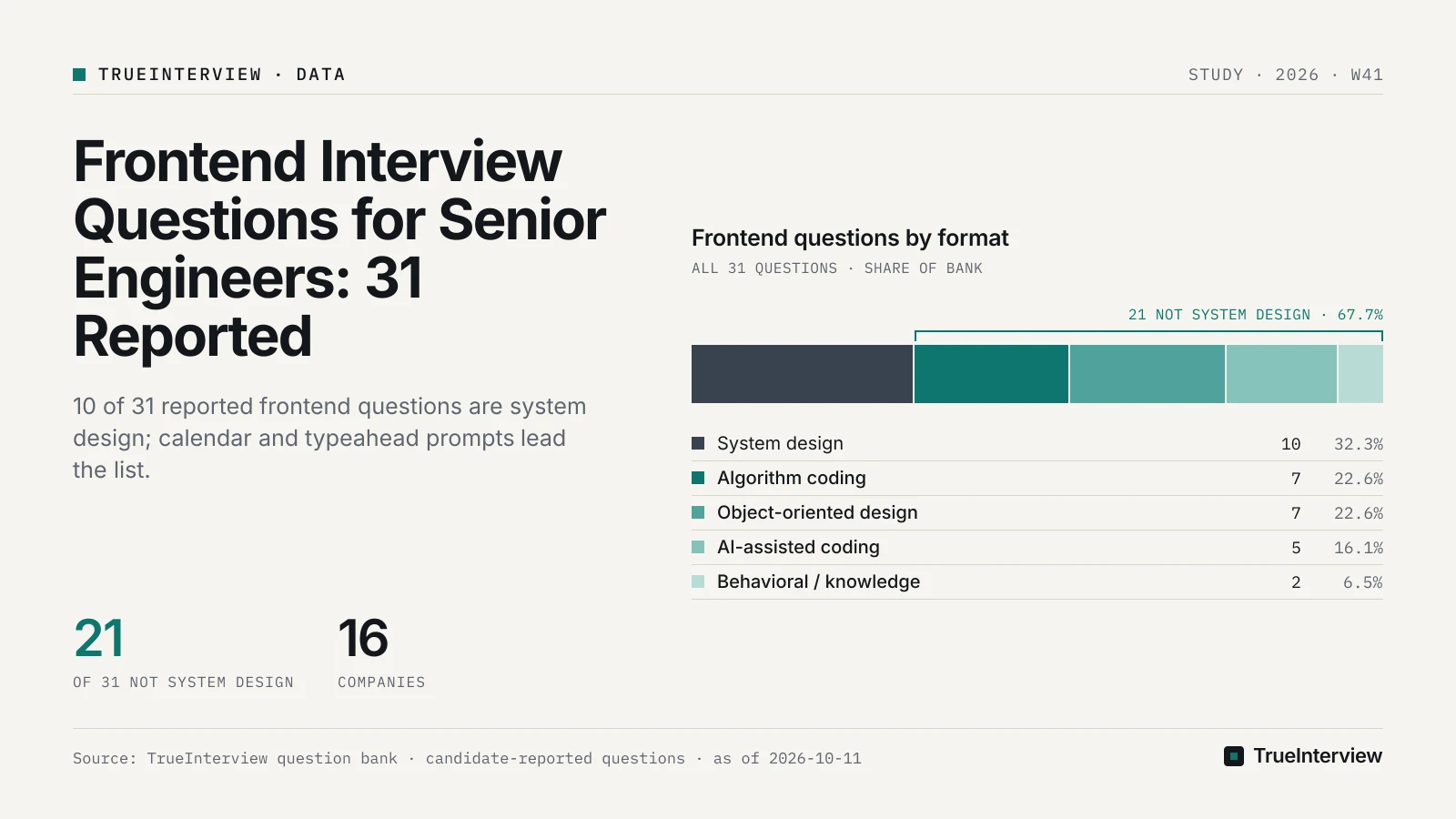
As of 2026-10-11, TrueInterview's bank holds 31 candidate-reported frontend questions from 16 big-tech companies. Of those, 10 are system design, 7 object-oriented design and 5 AI-assisted coding, against 7 algorithm questions, so the reports lean toward design rather than a LeetCode grind. Algorithms still count at Google, where SpaceComplexity's guide says frontend candidates face two full DSA rounds. The prompts linked from the most write-ups are client-side systems, led by Photo Album System Design at Robinhood and Design a Scalable Calendar Service at Uber and LinkedIn. Spend your first week on a calendar design and a typeahead design, then component builds, then hand-written JavaScript utilities.
Disclosure: TrueInterview is an interview-preparation product and publishes this article. Facts about other products come from their public pages on the dates listed under Sources.
Which frontend questions are reported most often?
Eight prompts are linked from at least two candidate write-ups, and five of them are calendar, autocomplete or build-from-mockup prompts. Rank your practice by write-up links, so Photo Album and the calendar service come before any utility drill. Our reading is that a prompt several candidates took the time to reconstruct is the strongest signal available about that company's current loop, even though a link count is not a frequency.
| Question | Company | Candidate write-up links | Practise |
|---|---|---|---|
| Photo Album System Design | Robinhood | 4 | Photo Album System Design |
| Design a Scalable Calendar Service | Uber, LinkedIn | 4 | Design a Scalable Calendar Service |
| Frontend Calendar UI | Robinhood | 3 | Build it as the hands-on half of the calendar pair |
| Render Blog Posts (Multi-Stage CodeSignal) | Coinbase | 2 | Render Blog Posts |
| Frontend Domain — Card / Validation Component to Mockup | Coinbase | 2 | Pair it with the DoorDash mockup build |
| Implement a ChatGPT-like Chat UI in React (Streaming + Loading + Message Flow) | OpenAI | 2 | ChatGPT-like Chat UI |
| Build UI from Mockup with API | DoorDash | 2 | Build UI from Mockup with API |
| Frontend Autocomplete Component | Lyft | 2 | Frontend Autocomplete Component |
The two calendar prompts come from Robinhood, Uber and LinkedIn, and the autocomplete and mockup builds come from three more companies. The calendar pair, the Lyft autocomplete and the two mockup builds fill five of the eight rows. A calendar and an autocomplete, each designed and built, plus one mockup build, give you a rehearsed version of the shape behind each of those five.
Photo Album System Design (Robinhood)
One of the two most-linked prompts, it was last reported at a Robinhood onsite in 2026-05. The reports do not say what interviewers asked about it, so what follows is our general engineering guidance for any photo-grid design. A photo album is a grid of many images, so a good design starts from what the browser holds in memory and what it fetches. Request thumbnails sized to the grid cell, load full resolution only when a photo opens, and lazy-load off-screen images. Once the grid can grow without limit, virtualize it so the DOM holds only the visible rows, and page with a cursor so new uploads do not shift the pages a user has already seen.
Our suggestion for a senior-level answer is to go beyond the grid and cover the upload path unprompted. Show an optimistic tile with a local preview, per-file progress and retry, and say exactly what happens to that tile when the server rejects the file.
The calendar pair: a service design and a UI build
Uber's reported phone-screen question is Design a Scalable Calendar Service, last reported in 2026-06. Treat Frontend Calendar UI at Robinhood as the build-it counterpart, and prepare both from one data model. Store each event as an instant in UTC plus the event's IANA time zone, render it in the viewer's zone, and keep all-day events as plain dates so they never drift across zones.
As general guidance for any calendar design, two decisions tend to separate a senior answer from a mid-level one. The first is recurrence: store the rule and its exceptions, and expand occurrences only for the visible range rather than materialising a year of events. The second is the optimistic update on drag-to-reschedule: move the event at once, keep the previous state, and roll back with a visible error if the server rejects the change or a version check shows that another client edited the event first. Finish with accessibility, because a calendar grid needs arrow-key navigation and an accessible name on each event that includes its time.
The typeahead cluster: Amazon, Lyft and Databricks
The same theme appears in three formats: Build an Autocomplete Search Bar at an Amazon phone screen in 2026-09, Frontend Autocomplete Component at a Lyft onsite in 2025-11, and Design a Typeahead Search System at a Databricks onsite in 2026-09. The Front End Interview Handbook lists autocomplete as very popular among its UI coding examples without naming a company or a date. The bank puts names and months on that advice.
As general guidance, a typeahead component rests on three mechanics. Debounce the input. Discard stale responses by aborting the previous request or tagging each request and ignoring any reply older than the latest one. Cache results by query so backspacing is instant. Then implement the combobox pattern: an input with role="combobox" and aria-expanded, a listbox of options, aria-activedescendant for the highlighted option, and arrow keys, Enter and Escape that behave as a screen-reader user expects. The design version adds the boundary questions a senior candidate should raise unprompted: where ranking happens, what the client caches, the minimum query length, and what the box shows when the service is slow or down.
Implement a ChatGPT-like Chat UI in React (OpenAI)
The prompt's title names streaming, loading states and message flow in React. As general engineering guidance for that kind of build: Read the response as a stream and append chunks to the last assistant message. Batch state updates so each token does not trigger a full render, and key messages by stable ids. Give the user a stop button that aborts the request, auto-scroll only when the user is already at the bottom, and announce completed messages through a polite live region rather than reading out every token.
What formats do big-tech frontend questions take?
Mostly design and component work, with algorithm coding tied with object-oriented design behind system design. Beyond the counts in the opening paragraph, the bank's fifth format is behavioral / knowledge with 2 questions. Plan your hours roughly in proportion to those counts, with the Google exception covered below. Even that smallest bucket has a React build as its dated example in the table below. Our reading is that definition-style trivia earns an evening of review, not a week.
| Format | Dated example from the bank | What to prepare |
|---|---|---|
| System design | Large-Scale Interactive Map Visualization, Google onsite, 2026-08 | Client state, rendering budget, what loads when; practise the map prompt |
| Coding (algorithm) | React / TypeScript Kanban Board, Snowflake onsite, 2026-08 | Working code under time, with drag state and reorder logic; practise the Kanban board |
| Object-oriented design | Build UI from Mockup with API, DoorDash phone screen, 2026-03 | Component boundaries, props versus state, a thin data layer |
| AI-assisted coding | Render Blog Posts (Multi-Stage CodeSignal), Coinbase online assessment, 2026-03 | Reading a staged spec and verifying generated code |
| Behavioral / knowledge | Implement a ChatGPT-like Chat UI in React, OpenAI onsite, 2026-08 | Explaining the why behind each UI decision as you build |
Frontend system design is a client-layer exercise. SpaceComplexity's Google guide says it centres on component architecture, client-side state and browser performance rather than databases and servers. The same guide names the usual failure: "The most common mistake here: treating this like a generic distributed systems question and describing load balancers for 15 minutes." If your design notes start with a load balancer, rewrite them to start with the component tree and the state each component owns.
Our take: the Front End Interview Handbook says front end interviews put less emphasis on algorithms and more on HTML, CSS and JavaScript knowledge, and roadmap.sh's list opens with id versus class and the CSS box model. Our bank holds few knowledge-format questions, which reflects what candidates chose to file rather than proof that companies skip them; the handbook's own company table lists quiz rounds at Amazon. Give definitions a focused evening rather than a week and spend the saved time drawing state diagrams for the calendar and typeahead prompts.
Where do frontend questions show up: phone screen, onsite or online assessment?
All three, and the phone screen carries more design than most candidates expect. Reported rounds run onsite 24, phone screen 11 and online assessment 1, and one question can count in more than one round. If your phone screen is inside two weeks, prepare a design narrative and a component build now rather than a trivia warm-up.
The dated phone-screen examples cover three formats: Uber's calendar service is a system design, Amazon's autocomplete bar is a coding question and DoorDash's mockup build is an object-oriented design. Company guidance points the same way. Amazon's front-end engineer prep page says the technical phone screen splits its time between Leadership Principles questions and front-end coding problems. The same page says, "Expect at least one question on front-end systems design." The page also asks for syntactically correct code with no pseudo code.
The coding environment matters as much as the question. SpaceComplexity's Amazon guide says the online assessment and phone screen require plain HTML, CSS and vanilla JavaScript, with React banned. Prepfully's Meta guide describes a 45-minute video screen on core JavaScript and browser fundamentals, run in CoderPad with code execution switched off. For a Meta screen, practise tracing your code by hand; for an Amazon screen, practise DOM work without a framework.
The online assessment is the thinnest slice of our data, with Coinbase's blog-post renderer as the one dated example. Amazon's prep page says its assessment gives 90 minutes for two technical questions, plus systems design scenarios and a work style survey. Rehearse one timed, multi-stage build before any assessment, because staged specs punish a first stage that cannot be extended.
Are AI-assisted coding rounds part of frontend loops now?
Yes, and they need their own rehearsal. AI-assisted coding is one of the five formats in the table above, and Coinbase's online assessment is its dated frontend example. Outside our bank, prep guides describe formats at Meta and Google. Senior candidates should prepare for Meta's version first, because the reported scope of Google's pilot is junior and mid-level roles.
GreatFrontEnd's interview-process blog says Meta rolled out an AI-assisted coding round starting October 2025, replacing one of the two traditional onsite coding interviews. Exponent's blog says the session lasts 60 minutes on a multi-file codebase and moves through bug fixing, core implementation and optimization, scored on problem solving, code quality, verification and communication.
For Google, Exponent's blog says a pilot lets candidates use an approved AI assistant during the coding round, with interviewers evaluating "AI fluency, including prompt engineering, output validation, and debugging skills." GreatFrontEnd's blog adds that the pilot is scoped to junior and mid-level roles on select US teams. Exponent's blog also reports that Canva announced in June 2025 that it expects frontend candidates to use tools such as Copilot, Cursor or Claude in technical interviews.
Our take: the graded skill is verification. Exponent's blog says candidates who appeared to "rely heavily on AI" without showing their own understanding received negative feedback. Rehearse on an unfamiliar multi-file React codebase: fix one bug with the assistant, then narrate how you check each generated change. Read the diff, run or write a test, and confirm the loading, empty and error states still render and the keyboard path still works.
Do algorithms and vanilla JavaScript still matter for senior frontend roles?
Yes, and at Google they carry equal weight with design. SpaceComplexity's Google frontend guide says the algorithmic bar is identical for frontend and backend at the same level, with two full DSA rounds and no frontend discount. If Google is on your list, give algorithms the same hours as client-side design.
One candidate's Primly write-up of a Google L4 loop in early 2026 makes the split concrete. That candidate reports one frontend-adjacent coding round, debounce from scratch and then a rate-limited autocomplete at pseudocode level, and two pure algorithm rounds on strings and trees. The same write-up says, "I used to think being strong in React and modern JS would be enough for a Google frontend loop."
Framework fluency does not substitute for the language. SpaceComplexity's Google guide says the coding round tests closures, prototypes and the event loop, and that reaching for framework APIs is the most common trap. Its Amazon guide says debounce, Promise.all, deep clone and Array.prototype methods are implemented from scratch. Prepfully's Meta guide says Meta's coding rounds stress JavaScript fundamentals, DOM manipulation and asynchronous programming, and skip dynamic programming.
Two dated algorithm-filed examples in our bank are UI builds: the Amazon autocomplete bar and the Snowflake Kanban board. Write each utility so it survives a follow-up: debounce with cancel, throttle with a trailing call, Promise.all that preserves input order and rejects on the first failure, deep clone that handles cycles with a WeakMap, and an event emitter whose once handler removes itself.
| If your loop includes | Weight your preparation toward | Evidence |
|---|---|---|
| Algorithms and vanilla JavaScript as much as client-side design | Two full DSA rounds reported by SpaceComplexity's guide | |
| Amazon | Leadership Principle stories with metrics, plain HTML, CSS and JavaScript, one front-end systems design | Amazon's prep page and SpaceComplexity's guides |
| Meta | JavaScript fundamentals, a no-code UI design round, the AI-assisted round | Prepfully's guide and GreatFrontEnd's blog |
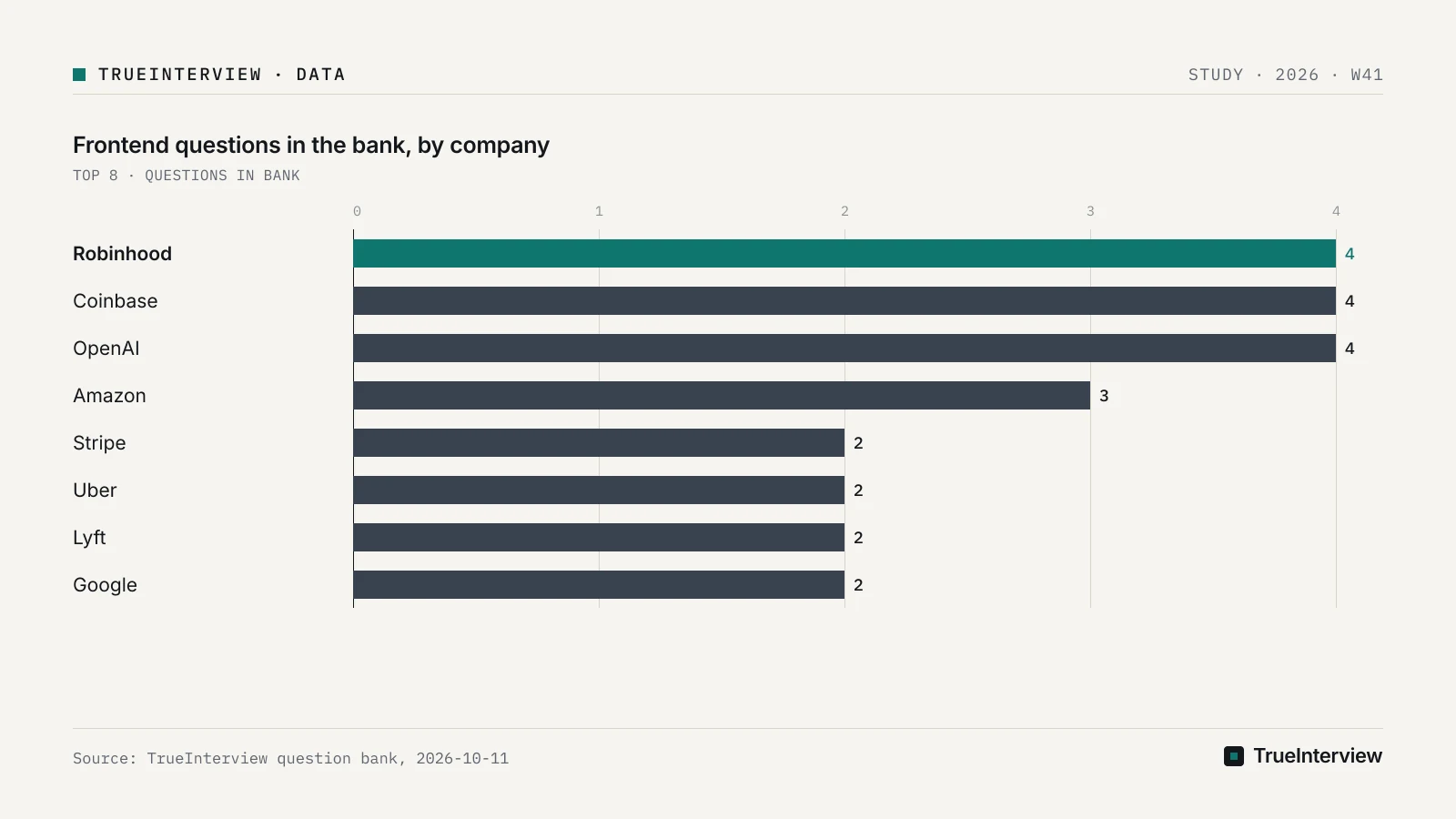
| Robinhood, Coinbase, Uber, Lyft, DoorDash | Calendar and typeahead first, then a component-from-mockup build and one AI-assisted rehearsal | Our bank: Robinhood 4, Coinbase 4, Uber 2, Lyft 2 questions, plus DoorDash's mockup build |
What changes at senior and staff level?
The calendar service is reported at both levels and the design-heavy prompts lean senior, so what changes most is the depth of the design answer. Candidate write-ups link these questions 23 times from candidates who reported a senior, staff-plus or manager level and 19 times from those who reported junior, new-grad or intern. That split measures who wrote reports rather than who is asked what, but the design prompts lean clearly senior.
| Question | Senior-or-above links | Junior-or-below links | Read it as |
|---|---|---|---|
| Photo Album System Design | 4 | none | Reported only by senior-or-above candidates; our suggestion is to cover the upload path |
| Frontend Calendar UI | 3 | none | Reported only by senior-or-above candidates |
| Design a Scalable Calendar Service | 3 | 1 | Asked across levels; senior answers own time zones and conflicts |
| Implement a ChatGPT-like Chat UI in React | 2 | none | A senior build; streaming, abort and render cost |
Level here is what each candidate reported for themselves, and the table counts links rather than people, so treat each split as a direction rather than odds.
Third-party guides describe the same shift. Prepfully's Meta guide says E4 and E5 candidates report two coding rounds, one UIE round and one behavioral round, while E6 candidates report an extra design round that sometimes replaces the second coding round. The same guide says that "the coding rounds play a big part in the hire/no-hire decisions and the design rounds suggest the level you'll be calibrated at." The guide says its design round focuses on client-side constraints, state management, component lifecycles and data flow. The Primly write-up above reports that even at L4 the system design round was a frontend news-feed design covering pagination, lazy loading, client-side caching and API shape for different devices.
| Level | Calendar answer must add | Typeahead answer must add |
|---|---|---|
| Mid-level | Month and week views, event create and edit, loading and error states | Debounced input, a results list, keyboard selection |
| Senior | Time zones and daylight saving, recurrence expanded per visible range, optimistic drag with rollback | Stale-response handling, a client cache, the full combobox pattern, a clear client and server boundary for ranking |
| Staff | Offline edits and conflict resolution across devices, a component API other teams reuse, a performance budget and how you would measure it | A search component shared across products, instrumentation, and a fallback when the service degrades |
Our take: the level table above is our view, built from what the senior-weighted prompts demand. The omid.dev author, who interviews frontend hires, defines a senior as someone who "Makes decisions the team will live with, and can explain the tradeoffs behind them." At senior and staff level, name the trade-off before the interviewer asks for it, and say who else in the organisation the decision affects.
Which rounds decide whether you are down-leveled?
Our take: the design round sets your level, a project-based design conversation confirms it where your loop has one, and behavioral scope decides close calls. Prepfully's calibration point above is the clearest external support for the first part. Candidates who pass coding comfortably but give a mid-level design answer are the ones most exposed to an offer one level below their target.
SpaceComplexity's Google guide says the Googleyness and Leadership round now includes a technical design conversation, and advises picking a project where you made real decisions rather than one you executed. Its Amazon guide says Leadership Principle stories need numbers, contrasting a measured LCP improvement with "we improved performance". Prepare one project story where you owned a frontend architecture decision, such as a state-management change or a performance budget, with the metric it moved and the option you rejected.
How we counted
Counts come from TrueInterview's question bank as of 2026-10-11 and cover the 31 frontend questions filed at 16 big-tech companies. They are candidate-reported questions reconstructed for practice, not any company's official list. A question can be reported in more than one round, so round tallies add up to more than the question count. Level splits count write-up links by self-reported level, and a link count is neither a count of distinct write-ups nor a measure of how often a company asks a prompt. TrueInterview says questions are dated when the report gives a month.
FAQ
Are these the questions big tech companies officially ask?
No. They are candidate reports reconstructed for practice, so use them to decide what to build first rather than to predict your exact prompt. Company pages describe formats instead: Amazon's student and graduate front-end page says technical interviews mix verbal and coding exercises on maintainable code, data structures and algorithms, and front end tech. A calendar or typeahead design you can extend under a new requirement transfers to prompts you have never seen.
How recent is this data?
Most of it comes from the past year: 28 of the 31 questions were last reported within the 12 months before 2026-10-11, so the question list reflects this year's reports rather than a canon passed between prep sites, even though older write-ups still add to a prompt's link count. Older prompts are still fair warm-ups, but they should not take a full evening away from the calendar, typeahead and mockup prompts that recent reports keep naming.
Do new grads get different frontend questions than senior engineers?
The prompts overlap, and the depth expected differs. The level table above shows the design prompts lean senior, while junior candidates report the calendar service too. Amazon's student front-end page says interns get one round of two interviews that combine technical and behavioral questions. Exponent's blog says Google is replacing one traditional technical interview for earlier-career applicants with a session on open-ended engineering problems. If you are early in your career, put component builds and utilities ahead of staff-level design depth.
What should a frontend developer with five years of experience prepare?
Prepare as a senior candidate, which means design depth first. The omid.dev author writes, "Notice how much of the senior definition is not framework knowledge." Build the calendar and typeahead prompts at the senior row of the level table, rehearse one AI-assisted session, and keep vanilla JavaScript utilities warm. Then prepare two project stories with measured results, because the design round and the project deep dive are where your level is decided.
Do I need React for big-tech frontend interviews?
Sometimes, but do not depend on it. The Front End Interview Handbook says not all interviews allow React because interviewers want to see mastery of the fundamentals, and the Amazon screens described above require vanilla JavaScript. Other reported prompts name React directly, such as Snowflake's React / TypeScript Kanban Board. Practise each component twice: once in React with hooks, and once with plain DOM APIs and event delegation.
Is a large generic question bank enough preparation?
It is useful for drilling utilities, but it does not tell you what to do first. GreatFrontEnd describes "The largest question bank of 500+ front end interview practice questions", and its questions page describes tasks such as a debounce with cancel and flush methods or a Hacker News job board by what to build. A reported prompt adds the company, round and month, and that is what tells you what to practise first. The Front End Interview Handbook's company table has no dates and lists no data for Apple's algorithm and system design columns. Use a bank for repetition and reported prompts for priority.
Your practice plan
The target is narrower than a generic list: two client-side systems, two component builds, one AI-assisted session and a set of utilities. This plan assumes about four evenings a week for three weeks while you work full time.
- Week one, first two evenings: write a design walkthrough for Design a Scalable Calendar Service covering the UTC-plus-zone data model, recurrence expansion, optimistic drag with rollback and a keyboard-navigable grid. Then build a month view as the hands-on counterpart.
- Week one, last two evenings: design Design a Typeahead Search System, then build Build an Autocomplete Search Bar in vanilla JavaScript with debounce, stale-response handling and the combobox pattern.
- Week two: run Photo Album System Design under a timer, then Build UI from Mockup with API to practise component boundaries and the data layer.
- Week two, final evening: do Render Blog Posts (Multi-Stage CodeSignal) with an AI assistant, narrating how you verify every generated change.
- Week three: write debounce, throttle, Promise.all, deep clone and an event emitter without a framework. If Google is on your list, alternate these evenings with algorithm sessions on trees and strings.
- Week three, if you are senior or above: build Implement a ChatGPT-like Chat UI in React with streaming, stop and error states, then rehearse one project story with the metric it moved and the option you rejected.
To check the company, round and month behind any prompt before you spend an evening on it, browse TrueInterview's candidate write-ups.
Sources
- TrueInterview question bank — frontend at big-tech companies — counted 2026-10-11
- Google Frontend Engineer Interview: The Full Process, Decoded · SpaceComplexity — checked 2026-10-11
- Introduction | The Official Front End Interview Handbook 2026 — checked 2026-10-11
- Top 30 Popular Front End Developer Interview Questions — checked 2026-10-11
- FEE Interview Prep — checked 2026-10-11
- Amazon Frontend Engineer Interview: Every Round, Decoded · SpaceComplexity — checked 2026-10-11
- Meta Frontend Engineer: Essential Interview Guide 2026 — checked 2026-10-11
- Frontend Interview Process at Google, Amazon, and Meta: What to Expect | Blog — checked 2026-10-11
- Google's AI-Assisted Coding Interview (2026 Guide) - Aced (formerly Exponent) — checked 2026-10-11
- Google frontend engineer interview: what the rounds look like | Primly Community — checked 2026-10-11
- I Interview Frontend Hires for Other Companies | Omid Farhang — checked 2026-10-11
- Real FAANG Interview Questions by Company · TrueInterview — checked 2026-10-11
- Interview prep for Front End Engineer roles — checked 2026-10-11
- 500+ Front End Interview Questions and Answers — checked 2026-10-11
Last reviewed: 2026-10-11.