Faire · Study
Faire Interview Process & Questions
TrueInterview
October 13, 2026 · 9 min read
Faire's coding rounds are rarely classic puzzles. Most are implementation tasks graded on exact output and on your tests: a Pascal's triangle that has to print symmetrically, a message splitter where every space has a defined place, a tag validator full of malformed edge cases. One interviewer required JUnit tests during the round. The system design round penalizes over-engineering as much as gaps, and a rejected candidate's feedback cited both an architecture that was hard to follow and too little on crash recovery.
This guide breaks down each stage of the Faire interview, what interviewers evaluate in each round, and how to prepare, with questions candidates were actually asked.
Verified: Based on 5 candidate-reported interview experiences, cross-checked against recent public accounts.
Faire interview process
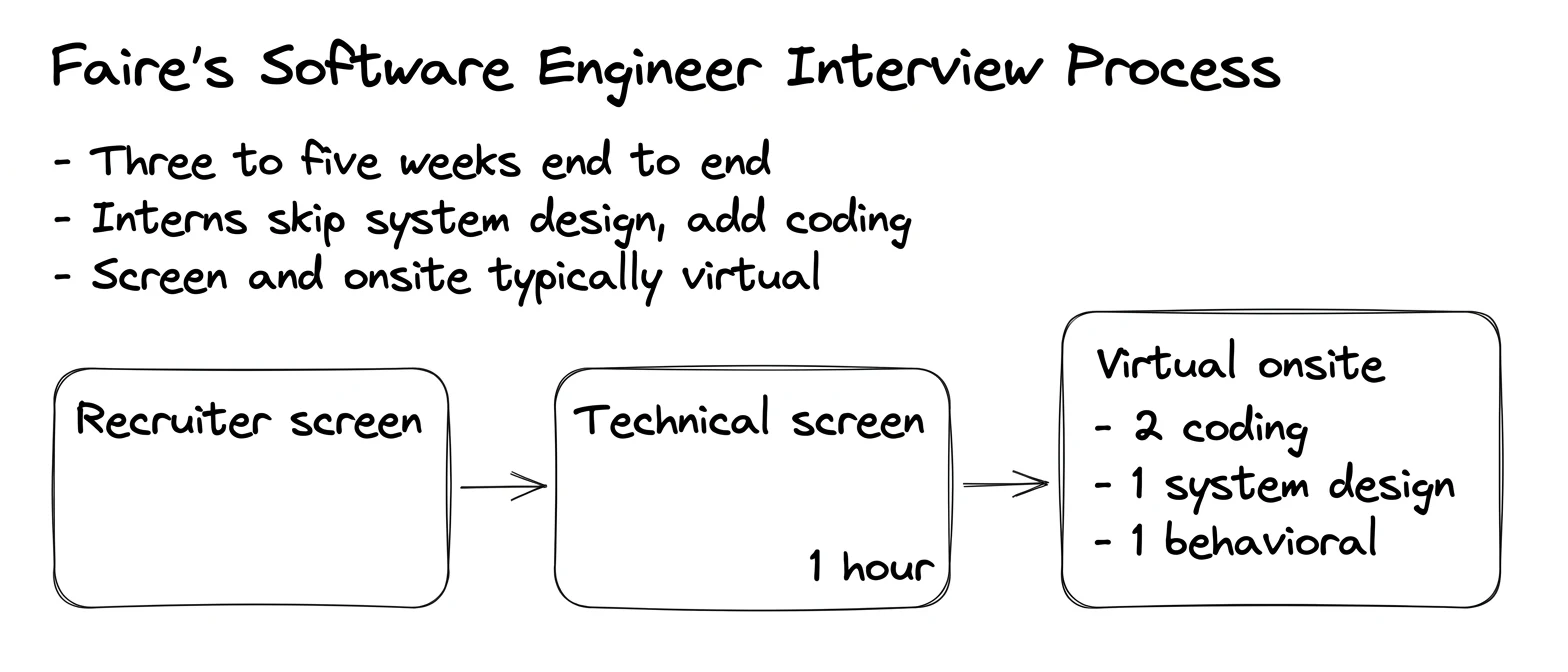
Faire hires engineers into product teams in San Francisco, Toronto and Kitchener-Waterloo, and the loop is broadly the same across them. It typically has three stages over three to five weeks: a recruiter call, one technical screen (sometimes an online assessment instead), and a virtual onsite of two coding rounds, a system design round and a behavioral round.
Intern loops usually drop system design and add a further coding round. Senior candidates get the full onsite, where the design round carries the most weight. Each coding round is typically one hour, built on one main problem with follow-ups rather than several unrelated problems.
Here's what the interview process can look like:
- Recruiter screen: A short call on background, motivation, location and the format of the loop.
- Technical screen or online assessment: A one-hour live coding session with a Faire engineer, or a timed assessment of about 70 minutes for some early-career candidates.
- Coding interviews (two): One-hour live rounds on string processing, validation and implementation problems, with heavy emphasis on tests.
- System design interview (experienced hires): A product-flavored design, such as a like system for brands, discussed at a high level, through APIs and the data model, and into failure handling.
- Behavioral interview: A structured conversation about past decisions, disagreements and collaboration.
Tip: Treat every coding round as a small, tested implementation task, not a puzzle. Clarify the exact output format first, write the code, then list your edge cases and run them before the interviewer asks.
Technical screen
The screen is a one-hour live coding session in a shared editor such as CoderPad. Recent prompts look easy, with a twist that decides the grade. In one screen, the candidate generated Pascal's triangle to height h and printed it symmetrically, padding every value to the width of the largest number. The follow-up was API design: the server returns the raw rows as lists of integers, and the client owns all formatting.
Another screen asked for the peak capacity needed across events that each have a start, an end and a capacity. One follow-up asked for the interval where the peak occurs, and the next for every interval where it occurs. Some early-career candidates take an online assessment instead, typically two problems (one easy, one medium) or a single timed sitting of about 70 minutes.
Interviewers evaluate:
- Choosing the right model: Turning intervals into +capacity and -capacity points and sweeping them in order, rather than forcing an interval-plus-heap solution.
- State tracking for follow-ups: Recording where a maximum starts and ends, not just its value, so the "every interval" follow-up is a small change.
- Exact output: Padding and spacing that match the spec character for character.
- Separation of concerns: In the API follow-up, keeping presentation logic out of the server response.
Practice strict-format problems, then add a follow-up that changes what you return.
Note: One candidate started the peak-capacity problem with a heap, ended up with awkward, bug-prone code, and called both follow-ups tricky. The event-point sweep makes both follow-ups straightforward. Spend a minute choosing the representation before coding.
Sample questions for the technical screen
Here are some questions reported by recent candidates:
-
Print Pascal's triangle to a given height so that it is symmetric, padding each number to the width of the largest one.
-
Design the API that serves Pascal's triangle, with the server returning raw numbers and the client handling all layout.
-
Given events with start time, end time and capacity, return the peak capacity, then the interval where it occurs, then every such interval.
Coding interviews
The onsite typically has two one-hour coding rounds with Faire engineers. They favor original string and simulation problems over well-known algorithm questions, and candidates note that dynamic programming is rare. One prompt splits a message into lines under a character limit, where each line ends in a numbered suffix such as #01 that counts toward the limit. A space that is not needed before a suffix moves to the start of the next line. The problem needs no algorithm beyond careful conditionals, so whitespace is where candidates lose points.
Other reported rounds asked for a validator for an HTML-like format with tags in double curly braces, with a demand for very precise test cases, and a funnel problem graded mainly on test coverage. An older Canadian loop also opened with Valid Anagram, where only the optimal solution was accepted and efficiency had to be argued in detail. Some recruiters have shared prep material that leans on graphs and topological sort.
Interviewers evaluate:
- Tests as a deliverable: Writing unit tests during the round, including boundary conditions, error paths and malformed input.
- Edge-case enumeration: Unmatched or badly nested tags, empty tags, stray characters, trailing punctuation, single words longer than expected.
- Precision: Output that matches the examples exactly, including where whitespace goes.
- Optimality when asked: Justifying counting over sorting on a frequency problem, with time and space stated.
Practice writing JUnit-style tests (or your language's equivalent) for a problem in under ten minutes.
Note: One candidate was pressed repeatedly about missed edge cases during a funnel problem, and when they asked afterward which cases they had missed, the interviewer could not name one. Coverage is graded as a habit. List categories of cases out loud, not just a few examples.
Sample questions for the coding interviews
Here are some questions reported by recent candidates:
-
Split a message into lines of at most a given length, each ending in an incrementing suffix like #01 that counts toward the limit, and move unneeded spaces to the next line.
-
Validate a string of nested tags in double curly braces, such as an opening div wrapping an opening and closing p, and write precise test cases for malformed input.
-
Implement the funnel problem and cover it with unit tests written during the round.
-
Decide whether two strings are anagrams with the optimal time and space complexity.
System design interview
Experienced candidates get one system design round, and the prompts come from Faire's own marketplace. One reported prompt was a like system for brands. The expected path runs from requirements to the high-level design, the API, the data model and scaling, with failure handling stated explicitly. Some candidates found the scenario deliberately open-ended and had to define the problem space themselves.
A rejected candidate with a data-infrastructure background added an asynchronous event pipeline with aggregation on top of the standard design. The feedback called it over-complicated and hard to follow, and said crash recovery was not covered enough, even though the candidate had discussed failure recovery earlier in the round.
Interviewers evaluate:
- Scoping: Turning an open prompt into clear requirements and a small set of core flows.
- Proportion: A design the interviewer can follow, with complexity added only when a requirement demands it.
- Data model and API: Clean entities for brands, products and likes, with counts that stay correct under contention.
- Failure handling: Crash recovery, retries and idempotency, stated more than once and confirmed with the interviewer.
Rehearse a marketplace feature you can present simply, then deepen where asked.
Tip: After covering failure recovery, ask the interviewer directly whether it was enough. A quiet interviewer may not register a point made once early in the round.
Sample questions for the system design interview
Here are some questions reported by recent candidates:
- Design a like system for brands, covering the API, the data model, scaling and recovery after a crash.
Behavioral interview
The behavioral round is typically structured: one candidate described an interviewer reading questions from a list with little back-and-forth. The focus is past experience, especially times your decision differed from your team's, plus collaboration and ownership. Some loops pair this with a hiring-manager conversation about motivation and team fit.
Interviewers evaluate:
- Disagreement handling: How you argued for your view, what you did once the team decided, and the outcome.
- Ownership: Concrete decisions you drove, with results.
- Motivation: Why a wholesale marketplace for independent retailers and brands interests you.
Prepare four or five complete stories, including one where you disagreed with your team's decision, since a scripted round leaves little room for follow-up.
How Faire makes hiring decisions
Interviewers submit feedback after the onsite, and decisions can be fast: one rejected candidate heard back the day after the final round, and the feedback was specific to the design round. Little else about leveling or team matching is consistently reported, so ask your recruiter which team and level the loop targets.
How to prepare for the Faire interview
- Write tests during practice: For every problem, write five to ten unit tests covering boundaries, malformed input and error paths, using JUnit or your language's framework.
- Drill exact-output problems: Practice formatting tasks such as padded triangles and line wrapping with suffixes until spacing is right on the first run.
- Master the event-point sweep: Solve peak-overlap problems with start and end deltas, then return the interval and every interval where the peak occurs.
- Practice validators: Build stack-based validators for custom tag syntaxes and list the ways input can be malformed.
- Keep designs proportional: Present a simple, complete marketplace design first, and add queues or aggregation only when a requirement calls for them.
- Say failure recovery twice: Cover crash recovery and idempotency in the high-level design and again at the end, and confirm the interviewer heard it.
- Separate data from presentation: In API follow-ups, return raw data and leave formatting to the client.
About working at Faire
Engineers work in product teams, some of which deploy to production several times a day. The backend is largely Kotlin, a monolith that is gradually being split into Kotlin services, with Java, JUnit, Hibernate, Guice, MySQL, CockroachDB and AWS listed across postings. Kotlin is also used on Android. Hybrid roles typically involve three office days a week.
Faire hires engineers across its marketplace teams. Teams include:
- Brand and Brand Platform: The tools brands use to list products, fulfill orders and talk to retailers, plus the platform services underneath.
- Search and discovery: Search, retrieval and ranking for retailers browsing the catalog, increasingly AI-assisted.
- Ads: Ad retrieval, ranking and measurement, in partnership with data science.
- Growth Platform: Shared services for the teams that grow retailer and brand activity.
- Insider membership: Backend services behind the retailer membership program.
Experience and education requirements
Postings emphasize hands-on coding, testing and maintainable code over specific degrees. Backend roles ask for Kotlin or Java experience, relational databases and API design. Staff postings ask for eight or more years of professional experience, along with experimentation and mentoring. Recent postings also value using AI to improve large codebases. Posted Canadian base ranges were about CA$156K–$215K for Senior Software Engineer and about CA$191K–$262K for Staff, plus equity.
FAQs about the Faire interview
How long does the Faire interview process take?
Typically three to five weeks from recruiter call to decision. Feedback after the onsite can come within a day.
What is the hardest round of the Faire interview?
For experienced candidates, system design, because it is open-ended and graded on proportion and failure handling. For everyone, the coding rounds' testing and exact-output demands catch candidates who prepared only for algorithm puzzles.
Which language should I use?
Use the language you are fastest in, but be ready to write unit tests in it. One interviewer specifically required JUnit, and Faire's backend runs on Kotlin and Java.
Is the Faire interview remote?
Yes. The screen and onsite are typically virtual, though most roles are hybrid once hired.