Ebay · Study
eBay Interview Process & Questions
TrueInterview
August 22, 2026 · 10 min read
eBay's loop is set by the hiring team, so the same title can mean a two-problem algorithm screen, an object-oriented design exercise, or a code-review conversation, and the recruiter's preview, even of the required language, is often wrong. Code is held to a literal bug-free standard, and a strong design discussion does not offset slow or buggy code. Recent senior loops added AI-assisted code review rounds.
This guide breaks down each stage of the eBay interview, what interviewers evaluate in each round, and how to prepare, with questions candidates were actually asked.
Verified: Based on 11 candidate-reported interview experiences, cross-checked against recent public accounts.
eBay interview process
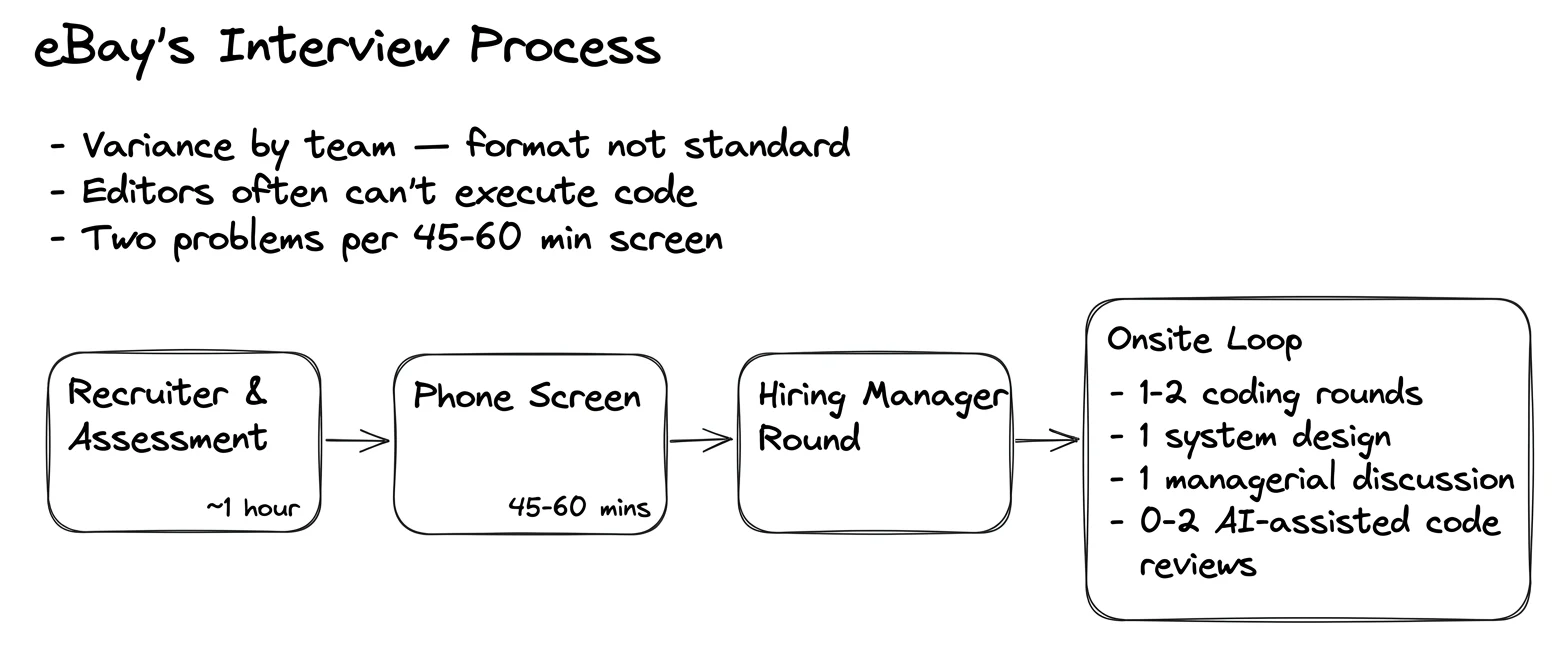
The process usually takes about a month. Early-career and cold applicants usually start with a timed online assessment, while experienced candidates go straight to one or two phone screens. Final loops run about four rounds, or up to six stages counting the phone rounds.
New-grad and SE-level loops are almost all algorithms. MTS 1 and MTS 2 loops add system design, a hiring-manager round and, in some 2026 loops, AI-assisted code review. One reported senior onsite was system design, two coding rounds and a managerial discussion.
Here's what the interview process can look like:
- Recruiter screen: A short call on background, level and location, and the only chance to pin down the language and round types.
- Online assessment (early career): Four timed coding tasks ending in a grid simulation.
- Technical phone screen (one or two): 45–60 minutes, usually two algorithm problems back to back, though some teams substitute design or infrastructure questions.
- Hiring manager and behavioral interview: Influence, scope and technical-depth stories, sometimes as a separate phone screen.
- Coding interviews: One or two onsite rounds at the screen's bar, often ending in a scalability discussion.
- System design interview (MTS and above): Prompts drawn from eBay's own operations, such as payment disputes and database migrations.
- AI-assisted code review (some recent loops): Critique supplied code for extensibility gaps and wrong data types.
Tip: Ask the recruiter in writing for the language, the editor and whether code can be run. Two reported failures began with a surprise in the first minute: a TypeScript-only requirement, and a promised new format that turned out to be a classic algorithm problem.
Online assessment
The assessment is four auto-graded tasks, typically on CodeSignal and typically 70–90 minutes. A December 2025 sitting had two easy warm-ups, a rearrangement task, and one long simulation. The tasks were counting uppercase and lowercase letters, rearranging numbers against two reference groups, bursting balloons on an n x n grid with fragments falling under gravity, and applying operations to a binary array to build a string.
Interviewers evaluate:
- Throughput: Clearing the warm-ups in minutes leaves time for the simulation.
- Simulation order: Applying the explosion and the settling phase in the right sequence without double-counting cells.
- Edge cases: Empty inputs, single-row grids, and operations that change nothing.
- Indexing: Hidden tests catch off-by-one errors in grid traversal.
Practice four-question timed sets that end in a multi-step grid simulation.
Sample questions for the online assessment
Here are some questions reported by recent candidates:
-
Count uppercase and lowercase letters across a list and report the difference.
-
Burst balloons on an n x n grid, let fragments fall under gravity, and return the final board.
-
Apply count and flip operations to a binary array and output the resulting string.
Technical phone screen
This is the stage with the most variance. The common version is a 45–60 minute shared-editor call with two problems: Two Sum then Sliding Window Maximum, or K smallest elements across sorted arrays then a single-pass rotated-array search. Interviewers want the brute force, the optimal solution, a dry run and the complexity. Follow-ups change one constraint. A balanced-subarray answer was followed by allowing one element to be modified, and a subtree count by adding a completeness requirement.
Other teams use the slot differently. One screen was an object-oriented bitmap block class (allocate a range, find a free bit, count holes) with a working main function. Another covered Redis and MySQL internals, Docker versus Kubernetes and versus virtual machines, finding one bug in a long listing, and a phone-number regex. A third had the candidate code ad-to-slot assignment in TypeScript and then design its API. A senior screen on top-K frequency turned into a review of the candidate's Java streams and map usage.
Interviewers evaluate:
- Pacing: Finishing both problems and the follow-up within the hour.
- Bug-free code: One candidate was rejected on a chess-horse problem whose leg-blocking rule had to be right for all eight jumps.
- Production quality: Idiomatic standard-library use and willingness to refactor a correct answer.
- Balance: One candidate did the API design well but was still rejected for slow coding in a rusty language.
Rehearse two mediums in 45 minutes without running code, hand-tracing one input each.
Note: Some screens use editors that cannot run code. With a bug-free bar, reading your own code line by line is part of the job.
Sample questions for the technical phone screen
Here are some questions reported by recent candidates:
-
Find the longest even-length subarray whose halves have equal sums, then allow one element to change first.
-
Find where a Chinese-chess horse can move on a board with obstacles when a blocked adjacent square cancels the jump.
-
Assign ads to browser positions with no duplicates and per-ad caps, update per-user state, then design the REST API.
-
Write a regex matching US phone numbers in the form 123-456-7890.
Hiring manager and behavioral interview
This round often comes early, sometimes as a hiring-manager phone screen, and some MTS loops add a second behavioral hour onsite. Questions cover influence and scope: changing a major decision, a project with organization-level impact, and the most complex system you have shipped. The manager presses on why you made each choice and what you would change. In one MTS 1 loop, the round was a discussion of the team's own recommendation system.
Interviewers evaluate:
- Influence: Named objections and how you resolved them, not just "I proposed and we agreed."
- Scope for the level: Cross-team impact for MTS 2, one-service ownership for MTS 1.
- Depth: Going two or three levels into the hardest project, including rejected options.
- Domain fluency: Discussing the team's problem space, such as recommendations, search or payments.
Prepare four or five quantified stories, each with what you would do differently.
Sample questions for the hiring manager and behavioral interview
Here are some questions reported by recent candidates:
-
Tell me about a time you influenced a big decision.
-
Describe your most technically complex project and why you made its key choices.
Coding interviews
Onsite coding is one or two hour-long rounds, sometimes with two problems each. Reported problems include course-schedule ordering, implementing a trie, an LRU cache, and validating integer, decimal and scientific-notation strings. Another was dictionary pattern matching, where one wildcard matches exactly one character and another matches one or more.
Interviewers evaluate:
- First-pass correctness: One MTS candidate was rejected because the number validator was not bug-free.
- Structure choice: A trie for prefix and pattern lookups, a hash map plus linked list for the cache.
- Edge cases: Signs, dots and e-notation markers in parsers, and cycles in dependency graphs.
- Scaling: Memory and latency once inputs outgrow one process.
Drill parsers with many legal forms until you can write them clean without running them.
Sample questions for the coding interviews
Here are some questions reported by recent candidates:
-
Decide whether courses can be completed given prerequisites, then implement a trie in the same round.
-
Validate whether a string is an integer, a decimal or a scientific-notation number.
-
Return dictionary words matching a two-wildcard pattern, then discuss scaling.
System design interview
Experienced candidates get one design round grounded in eBay's operations. Reported prompts include a customer dispute payment system and a migration of a live service from a relational database to DynamoDB. The migration round asked which indicators to monitor and followed with DevOps questions on rollout. API design (persistence, errors, schema, REST versus alternatives, HTTP methods, URL structure) can also appear inside a coding screen.
Interviewers evaluate:
- Data modeling: The states a dispute or listing moves through, and where the source of truth sits.
- Money correctness: Idempotency, double-write windows and reconciliation.
- Migration safety: Backfill, dual writes, read verification, cutover and rollback.
- Operations: Deployment, monitoring and alerting, not just a box diagram.
Prepare one payments design and one live-migration design end to end.
Tip: In the migration prompt, monitoring and rollback weighed as much as the architecture. Name the signals, such as row-count drift, read-mismatch rate and replication lag, and the threshold that triggers a rollback.
Sample questions for the system design interview
Here are some questions reported by recent candidates:
-
Design a system that handles customer payment disputes from filing to resolution.
-
Design a relational-to-DynamoDB migration and list the indicators you would monitor.
AI-assisted code review
This round appeared in a 2026 MTS loop, once as a phone screen and again onsite. The interviewer presents existing code and asks what is wrong with its design rather than whether it runs: missing extension points, misapplied patterns and unsuitable data types.
Interviewers evaluate:
- Design smells: Branching that should be polymorphic, and classes that cannot be extended without editing.
- Type choices: Floats for money, strings for enums, lists where a map fits.
- Prioritization: Leading with defects and blockers to change, not style nits.
- Concrete fixes: Naming the refactor and its trade-off.
Practice reviewing unfamiliar classes out loud and ranking what you would fix first.
Sample questions for the AI-assisted code review
Here are some questions reported by recent candidates:
- Identify design-pattern weaknesses that limit the extensibility of a provided module.
- Point out unsuitable data types in supplied code and propose replacements.
How eBay makes hiring decisions
The hiring team decides after reviewing all rounds, and in the reports one weak round was not offset by strong ones. Code is judged against the target level, which is often open between MTS 1 and MTS 2 and settled by design and behavioral scope. Outcomes are not purely about performance: one role was filled before a decision, and another candidate heard nothing after finishing every round.
Note: Silence after a full loop is common. Follow up once or twice, then keep other processes moving.
How to prepare for the eBay interview
- Confirm the format in writing: Language, editor, whether code runs, and round types. Keep TypeScript warm in case a team requires it.
- Code without a run button: Write mediums end to end and hand-trace one input, because the bar is bug-free.
- Budget for two problems: One sentence of brute force, then the optimal solution, with five minutes left for the follow-up.
- Drill rule-heavy simulations: Grid gravity, blocked chess moves and number parsers are where correctness slips.
- Refresh infrastructure basics: Redis, MySQL storage engines, and containers versus virtual machines.
- Prepare two marketplace designs: A payment-dispute flow and a relational-to-DynamoDB migration, each with monitoring and rollback.
- Rehearse code review: Critique unfamiliar code for extensibility and types, and refactor your own answers into idiomatic code.
About working at eBay
eBay engineers work on long-lived commerce systems (search, listings, payments, trust and ads), mostly in Java, with Scala and JavaScript in places. Since 2025 the company has shipped agent-based experiences, including an AI listing tool that builds a listing from photos and is the default for new US mobile sellers. Most engineering roles are hybrid, with in-office expectations set by team.
| Level | Primary focus | Impact scope |
|---|---|---|
| SE 1 / SE 2 | Well-defined features with guidance | Tasks within one team |
| SE 3 | Features and small services independently | A team's components |
| MTS 1 | Owning services end to end, leading projects | A team's systems |
| MTS 2 | Technical leadership across services | Several teams |
| Senior MTS / Principal MTS | Architecture and technical direction | A domain or organization |
eBay hires software engineers across its marketplace. Teams include:
- Search: Query understanding, ranking and low-latency retrieval.
- Payments and fintech: Managed payments, disputes and payouts.
- Trust and risk: Fraud detection on large data pipelines and ML models.
- Seller experience: Listing creation, pricing guidance and the AI listing agent.
- Advertising: Promoted listings and ad placement.
Experience and education requirements
Postings ask for a computer science degree or equivalent experience. MTS roles expect several years of backend work on large-scale, low-latency systems. Java is the most common requirement, with Scala, Python and TypeScript depending on the team, and distributed systems and cloud experience are preferred.
FAQs about the eBay interview
How long does the eBay interview process take?
Usually about a month; senior loops calibrating between MTS 1 and MTS 2 can run longer.
What is the hardest round of the eBay interview?
Most rejections in the reports came from coding, not design: a chess-horse problem, a number validator, and slow work in an unfamiliar language. The bug-free bar makes routine mediums unforgiving.
Is there an online assessment?
Yes, for many new-grad, intern and cold applicants; experienced candidates usually skip it.
What language should I use?
Most rounds let you choose, and Java is common. Some teams require JavaScript or TypeScript and say so only at the start of the call.
How much does an eBay software engineer make?
Posted US base pay for MTS 1 roles is about $119K to $206K depending on location. Total compensation adds a target bonus and restricted stock units vesting over four years.