Study
Which Dynamic Programming Questions Were Reported in 2026?
TrueInterview
October 18, 2026 · 14 min read
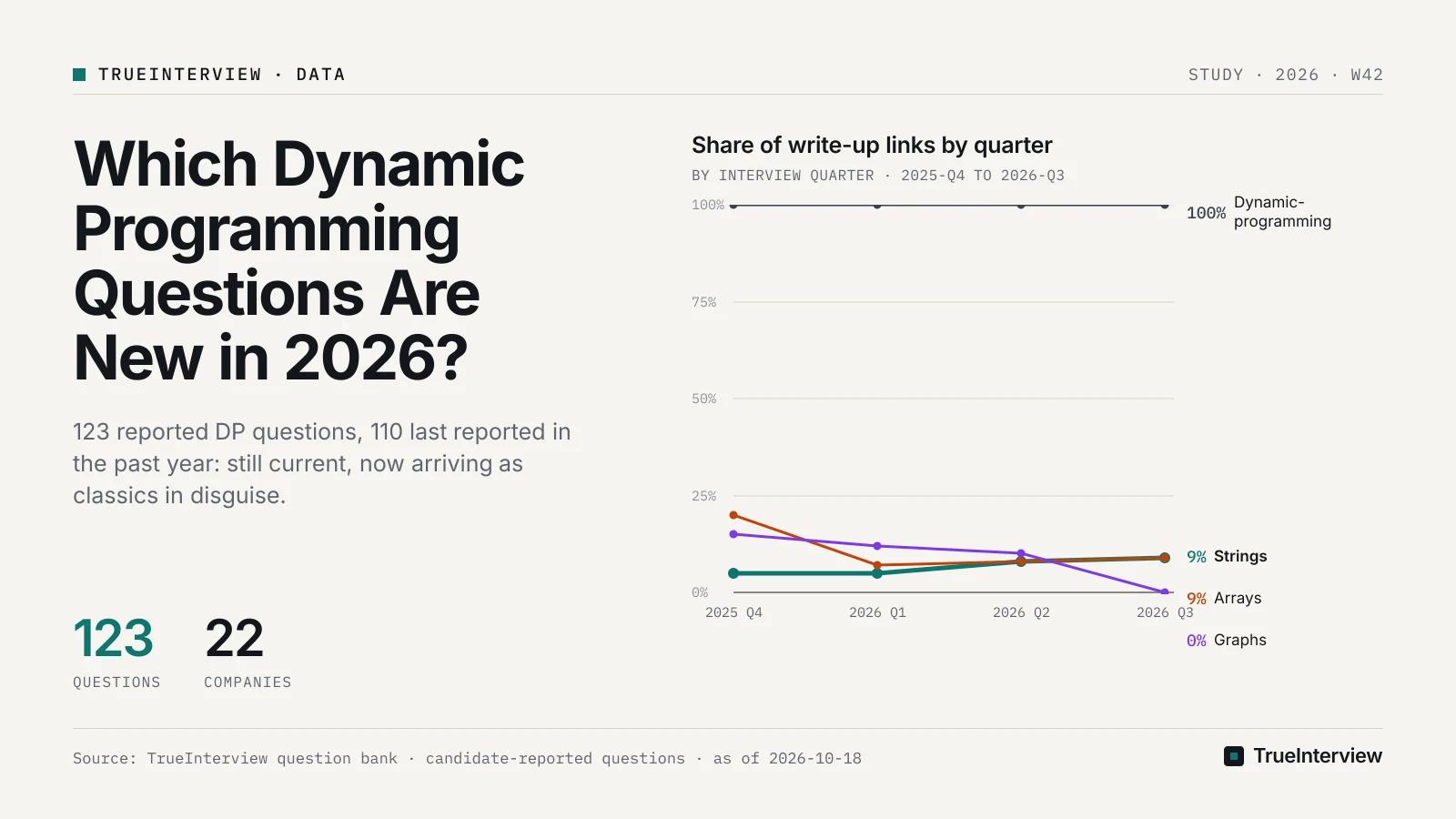
As of 2026-10-18, TrueInterview's bank holds 123 candidate-reported dynamic programming questions from 22 big-tech companies, and 110 of them were last reported within the past 12 months. That makes DP current, but candidate reports cannot tell you whether it is rising or falling, because quarterly link totals mostly track how many write-ups were collected. The reports do show that phone screens carry most of it, and recently reported questions include Uber's Jump Game Prime in an online assessment and ByteDance's House Robber (Large Inputs) in a phone screen. Read by their titles, many are classic recurrences behind new names and constraints. Train for spotting a known recurrence in disguise.
Disclosure: TrueInterview is an interview-preparation product and publishes this article. Facts about other products come from their public pages on the dates listed under Sources.
Is dynamic programming becoming more or less common in big tech interviews?
No honest dataset of candidate reports can answer that with a number, and ours is no exception. What it can say is that DP never went away: write-up links to these questions appear in every quarter we track, and the quarterly totals move with collection volume rather than with interviewer behaviour. Treat DP as a standing requirement for any big-tech coding loop instead of waiting for a trend signal.
| Interview quarter | Write-up links to DP questions | DP share of links | Strings co-tag share | Graphs co-tag share |
|---|---|---|---|---|
| 2025-Q4 | 20 | 100% | 5% | 15% |
| 2026-Q1 | 41 | 100% | 5% | 12% |
| 2026-Q2 | 40 | 100% | 8% | 10% |
| 2026-Q3 | 47 | 100% | 9% | 0% |
Two readings of this table are wrong. The jump from 20 to 47 links is mostly more write-ups being collected, so it is not evidence that DP is growing. The flat 100% share is a property of how the set was built: every question in it carries the DP tag. The co-tag columns are small numbers inside the DP set, a handful of links each quarter, so they describe which DP questions candidates wrote up, not how often companies ask DP.
Our take: the "is DP dying" debate is a distraction. Our data shows only that the topic keeps being reported, and that is enough to plan around. Spend the energy you would put into the debate on the variants below.
Which DP questions were reported recently?
Our bank records when each question was last reported, not when it first appeared, so read this as recent rather than brand new. By our reading of the titles, the recent reports are mostly familiar recurrences with a twist: a new name, a larger input, an extra dimension or a domain object. Uber's Jump Game Prime is linked from 8 write-ups, Amazon's Make Array Bitonic from 5 and Databricks' File Encryption Tree Optimization from 4.
| Question | Reported at | Round | Last reported | Base recurrence (our read of the title) | Practise |
|---|---|---|---|---|---|
| Jump Game Prime | Uber | OA | 2026-06 | Jump Game reachability over indices | Jump Game Prime |
| Make Array Bitonic | Amazon | OA | 2026-08 | Longest increasing subsequence from both ends | Make Array Bitonic |
| File Encryption Tree Optimization | Databricks | Phone screen | 2026-09 | State per tree node | File Encryption Tree Optimization |
| Count Same-Color Squares in Matrix | Onsite | 2026-09 | Square-ending-at-cell grid DP | Count Same-Color Squares | |
| Best Time to Buy and Sell Stock IV | Meta | Phone screen | 2026-08 | Stock trading with a transaction cap | Stock IV |
| Limit Tree Height by Deletions | Snowflake | Phone screen | 2026-07 | State per tree node | Limit Tree Height by Deletions |
| Fill Layover With Experiences | Airbnb | Phone screen | 2026-06 | Exact-fill knapsack | Fill Layover With Experiences |
| House Robber (Large Inputs) | ByteDance | Phone screen | 2026-05 | House Robber with tight memory | House Robber (Large Inputs) |
Read the last column as the point of the table. Jump Game Prime, by its title, likely uses the reachability recurrence where dp[i] says whether index i can be reached, with a restriction on which jumps count. Make Array Bitonic, by its title, likely builds on increasing runs from each end meeting at a peak; read the statement before you commit to a recurrence. House Robber (Large Inputs), by its title, likely keeps the two-variable recurrence and tests whether you drop the table when the input is large; it is linked from 3 write-ups at Meta and ByteDance. Trapping Rain Water, linked from 7 write-ups at Amazon and Meta, is the same story from an older vintage: left-maximum and right-maximum arrays, then a two-pointer refinement.
Two outside guides already point at this skill. Design Gurus' pattern guide says, "The skill being tested is recognizing the pattern, not remembering hundreds of solutions." PracHub's guide calls memorising individual LeetCode solutions "an anti-pattern" for DP preparation. Our data adds a different layer: which disguises candidates reported, at which company, in which month.
Our take: for every problem you practise, write one line before coding: the base pattern, the twist, and what the twist does to the state. That habit transfers to a question you have never seen; a longer list of classics does not.
Where do DP questions show up: OA, phone screen or onsite?
The phone screen carries most of the DP reports in our bank: 79 questions were reported there, against 39 onsite and 16 in online assessments, and a question can appear in more than one round. Prepare DP for the screen first, as a single timed problem where you state the recurrence quickly and code it cleanly in one pass.
The co-tags shift by round. Phone-screen DP questions most often add graphs (7), trees (5) and matrix (4). Onsite DP questions add strings (7), arrays (7) and matrix (5). OA questions are fewer and lean on strings, with 4 of 16 carrying that tag. Read that as a hint, not a rule: graph and tree co-tags rank high among screen questions, while string and array co-tags rank high onsite.
PracHub's guide gives the right order of work for a timed screen: "In an interview, start with the recursive relation." Once the recurrence is right, choosing memoisation or a table is a translation step, so spend your practice minutes on the recurrence, not on the loop syntax.
Which companies report the most DP questions?
Google has the most reported DP questions in the bank with 18, but Amazon (16), Uber, ByteDance, Meta and Snowflake (12 each), Microsoft (11), Salesforce (10), Airbnb (8) and Apple (7) follow. DP is a cross-company requirement, so do not cut it because your target is not Google.
Tech Interview Handbook's DP page says Google is among the companies "famous for asking Dynamic Programming questions". The counts support Google at the top, not Google alone. The secondary tags differ a little: Google's DP questions most often add arrays (4 of 18), while Amazon's add arrays and strings (3 each of 16). These counts describe what candidates reported and filed, not how often any company asks DP, and none of them is an official company question list.
Worked example: how do you get from Best Time to Buy and Sell Stock to Stock IV?
Name the base pattern, then name the dimension the twist adds. The plain Best Time to Buy and Sell Stock was reported in an Oracle OA in 2026-08 and is linked from 3 write-ups by senior-or-above candidates. Its harder sibling, Best Time to Buy and Sell Stock IV, is filed under Meta, Amazon, Apple, Lyft and Microsoft.
Stock IV is linked from 3 candidate write-ups, 2 of them by senior-or-above candidates. The base problem keeps one running minimum and one best profit. The variant caps you at k transactions, so the state gains a dimension: for each day, the best profit with j transactions used, split by whether you hold a share. Written that way, the recurrence comes straight from the base, and you do not need to have seen the variant before.
Then size it before you code. CP-Algorithms describes the usual estimate as work per subproblem times the number of subproblems, introduced with the line "The layman's way of analyzing the runtime of a memoized recursive function is:". For Stock IV that gives days times k times two holding states, which, in our view, is the number to be ready to defend and then reduce.
Why do tree-shaped DP questions belong in your plan?
Several recent reports look like DP over a tree or a domain object rather than over an array or string. File Encryption Tree Optimization (Databricks, phone screen, 2026-09) is linked from 4 write-ups, 3 of them by senior-or-above candidates. Snowflake's Limit Tree Height by Deletions appeared in a 2026-07 phone screen.
Design Gurus' six-pattern list does not cover this shape. That guide lists six patterns, Fibonacci-style, 0/1 knapsack, unbounded knapsack, longest common subsequence, palindromic subsequence and longest increasing subsequence, and every one runs over a sequence. This is our reading of a few titles, not a counted category, so do not over-weight it. Still, a plan built only on sequence patterns leaves you unrehearsed for keeping a state per node and combining the children, which is the move both tree questions need.
How do the six core patterns map to reported questions?
Five of the six standard patterns have a reported question you can practise instead of a textbook stand-in; palindromic subsequence does not, and two reported questions sit outside all six. Use the table to swap generic examples for reported ones.
| Pattern (Design Gurus' list) | Reported question that fits (our read) | Filed under | Practise |
|---|---|---|---|
| Fibonacci-style | House Robber Series | Databricks, Amazon, Meta | House Robber Series |
| 0/1 knapsack | Fill Layover With Experiences | Airbnb | Fill Layover |
| Unbounded knapsack | Word Break | 3 big-tech companies | Word Break |
| Longest common subsequence | Wildcard / Regex String Matching | Not split by company here | Two-sequence table, same indexing traps |
| Longest increasing subsequence | Finding the Longest Increasing Subsequence | 3 big-tech companies | Longest Increasing Subsequence |
| Outside the six: grid | Maximal Square and Rectangle in Binary Matrix | Databricks, Salesforce, Uber | Maximal Square and Rectangle |
| Outside the six: weighted intervals | Maximum Profit in Job Scheduling | Snowflake, Airbnb, Google, Pinterest | Job Scheduling |
Palindromic subsequence is the one pattern without a match among the questions we cite here, so learn it from a standard problem and move on. PracHub's guide lists Longest Common Subsequence, Edit Distance and Minimum Insertions to Form a Palindrome as its classic two-sequence problems, which covers both string patterns in one sitting. Job Scheduling deserves the extra hour: it combines sorting, binary search and a DP over intervals, a composite that none of the six patterns describes on its own.
Which implementation mistakes should you drill out?
Design Gurus' guide names a usual mistake for each pattern, and in our view each one is a habit you can drill out before the interview. For Fibonacci-style problems, that guide names confusing sum and maximum, and advises stating the operation before writing the loop.
- Knapsack direction. Design Gurus' guide says the unbounded knapsack inner loop runs forward because items repeat, the opposite of 0/1 knapsack.
- Coin Change II order. Design Gurus' guide calls loop order in Coin Change II the usual mistake. The same guide says, "The first counts combinations and the second counts ordered sequences." Per that guide, coins outside and amounts inside counts combinations, so read the wording before you pick the order.
- Two-sequence indexing. For Longest Common Subsequence, Design Gurus' guide calls the off-by-one between the string index and the table index the usual mistake.
- Memo container. CP-Algorithms says hash-table or tree-map memoisation will almost always be slower than an array-based version.
- Space. Tech Interview Handbook says the last two values or the last two rows of the table often suffice, which, in our reading, is the point of House Robber (Large Inputs).
Before you code, say aloud three things: the operation (sum or max), the loop order, and what dp[i] means for index i. Then check them on a tiny example. That ritual costs a minute and targets each bug listed above.
What changes at senior and staff level?
Senior candidates still meet DP. Write-ups from candidates who reported a senior, staff-plus or manager level link these questions 61 times, against 100 from junior, new-grad or intern candidates. Levels are self-reported on the write-ups. Skipping DP because you are interviewing at senior level is a bet the reports do not support.
The counts per question are small, two to four links each, so treat any shift as tentative. Several senior-leaning links go to variants with a twist: File Encryption Tree Optimization (3 senior, 1 junior), Maximum Profit in Job Scheduling (2 of 3) and Wildcard / Regex String Matching (2 senior). Staff-plus or manager write-ups link Trapping Rain Water and Maximum Subarray Sum After K Concatenations. Plain Maximum Subarray has 0 senior-or-above links among its 5, but the counter-examples matter: the plain Best Time to Buy and Sell Stock is linked only by senior-or-above candidates, and Trapping Rain Water has 3 senior-or-above links, 1 of them staff-plus or manager. By co-tag, matrix (6 senior vs 4 junior) and stack (5 vs 4) lean senior, while trees (4 vs 10) and greedy (2 vs 6) lean junior.
DP is not only a software engineer topic either. Links come from Software Engineer (143), Machine Learning Engineer (10), Quantitative Researcher (3), Frontend and Backend Engineer (2 each) and Data Scientist (1) candidates. MLE candidates account for some of these links, so DP does appear in MLE coding rounds; do not drop it because the rest of your loop is about models.
Our take: at senior level the bar moves from knowing the pattern to handling the constraint change cleanly and explaining the trade-off, such as when to drop the table for two variables. PracHub's guide describes readiness the same way: "You can explain your approach clearly, recover from hints, and name tradeoffs without relying on memorized wording."
Down-leveling note (our view): a DP question rarely decides your level on its own. The level signal usually sits in system design depth, the project deep dive and behavioral scope. A slow or messy DP screen, however, can end the loop before those rounds happen, so treat it as a gate to clear cleanly rather than a place to show range.
What should you practise, depending on your first round?
Match your DP time to the round that comes first. Jump Game Prime and Make Array Bitonic, both linked from several write-ups, were reported in Uber and Amazon online assessments. Phone screens carry the bulk of reports, and onsites add string and array co-tags. The table turns that into a practice order.
| Your first round | What the reports show | What to practise | Start with |
|---|---|---|---|
| Online assessment | Uber and Amazon OA reports, strings as the main co-tag | Fast, test-passing solutions to named variants | Jump Game Prime, Make Array Bitonic |
| Phone screen | Most reported DP rounds; Apple reported Trapping Rain Water there in 2026-06 | One timed problem with the recurrence spoken first | Trapping Rain Water, House Robber (Large Inputs) |
| Onsite | Fewer DP reports; strings, arrays and matrix as co-tags | Our view: DP inside string, array and matrix problems | Count Same-Color Squares |
CP-Algorithms puts it plainly: "Of course, the most important trick is to practice." No amount of pattern study guarantees a pass, but a known recurrence, rehearsed under time, is the part you control.
How we counted
We counted the dynamic programming questions in TrueInterview's bank as of 2026-10-18, by company, reported round, last-reported month and the candidate write-ups that link to them. Levels and roles come from what candidates reported on their write-ups. A question can be filed under several companies and reported in several rounds, so round counts do not add up to the total, and link totals reflect how many write-ups were collected, which is why we compare shares across quarters.
FAQ
Should I learn memoization or tabulation first?
Start with memoisation, because it follows directly from the recursive relation. CP-Algorithms describes writing the recursive solution and saving repeated states in a lookup table as top-down dynamic programming with memoisation. The same site describes bottom-up as starting from the base cases and extending to larger values. Learn to convert one into the other on the same problem; in our view, the table version is where the space discussion starts.
Which DP questions does Google ask?
Google has the most reported DP questions in our bank, and its set most often adds arrays and matrix tags. Count Same-Color Squares in Matrix is a recent Google onsite example, so practise grid DP alongside the sequence patterns. These are candidate-reported questions reconstructed for practice, not Google's own list, so use them to rehearse patterns rather than to predict your exact question.
Are DP questions only asked of new grads?
No. Senior-or-above candidates account for a large share of the write-up links, as the senior section above shows, and staff-plus write-ups appear too. The difference is emphasis: senior-leaning links go to variants with an added constraint or dimension, so practise explaining why your state is the right one and how you would cut its memory, not only reaching a correct answer.
Where can I find DP interview questions with answers?
GeeksforGeeks' DP interview list was last updated in February 2026. TrueInterview's practice question bank holds the reported questions cited in this article, filed by company and by the round candidates reported. Use a classic list to learn a pattern, then switch to reported variants such as Jump Game Prime to test whether you recognise the recurrence without being told.
What are the core DP patterns to learn?
Start with the six sequence patterns in the table above: Fibonacci-style, the two knapsack forms, longest common subsequence, palindromic subsequence and longest increasing subsequence. Add grid DP, weighted intervals and tree DP, which recent reports include and Design Gurus' six-pattern list leaves out. Tech Interview Handbook says recognising that a problem can be solved by DP takes practice, so drill recognition rather than collecting more problems.
Your practice plan
A three-week plan for someone working full time, about an hour on weekdays:
- Week one, first two evenings. Solve House Robber Series and House Robber (Large Inputs), and finish each by replacing the table with two variables.
- Week one, rest of the week. Do three timed phone-screen sessions on Trapping Rain Water, Jump Game Prime and Make Array Bitonic. Say the recurrence aloud before typing.
- Week two, first half. Work the base-and-twist pair: Best Time to Buy and Sell Stock, then Stock IV. Write the added state dimension on paper first.
- Week two, second half. Cover knapsack direction and two-sequence indexing with Word Break and Fill Layover With Experiences, checking loop order against a tiny example each time.
- Week three, first half. Add the shapes outside the six patterns: File Encryption Tree Optimization, Limit Tree Height by Deletions and Maximal Square and Rectangle in Binary Matrix.
- Week three, second half. Finish with Maximum Profit in Job Scheduling, then redo the two problems you found hardest under time, explaining the trade-offs aloud as you would to a senior interviewer.
Sources
- TrueInterview question bank — dynamic programming at big-tech companies — counted 2026-10-18
- Dynamic Programming Patterns for Coding Interviews: The Complete Guide — checked 2026-10-18
- Top 5 Dynamic Programming Patterns to Master for FAANG Interviews | PracHub Knowledge Hub — checked 2026-10-18
- Dynamic programming cheatsheet for coding interviews | Tech Interview Handbook — checked 2026-10-18
- Introduction to Dynamic Programming - Algorithms for Competitive Programming — checked 2026-10-18
- Dynamic Programming Interview Questions - GeeksforGeeks — checked 2026-10-18
Last reviewed: 2026-10-18.