DoorDash · Study
DoorDash Software Engineer Interview Process
TrueInterview
July 24, 2026 · 14 min read
DoorDash tests practical engineering, not puzzle solving. The screen is a "Code Craft" problem, usually Dasher pay or an API that aggregates three services, and it must run. The onsite adds rounds few companies use: debugging someone else's delivery code, a system design that opens with a 25-minute defense of your own past architecture, and an AI Code Craft round where using an AI coding agent is required. The question bank is small and repeats, so most rejected candidates knew the problem and lost on the clock, on concurrency follow-ups, or in the values round.
This guide breaks down each stage of the DoorDash Software Engineer interview, what interviewers evaluate in each round, and how to prepare, with questions candidates were actually asked.
Verified: Based on 61 candidate-reported interview experiences, primarily from 2025 Q4 through 2026 Q3, cross-checked against recent public accounts.
DoorDash Software Engineer interview process
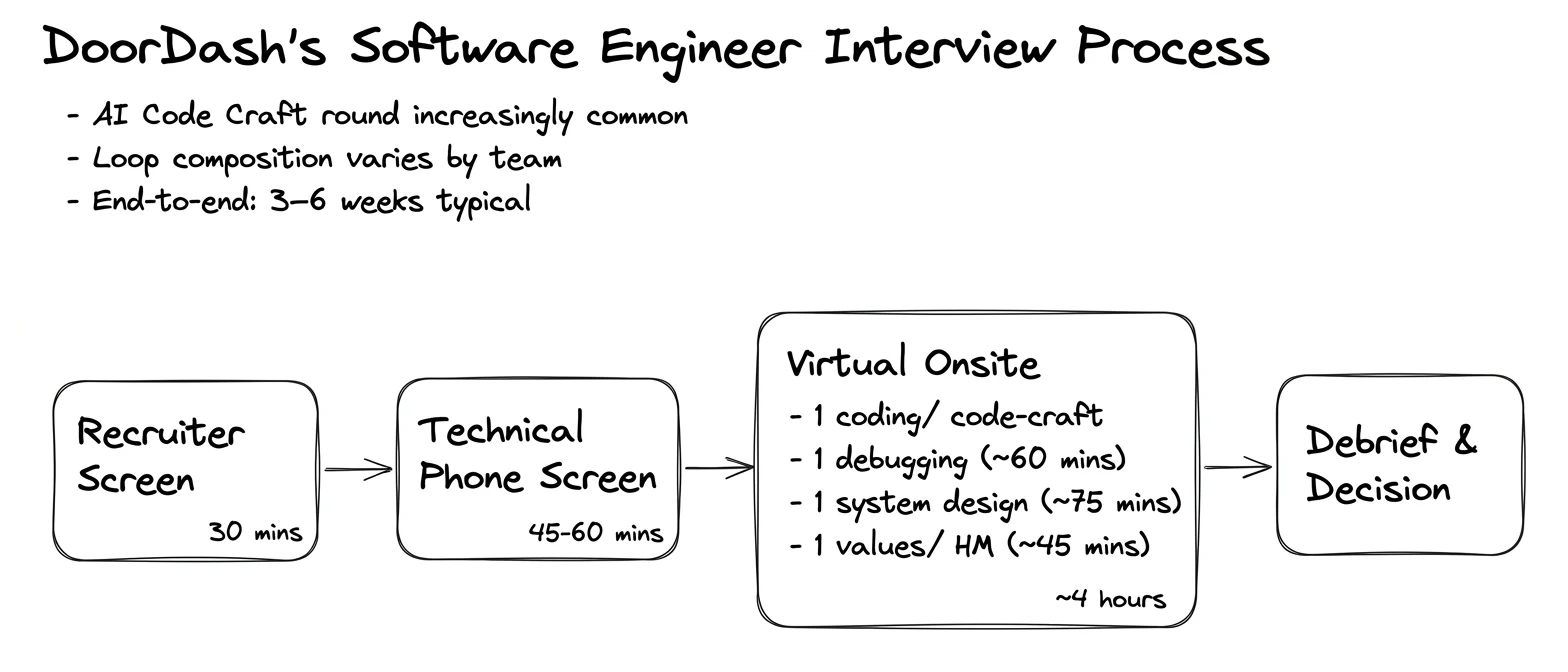
Recruiters hire by team, but onsite interviewers often come from other teams. The 2026 loop is fairly standard: a recruiter call, one Code Craft screen, then a virtual onsite of four rounds (sometimes three or five), taken in one day or split over two. Most processes take three to eight weeks.
Senior and staff candidates often get an extra project deep-dive screen, sometimes with a director, and some pipelines require a second coding screen even after the first is passed. Some teams still run a classic algorithm round or an operations-incident round. Frontend-leaning loops swap in UI coding but keep a backend system design.
Here's what the interview process can look like:
- Recruiter screen: A short call on background, your area of the marketplace and why DoorDash.
- Code Craft phone screen (45 to 60 minutes): One business-logic problem coded to a running state, then production follow-ups.
- Onsite coding round (some loops): Delivery-framed algorithm problems with layered follow-ups.
- Debugging interview (about 60 minutes): Fix planted bugs in a dispatcher or Dasher picker, then handle concurrency and consistent hashing.
- System design interview (about 75 minutes): About 25 minutes on a past project, then a payments, reviews or alerting design.
- AI Code Craft interview: Build a small workflow system with an AI coding agent in your own IDE.
- Hiring manager and engineering values interview: Behavioral depth, AI usage and an operational scenario.
Tip: Every technical round is scored on finishing. Agree on rules and input format in the first five minutes, get the core path running, then spend the remaining time on edge cases. One candidate who reached a working cart happy path with two minutes left expected a rejection.
Recruiter screen
The call is brief: current scope, which part of the three-sided marketplace you have built for (payments, logistics, merchant or consumer systems), target level and round names. Recruiter turnover is common: one went silent for three weeks and left the company, delaying the onsite by about a month.
Interviewers look for:
- Marketplace relevance: A one-line summary of systems you owned that maps onto pay, dispatch, orders or merchants.
- Motivation: A specific reason for DoorDash and for leaving now, which the hiring manager asks again.
- Level fit: Tenure is weighed openly; a candidate with under three years of experience was told it would count against them.
- Communication: A crisp account of your role, not your team's.
Ask which onsite rounds your team uses and in which rounds AI tools are allowed.
Sample questions for the recruiter screen
Here are some questions reported by recent candidates:
-
Why DoorDash, and why change roles now?
-
Walk through your current scope and the systems you own.
Code Craft phone screen
One engineer runs a 45-to-60-minute live session in a browser environment that executes code, sometimes with a silent shadow. Some versions start from a blank file (in Java, you write your own Main and print results); others supply boilerplate and mock services.
Dasher pay dominates: per-minute pay from accept to drop-off with partial minutes rounded up, a rate multiplied by concurrent orders (a sweep line), double pay in peak windows, partial pay for cancellations, excluding restaurant wait time, or merging duplicate activity IDs. Timestamps like 2026-3-16 12:00 trip up candidates rusty with their date library. The other staple is a bootstrap API: resolve a user to a consumer ID, then call payment and address services. A failed user lookup may return HTTP 500, but payment or address failures must still return the remaining fields. Rarer prompts include cart promotions, a path-based key-value store and five-minute interval codes. The last 10 to 20 minutes become design on the same problem: a double-tapped pay button, Redis versus a relational store, a slow upstream against an SLA, retries with jitter, dead-letter queues, and fail-open versus fail-closed.
Interviewers evaluate:
- Requirement negotiation: Whether overlapping orders pay once or twice, whether discounts touch shipping, what a failed call returns.
- Running code: Passing provided tests plus your own edge cases, such as empty input or delivery before acceptance.
- Failure semantics: Checking status codes rather than only catching exceptions, and testing each upstream failure separately.
- Production depth: Idempotency keys with a TTL, timeouts and circuit breakers explained as mechanisms.
Code two or three Dasher pay variants and the bootstrap API end to end against a 45-minute timer.
Note: The interviewer's rules are the spec. One candidate argued overlapping orders should be paid once after the interviewer said each order is paid in full, and was rejected. Confirm the rule early, then implement it as given.
Sample questions for the Code Craft phone screen
Here are some questions reported by recent candidates:
-
Compute shift pay when the per-minute rate scales with active orders, then exclude restaurant wait time and double the rate from 5 to 7 PM.
-
Aggregate consumer, payment and address services into one response that keeps every field it can when a service returns 500.
-
Apply the best of several percentage and fixed promotions to a cart, never discounting shipping by percentage and never going below zero.
-
Convert "Mon 10:00 AM - 11:00 AM" into five-digit codes for each five-minute slot, handling noon, midnight and day rollover.
Onsite coding round
Not every loop has one: several 2026 onsites had none, while one had three. Problems are medium and delivery-framed, with follow-ups that change constraints. Examples: assigning chefs to dishes for maximum profit, then letting chefs pool skill, which turns greedy into grouping; the slowest rider speed that finishes all orders in H hours; and the first restaurant ID seen exactly once in an order stream.
Interviewers evaluate:
- Unwrapping the scenario: Spotting binary search on the answer, a map plus linked list, or counters instead of a stack before coding.
- Adaptability: Multiple riders, returning deletion indices, or a profit function in place of a list.
- Memory and concurrency: Whether a map grows without bound and what breaks under concurrent
addcalls. - Time management: One candidate finished only part one after losing time to environment setup and parsing.
Drill medium problems wrapped in delivery stories and practice extending your own solution twice per session.
Sample questions for the onsite coding round
Here are some questions reported by recent candidates:
-
Maximize kitchen profit when each chef cooks one dish no harder than their skill, then allow chefs to combine skill.
-
Find the minimum hourly speed that lets a rider finish all orders in H hours, then discuss multiple riders.
Debugging interview
About an hour on a component with planted bugs, sometimes framed as a pull request review. One family is a round-robin dispatcher or load balancer followed by consistent hashing. The other is a random Dasher picker that keeps Dashers under contiguous integer keys and removes one by moving the last element into the gap, without breaking its time complexity. Reported defects include a missing constructor, a one-letter string typo, an off-by-one between map size and array length, and a random index that is already the last element.
After the logic fixes, recent interviewers expect thread safety: where synchronized belongs, method versus block, and why calling a remote recording service inside the lock can freeze the object when that service times out. Consistent hashing often shrinks to pseudocode for adding and finding a node.
Interviewers evaluate:
- Diagnostic method: Reproducing each defect with a test and explaining its root cause before a minimal fix, not a rewrite.
- Boundary cases: Last index, single element and empty structure, each with its own test.
- Concurrency judgment: Correct lock scope and slow I/O kept out of critical sections.
- Pace: Both parts must fit the hour; when an interviewer arrived 10 minutes late, the candidate only sketched the hash ring.
Implement a round-robin router, an O(1)-removal random picker and a minimal hash ring from memory, then break each and find the bug.
Note: Knowing the problem is not enough. Candidates who had studied the picker still stalled on removing at size versus size minus one, and one spent ten minutes on the last-element case and was rejected.
Sample questions for the debugging interview
Here are some questions reported by recent candidates:
-
Fix a delivery assignment service that randomly picks and removes a Dasher without adding a full scan, then review it as a pull request.
-
Find why a round-robin dispatcher skips a Dasher or assigns two orders in a row to one, then implement consistent hashing.
-
Debugging a Load Balancer Implementation and Add Round-Robin Routing
System design interview
About 75 minutes. The first 25 or so are a diagrammed walkthrough of a resume project, with pointed questions on what you personally owned and what you would rebuild; the remaining 50 cover one prompt. Write functional and non-functional requirements down before drawing.
The best-known prompt is a donation app for a three-day charity weekend: millions of donations, about $100M for ten charities, a third-party payment API that simply returns 201, and funds pooled for manual payout. The goal is to capture every dollar despite provider failures. The other staple is dish reviews: one restaurant, 0-to-5 ratings, one review per user per dish, toggleable votes, about 10,000 reviews and millions of votes a day. Follow-ups hit Redis counters, eviction before counts persist, and rewarding highly voted reviews. Others include alert notifications, a job scheduler and a real-time restaurant leaderboard.
Interviewers evaluate:
- Payment correctness: Idempotency keys, exactly-once effects over at-least-once delivery, reconciliation, and proving totals to finance.
- Schema justification: Every table defended, such as separating reviews from votes and enforcing one vote per user and review.
- Mechanism depth: Exactly how a retry queue or cache-database sync works, not just its name.
- Holding a position: Interviewers play a skeptical challenger and often answer questions with "you decide."
Prepare the donation and review designs end to end, and rehearse a 20-minute diagrammed walkthrough of your strongest distributed-systems project.
Tip: Pick the deep-dive project for technical depth, not organizational scope. A candidate who presented a migration centered on cross-team coordination was grilled on partitions, consistency and rollback and believed the mismatch cost the offer.
Sample questions for the system design interview
Here are some questions reported by recent candidates:
-
Design the backend for a three-day donation app that must capture an expected $100M through a simple third-party payment API.
-
Design dish reviews with average ratings and votes, then explain what happens if Redis evicts counts before they reach the database.
AI Code Craft interview
This newer round appears in a majority of recent onsites. Candidates share their screen and work in a local IDE with an AI assistant or command-line agent; other live rounds forbid AI unless the interviewer invites it. The common task is a refund workflow defined as a directed acyclic graph: check an order-status API and refund late orders. Follow-ups add partial-refund and cancel nodes, repeated API calls and user-visible latency. One version had no starter code and required separate services on their own ports calling each other over HTTP, demonstrated with curl.
Interviewers evaluate:
- A running system: End-to-end behavior outweighs clean abstractions or test volume.
- Scoping: Defining "late" and node dependencies, and stating a plan before prompting.
- Controlled AI use: Narrow prompts, reviewed diffs, each change confirmed with the interviewer and tested.
- Velocity: Interviewers push for speed; candidates who read the whole codebase first felt rushed.
Rehearse the refund workflow with your own AI tool, including two services on separate ports, until it runs in under 45 minutes.
Note: The costliest mistake was assuming in-memory classes would do. One interviewer wanted genuinely separate HTTP services, and the candidate's last-minute rewrite could not be reviewed. Ask early whether services must be real processes.
Sample questions for the AI Code Craft interview
Here are some questions reported by recent candidates:
-
Build an order-status service, a refund service and a workflow engine that refunds late orders, and show a refund firing live.
-
Extend a DAG workflow engine with partial-refund and cancel nodes, then reduce latency when the workflow is slow.
-
Build an Order-Exception Microservice with Explicit Refund Policies
Hiring manager and engineering values interview
Usually the hiring manager, sometimes billed as engineering values, and fast: one asked six or seven questions, another two or three with deep probes. Topics lean negative (a conflict, your biggest mistake, feedback received, a project to redo) plus a proud project told in business terms. AI usage comes up in most loops: share of code generated, which models and why, token budgets.
Many loops add an operational scenario: a spike in misdelivered orders across thousands of deliveries, a merchant price error that left Dashers' cards declined while support lines flooded, or a payment outage. These are graded on triage order, investigating at scale and stakeholder communication, not the code fix.
Interviewers evaluate:
- Ownership: Self-started work, and who owned migration health when an alert never fired.
- Self-awareness: A real mistake plus the guardrail added afterward; unprompted complaints about past teams cost points.
- Concision: One to two minutes per story before the result.
- Engagement: Four or five specific questions for the interviewer.
Prepare six stories (conflict, failure, feedback, an AI-assisted project, a self-started project, an incident), each with a metric.
Sample questions for the hiring manager and engineering values interview
Here are some questions reported by recent candidates:
-
Support reports misdelivered orders across thousands of deliveries; how do you find the cause without reviewing each one?
-
How much of your code is AI-generated, and which models do you use?
-
Investigate a Surge of Incorrect-Delivery Complaints at Scale
-
Explain AI Tool Use, Model Selection, and Engineering Validation
-
Own Production Incidents and Validate Large Pipeline Migrations
How DoorDash levels and evaluates Software Engineer candidates
Interviewers submit independent feedback, and the hiring manager and a debrief decide. Candidates have cleared most technical rounds and still been rejected on values or one stalled debugging case, usually without explanation. The target level is set at the recruiter stage; senior and staff candidates face more project deep dives, and short tenure has counted against mid-level candidates. Decisions usually arrive within two to three business days of the onsite, occasionally two weeks. Hiring pauses have ended loops that seemed to be going well. DoorDash publishes no reapplication waiting period, so ask the recruiter.
Tip: Treat every round as a gate. In the reports, strong design never offset a messy debugging round.
How to prepare for the DoorDash Software Engineer interview
- Master the recurring Code Craft problems: Dasher pay with concurrency, peak and cancellation rules, and the three-service bootstrap API, to running code with your own tests.
- Practice date-time parsing in your language: Timestamp handling has sunk otherwise correct pay solutions.
- Rebuild the debugging components, then add threads: A random picker, a round-robin router and a hash ring, with lock placement and slow-I/O questions.
- Run the refund workflow with your own AI tool: Plan, prompt narrowly, review each diff and run real services on separate ports.
- Prepare two payment-grade designs: The donation app and dish reviews with votes, covering idempotency, reconciliation and cache consistency.
- Rehearse a 20-minute project deep dive: A technically deep project, with exactly what you owned.
- Bring failure stories and an AI-usage story: Mistakes and incidents with the fix you added, plus how you validate AI output.
About the DoorDash Software Engineer role
DoorDash engineers build the logistics platform behind a marketplace of consumers, merchants and Dashers handling millions of orders a day. Backend engineers own services such as order routing, dispatch, Dasher pay, merchant payouts, subscriptions and search, with on-call duty where an incident means late food or a wrong payout.
| Level | Primary focus | Impact scope |
|---|---|---|
| E3 (Software Engineer, entry) | Well-scoped features with guidance | Components of one team's service |
| E4 (Software Engineer) | Features and services end to end, including on-call | A team's services |
| E5 (Senior Software Engineer) | Leading projects, design reviews and mentoring | A team's roadmap and adjacent services |
| E6 (Staff Software Engineer) | Cross-functional projects and technical roadmaps | Several teams or a platform |
DoorDash hires Software Engineers across the marketplace. Teams include:
- Logistics and dispatch: Assignment, ETAs, last-mile delivery and Dasher-facing systems.
- Dasher pay and money movement: Earnings calculation, payouts and payment reliability.
- Order platform: The order service that routes, schedules and tracks every order.
- Merchant platform: Menus, onboarding, integrations and merchant finance.
- DashPass and consumer growth: Subscription lifecycle, billing, benefits and promotions.
- Search, ads and infrastructure: Discovery, ranking, advertising and shared platform services.
Software Engineer experience and education requirements
Postings ask for a computer science degree or equivalent experience. Senior postings ask for several years of industry experience (five or more on some teams); staff backend postings ask for eight or more plus cross-functional project leadership and mentoring. Any mainstream language works; Java and Python dominate reports, and Java users note that mapping-heavy Code Craft tasks punish boilerplate.
FAQs about the DoorDash Software Engineer interview
How long does the DoorDash Software Engineer interview process take?
Usually three to eight weeks; a recruiter change stretched one to about two months. Screen results take about a week; onsite decisions often come within three business days.
What is the hardest round of the DoorDash Software Engineer interview?
Most name the 75-minute system design, where the resume deep dive and an adversarial payment discussion leave little slack. Debugging surprised the most strong candidates because it now tests concurrency as well as logic.
Can you use AI tools during the interview?
Only when invited. The AI Code Craft round requires an assistant in your own IDE; other live rounds forbid AI unless the interviewer allows it.
How much does a DoorDash Software Engineer make?
Approximate total annual compensation in the United States:
- E3: ~$180K
- E4: ~$280K
- E5: ~$385K
- E6: ~$530K
Packages combine base salary with a large stock component vesting over four years, so totals move with the share price, especially at E5 and above.