DoorDash · Study
DoorDash Machine Learning Engineer Interview Process
TrueInterview
July 24, 2026 · 11 min read
DoorDash interviews Machine Learning Engineers across algorithm coding, ML system design and marketplace reasoning, and rejections often come from the rounds with no modeling in them: a refund policy built as a decision tree, a case on why customers get the wrong meal, or a grid-aggregation problem that fills the whole coding round. Level is decided early, too. A one-hour deep dive on a single past project can down-level a senior applicant before the onsite is booked.
This guide breaks down each stage of the DoorDash Machine Learning Engineer interview, what interviewers evaluate in each round, and how to prepare, with questions candidates were actually asked.
Verified: Based on 11 candidate-reported interview experiences, primarily from 2025 Q4 through 2026 Q3, cross-checked against recent public accounts.
DoorDash Machine Learning Engineer interview process
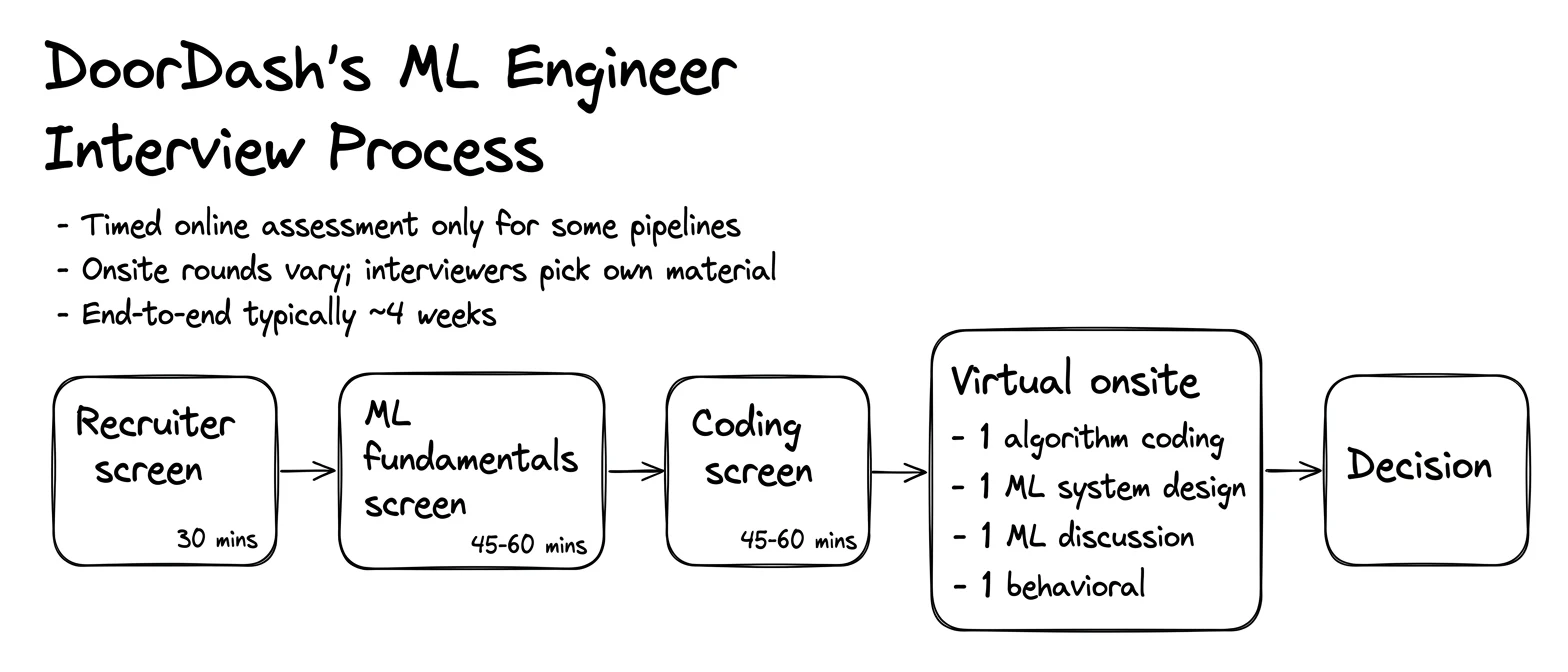
The loop depends on the team, and interviewers choose their own questions, so two candidates rarely see the same set. Most processes have one to four phone-stage rounds and a virtual onsite of four to five back-to-back rounds, over three to six weeks.
Analytics-leaning and early-career pipelines add a timed SQL-and-Python assessment. Senior loops get deeper project questioning and sometimes two design rounds, one product-facing and one on training and serving infrastructure.
Here's what the interview process can look like:
- Recruiter screen: About 30 minutes on background, the modeling areas you have shipped in, and a provisional level.
- Project deep-dive screen: 60 minutes on one past project, from problem framing to production metrics.
- Coding interviews (one screen, one onsite): 45 to 60 minutes of medium algorithms in a shared editor.
- ML system design interview (one or two): A recommender end to end, or the training and inference platform behind it.
- ML domain and experimentation interview: A no-code discussion of delivery time, multi-objective ranking, promotion uplift or A/B testing.
- Behavioral and marketplace-scenario interview: Conflict and failure stories, often paired with an order-failure case.
Recruiter screen
The call typically runs about 30 minutes on scope, motivation, and the business area you have modeled for: ranking, delivery time and dispatch, consumer growth, or ML infrastructure. The level set here is provisional. In one senior process the recruiter supplied materials for a presentation, the single interview centered on it, and a rejection with no feedback arrived the next day.
Interviewers evaluate:
- Area match: Whether your shipped models map to a team that is hiring, which shapes your design and domain rounds.
- Scope at the claimed level: Owning a model end to end rather than contributing features to someone else's pipeline.
- Motivation: A concrete interest in logistics and marketplace problems, not ML in general.
Prepare a two-minute summary of each shipped model with its business metric, and confirm the role is still open before building custom presentation material.
Sample questions for the recruiter screen
Here are some questions reported by recent candidates:
-
Why DoorDash, and why are you leaving your current role?
Project deep-dive screen
This is the most consistently reported screen. It runs 60 minutes with almost no small talk, and some interviewers send an outline in advance: problem, your role, methods and tools, key difficulties, and how success was measured. The questions go several layers deep: why that model, why that offline metric, how it tracked the online and business metrics, and what happened after launch.
Candidates with language-model work get questions on evaluation, retrieval-augmented generation and fine-tuning; one such screen ended with designing a language-model layer over query-based restaurant retrieval. Some loops split this stage into two resume screens, one on values and one on past methods.
Interviewers evaluate:
- Individual contribution: What you decided and built, kept separate from what the team did.
- Metric reasoning: How the offline metric connected to the online and business results.
- Production depth: Drift you saw, what you monitored, how often you retrained, and how you would roll back a bad model.
- Calibration signal: The scope and ambiguity of the project, which feeds the level decision.
Fill in the outline for two projects and rehearse each down to the feature pipeline and the experiment readout.
Note: This screen sets your level. One senior applicant was down-leveled on its feedback and never interviewed at the senior level.
Sample questions for the project deep-dive screen
Here are some questions reported by recent candidates:
-
Walk through one project's problem, role, methods, hardest difficulty and success metric, defending each metric choice.
-
Design a personalized restaurant recommendation feature that adds a language model to query-based retrieval.
-
Explain a Project's Most Complex Technical Component in Depth
Coding interviews
Expect one screen and one onsite coding round, each 45 to 60 minutes at medium difficulty. Screen problems include the maximum-sum window of length k (edge cases: an empty array, k larger than the array), word segmentation against a dictionary using dynamic programming, and greedy batch packing within capacity B and time window W. In the packing screen the candidate had to write and run their own tests, and a second problem came late: the minimum number of drivers needed to cover timed trips.
Onsite problems are less textbook. One asked for the fewest deletions so that no even-indexed element equals the next. Another put restaurant locations on a geographic grid and aggregated a demand metric per cell, which took the whole round. Analytics-leaning pipelines use a timed assessment instead: three SQL tasks on a delivery schema and one Python window problem, where one bug can use up a section.
Interviewers evaluate:
- A tested, working solution: Code that runs against cases you wrote. Being asked to test is routine, not a hint.
- Complexity and limits: Time and space stated unprompted, and where a greedy choice breaks.
- Requirement clarification: Grid bounds, sparse cells, ties and word reuse settled before coding.
- Composure late in the round: A clear sweep-line plan when there is no time left to code it.
Practice sliding windows, interval sweeps, greedy packing and grid aggregation on a 30-minute clock, writing your own tests.
Tip: The onsite heatmap problem used up one candidate's whole round. Settle bounds and the output format in the first five minutes and get a simple version running before optimizing.
Sample questions for the coding interviews
Here are some questions reported by recent candidates:
-
Return every 1-based start day of a length-k window with the maximum total sales.
-
Build a demand heatmap by bucketing restaurant locations into grid cells.
-
Minimum Number of Couriers Needed (Meeting Rooms II Variant)
ML system design interview
This is the centerpiece of the onsite and sometimes takes two rounds. The product round asks for a recommender end to end: a personalized feed at millions of requests per minute, store-item recommendations with cold start, or a restaurant matched to a text query. The platform round covers distributed training, experiment tracking, serving, monitoring, and shipping model updates behind an A/B test.
One candidate got an ads recommendation design at the phone stage. Candidates describe these rounds as general system design applied to an ML problem, weighted toward data pipelines and where features live at request time.
Interviewers evaluate:
- Serving path: Where each feature comes from at request time and how the latency budget holds at scale.
- Feature freshness: Short-term and long-term signals stored and updated differently, with a reason for each.
- Cold start and evaluation: A plan for new users and stores, and an online test linked to an offline metric.
- Lifecycle: Retraining, monitoring, rollback and experiment gating for model updates.
Practice two recommender designs and one training-and-serving platform design, with request-volume and latency numbers.
Sample questions for the ML system design interview
Here are some questions reported by recent candidates:
-
Recommend a restaurant from a text query, serving short-term session features and long-term preferences from different stores.
-
Design the training and inference pipeline that supports distributed training, A/B tests and safe model updates.
ML domain and experimentation interview
This no-code discussion draws the most difficulty reports. In one, the candidate designed a ranking model with two heads, one predicting conversion and one predicting delivery time, then specified shared and task-specific layers, a loss for each head, and how the outputs combine into one score. Another covered consumer growth: modeling offer redemption, setting discounts that balance growth against margin, and measuring incremental lift with uplift modeling.
The candidate who got an offer had a delivery-time case at the phone stage: framing for checkout and dispatch, features such as prep time and traffic, gradient-boosted trees, mean absolute error, and log-transforming long deliveries. Trees are a defensible baseline, but the production delivery-time model is now a deep multi-task network, so be ready to say when that switch pays off. Some loops run this stage as an A/B testing screen on sample size, peeking and Bonferroni correction.
Interviewers evaluate:
- Business framing first: Which decision the prediction serves and what an error costs there.
- Multi-objective design: How competing targets share layers and combine without one dominating.
- Causal thinking: Uplift instead of raw redemption, and incrementality against a proper control.
- Statistical rigor: Sample sizing, peeking, multiple comparisons, and the long tail of extreme outcomes.
Rehearse three cases aloud (delivery time, two-head ranking, promotion uplift), each running from business goal to launch test.
Note: Candidates found this round and the design round different from other ML loops. Experimentation statistics and marketplace economics come up as often as model architecture.
Sample questions for the ML domain and experimentation interview
Here are some questions reported by recent candidates:
-
Design one ranking model with a conversion head and a delivery-time head, and explain how both enter the ranking score.
-
Model promotion redemption, choose discount levels, and measure incremental lift.
Behavioral and marketplace-scenario interview
Usually one round, focused on negatives: conflicts, mistakes, projects that went off track. Several loops add an operational case: why delivered food might not match the order, or what checks catch an order error just before hand-off to a driver. One phone screen asked for refund decisions as a decision tree, a format the candidate had not seen before.
Interviewers evaluate:
- Ownership of failure: A real mistake, what you changed afterward, and evidence the change held.
- Conflict specifics: How you learned the other side's view and how it was resolved.
- Causal decomposition: Failures split by actor before any fix is proposed.
- Decision logic: Ordered, complete rules for refunds or escalation.
Prepare four failure-and-conflict stories with measurable outcomes, and practice breaking a delivery failure into causes by actor.
Sample questions for the behavioral and marketplace-scenario interview
Here are some questions reported by recent candidates:
-
Tell me about a disagreement with a colleague and how it was resolved.
-
What are the main reasons the food delivered might not match what was ordered?
-
Build a decision tree that decides whether to refund an order.
How DoorDash levels and evaluates Machine Learning Engineer candidates
All rounds feed a debrief, but the target level is largely set at the project deep dive. Of the 11 reported outcomes, one was an offer, eight were rejections and two were pending. Rejections usually came without specific feedback, and several weeks of post-onsite silence were common even for candidates who felt strong. One onsite round was rescheduled when the interviewer did not show up.
Tip: Ask for a decision date at the end of the onsite and follow up on it. A long gap usually reflects scheduling, not your result.
How to prepare for the DoorDash Machine Learning Engineer interview
- Script two projects to production depth: Cover problem, role, methods, difficulty and success metric, plus drift, monitoring and the A/B readout.
- Treat coding as a full round: Practice medium window, sweep-line, greedy and grid problems, writing and running your own tests.
- Build two recommender designs and one platform design: Cover feature freshness, cold start, caching and model rollout with real numbers.
- Rehearse marketplace modeling cases: Delivery time, conversion plus delivery-time ranking, and promotion uplift.
- Refresh experimentation statistics: Sample size, power, peeking and multiple-comparison correction.
- Practice failure-mode reasoning: Break wrong orders, refunds and dispatch errors into causes by actor, then rank fixes.
About the DoorDash Machine Learning Engineer role
Machine Learning Engineers at DoorDash own production models that are judged on business metrics. The delivery-time model was rebuilt as a deep multi-task mixture-of-experts network, reported to improve accuracy by about 20% relative to the earlier tree-based models. Dispatch feeds ML estimates for each order, store and Dasher into a mixed-integer optimizer, and the shared prediction service handles more than ten billion predictions a day.
DoorDash hires Machine Learning Engineers across teams including:
- ETA and logistics: Delivery-time prediction, routing and dispatch models.
- Search and personalization: Ranking and recommendations for stores, dishes and items.
- Consumer growth: Promotion targeting and incrementality measurement.
- New Verticals: Grocery and retail catalog models, computer vision and reinforcement learning for fulfillment.
- Merchant: Menu understanding using vision, language and generative models.
Machine Learning Engineer experience and education requirements
Full-time postings typically ask for five or more years shipping production ML systems with measurable business impact, and a bachelor's, master's or PhD. They expect strong Python, PyTorch, and distributed data tools such as Spark and Airflow, plus deep expertise in one area such as deep learning, optimization, reinforcement learning, or large language and vision models. Separate internship tracks exist for master's and PhD students.
FAQs about the DoorDash Machine Learning Engineer interview
How long does the DoorDash Machine Learning Engineer interview process take?
Typically three to six weeks, longer when post-onsite feedback stalls or interviews are rescheduled.
What is the hardest round in the DoorDash Machine Learning Engineer interview?
The ML domain discussion draws the most difficulty reports, because two-head ranking and promotion uplift combine modeling, economics and serving constraints. The onsite coding round is the most underestimated, since its problems are often custom.
Is there an online assessment?
Not for most experienced ML candidates, who start with a project deep dive and a live coding screen. Analytics-leaning and early-career pipelines can include a timed SQL-and-Python assessment.