Study
Do Big Tech Phone Screens Include System Design Now?
TrueInterview
October 11, 2026 · 14 min read
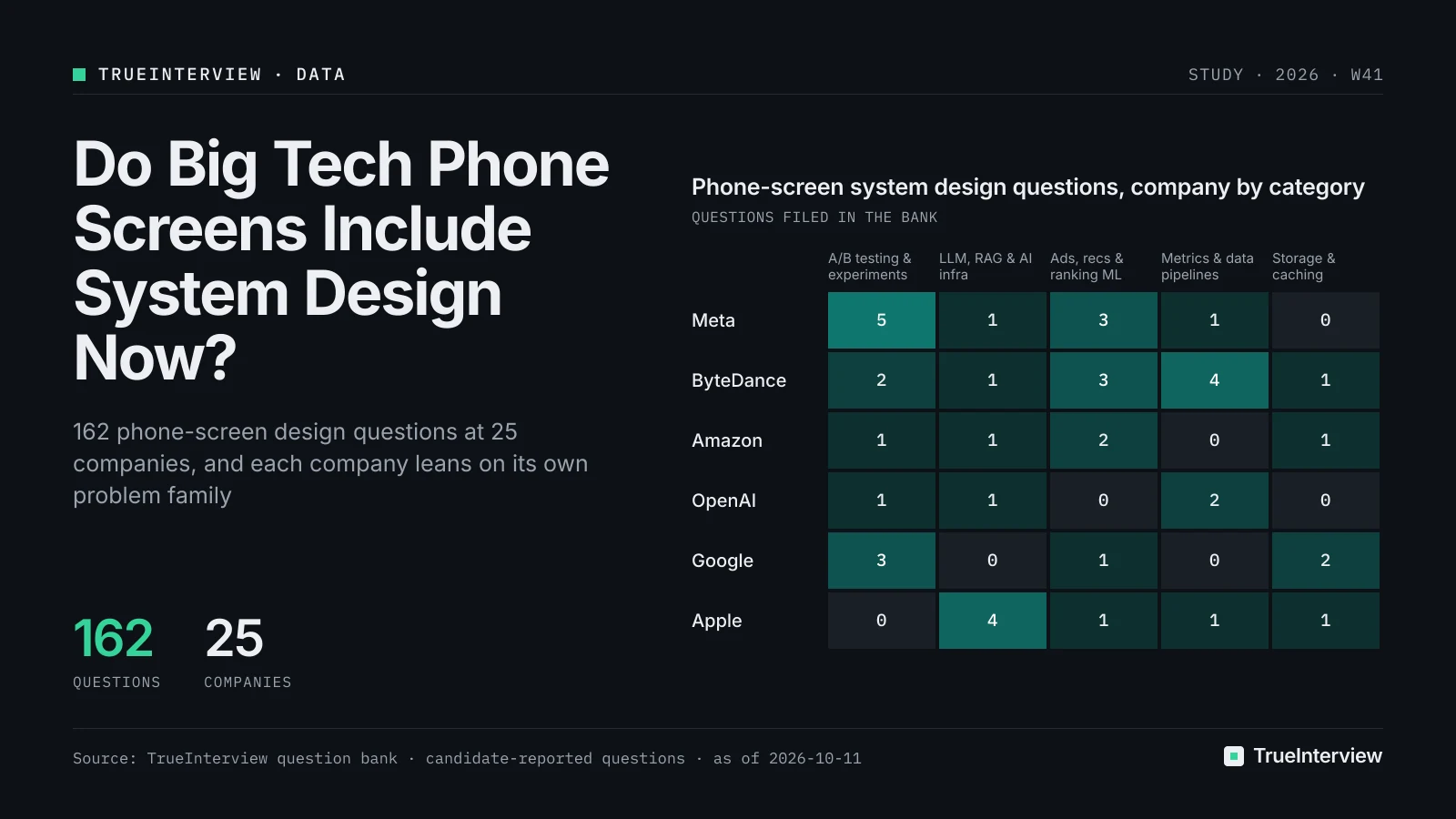
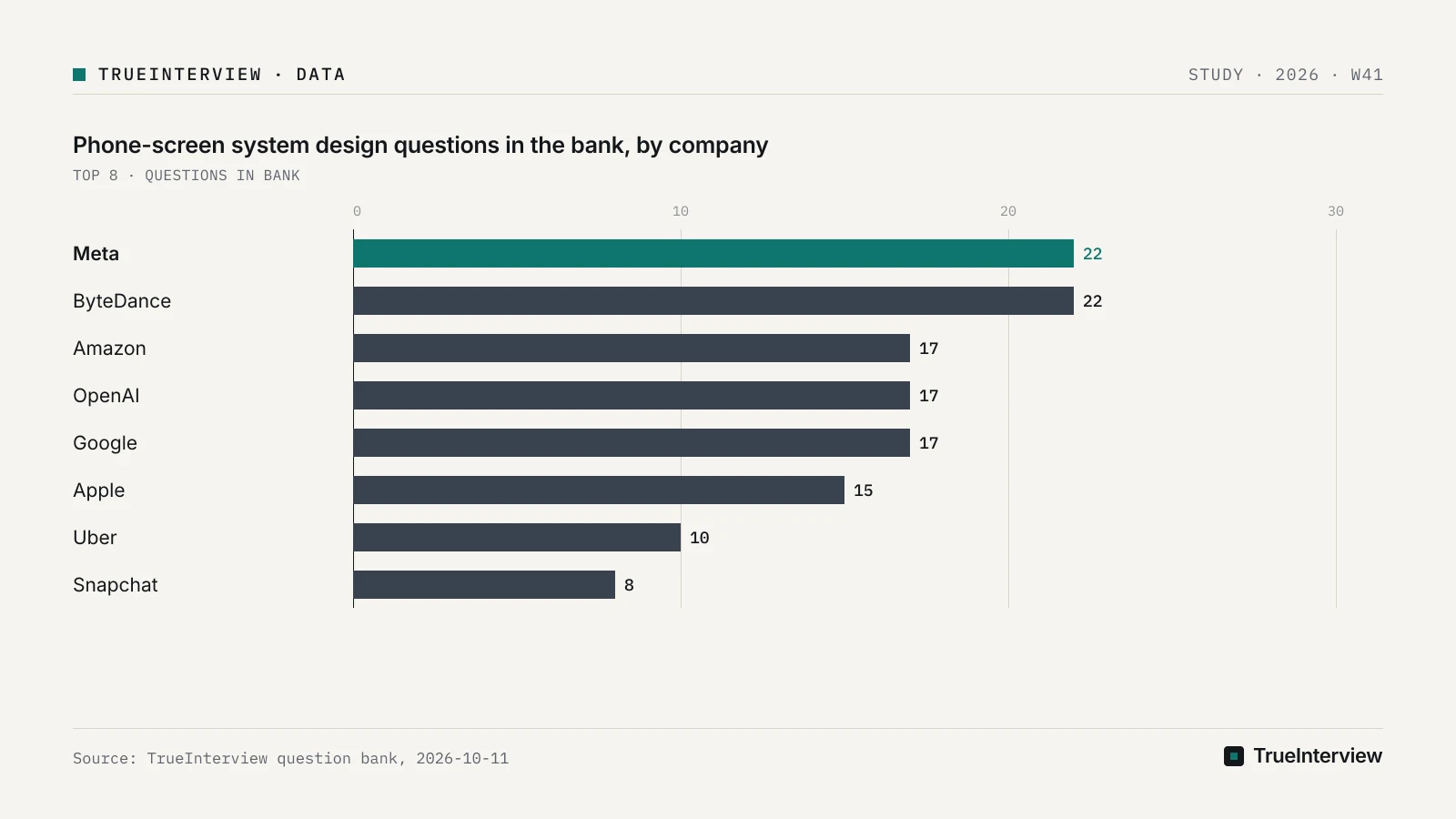
Yes, and mostly for experienced hires, but what appears is a scoped probe tied to the company's own domain, not a shortened onsite round. As of 2026-10-11, TrueInterview's bank holds 162 system design questions that candidates reported from big-tech phone screens at 25 companies, with Meta and ByteDance at 22 each. Meta's leading family is A/B testing and experiment design (5 of 22), ByteDance's is metrics, logging and data pipelines (4), and Apple's is LLM, RAG and AI infrastructure (4 of 15). Prepare your target company's family at screen depth instead of rehearsing the full onsite canon.
Disclosure: TrueInterview is an interview-preparation product and publishes this article. Facts about other products come from their public pages on the dates listed under Sources.
How common is a design segment in a big-tech phone screen?
Common enough that a senior candidate should plan for it. Of the 162 phone-screen design questions in the bank, 121 were last reported within the 12 months before 2026-10-11, so this is current practice rather than an old habit. Only 31 of those questions were also reported in an onsite round, so most of them appear in the screen and nowhere else.
One company confirms it officially. Amazon's SDE III prep page says of the 60-minute technical screen, "Half of the time will be spent on questions that focus on our Leadership Principles and the other half will be spent on coding problems and system design." Outside Amazon, a phone screener writing on DEV Community says the technical screen usually covers one coding problem and sometimes a brief system design discussion.
The practical consequence is a question you should settle this week: does your screen have a design segment? If the answer is yes, a rehearsed answer for it belongs in your plan, because the coding half will not carry a weak design answer on its own.
What shape does the screen's design question take?
A narrow prompt with room for one or two components, often from a domain the company runs. The 162 questions split into distributed systems (68), ML system design (44), experiment design filed as data science (32), low-level design (8), frontend system design (4), ML fundamentals (3) and product case (3). Close to half are ML or experiment questions rather than the classic web-service canon.
The mix of problem families also differs by round. Phone-screen reports are led by A/B testing and experiment design (24), LLM, RAG and AI infrastructure (16), ads, recommendation and ranking ML (16), and metrics, logging and data pipelines (10). The 31 onsite reports are led by storage and key-value stores (4), chat and messaging (3), and news feed and social graph (3). If you prepare for the screen from an onsite list, you rehearse the families candidates rarely report there.
Depth is shallow by design. The DEV Community screener puts it plainly: "The system design component, if it exists, is shallow, one or two components rather than a full architecture." Aceloop's Google coding interview guide says the 45-minute screen at L4 and above now includes a 10-minute scaled-down SD probe. Rehearse to that clock: one scoping sentence, two named components, one failure mode or trade-off.
What each family looks like in practice
- Experiment design. Examples include Uber's Design a switchback and choose block length and Design Pricing Model Experiment, and OpenAI's Design a free-month experiment. The decisions to own are the randomization unit, interference between treatment and control, and the metric that decides the launch.
- LLM, RAG and AI infrastructure. Examples include Anthropic's Design GPU Inference Serving System and Route and Batch Inference with Eight GPUs, Amazon's Design a Reliable AI Chatbot Architecture and Apple's Siri Grounded Response Generation. Own the trade between batch size and per-request latency, and what the system does when the model is slow or wrong.
- Ads, recommendation and ranking ML. Examples include Snapchat's Short Video Recommendation & Ranking, LinkedIn's Design a Personalized Feed and Compare Ranking Objectives and Microsoft's Design local sports team recommendation system. Own the objective you rank on and the split between candidate generation and ranking.
- Metrics, logging and data pipelines. Examples include ByteDance's Design a Data Service for Downstream Consumers and Model Data for Analytics, Reporting, and Applications, and Apple's Log Processing System. Own the schema contract with downstream consumers and the handling of late or replayed events.
Our take: do not read the A/B testing count as the prompt you are most likely to meet. That family holds 24 distinct questions, yet it took between 0% and 1% of write-up links in each of the last four quarters. We read it as a signal for data-science and ML candidates, which matches the bank filing 32 questions under the experiment design (data science) subtype. A software engineer at Meta or Google gets more from the ranking and prediction prompts; a data scientist should flip that order.
Which companies put design in the screen, and which family does each lean on?
Each company's reports point at a different first family, so the row for your target company matters more than any total. The table lists selected companies with a distinct family mix or a recent reported example, each with its practice page; Uber, Microsoft and LinkedIn examples appear in the family list above. Write down your company's top two families before you open a course.
| Company | Phone-screen design questions | Leading families (count) | Recent example |
|---|---|---|---|
| Meta | 22 | A/B testing and experiment design 5, ads and ranking ML 3, prediction and classification ML 3 | Design Online Game Leaderboard, last reported 2026-05 |
| ByteDance | 22 | Metrics, logging and data pipelines 4, ads and ranking ML 3 | Design Google News, last reported 2026-06 |
| OpenAI | 17 | Chat and messaging 3, payments and ledgers 3 | Payment / Coffee-Shop Ordering, last reported 2026-06 |
| 17 | A/B testing and experiment design 3, storage and caching 2, ads and ranking ML 1 | Design a Product or Video Recommendation System, last reported 2026-08 | |
| Amazon | 17 | Ads and ranking ML 2; A/B testing, LLM infrastructure and storage 1 each | Design News Feed, last reported 2026-07 |
| Apple | 15 | LLM, RAG and AI infrastructure 4 | Siri Grounded Response Generation |
| Snapchat | 8 | No single family leads in the counts | Design a News Aggregation Feed, last reported 2026-06 |
OpenAI's row is chat and money movement, and Apple's is model serving, so a candidate who rehearsed only feeds and URL shorteners walks into both screens cold. Smaller rows matter when they are on your list. Robinhood's latest Design Job Scheduler report is from 2026-09. Databricks has Design Book Price Aggregator from 2026-06, and Salesforce has Coffee Ordering System Design from 2026-09. Treat each of these as evidence for that company, not for big tech as a whole.
Which named questions repay the most rehearsal?
Rank by breadth first, then by your target list. Design Job Scheduler is linked from 21 candidate write-ups across 6 companies and filed under 12 companies in the bank, so one rehearsed answer travels further than any other title. Famous titles are weaker signals: Design TinyURL is filed under 6 companies but linked from only 5 write-ups.
Design Job Scheduler
The prompt asks for a service that runs jobs at a set time or interval across a pool of workers. The two decisions to own are how a job survives a worker dying mid-run, usually leases with heartbeats and a retry, and how a retried job avoids running twice in effect, usually idempotent handlers keyed by a run id. Its reach also crosses levels: senior-or-above candidates account for 16 of its write-up links and junior, new-grad or intern candidates for 5. Practise it at Design Job Scheduler.
Design GPU Inference Serving System
This is the most-linked title in the set, with 22 write-ups, all from Anthropic, and an Anthropic phone-screen report last dated 2026-07. That is strong evidence for one company and none for the rest of big tech. The decisions to own are batching, where larger batches raise throughput but add queueing delay to each request, and admission control when every GPU is busy. Practise Design GPU Inference Serving System only if Anthropic or another AI lab is on your list.
OpenAI's ordering and game-state prompts
Payment / Coffee-Shop Ordering (read the prompt!) is linked from 16 write-ups and Design Online Chess Game from 14, both from OpenAI only. The parenthetical in the first title tells you where candidates slip: the prompt itself. For the ordering prompt, own idempotency keys so a retried payment is not charged twice, and a ledger entry for every state change. For chess, own a server that holds the authoritative game state and validates every move.
Design News Feed and Design Google News
Design News Feed is linked from 11 write-ups from 5 companies and filed under 9. Own the choice between fan-out on write and fan-out on read, and what changes for accounts with very large follower counts. Design Google News reaches the same 11 write-ups but is filed under only 2 companies, so its reach is title-level, not company-level. Its decisions are grouping near-duplicate stories from many publishers and weighting freshness against relevance.
What changes at senior and staff level?
The screen's design question is mostly a senior-candidate event. Candidate write-ups link these questions 197 times from people who reported a senior, staff-plus or manager level, and 38 times from people who reported a junior, new-grad or intern level. If you are interviewing at senior level or above, assume the probe is coming and rehearse it out loud.
The skew is sharpest in the least introductory families. LLM, RAG and AI infrastructure runs 33 senior-or-above links to 1 junior-or-below, payments and ledgers 21 to 1, and storage and caching 10 to 1, while chat and messaging (10 to 3) and booking, inventory and ticketing (6 to 5) appear at both levels. The same chat or booking title can therefore carry a different bar depending on who is answering it.
Staff-plus and manager write-ups link GPU Inference Serving System twice, Job Scheduler twice, and 1-to-1 Chat, Distributed File System, Google News and Short Video Recommendation & Ranking once each. Those prompts share an operating cost or a failure story. Outside our data, a scoring guide on systemdrd.com says the L5 bar is to defend decisions under probing and name failure modes, and the L6 bar adds SLOs with monitoring signals, cross-system trade-offs and the operational layer.
Down-leveling note (our view): the screen's design probe is the first place a senior packet can pick up a lower-level signal. A correct but generic answer that never names a failure mode falls short of the bar that guide sets for L5. The onsite rounds that set level are design depth, the project deep dive and behavioral scope; use the screen to avoid being marked down before you reach them.
What should you ask your recruiter before the screen?
Five questions settle most of the uncertainty, and each answer changes what you rehearse. Ask them in writing as soon as the screen is booked: whether there is a design segment, which domain it draws on, what level the loop targets, and whether the onsite repeats the topic. The table pairs each question with the evidence behind it and the action it should trigger.
| Ask the recruiter | Why it matters | What to do with the answer |
|---|---|---|
| Does the technical screen include a design segment, and how long is it? | A phone screener on DEV Community says design is sometimes a brief discussion after one coding problem | If yes, rehearse a timed answer of ten to fifteen minutes; if no, keep design to a single rehearsal |
| Is the role on an ML, data or experimentation team? | The bank files 44 of the screen questions as ML system design and 32 as experiment design | If yes, put an ML or experiment family on your two-family list |
| Does the design question come from the team's product domain? | Final Round AI's ServiceNow guide says a senior screen may ask for a component of a notification system, a workflow queue or a data synchronization pipeline | If yes, rehearse one prompt from that domain before any generic title |
| Which level is the loop calibrated for? | A scoring guide on systemdrd.com says, "Interviewers are calibrating your answer against the level you’re being hired for." | At senior level and above, prepare the failure and cost half of each answer |
| Does the onsite have its own design rounds? | Only 31 of the 162 screen questions were also reported onsite | If yes, keep the screen answer scoped and save full-architecture practice for after you pass |
How much design should you prepare before a screen?
Our rule: size design prep by your level and your target company's row, never by the onsite syllabus. Senior candidates should assume the probe happens and give design about a third of screen prep. Junior and new-grad candidates should give it about a fifth and keep coding first; they supplied the minority of level-tagged links described above.
| Your self-reported level | Design share of screen prep (our view) | Start with |
|---|---|---|
| Junior, new-grad or intern | About a fifth | A chat or booking prompt, the families reported at both levels, then Design News Feed |
| Senior | About a third | Your company's two leading families, then Design Job Scheduler |
| Staff-plus or manager | About a third, weighted to failure and cost | One operational prompt such as Design GPU Inference Serving System, rehearsed through overload and recovery |
Our take: most system design advice starts with the classic canon and a full-length framework, and for the screen we would cut both. The canon is thin in screen reports, as the TinyURL figures above show, and the clock is closer to the ten-minute probe Aceloop's guide describes than to a full round. Rehearse a fixed answer shape instead, and practise the pivot. An interviewer quoted by Deep Engineering says, "The signal that I trust the most is not the architecture a candidate produces, it's how they think if I change a constraint in the middle of the interview."
Which families are gaining share in screen reports?
Model serving is steady and data pipelines are rising. LLM, RAG and AI infrastructure took 12%, 15%, 11% and 15% of write-up links across the four quarters from 2025-Q4 to 2026-Q3. Metrics, logging and data pipelines went from 0% in 2025-Q4 to 8% in 2026-Q3. Ads, recommendation and ranking ML moved from 15% in 2026-Q1 to 4% in 2026-Q2 and back to 8%.
Compare shares, not totals. Links number 25, 73, 84 and 40 across those quarters, and the totals mostly reflect how many write-ups were collected. For your next month, the share data argues for one data-pipeline rehearsal even if ByteDance is not on your list, and for keeping a model-serving answer warm at any AI-heavy company.
How we counted
These are candidate-reported questions reconstructed for practice, not any company's official list, and counts measure what candidates reported, not how often a company asks. Problem families are assigned from question titles, and 17 of the 162 titles match no family. Level splits use the level each candidate reported about themselves, and a question reported in several rounds counts in each of them.
FAQ
Is the phone-screen design question the same as the onsite one?
No, and treating it as a shorter onsite round is the most common framing error. A phone screener on DEV Community says, "The phone screen is not a simplified version of the full interview loop." Treat the screen as its own format: smaller scope, a different family mix from the onsite reports shown earlier, and one pivot instead of a long deep dive. Save the full architecture narrative for the onsite.
Do new grads get system design in the phone screen?
Some do, but far less often in what candidates report, and the level split above shows how lopsided it is. Aceloop's Google guide says phone screens for L3 candidates were shortened to 35 minutes while L4 and above kept 45. If you are early in your career, keep coding first and rehearse one chat or booking prompt so a short design question does not catch you unprepared.
Does Amazon's phone screen include system design?
For SDE III and manager roles, Amazon's own prep pages say yes. Amazon's SDM page says half of the 60-minute screen goes to system design questions about new or existing systems. Its front-end engineer page splits the screen between Leadership Principles and front-end coding instead. For SDE II, Amazon's online assessment page lists a system design section of about 15 minutes.
How do I prepare for a system design question in a phone screen?
Start from the answer shape, not the syllabus. A scoring guide on systemdrd.com says candidates who score well "explicitly choose what they’re designing and why, and they do this in the first 3–5 minutes." In a short probe, that scoping minute carries most of your signal, so rehearse it with a timer on two prompts from your target company's row and say each choice out loud.
Your practice plan
A three-week plan for someone working full time, at roughly an hour on weekdays and a longer session at the weekend.
- In the first two days, send the recruiter the five questions from the table above and write your two-family list from your company's row.
- In the first week, rehearse Design Job Scheduler twice against a fifteen-minute timer: one scoping sentence, two named components, one failure mode.
- Also in the first week, rehearse Design News Feed, then change one constraint, such as an account with ten times the followers, and adapt the answer without starting over.
- In the second week, drill your company's first family: Design a Product or Video Recommendation System for Meta or Google, Design Google News for ByteDance, Payment / Coffee-Shop Ordering for OpenAI, or Design GPU Inference Serving System for Anthropic.
- Later in the second week, drill the second family from your list and one data-pipeline prompt, naming the schema contract and the late-data plan in each.
- In the third week, run two mock screens that pair a coding problem with a short design probe, and ask the mock interviewer to change a constraint halfway through.
- Before the screen, browse the practice question bank for your target company's newest prompts and rehearse the scoping sentence for each one you have not yet seen.
Sources
- TrueInterview question bank — phone-screen system design at big-tech companies — counted 2026-10-11
- SDE III Interview Prep — checked 2026-10-11
- I Have Run 80+ Phone Screens. Here Is Why Good Engineers Keep Bombing Them. - DEV Community — checked 2026-10-11
- Google's 2026 Loop Killed Your 2022 Prep. Here's the Fix. — checked 2026-10-11
- What Interviewers Actually Score in System Design Rounds — checked 2026-10-11
- ServiceNow Interview Process: Rounds and Tips — checked 2026-10-11
- System Design Hiring Is Really a Judgment Test — checked 2026-10-11
- SDM Interview Prep — checked 2026-10-11
- FEE Interview Prep — checked 2026-10-11
- Online Assessment Prep: Software Development Engineer II — checked 2026-10-11
Last reviewed: 2026-10-11.