Study
How to Prepare for a Debugging Round at Big Tech (2026)
TrueInterview
October 18, 2026 · 12 min read
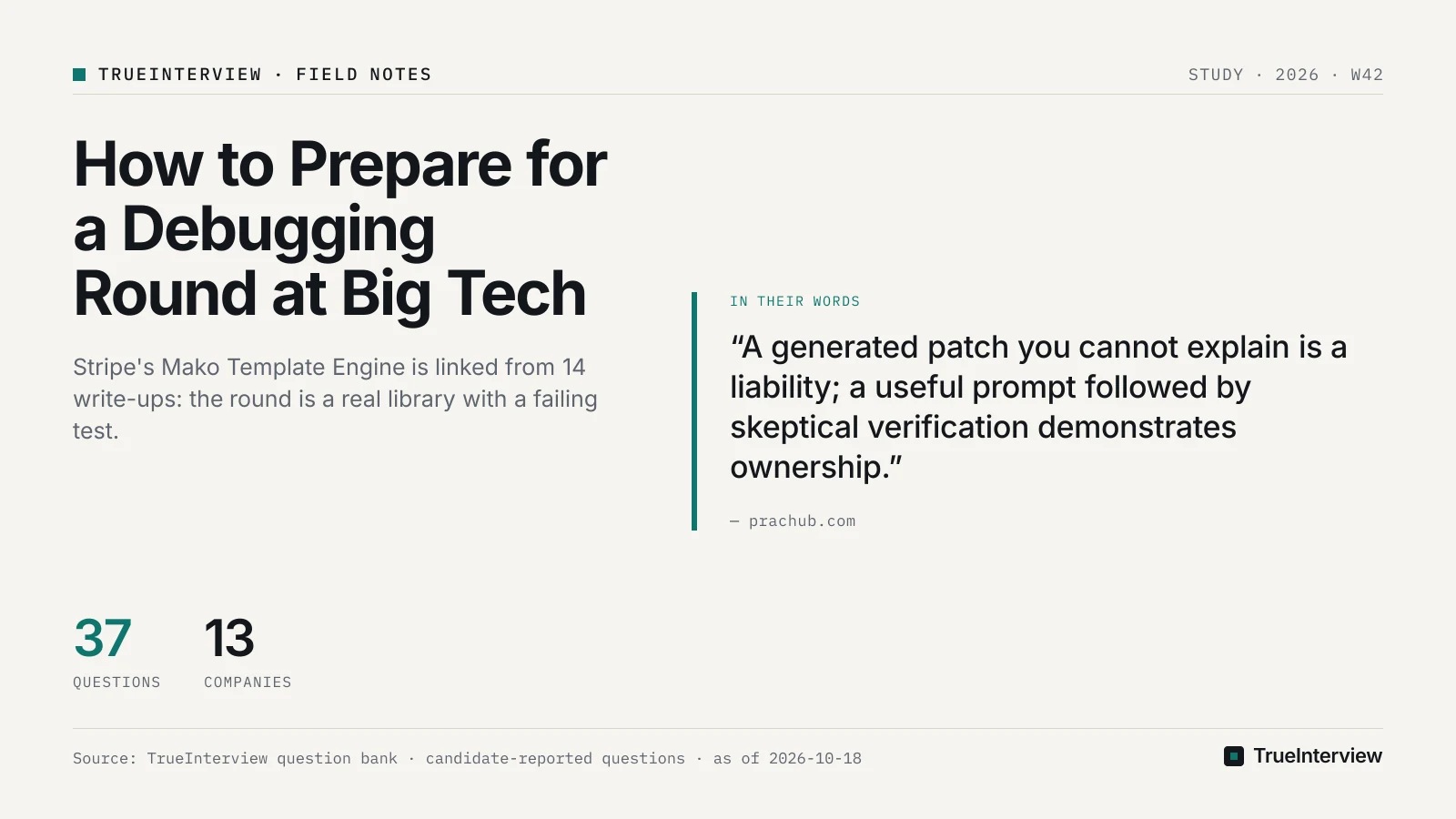
A big-tech debugging round is really one of two rounds: a bug fix inside a real library or app, often with an AI assistant allowed, or a spoken investigation of a broken production system. As of 2026-10-18, TrueInterview holds 37 candidate-reported debugging-round questions from 13 big-tech companies, and across 34 of them the subtypes filed are debugging (17) and troubleshooting (17). Find out which of the two your target company runs, then rehearse that one on a real codebase or a real incident scenario instead of memorising a generic debugging checklist.
Disclosure: TrueInterview is an interview-preparation product and publishes this article. Facts about other products come from their public pages on the dates listed under Sources.
Which kind of debugging round will you get?
You will get either a repo bug-fix, where you are handed an existing library or app with a failing behavior, or a troubleshooting conversation, where you reason out loud about a broken system. Candidates report the first at Stripe, Amazon, Coinbase, Uber and OpenAI, and the second at ByteDance, Meta and DoorDash. The two share a method but almost no practice material.
| Flavor | Company | Reported question | Round | Last reported |
|---|---|---|---|---|
| Open-source library bug-fix (AI-assisted format) | Stripe | Mako Template Engine | Onsite | 2026-06 |
| AI-assisted repo bug-fix | Amazon | AI Assistant Repo Bug-Fix | OA | 2026-09 |
| AI-assisted repo bug-fix | Coinbase | AI Enhanced Pilot — Domain (AI-Assisted Coding Round) | Onsite | 2026-07 |
| AI-assisted debug | Uber | AI-Assisted Coding / Debug Round (HackerRank IDE + AI) | Onsite | 2026-05 |
| AI-assisted debug | OpenAI | Debug a Buggy Distributed Job Scheduler | Onsite | 2026-05 |
| Application debug | Instacart | Debug Search and Stock Behavior in a Library Application | OA | 2026-09 |
| Production troubleshooting | Oracle | Troubleshoot a Frontend Failure in a Client-Server Application | Onsite | 2026-09 |
| Production troubleshooting | ByteDance | SRE Linux / Networking Troubleshooting Round | Phone screen | 2026-05 |
| Production troubleshooting | Meta | PE Troubleshooting: Web Server / Disk Full | Phone screen | 2026-04 |
| On-call investigation | DoorDash | On-Call Case Investigation | Onsite | 2026-07 |
Amazon also has a full-stack variant: Debug a Movie DB Watchlist Full-Stack Project is linked from 7 candidate write-ups. Only 1 of the 37 questions is filed as an algorithm coding question. Expect someone else's code or a live system, rather than a hunt for the bug in your own algorithm solution.
Our take: ask your recruiter one question before you prepare anything: will there be a codebase, or will it be a conversation about a system? The answer decides how you spend the next two weeks. If the recruiter cannot say, split your time evenly between the two flavors until you know.
Where and when are debugging rounds reported?
Debugging rounds are mostly an onsite event, and they are current. Reported rounds for these questions are onsite (27), phone screen (8) and OA (4), and a question can appear in more than one round. 35 of the 37 questions were last reported within the 12 months before 2026-10-18.
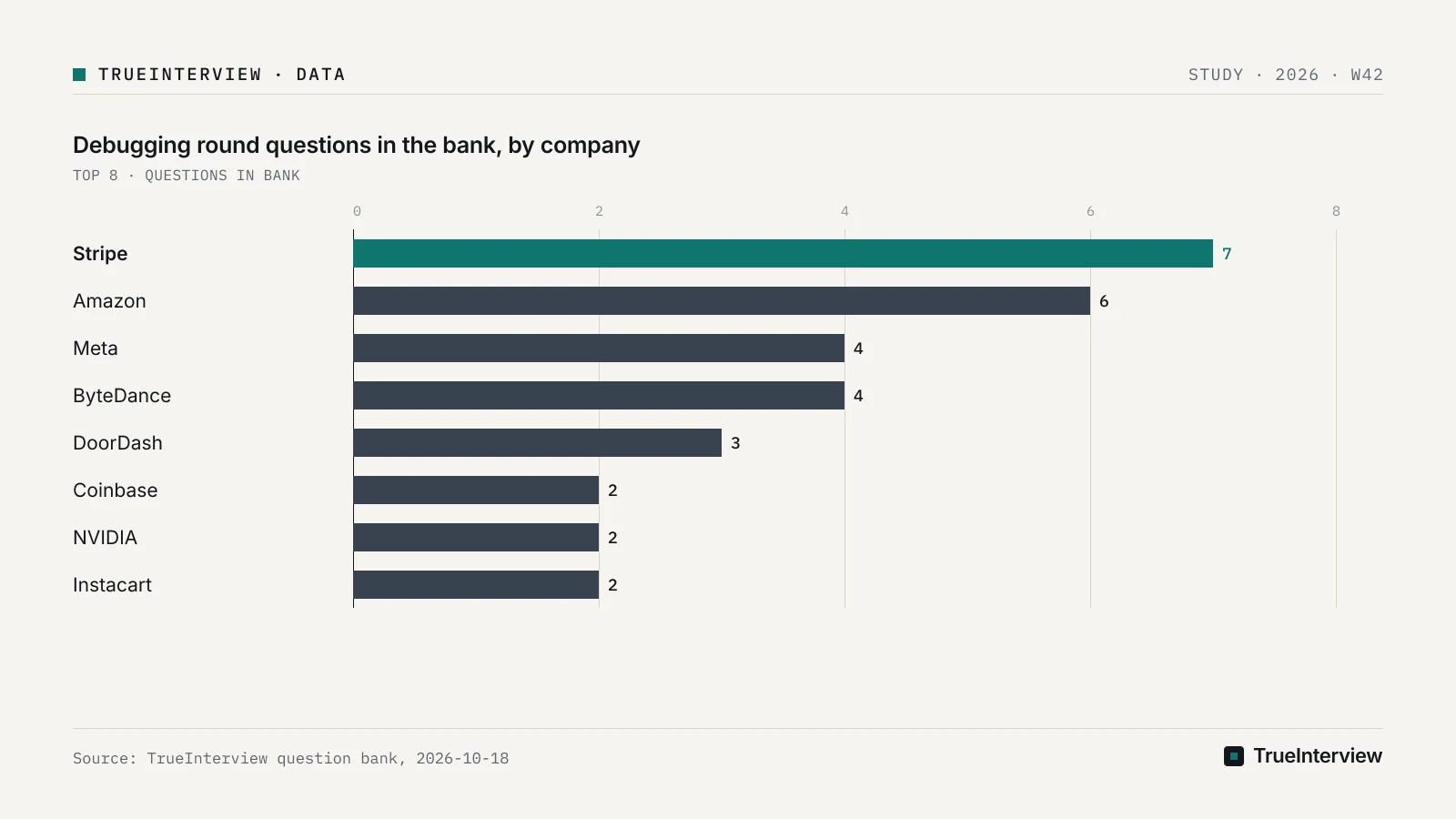
By company, the bank holds Stripe (7), Amazon (6), Meta (4), ByteDance (4), DoorDash (3), and two each at Coinbase, NVIDIA, Instacart, Microsoft and Oracle. These counts measure what candidates reported, not how often a company runs the round, and the questions are reconstructed for practice rather than any company's official list.
What this means for your calendar: if Amazon or Instacart is in your pipeline, the debugging exercise can arrive as early as the OA, so do one timed repo drill before you open the assessment link. For everyone else, it is an onsite skill, and you have until the onsite to build it.
How do you prepare for a repo bug-fix round?
Practise inside real open-source libraries, because that is what candidates report being handed. Stripe's reported questions are named libraries: Mako Template Engine is linked from 14 candidate write-ups, Requests Library Debug (BugSquash) from 5, SnakeYAML Debug (Java) from 3, and Repo Debugging: Fix Failing Tests in a Failsafe Project from 3.
One engineer's post on zhenghao.io describes the Stripe format directly: "They call it Bug Squash, where you’d dive into a large, well-written library codebase to fix real-world open-source bugs." The environment matters too. PracHub's guide says CoderPad Projects provides a VS Code workspace where candidates can build, run, test and debug code. Practise in a full editor with a terminal, not in a blank text box.
The best drill comes from the dglearning Substack author, who suggests picking a recently merged bug-fix pull request in an unfamiliar open-source library. Revert the fix, run the test suite, and find the bug again from the failing test within one hour.
Worked example: a Stripe loop
Suppose your onsite is at Stripe. Of the 7 Stripe debugging questions in the bank, the most-linked is Mako Template Engine, last reported in an onsite in 2026-06. The pattern across Mako, Requests and SnakeYAML is a real bug in a mature open-source library, which the zhenghao.io post also describes. So you would clone a templating or HTTP library in your interview language, read the README and the test command, run the suite and reproduce the broken behavior, and trace from the test into the one module it exercises. Then state a hypothesis, prove it with a narrower test, make the smallest fix, rerun the nearby tests, and close with the four-point summary described below.
Where do you start in an unfamiliar codebase?
Start from the failing test or the symptom and trace one path through the code. PracHub's guide says plainly, "You are not expected to understand the whole repository." The dglearning Substack author calls reading top to bottom, line by line, the biggest mistake candidates make, and says candidates who fail spend 30 minutes on that first read.
The dglearning Substack author's time budget is to spend the first five minutes on the problem statement and tests before looking at the code. Then reproduce the failure before you edit anything. PracHub names coding before reproducing the behavior as one of the largest mistakes, alongside reading the tree top to bottom.
Write the bug down the way Google's SRE book frames a good report: expected behavior, actual behavior and, if possible, how to reproduce it. From there, follow the error message or stack trace to the point where behavior diverges, which is the signal the zhenghao.io author lists as tracing to the root cause. PracHub's version of the whole opening is a five-step frame of clarify, run, map, test and patch.
Our take: the five-minute read of the tests is the highest-return habit in this round. Tests tell you the contract, the entry point and the input that breaks it, which is most of the map you need.
How do you debug with a hypothesis instead of tweaking code?
Run a loop of hypothesis, experiment and result, and say each step out loud. Google's SRE book describes troubleshooting as the practice where "we iteratively hypothesize potential causes for the failure and try to test those hypotheses." It adds that you can test a theory by comparing the system's observed state against it.
The interviewer can see the difference. The zhenghao.io author writes that a watcher can tell whether a candidate is debugging with a plan, bisecting the code, or randomly tweaking it. The same author lists writing a test that reliably reproduces the issue as a signal.
PracHub lists the costly moves to avoid: changing several layers at once, adding a dependency for a local problem, and scattering logs without a hypothesis. PracHub's judgment criterion is preserving established abstractions and avoiding an unnecessary rewrite. In practice, the smallest diff that turns the failing test green, plus one new test, beats a refactor every time in this round.
How should you use an AI assistant in a debugging round?
Treat every suggested patch as a hypothesis you still have to verify and explain. AI-assisted coding is the largest format among reported debugging questions, with 17 of 37, tied with behavioral / knowledge questions. Stripe, Amazon, Coinbase, Uber and OpenAI all have reported questions in that format.
The dglearning Substack author reports that Meta's AI-assisted round, rolled out in Q4 2025, gives partially implemented multi-file projects with debugging as one of three problem patterns. PracHub's guide is blunt about the risk: "A generated patch you cannot explain is a liability".
Our take: the assistant does not make this round easier; it moves the grading from finding the bug to judging the fix. Use it to read unfamiliar code faster and to propose candidate causes, then confirm each one with a test before you accept the change. Run at least two practice sessions with an assistant allowed and one without, and in each, say why the change is correct before you apply it.
How do you prepare for a troubleshooting round with no codebase?
Run the same hypothesis-test loop, spoken over symptoms and system state instead of source files. The ByteDance SRE Linux / Networking Troubleshooting Round is linked from 6 candidate write-ups, and Meta's PE Troubleshooting prompt covers a web server and a full disk. Among the 25 onsite questions filed with a subtype, debugging accounts for 16 and troubleshooting for 9. Troubleshooting is an onsite format too, so do not treat it as a phone-screen formality.
Google's SRE book makes the hopeful point for this flavor: "troubleshooting is both learnable and teachable." Do not prepare for it with algorithm drills. Instead, rehearse scenarios out loud, standard ones from Linux operations: a disk that fills, a service that stops answering, a host that cannot reach a dependency.
For a disk-full prompt, prepare spoken answers to three operations questions: how you find what is consuming space, what you do about a large file still held open by a running process, and how you stop the alert from firing again. For an on-call investigation, prepare how you would limit impact first and then find the cause, and what you would add so the next on-call engineer sees it sooner.
What do interviewers score, and how should you close?
Interviewers score how you got to the fix as much as the fix itself. The dglearning Substack author states that debugging rounds are graded on what you say out loud as well as on what you fix. PracHub's guide names orientation, evidence, judgment, verification and communication as scored dimensions.
PracHub's evidence criterion, "Separate what you observed from what you suspect.", is the habit most candidates skip under time pressure. Label each statement as an observation or a suspicion as you speak, so the interviewer can follow your reasoning without asking.
Close with the four points PracHub recommends: root cause, change, evidence and remaining risk. Add the regression test to the evidence point, since OfferGenie's example answer also recommends ensuring the bug is covered by an automated test.
What changes at senior and staff level?
Senior candidates face the same core repo exercise, and Stripe's library questions are linked from both groups. One troubleshooting question, DoorDash's on-call investigation, has links only from senior-or-above candidates, while ByteDance's SRE round leans junior. Candidate write-ups link these questions 28 times from candidates who reported a senior, staff-plus or manager level and 48 times from junior, new-grad or intern candidates. Levels are self-reported on each write-up.
| Question | Senior-or-above links | Junior-or-below links |
|---|---|---|
| Mako Template Engine (Stripe) | 7 | 7 |
| Requests Library Debug (BugSquash) (Stripe) | 3 | 2 |
| Repo Debugging: Fix Failing Tests in a Failsafe Project (Stripe) | 2 | 1 |
| AI Enhanced Pilot, Domain (Coinbase) | 2 | 1 |
| On-Call Case Investigation (DoorDash) | 3 | Not reported |
| SRE Linux / Networking Troubleshooting Round (ByteDance) | 2 | 4 |
On-Call Case Investigation is the one question in this table with links only from senior-or-above write-ups. The dglearning Substack author adds that senior candidates are scored on whether they propose a regression test that would have caught the bug.
Our take: at senior and staff level, expect to be judged on investigation judgement and on what you would change so the bug cannot recur. After the fix, say which test, alert or invariant would have caught it, and why the original code let it through.
Down-leveling note (our view): a strong debugging round rarely sets your level on its own. In our view, the level signal usually comes more from system design depth, the project deep dive and the scope of your behavioral stories. Where the debugging round does contribute, it is through how you scope the investigation and the trade-offs you name about the fix.
How we counted
Counts come from TrueInterview's question bank as of 2026-10-18 and cover questions filed under the debugging round. A question can be filed under more than one round, so round tallies overlap. Write-up links count candidate write-ups that point to a question, split by the level each candidate reported; they measure what candidates wrote up, not how often a company asks.
FAQ
How is a debugging round different from a regular coding interview?
A regular coding round asks you to write a solution from a blank editor. A debugging round hands you existing code or a running system and asks you to find what is wrong. The zhenghao.io author argues that standard coding interviews leave out searching and comprehension activities, which is exactly what this round tests. Prepare by reading and tracing unfamiliar code, not by solving more algorithm problems.
Can I use print statements or a debugger?
It depends on the environment. One Blind commenter reported using print statements in interviews, with interviewers generally fine with it, while a different commenter in the same thread said that at Amazon you cannot run your code at all. Ask your recruiter whether the round uses a runnable workspace. The zhenghao.io author lists familiarity with breakpoints and watches as a signal. Whichever you use, place each print or breakpoint to test a stated hypothesis rather than to explore at random.
How should I split a 45 to 60 minute round?
Spend the first five minutes on the problem statement and tests, reproduce the failure next, then trace the one path the failing behavior touches. Leave the final ten minutes for the minimal fix, nearby tests and the four-point close. If you are still reading code after twenty minutes, stop and state your best hypothesis out loud.
Do junior and senior candidates get different debugging questions?
Mostly not for the repo flavor, and on the troubleshooting side the split depends on the question; the senior-level table above shows it question by question. What changes more is the grading: senior candidates should expect follow-ups on prevention and on what they ruled out.
Is this round only for SRE and production engineering roles?
No. The repo flavor appears in software engineer loops at Stripe, Amazon, Coinbase, Uber and OpenAI, as the first table shows. The spoken troubleshooting flavor is where the SRE, production engineering and on-call roles concentrate, so check which role family your loop belongs to.
Your practice plan
A three-week plan for someone working full time, about an hour a day:
- Week one. For every company in your loop, mark the flavor from the first table: repo bug-fix or troubleshooting. Read the matching candidate write-ups on the interview board and drop the prep for the flavor you will not face.
- Week one. Do one timed repo fix from a failing test: Mako Template Engine. Spend five minutes on the tests before opening any source file.
- Week two, repo flavor. Revert a recently merged bug-fix pull request in an open-source library in your interview language and find the bug again within 60 minutes, the drill the dglearning Substack author suggests. Then work Requests Library Debug (BugSquash) and SnakeYAML Debug (Java).
- Week two, AI-assisted. Do AI Assistant Repo Bug-Fix with an assistant enabled and Repo Debugging: Fix Failing Tests in a Failsafe Project without one. Before accepting any suggested change, say which test proves it.
- Week two, troubleshooting flavor. Talk through SRE Linux / Networking Troubleshooting Round, PE Troubleshooting and On-Call Case Investigation out loud, recording yourself, as hypothesis, check and result.
- Week three. Run two full timed mocks in your flavor with narration. End each with root cause, change, evidence and remaining risk, and add a regression test every time.
Sources
- TrueInterview question bank — debugging round at big-tech companies — counted 2026-10-18
- Why you should include debugging in the interview process — checked 2026-10-18
- Existing Codebase Interview Guide: How to Navigate and Debug an Unfamiliar Repository | PracHub Knowledge Hub — checked 2026-10-18
- Reading Code Like an Interviewer: The Debugging Round Framework for 2026 — checked 2026-10-18
- Google SRE - Troubleshooting Methodology: A Learning Path — checked 2026-10-18
- How do you debug a complex coding issue? | Expert Answer & Analysis — checked 2026-10-18
- How do you debug during FAANG interview? | Software Engineering Career - Blind — checked 2026-10-18
Last reviewed: 2026-10-18.