Confluent · Study
Confluent Interview Process & Questions
TrueInterview
August 22, 2026 · 10 min read
Confluent draws on a small, recurring question pool: implementing tail -n over a large file, searching a file for a word and then a phrase, a news feed, and a temporary email service each appear in several reports. Rounds are decided by the follow-up, not the first pass. Interviewers add a constraint (thread safety, preserved positions, run-length-encoded storage) and grade the adaptation. Design rounds lead with API and table design rather than diagrams, and they weigh heavily: one candidate passed both coding rounds, narrowly missed both design rounds, and was rejected.
This guide breaks down each stage of the Confluent interview, what interviewers evaluate in each round, and how to prepare, with questions candidates were actually asked.
Verified: Based on 9 candidate-reported interview experiences, cross-checked against recent public accounts.
Confluent interview process
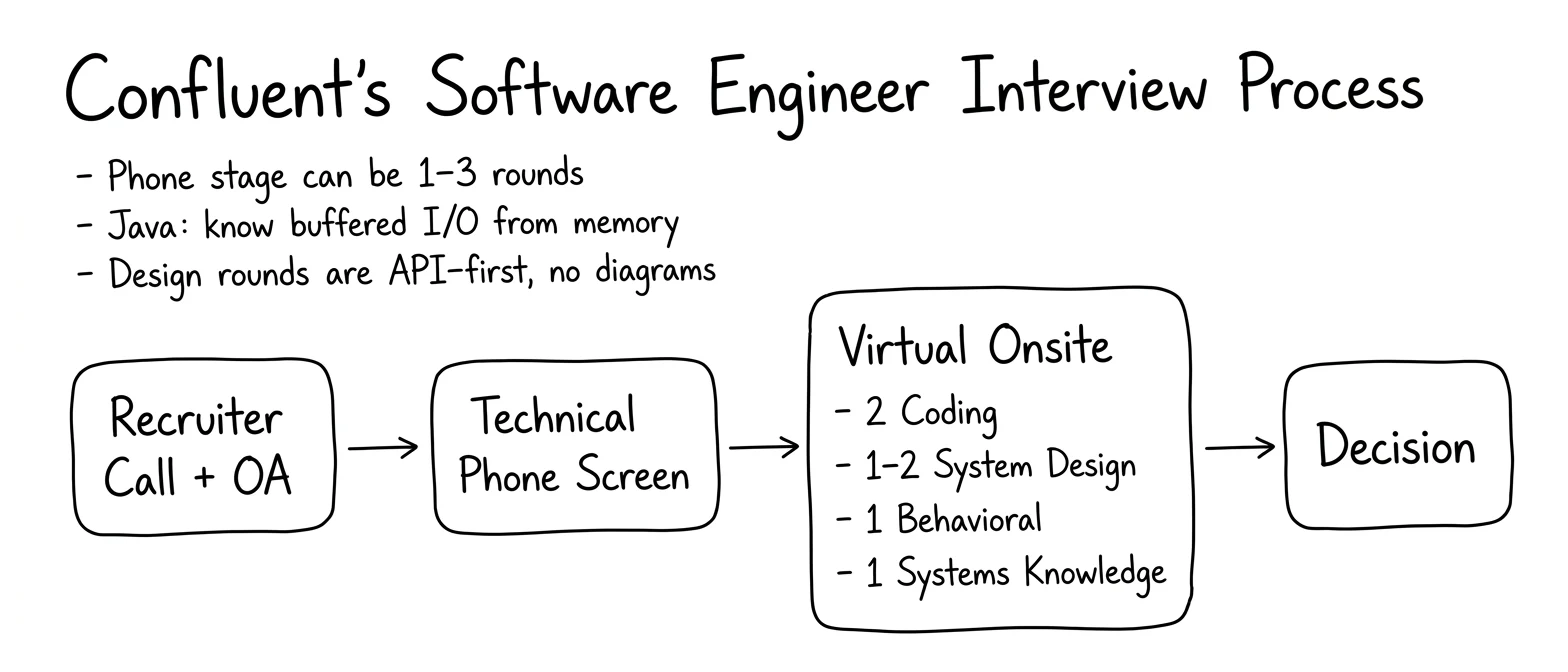
The structure is similar across teams, and Confluent assigns many backend hires to a team during or after the process rather than before it. A typical path is a short recruiter call on background and level, an online assessment for some candidates, one to three technical phone rounds, and a virtual onsite of three to five rounds. Some loops never reach an "onsite" by name: one candidate sat three phone rounds (design, then two coding sessions) and was rejected without further contact.
Mid-level loops are mostly coding plus one design round; senior loops add a second design round, a behavioral round and sometimes a Linux deep dive. The process typically runs several weeks, and responses slowed around IBM's acquisition of Confluent, completed in March 2026.
Here's what the interview process can look like:
- Online assessment (some candidates): Timed coding on small stream-processing and data-structure problems.
- Technical phone screens (one to three): Usually two coding problems per session, sometimes split across a follow-up call; senior screens may be verbal design.
- Coding interviews: Two onsite rounds: file I/O (
tail -n) and a data-structure design that grows under follow-ups. - System design interview (one or two): Feeds, temporary email or URL shortening, argued through APIs, schemas and trade-offs.
- Systems fundamentals and behavioral (senior loops): Linux internals, then leadership, customer-success and team-growth stories.
Tip: Build your tests quickly. In a file-based round, one candidate spent so long building test cases from the provided text file that the planned follow-up was cut short.
Online assessment
Some candidates get a timed coding assessment before any live round. The problems are small stream-processing exercises rather than puzzles. One late-2025 set paired a prefix-sum problem with time-series message processing over timestamp-ordered records. An early-2026 assessment asked for a token store built from create_time and token pairs that supports both a single-token lookup and retrieval of the full current list.
Interviewers evaluate:
- Data-structure choice: A layout that makes both the point query and the full-list query cheap.
- Timestamp edge cases: Ties, boundaries and out-of-order records.
- Cumulative techniques: Prefix sums and sliding windows instead of recomputing ranges.
Practice time-keyed stores and sliding-window aggregation.
Sample questions for the online assessment
Here are some questions reported by recent candidates:
-
Store tokens keyed by creation time and support fetching one token as well as the current token list.
-
Aggregate time-series messages in timestamp order and answer range queries with prefix sums.
Technical phone screens
Expect one to three live sessions. A coding screen usually holds two problems, sometimes split across the first call and a follow-up session. Recurring prompts: return the last n elements of a list or stream; search a file for a word, then a phrase, then optimize the hashmap or keep word positions unchanged; a sensor-health class judging stability from ping logs across five consecutive 60-second windows; whether any ordering of load and unload operations reaches a target weight; and function-signature matching with optional and variable-length arguments.
Senior screens shift toward explanation. One Senior Software Engineer II screen paired n-tail with how variadic arguments work underneath and how to make a variadic interface type-safe. Another senior screen was entirely verbal, covering tail -n, a news feed discussed through SQL and API structure, and database questions, with no diagram.
Interviewers evaluate:
- Edge cases:
nlarger than the collection, empty input, phrases that span lines. - Follow-up handling: Extending a working solution to the new constraint without a rewrite.
- Trade-off narration: Interviewers valued stated choices over a bare working snippet.
Rehearse each recurring prompt with its known follow-up under a strict clock.
Note: The most reported miss is running out of time while debugging the follow-up after a clean first solution. Budget at least a third of the session for it.
Sample questions for the technical phone screens
Here are some questions reported by recent candidates:
-
Implement
n-tail over a collection, including the case wherenexceeds its size. -
Search a file for a word, then a phrase, without changing the positions of the words.
-
Build a class that flags unstable sensors from ping logs across five consecutive 60-second intervals.
-
Match a function call against signatures that allow optional and variadic arguments.
-
Warehouse Loading: Reach TargetWeight at Any Point with Reordered +/- Weights
Coding interviews
The onsite usually has two coding rounds over video. The signature one is tail -n on a real file: print the last N lines, stream them to stdout without holding the file in memory, and weigh a fixed buffer against seeking backward by byte offsets with a small pseudo-API (read N bytes, move the pointer, get the file size). Looking up documentation may not be allowed, so Java candidates need the buffered I/O APIs from memory; one candidate found Python faster for building tests from the provided file.
The second round is a data structure that grows under follow-ups. Examples include a random queue whose dequeue order is random, extended to equality between two queues, thread safety, and comparison when storage is run-length encoded. Others are an LRU cache with get, put and getAverage, and a minimum-cost graph problem solved with DFS or BFS, followed by a new constraint.
Interviewers evaluate:
- Bounded memory: Streaming output and reading from the end, not loading the file.
- I/O fluency: Correct buffer and offset handling without references.
- Semantics: A defensible definition of equality for a structure with random order.
- Concurrency: What breaks under threads and the narrowest lock or structure that fixes it.
Implement tail -n twice, buffer-based and seek-based, before the onsite.
Sample questions for the coding interviews
Here are some questions reported by recent candidates:
-
Print the last N lines of a very large file to stdout, comparing a buffer with file-pointer seeks.
-
Design a random queue, then define equality, add thread safety and compare run-length-encoded storage.
-
Build an LRU cache that also returns the average of stored values in constant time.
-
Random Queue ADT + Equality + Thread Safety + RLE-backed Comparison
System design interview
Mid-level loops have one design round and senior loops often two. Prompts recur: an aggregate or RSS news feed, a temporary email service for 100 million active users, and TinyURL with trade-off follow-ups. Feed rounds center on table design for feeds, articles and subscriptions, concrete endpoints, REST versus RPC, and serving mobile and other clients. Several candidates were not asked for any architecture diagram.
The temporary email prompt goes deep on specifics. Candidates had to generate human-looking unique usernames from dictionary fragments, check duplicates fast with a bloom filter, absorb high daily volume, and handle addresses that never expire. A related prompt about a flood of incoming email focused on partitioning, indexing and heavy writes alongside low-latency reads.
Interviewers evaluate:
- API and schema precision: Endpoints, request shapes and tables stated concretely.
- Write-path scaling: Partitioning and fault tolerance under sustained ingest.
- Probabilistic structures: When a bloom filter's false positives are acceptable.
- Trade-offs: Each choice tied to a requirement, with the alternative named.
Practice talking through a feed and a temporary email service without a whiteboard, endpoints first.
Note: Design weighs as much as coding. The candidate who passed both coding rounds and narrowly failed both design rounds was rejected, though told they could reapply sooner than the usual waiting period.
Sample questions for the system design interview
Here are some questions reported by recent candidates:
-
Design a temporary email service for 100 million active users with realistic, unique random usernames.
-
Design an RSS news feed, specifying the tables for feeds, articles and subscriptions and the REST endpoints.
Systems fundamentals and behavioral interviews
Senior loops can include a Linux deep dive. One candidate was asked how ls, pwd, ip and ifconfig work underneath, how files and directories are opened, permissions and groups, the layout under /, the proc filesystem, kernel basics, and containers versus VMs. The same loop closed with a behavioral round on leading projects, external customer success and growing a team. Recent accounts describe this as a values conversation with a senior leader or manager about trade-offs and collaboration.
Interviewers evaluate:
- Depth below the API: System calls, inodes and file descriptors behind everyday commands.
- Isolation concepts: Namespaces and cgroups versus a hypervisor.
- Customer orientation: A story where your work changed an external customer's outcome.
- Leadership: Driving a project across people you did not manage.
Refresh Linux internals and prepare one measurable customer story.
Sample questions for the systems fundamentals and behavioral interviews
Here are some questions reported by recent candidates:
-
Explain what happens when you run
ls, and how the kernel opens a directory. -
Describe a project you led that produced a customer success.
How Confluent makes hiring decisions
The interviewers' feedback is weighed together, and design and coding both count: strong coding did not offset two weak design rounds. Many backend roles are posted by level, with team alignment during the process based on experience and business needs. A typical waiting period applies after rejection, shortened for close candidates. Communication after phone rounds can be slow or absent, and silence is not a verdict.
How to prepare for the Confluent interview
- Master
tail -n: Buffer-based and seek-based, streaming to stdout, with fast file-based tests in your language. - Rehearse the recurring prompts with their twists: Word-then-phrase search with fixed positions,
n-tail edge cases and variadic signature matching. - Grow a class under pressure: Add equality, thread safety or a new aggregate query to a working structure.
- Design endpoints first: For feeds and temporary email, state schema and APIs aloud, then scale the write path.
- Know bloom filters and partitioning: Be ready to size them for 100 million users.
- Refresh Linux internals for senior roles: System calls behind common commands, procfs, permissions and container isolation.
- Prepare a customer-impact story: Senior behavioral rounds ask for external customer success, not only team wins.
About working at Confluent
Confluent was founded in 2014 by the creators of Apache Kafka and sells a managed data-streaming platform used by more than 6,500 organizations. IBM completed its roughly $11 billion acquisition in March 2026, ending Confluent's run as a public company; the IBM plan pairs Confluent's streaming with its data and integration products. Engineers build distributed systems run as multi-tenant cloud services, largely in Java and Scala.
Confluent hires software engineers across its streaming platform. Teams include:
- Kafka: The core broker, storage and replication engine, plus the control plane that provisions clusters.
- Apache Flink: The managed stream-processing service and its infrastructure.
- Connect: Managed connectors that move data in and out of Kafka.
- Cloud compute platform: A multi-tenant, multi-cloud substrate that runs Kafka, Flink and Connect.
Experience and education requirements
Postings ask for a degree in computer science or equivalent experience. Kafka control-plane roles have asked for two or more years of distributed-systems work and Java or Scala; senior Flink infrastructure roles ask for five or more years and experience operating large-scale systems. Senior Software Engineer II is posted as an L4 role that leads design work and mentors engineers.
FAQs about the Confluent interview
How long does the Confluent interview process take?
Typically several weeks from recruiter screen to decision, longer when the phone stage runs to three rounds. Responses were slower around the 2026 acquisition.
What is the hardest round of the Confluent interview?
System design, especially for senior candidates. The prompts are predictable, but the bar for concrete APIs, schemas and trade-offs is high, and failing design is a common rejection path even after strong coding.
What language should I use?
Any mainstream language. Java is common, but you must know its buffered I/O APIs without references; Python makes file-based test setup faster.
How much does a Confluent software engineer make?
Official US postings list a base range of about $197K to $232K for Senior Software Engineer II (L4), with equity on top; actual pay varies by skills, experience and location.