Coinbase · Study
Coinbase Software Engineer Interview Process
TrueInterview
July 24, 2026 · 14 min read
Coinbase tests production code, not puzzles. The assessment and most live rounds grow one small system through three or four levels of new requirements, written from an empty file with no class templates and few or no visible tests. The live pool is narrow enough to drill: pagination, crypto order state machines and block-fee selection recur constantly, and a newer round has you debug, extend and review code with an AI assistant. Clearing every round does not guarantee an offer: hiring runs team by team, and candidates told they did well were still rejected when another finalist was chosen, team matching failed or the requisition closed.
This guide breaks down each stage of the Coinbase Software Engineer interview, what interviewers evaluate in each round, and how to prepare, with questions candidates were actually asked.
Verified: Based on 40 candidate-reported interview experiences, primarily from 2025 Q4 through 2026 Q3, cross-checked against recent public accounts.
Coinbase Software Engineer interview process
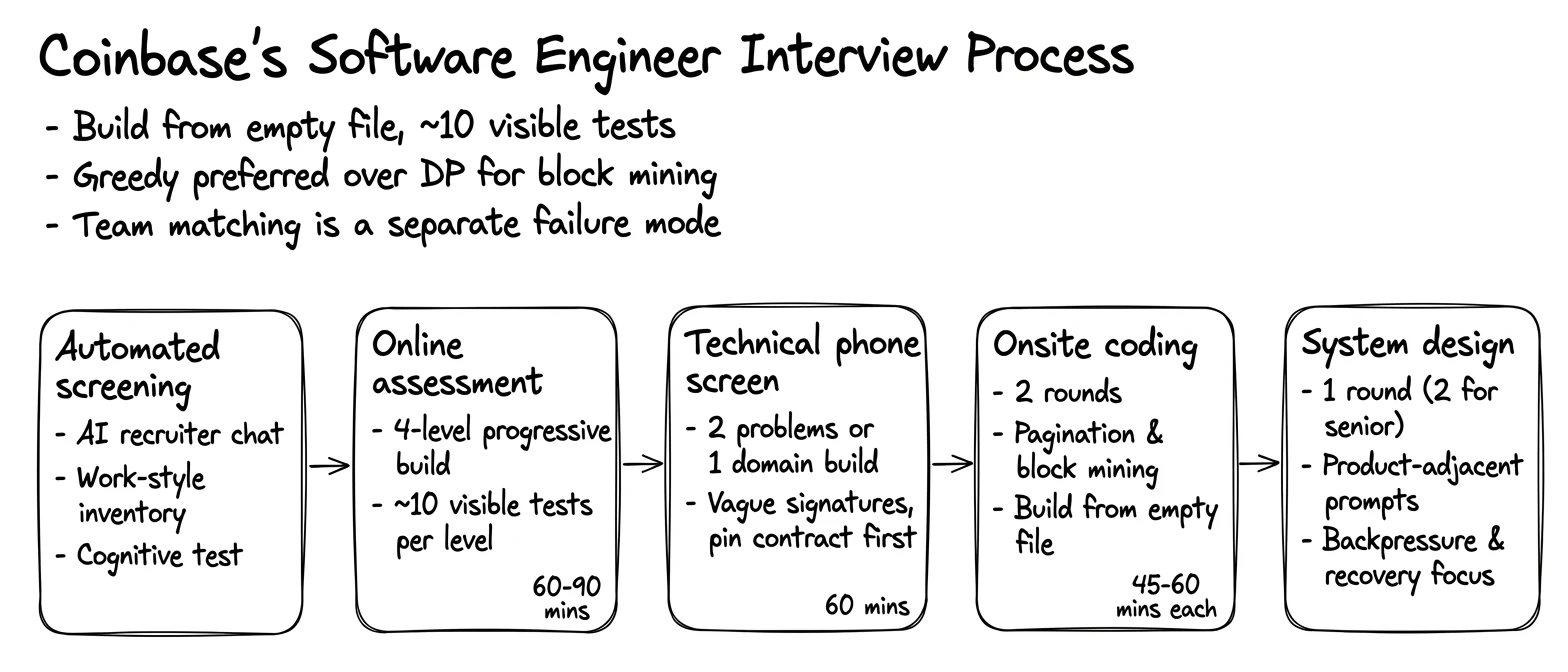
Automated screening and an online assessment come first, then one to four live technical rounds and a hiring manager conversation. The screen-onsite line moves: one senior candidate sat all four rounds as separate video calls. Reported timelines run from under two weeks to about six.
Level changes content more than shape: the assessment is tuned to the target level, senior candidates face broader design rounds and promotion-history questions, and IC4 loops can swap open-ended design for a pagination design round.
Here's what the interview process can look like:
- Automated screening: An AI-led recruiter conversation, a personality inventory of about 200 items and a cognitive test of about 50 questions in 30 minutes, sometimes followed by a recruiter call.
- Online assessment: A 60 to 90 minute build in about four levels, or a newer 60-minute AI-assisted game-agent task.
- Technical phone screen (one or two): About an hour of practical coding or object design that grows through follow-ups.
- Coding interviews (one to three): Pagination, order management and block-fee selection, coded without templates.
- AI-assisted coding round (increasingly common): Debug, extend, diagnose and review an existing codebase with an assistant.
- System design interview: A verbal design close to the product, most often a real-time price page or order flow.
- Hiring manager interview: A project deep dive, level and promotion questions, and daily AI use.
Tip: Write tests as you go in every live round, even unasked. Recruiters have advised it, few or no tests are supplied, and candidates who added edge-case tests unprompted were credited for it.
Online assessment
The standard assessment is one problem revealed in about four levels, done in one sitting of 60 to 90 minutes in your choice of language. Each level builds on the last, partial credit is awarded, and each level has its own small suite, about ten tests in one report. A senior candidate who finished three of four levels was told that was enough; one file-system version counted a part only when all its tests passed.
The scenarios rotate around one shape. The most common is a wallet or bank: accounts, deposits and transfers; ranking top spenders; scheduled and cancellable payments; merging accounts without losing history. A recent reskin used workspaces trading compute credits, with a 2% rebate landing exactly 24 hours after each charge and a balance-at-time query that must not credit a merged workspace's balance before the merge. Other variants: a recipe manager with rollback, cloud storage with quotas, a database with expiry and backup, a worker-salary tracker and a task manager.
A newer 60-minute variant replaces the build with a game task: a jump-or-not decision function for a Flappy Bird-style character, sometimes with coins as a jump budget, graded on about 20 scenario tests with a replay visualizer. The built-in assistant has been slow and unreliable, and one version disabled copy-paste.
Interviewers evaluate:
- Code volume under the clock: No hard algorithms, but candidates who had not practiced this shape ran out of time.
- A state model that survives later levels: Storing per-account history at level one makes merges and point-in-time balances easy instead of a rewrite.
- Exact boundary semantics: Rebates due at the same timestamp as an operation, integer flooring, failures returning empty instead of throwing.
- Iterating on a policy: In the game variant, using the replay to fix jump timing instead of guessing from vague failures.
Practice four-level builds inside 90 minutes, keeping earlier levels passing.
Note: The game variant does not need a perfect score. One candidate passed 16 of 20 tests and advanced; another passed 18 with a simple rule and spent the rest of the hour on one case. Get a baseline in first, then refine.
Sample questions for the online assessment
Here are some questions reported by recent candidates:
-
Build a wallet with transfers, rank accounts by outgoing spend, schedule and cancel payments, then merge two accounts while keeping their records.
-
Change a user's storage quota, deleting their largest files first until usage fits, and compress or decompress files by renaming and halving or doubling them.
-
Decide every frame whether a character should jump, simulating both choices ahead and forcing a jump when a collision is imminent.
Technical phone screen
The live screen runs about an hour in a shared editor, usually one domain problem with three or four follow-ups. Reported prompts: an in-memory database extended four times; a key-value store with per-user locks and top-N keys by operation count; a log parser that groups lines by thread and sorts by time; and an NFT generator that moves from deduplicated enumeration of attribute combinations to rarity-weighted sampling.
Order management is the recurring screen. Orders arrive as messages with an ID, operation, symbol, quantity and type, move from New to In Progress to Completed, and may be cancelled only before any fill; the talk then turns to offset versus cursor pagination for transaction history filtered by time, user and currency. The data structure itself was graded in one screen: a list of orders per state counted against the candidate, and a map from state to a dictionary of order ID to order was preferred.
Interviewers evaluate:
- Pinning down the contract: Signatures and input formats are often deliberately vague; defining them early is part of the grade.
- State data structures: Constant-time moves between states beat scanning lists.
- Lock and ownership edge cases: Locking a locked key, unlocking a key you do not hold, counting every operation atomically.
Practice order-lifecycle and key-value systems where each follow-up changes one invariant, and state the invariant before coding it.
Sample questions for the technical phone screen
Here are some questions reported by recent candidates:
-
Build a key-value store where users set, delete, lock and unlock keys, and return the top N keys by operation count.
-
Compute the total walking and flying distance for a drone that launches only from charging stations and flies at most 10 units per launch.
-
In-Memory DB with per-key user lock: setByUser/deleteByUser/lock/unlock
Coding interviews
Onsite coding rounds run 45 to 60 minutes, often with no class template, no test examples and an interviewer who says little. Pagination is the most frequent problem: forward and backward cursors, empty pages, invalid cursors, filters and page sizes, sometimes behind an API you define. Next comes block mining: pick transactions that maximize fees within a fixed block size, then handle parent-child dependencies where only complete root-to-leaf chains count, found by DFS. The crypto trading system places, pauses, resumes, cancels and completes orders and lists live ones by timestamp, then adds per-user cancel-all and a split into n streams that keeps each user's orders together.
Also reported: food delivery with binary search over prices, the shortest path collecting every item in a restaurant grid, idempotent handling of duplicate, out-of-order queue events, and one loop of clean classics (cooldown task scheduling, moving average, leaderboard with removal) graded on maintainability.
Interviewers evaluate:
- Self-written tests: Empty input, a window of one, a removed user on the top-k boundary, written before anyone asks.
- The expected solution shape: On block mining, interviewers usually expect a greedy sort by fee-to-size ratio; one version banned heaps.
- Explicit state machines: Valid transitions defined first, with every invalid call returning a defined failure.
- Maintainability: One interviewer asked which line a future maintainer would break and credited a named constant with a comment.
- Independence: Driving clarifications yourself when the interviewer is quiet or unsure of the problem's details.
Drill pagination, block-fee selection with dependencies and the order system until each fits in 40 minutes with tests.
Note: On block mining, a 0-1 knapsack solution is more rigorous but is not what interviewers expect. A candidate who argued for it with a counterexample to greedy found the interviewer unfamiliar with the point. Lead with the greedy ratio solution, then name its limits.
Sample questions for the coding interviews
Here are some questions reported by recent candidates:
-
Implement forward and backward pagination over a result set, defining the cursor format and handling the first and last pages.
-
Choose transactions for a block of size 100 to maximize total fees, then require parents to be included before their children.
-
Manage orders through live, paused, completed and cancelled states, add per-user cancel-all, then partition orders into n streams by user.
AI-assisted coding round
Recent loops add a round, sometimes called the AI Enhanced Pilot, where you share your screen and work in an existing codebase with an assistant that can read the task and open files. It has several parts with many sub-questions, and candidates found time tight. One version, built on in-memory transaction pagination, had four parts: fix an invalid cursor format and ties on timestamp not broken by ID while staying backward compatible; design sorting by amount and compare cursor variants; read logs to explain frequent timeouts (a missing index on the amount column) and propose a fix without an index; and review a colleague's pull request. Another combined a database cursor, bug finding, a feature, a review and a production debugging task.
Interviewers evaluate:
- Directing the assistant: Specific asks and verified output, not the first suggestion accepted.
- Root cause from evidence: From logs and query patterns to the missing index, then the alternatives.
- Review judgment: Finding the defects that matter in a pull request and explaining their risk.
Practice one 60-minute session fixing, extending and reviewing an unfamiliar pagination module with an assistant, noting what you verified.
Sample questions for the AI-assisted coding round
Here are some questions reported by recent candidates:
-
Fix a transaction paginator whose cursors break on equal timestamps without invalidating cursors already issued.
-
Explain from request logs why one paginated query times out, and propose a fix that adds no index.
System design interview
Usually one verbal round of 45 to 60 minutes, often with no drawing. The most common prompt is a page like Coinbase Explore showing live prices, extended to several external sources read over WebSockets, real-time updates for every viewer and growth in users and data. Other prompts: crypto order flow around a third-party matching engine and external exchange protocols, an end-to-end stock trading platform, a crypto ledger with per-wallet history, blob storage on the moon with slow, intermittent links to Earth, and a producer-consumer ring buffer pushed into backpressure, multiple consumers, restarts and monitoring.
Interviewers evaluate:
- Clarifying the product first: Whether prices stream or are polled, how fresh they must be, who subscribes.
- Push versus pull: WebSockets, polling and caching weighed for latency and fan-out.
- Failure handling and operations: Backpressure, idempotency, restart durability, metrics and load testing.
- Breadth at senior level: One senior candidate was expected to cover every subsystem of a trading platform.
- Adapting to the scenario: A standard template restated unchanged loses credit.
Practice the price page and an order-flow design until requirements, data flow, fan-out and failure modes fit in 45 minutes.
Note: A candidate who reused a generic brokerage template for the price page, without asking whether clients needed a subscription model, was rejected and named that as the mistake.
Sample questions for the system design interview
Here are some questions reported by recent candidates:
-
Design a page showing live prices for many assets, aggregated from several WebSocket feeds and pushed to every viewer.
-
Design order flow for a crypto exchange that routes to a third-party matching engine and external venues.
Hiring manager interview
The final conversation, 30 to 60 minutes with the hiring manager, centers on a project deep dive with repeated follow-ups on trade-offs, your own contribution and what you would redesign with unlimited resources. Managers have asked for current level, promotion timeline and whether the project was a promotion project; one told a candidate the project was not a tier-0 service. Other topics: cross-team conflict, mentoring, a missed deadline, daily AI use and when tests are optional.
Interviewers evaluate:
- Business criticality: Why the system mattered, in uptime, money or users.
- Ownership at the claimed level: Scope that matches the level you are interviewing for.
- Cross-team influence: Aligning teams with different priorities, and what happened after the disagreement.
- AI with judgment: Concrete daily uses and where you do not trust the output.
Prepare one large, high-stakes project in depth, plus five or six supporting stories.
Tip: Have a short account of how and why you reached your current level ready. Senior candidates were asked mid-round, and a vague answer reads as a scope gap.
Sample questions for the hiring manager interview
Here are some questions reported by recent candidates:
-
Walk through your most challenging project, then say what you would redesign with unlimited resources.
-
What would you do if you could not meet the deadline for an important launch?
-
How do you use AI in your day-to-day work?
How Coinbase levels and evaluates Software Engineer candidates
Interviewers submit independent feedback and the hiring manager makes the call after the debrief. Because hiring is per team, a technical pass can still end in rejection when a more experienced finalist is chosen, team matching fails or the position closes. The target level is set before the loop; candidates just short of one level are sometimes considered for the level below. Decisions have arrived within two business days of the last round, sometimes by a brief recruiter call. A reapplication wait of about six months is most often reported, though recruiters have differed on whether it covers every team.
Tip: Ask your recruiter early which team and level you are interviewing for and whether the headcount is confirmed. Several clean loops ended because the requisition closed.
How to prepare for the Coinbase Software Engineer interview
- Build four-level systems against the clock: Wallet, storage and recipe builds in 90 minutes, with a level-one state that already supports merges, history and rollback.
- Master the recurring live problems: Two-way pagination with cursors, block-fee selection with parent-child dependencies, and the order lifecycle with per-user follow-ups.
- Test without being asked: Few or no tests are supplied, so your boundary cases are the evidence.
- Define vague interfaces first: Write down signatures, return values and failure behavior and confirm them before coding.
- Rehearse an AI-assisted session: Debug, extend and review an unfamiliar module with an assistant, verifying each suggestion and reading logs for root causes.
- Prepare the price page and order flow in depth: Clarify streaming needs, then cover fan-out, external feeds, backpressure, idempotency and monitoring.
- Frame your career by level: Bring a high-criticality project, a promotion narrative, a cross-team conflict and real examples of daily AI use.
About the Coinbase Software Engineer role
Coinbase Software Engineers build trading, custody, payments and on-chain systems where financial correctness is paramount; idempotency and reconciliation come up even in casual team conversations. Backend work is mostly Go. The company is remote-first, not remote-only, and engineers now routinely work alongside AI coding agents.
| Level | Primary focus | Impact scope |
|---|---|---|
| IC3 (entry level) | Well-scoped features with guidance | Components of one team's services |
| IC4 (Software Engineer) | Owning features and services end to end | A team's systems |
| IC5 (Senior Software Engineer) | Leading designs and delivery, mentoring | A product area and neighboring teams |
| IC6 (Staff Software Engineer) | Technical direction across teams | Several teams or a product group |
Coinbase hires Software Engineers across its Consumer, Institutional, Developer, Base and Platform product groups and its Security organization. Teams include:
- Exchange: The order-matching systems behind retail and advanced trading, where latency and throughput dominate.
- Institutional: Execution, custody and trading APIs for funds and professional traders, with uptime targets near 99.99%.
- Consumer: The retail app, onboarding and identity verification, and international growth such as Latin America.
- Crypto infrastructure: Shared services connecting blockchains and assets to every product, including the Base network.
- Platform and Security: Shared backend foundations, authentication and authorization, and protection of keys and accounts.
Software Engineer experience and education requirements
Postings rarely require a specific degree. Emerging-talent roles ask for backend or frontend project experience; senior backend roles usually ask for five or more years, distributed-systems knowledge and Go or a similar statically typed language with well-tested production code; staff roles list around eight years. Crypto experience is a plus, not a requirement. Recent US postings list base pay of roughly $129K to $152K for emerging talent, $152K to $179K for mid-level backend and $186K to $219K for senior, plus equity and bonus. Any mainstream language is fine in interviews.
FAQs about the Coinbase Software Engineer interview
How long does the Coinbase Software Engineer interview process take?
Reported timelines range from under two weeks to about six weeks from first contact to a decision, with decisions usually within two business days of the last round. Team matching or a closed requisition can stretch or end the process.
What is the hardest round of the Coinbase Software Engineer interview?
System design draws the most self-reported failures: workable architectures lose points on clarifying requirements, backpressure, restart behavior or monitoring. In coding, the difficulty is volume and ambiguity rather than algorithms.
Is there an online assessment, and can you use AI in it?
Almost every candidate takes one. The four-level build has no assistant; the game-agent version includes one you may use, though it has been slow and unreliable. Outside the assessment, reports describe an assistant only in the dedicated AI-assisted round.
What happens after a rejection?
A wait of about six months is commonly reported; ask whether it covers every team. One candidate was recommended for a different role mid-process, so ask whether another team or level is open.