Coinbase · Study
Coinbase Machine Learning Engineer Interview Process
TrueInterview
July 24, 2026 · 12 min read
Coinbase hires Machine Learning Engineers team by team, and a passing assessment does not guarantee a loop: one candidate was told the assessment had been cleared and was rejected in the same call because no team had an opening. The assessment is unusually broad for an ML track. In one timed sitting it combines ML multiple choice, a small network's output computed by hand, an algorithm problem, and classical ML algorithms written from scratch. Most candidates who fall short run out of time rather than knowledge. The live rounds reward pragmatism over novel modeling.
This guide breaks down each stage of the Coinbase Machine Learning Engineer interview, what interviewers evaluate in each round, and how to prepare, with questions candidates were actually asked.
Verified: Based on 5 candidate-reported interview experiences, primarily from 2025 Q4 through 2026 Q2, cross-checked against recent public accounts.
Coinbase Machine Learning Engineer interview process
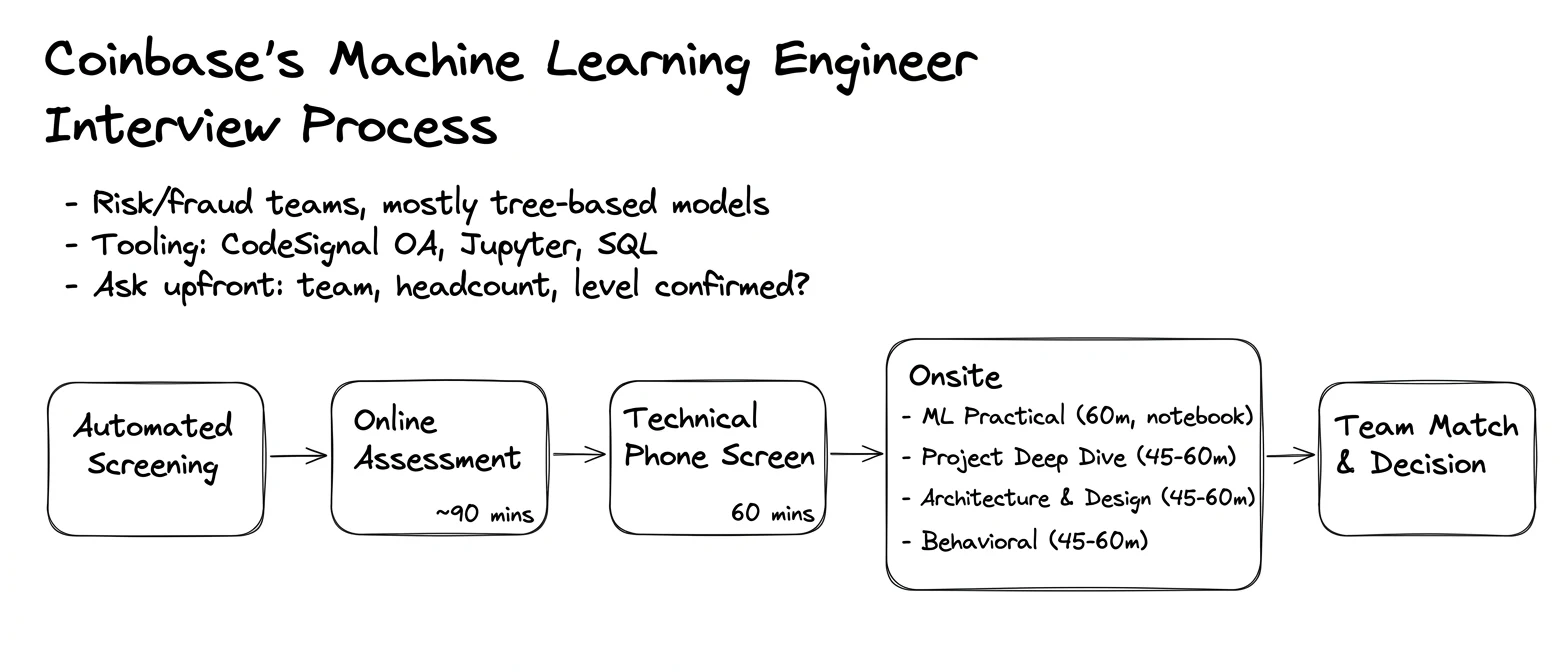
Most reported openings sit on risk teams that fight fraud, scams and account takeover, so the loop tests classical, tree-based modeling done correctly and quickly rather than deep-learning research. Some candidates finished every automated step before speaking to anyone; others had a short recruiter call first.
Once a team is committed, the process moves fast: one candidate went from first recruiter contact to a finished onsite in under two weeks. Early-career candidates are filtered mainly by the assessment; for senior candidates the project presentation and design rounds carry more weight.
Here's what the interview process can look like:
- Automated screening: A work-style inventory, a timed reasoning test and, for some candidates, a pre-recorded AI-led interview.
- Online assessment: One timed sitting, typically around 90 minutes, with ML multiple choice, a hand-computed network output, an algorithm problem and from-scratch ML implementations.
- Technical phone screen: A straightforward ML coding exercise followed by a medium SQL problem.
- Machine learning practical (onsite): A classification model built on a messy dataset in a shared notebook.
- Project presentation and deep dive (onsite): A walkthrough of your proudest project, as slides or a resume-driven conversation.
- ML system design and depth interview (onsite): Design and ML theory, sometimes combined with debugging and AI-assisted coding.
- Behavioral interview (onsite): Decisions, challenges and impact, explored through your own projects.
Tip: Ask the recruiter which team you are being run for and whether its headcount is confirmed before you sit the assessment. Candidates have been closed out after passing because no team had a slot.
Automated screening
Before any technical work, candidates complete a personality and work-style questionnaire and a timed cognitive test. The test mixes verbal fill-in-the-blank items in a graduate-admissions style with quantitative and logical reasoning, and the time limit is the real difficulty. One candidate also sat an automated interview with pre-recorded prompts.
Interviewers look for:
- Speed under a hard timer: The reasoning section rewards items finished, so skipping one hard vocabulary item beats stalling on it.
- Consistency in the inventory: Contradictory answers across similar items read worse than any single preference.
- Concise, specific answers: In the AI-led interview, concrete examples of your work rather than general claims.
Do a few timed graduate-admissions verbal and quantitative sets first, so the pace is not a surprise.
Online assessment
The assessment is one timed sitting with a separate limit for each section. Three of the four reported versions shared one structure; the fourth used standard algorithm problems instead of ML tasks. The ML version opens with about six multiple-choice questions, then one fill-in answer, one algorithm problem, and two or three ML algorithms implemented from scratch.
The multiple choice covers recall and false-positive rate from a confusion matrix, the logistic-regression loss, which interventions raise bias while cutting variance, ensemble trade-offs, and PCA versus LDA. The fill-in is a two-layer forward pass with ReLU and sigmoid. The algorithm problem is easy to medium, such as a local maximum in an array or the longest run of one character with ties going to the rightmost run. The from-scratch tasks rotate through bootstrap resampling used to fit and predict, a bagging classifier over a supplied base learner, k-means with a caller-supplied distance function, a random forest, and a decision tree splitting on information gain under a custom purity formula instead of Gini.
Interviewers evaluate:
- Mechanics, not libraries: Credit depends on correct sampling with replacement, centroid updates and split selection written by hand.
- Following the stated formula: Using Gini where the prompt defines its own purity, or Euclidean distance where a function is passed in, fails hidden tests.
- Edge cases: Empty clusters, ties in splits and votes, and iteration limits.
- Triage: The heavy implementations come last, and they decide the score.
Practice writing bagging, k-means, a decision tree and a random forest in plain Python and NumPy in under 20 minutes each.
Note: The most reported failure is spending too long on the early algorithm problem and leaving too little time for the bagging and clustering tasks. Answer the multiple choice and the forward pass quickly, then protect your implementation time.
Sample questions for the online assessment
Here are some questions reported by recent candidates:
-
Return the longest run of a single repeated character and its length, choosing the rightmost run on a tie.
-
Implement a bagging classifier from a base classifier and labeled data, then predict by vote.
-
Implement k-means clustering where the distance function is supplied by the caller.
-
Build a decision tree that splits on information gain under a custom impurity formula, with a predict method.
Technical phone screen
The screen is a live session with an engineer, split in two: a straightforward ML coding exercise, then a medium SQL problem needing window functions and subqueries. The SQL half reflects the job: risk modelers build their own features and labels from event tables.
Interviewers evaluate:
- Window-function fluency: Ranking, running totals and per-group deduplication, correct on the first pass.
- Stated assumptions: How you treat duplicates, nulls and ties before the query depends on them.
- Clean ML code: Readable, vectorized functions plus a quick sanity check of the output.
Drill medium window-function SQL until ranking-per-group and running-aggregate queries take under ten minutes.
Sample questions for the technical phone screen
Here are some questions reported by recent candidates:
-
A simple ML coding task, implemented and checked on a small input.
-
A medium SQL problem combining window functions with a subquery.
Machine learning practical
This is pair programming in a Jupyter notebook on a deliberately messy tabular dataset, ending in a classification model. The candidate who described it said the focus was pragmatic feature selection and a simple, working solution rather than complex modeling, and interviewers helped with minor typos. Public accounts describe up to two such rounds.
Interviewers evaluate:
- Data triage: Profiling columns, handling missing values and odd types, and dropping features that leak the label.
- Feature selection with reasons: Why each kept feature should predict a risk-style label.
- Fitting validation: A time-aware split when the data is temporal, and a metric suited to an imbalanced class.
- A baseline that runs: A tree-based or logistic model working end to end before any tuning.
Rehearse a full clean, split, train and evaluate pass on an unfamiliar messy dataset in 45 minutes, narrating each choice.
Tip: Build the plain baseline first and improve it only if time remains. A simple model with defended cleaning, split and metric beats an elaborate pipeline.
Sample questions for the machine learning practical
Here are some questions reported by recent candidates:
-
Given a messy labeled dataset, clean it, select features and train a classifier within the hour.
-
Keep the model simple and justify the features you selected rather than reaching for complex modeling.
Project presentation and deep dive
Some loops open the onsite with prepared slides on the project you are proudest of: technical decisions, your contribution and measured impact. Others run it as a resume-driven conversation. Either way the interviewer pushes several layers past the summary.
Interviewers evaluate:
- Personal ownership: What you decided and built, separated from the team's work.
- Modeling rationale: Data quality, model choice, validation split and the metric you optimized.
- Impact with numbers: Risk or business metrics moved, not only offline accuracy.
Prepare a 10 to 15 minute deck on one production ML project, with backup detail on data, validation and deployment.
Sample questions for the project presentation and deep dive
Here are some questions reported by recent candidates:
-
Present the project you are proudest of, then defend its key technical decisions and your specific contribution.
-
Walk through a resume project: the challenges you hit and the impact the work had.
ML system design and depth interview
The onsite includes system design and deeper ML theory; candidates were not permitted to share exact prompts, but the teams' work points to risk systems. Expect real-time and batch scoring of transactions or logins, the cost of false positives against false negatives, feature freshness, and retraining when a new attack appears. Risk postings describe turning temporary rules into production models in under a week, so iteration speed is fair game.
A related variant packs three tasks into one session: debug an anomaly in a distributed system, sketch the architecture for a new high-throughput feature, then write production-quality code with an AI pair programmer while interviewers watch how you steer and verify it.
Interviewers evaluate:
- Error-cost reasoning: Thresholds and metrics chosen from the cost of blocking a good user versus missing fraud.
- Data and feature flow: Online and offline consistency, label delay, and how reports and chargebacks become training data.
- Operating the model: Drift monitoring, shadow deployment and rollback.
Practice one end-to-end fraud or account-takeover design that opens with the cost of each error type before any components.
Sample questions for the ML system design and depth interview
Here are some questions reported by recent candidates:
-
Debug a subtle anomaly in a distributed system from logs and metrics, then design a new high-throughput feature.
-
Build a small feature with an AI assistant, catching the subtle bugs in its output.
Behavioral interview
The behavioral round is conversational. The interviewer digs into the projects on your resume, asking about specific technical decisions, the challenges you faced and the impact of the work, so technical follow-ups are common. Coinbase's mission-first culture shows up as questions about moving fast in a regulated, security-critical domain.
Interviewers look for:
- Ownership: Problems you drove to a result without being assigned.
- Integrity under pressure: Holding a line on correctness when a deadline pushes the other way.
- Mission alignment: A real reason to work on an open financial system and protect its users.
Prepare five or six stories with metrics, a disagreement and a mistake, and tie at least one to fraud or user protection.
Sample questions for the behavioral interview
Here are some questions reported by recent candidates:
-
Elaborate on a specific technical decision in a resume project and the challenges it created.
-
Explain the impact of your past work and how you measured it.
How Coinbase levels and evaluates Machine Learning Engineer candidates
Each loop is run for a specific team, and the hiring manager decides after the panel debrief. The target level is set before the onsite and tracks the posting: mid-level risk ML postings ask for about four years of experience, and senior postings add ownership of a whole risk domain. Passing is separate from whether a team has headcount at your level.
How to prepare for the Coinbase Machine Learning Engineer interview
- Confirm the team first: Ask which team, level and headcount you are being run for, since a pass without an open slot still ends the process.
- Implement classical ML from scratch: Bagging, bootstrap, k-means with a pluggable distance, decision trees with a custom impurity and random forests.
- Make theory instant: Confusion-matrix arithmetic, logistic loss, bias and variance moves, PCA versus LDA and a ReLU and sigmoid forward pass.
- Rehearse the time split: Take a mock assessment with section timers and practice moving on from the algorithm problem.
- Drill window-function SQL: Ranking within groups, running totals and deduplication, with stated assumptions.
- Practice the messy-notebook hour: Clean, split by time, fit a tree-based baseline and choose an imbalance-aware metric, aloud.
- Prepare one presentation-grade project: Slides plus backup detail on data, validation, deployment and measured impact.
- Frame designs by error cost: Open fraud designs with the cost of each error type, then cover feature freshness, retraining and monitoring.
About the Coinbase Machine Learning Engineer role
Coinbase Machine Learning Engineers mostly build and run production models rather than doing research. Risk teams work in small groups, each improving one core model family on a centralized platform with a feature store, CI/CD pipelines and model serving, and act on threat data from risk operations within days. The company is remote-first but not remote-only, with in-person offsites several times a year.
| Level | Primary focus | Impact scope |
|---|---|---|
| IC4 (Machine Learning Engineer) | End-to-end model delivery on the existing platform | One model family within a team |
| IC5 (Senior Machine Learning Engineer) | Technical ownership of a risk domain such as scams or account takeover, plus mentoring | All models in a domain |
| IC6 (Staff Machine Learning Engineer) | Technical strategy for a platform or a portfolio of projects | Several teams |
Coinbase hires Machine Learning Engineers across several groups. Teams include:
- Risk AI/ML: Scam, transaction risk, withdrawal-limit and account-takeover models, run in real time, near real time and on schedules.
- ML Platform: Productionizing and operating models and pipelines at scale in the platform product group.
- AI/ML Risk Platform: Shared feature, training and serving infrastructure for risk models.
- CX Intelligence: ML applied to customer support and experience.
Machine Learning Engineer experience and education requirements
Mid-level risk postings ask for about four years of software engineering or ML experience including production deployment, Python with TensorFlow or PyTorch, and familiarity with risk modeling, anomaly detection, NLP or recommender systems. A related bachelor's degree is preferred, not required. Pluses include feature stores, model serving, Spark, Kafka, LLM work and MLOps.
FAQs about the Coinbase Machine Learning Engineer interview
How long does the Coinbase Machine Learning Engineer interview process take?
It can be very short when a team is ready to hire: one candidate went from recruiter contact to a completed onsite in under two weeks. It can stop at any point if no team has an opening.
What is the hardest round of the Coinbase Machine Learning Engineer interview?
The online assessment. No other round makes you switch between theory recall, hand computation, an algorithm problem and from-scratch ML implementations under section timers.
How much does a Coinbase Machine Learning Engineer make?
Posted US base ranges for senior ML platform roles have run about $186K to $225K. Offers add equity and bonus eligibility, so total compensation is well above base.
Does Coinbase test deep learning?
Rarely. Reported rounds focus on classical ML, tree-based models, SQL and production judgment; the only network question is a small forward pass computed by hand.