Coinbase · Study
Coinbase Interview Process & Questions
TrueInterview
July 24, 2026 · 11 min read
Coinbase screens hard before any engineer joins the call: an AI-led recruiter interview, a long work-style inventory and a speeded cognitive test. After that, nearly every technical round is a build from an empty file where you write the classes, signatures and tests yourself. The final gate is a team, not a committee, and candidates who cleared every round were still turned away when no team at their level had headcount.
This guide breaks down each stage of the Coinbase interview, what interviewers evaluate in each round, and how to prepare, with questions candidates were actually asked.
Verified: Based on 45 candidate-reported interview experiences, cross-checked against recent public accounts.
Coinbase interview process
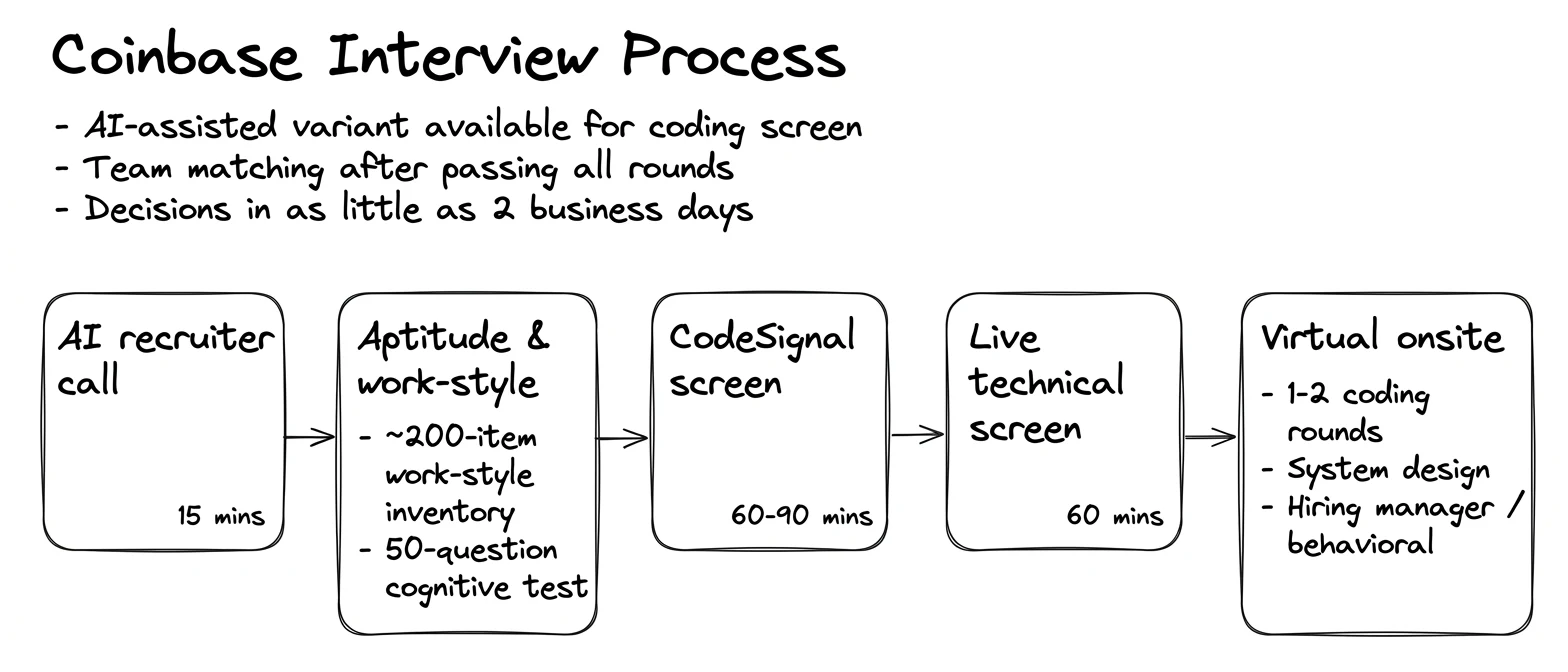
Each team hires for itself, so the coding pool stays narrow while design prompts follow the product. The usual path is automated screening, a coding assessment, one to four technical screens, and a virtual onsite of three or four rounds; one loop finished in under two weeks.
One L4 candidate got a scaled-down assessment, while senior and staff loops probe scope and promotion history harder. Frontend loops use named rounds (Execution, Foundation, Domain, System Design), and machine learning loops swap the build for ML theory and from-scratch algorithms.
Here's what the interview process can look like:
- Automated screening: An AI-led recruiter interview, a work-style inventory of about 200 items, and a speeded cognitive test.
- Online assessment: One progressive build in four levels, or a 60-minute AI-assisted game-agent task.
- Technical phone screens (one to four): 60-minute live builds or two medium problems, with escalating follow-ups.
- Coding interviews: One or two onsite rounds from a small, repeating pool: pagination, block mining, order state machines.
- AI-assisted coding round (some 2026 loops): Debugging, feature design, log analysis and pull-request review with an assistant on screen.
- System design interview: Product-anchored prompts such as a live price page, a crypto ledger, or exchange order flow.
- Hiring manager interview: A project deep dive with direct questions on level, promotion and daily AI use.
Tip: Every live round rewards the same habit: pin down the interface before typing, then write your own tests out loud. Candidates who left signatures vague lost time to rework even when their algorithm was right.
Automated screening
The first touchpoints are often not human: an AI-driven interview with pre-recorded prompts, a questionnaire probing communication and appetite for intense work, and a timed cognitive test of sentence completion, number patterns and figure sequences. One version ran 50 questions in 30 minutes; others describe a tighter clock. All tracks take these screens, often alongside the coding assessment, and a later recruiter call may redirect you to another role.
Interviewers look for:
- Speed under a hard clock: Guessing costs nothing, and stalling on one obscure vocabulary item costs several easy ones.
- Culture alignment: Answers consistent with a high-intensity, mission-driven workplace.
- Level and fit: The target band and which team or role you match.
Do one timed practice run of a 50-question aptitude test so the pace is not a surprise.
Sample questions for the automated screening
Here are some questions reported by recent candidates:
- Complete sentences with the most fitting, sometimes obscure, vocabulary word.
- Find the missing number in a sequence, or pick the next figure in a series.
- Rate statements about consistency, hard work and direct communication.
Online assessment
The software engineer assessment is one problem revealed in four levels, about 60–90 minutes, with partial credit: one candidate solved three of four levels and advanced. Themes rotate: a recipe manager with versioned rollback, a wallet with scheduled payments and account merges, cloud storage that evicts the largest files when a quota drops, a database with expiry and backups, and, in late 2026, a task manager replacing the payments theme.
A newer 60-minute variant asks for a jump-or-not function for a Flappy Bird-style game, with a built-in AI assistant, copy-paste disabled and a visual replay; one candidate advanced with 16 of 20 tests. Frontend candidates build a React app in steps instead, and machine learning candidates get ML multiple choice, a hand-computed forward pass, and k-means or a decision tree from scratch.
Interviewers evaluate:
- Code volume under time: The algorithms are easy to medium; wiring a lot of state quickly is the bottleneck.
- Forward-compatible state: The data shape chosen at level one decides whether level four is ten lines or a rewrite.
- Self-testing: Each level exposes about ten tests and skips boundaries such as expiry at the exact timestamp.
- Policy iteration (AI variant): A lookahead strategy with an emergency-jump override, tuned from the replay.
Rehearse a four-level build from an empty file against a 75-minute timer.
Note: The built-in assistant was described as laggy and often wrong. Candidates who passed treated it as optional and debugged from the replay rather than the terse failure messages.
Sample questions for the online assessment
Here are some questions reported by recent candidates:
-
Build a wallet with transfers, then rank top spenders, then schedule and cancel delayed payments, then merge accounts.
-
Lower a user's storage capacity and evict files largest-first until they fit.
-
Decide each frame whether a bird should jump when every flap costs one of a limited supply of coins.
Technical phone screens
Screens run 60 minutes and fit either two medium problems or one domain build with three or four follow-ups. Reported prompts include a thread-log parser, NFT generation by rarity weight, a key-value store with per-user locks, and an order state machine followed by offset-versus-cursor pagination. One senior candidate sat four screens back to back. Machine learning screens pair simple ML coding with medium SQL using window functions.
Interviewers evaluate:
- Data-structure choices out loud: One candidate was marked down for a list of orders per state instead of a state-to-map-by-ID structure.
- Contract definition: Inputs and outputs are deliberately vague, and pinning them down is graded.
- Debugging pace: A rejected candidate ran out of time fixing errors on the NFT problem's third level.
- Production follow-ups: Concurrency, idempotency and pagination trade-offs once the core works.
Practice one-hour builds that absorb three follow-ups without a restructure.
Sample questions for the technical phone screens
Here are some questions reported by recent candidates:
-
Parse log lines, group them by thread ID and sort each group chronologically.
-
Generate unique NFTs from JSON attribute lists, then sample by rarity weight.
-
Track per-key operation counts in a key-value store with user locks and return the top N keys.
-
In-Memory DB with per-key user lock: setByUser/deleteByUser/lock/unlock
Coding interviews
Onsite coding is one or two rounds of 45–60 minutes with no class templates and often no test cases. Three families dominate: pagination (forward and backward cursors, invalid cursors, an API you specify yourself); block mining (maximize fees in a fixed-size block, then respect parent-child dependencies via depth-first search over complete paths); and a crypto order system with place, pause, resume and cancel, extended to multiple users and user-partitioned streams. Some 2026 loops added conventional problems judged on maintainability, such as a cooldown task scheduler and a moving-average tracker.
Interviewers evaluate:
- Production-minded answers: On block mining, interviewers prefer a greedy fee-per-size sort to dynamic programming, and one variant banned heaps.
- Explicit state machines: Valid transitions defined before code; illegal ones return cleanly.
- Unprompted tests: Recruiters have advised writing test cases proactively.
- Engineering follow-ups: Floating-point drift, thread safety, and which line a future maintainer would break.
Drill pagination, block mining and order lifecycles until each takes under 30 minutes.
Tip: Engagement varies widely: some interviewers help debug typos, others stay silent for the hour. Practice narrating and self-testing as if no one will prompt you.
Sample questions for the coding interviews
Here are some questions reported by recent candidates:
-
Select transactions to maximize fees in a block of size 100, then honor parent-child dependencies.
-
Implement forward and backward cursor pagination, including invalid cursors and past-the-end requests.
-
Manage crypto orders through live, paused, completed and canceled states, then add cancel-all per user.
AI-assisted coding round
Since early 2026, some loops add a screen-shared round, sometimes billed as an AI Enhanced Pilot, where an assistant sees the task and your open files. One version had four parts on a transaction pager: fix a buggy sort, design a new sort order, find from logs why a request timed out (a missing index), and review a colleague's pull request.
Interviewers evaluate:
- Verification: Catching wrong suggestions instead of pasting them in.
- Structured debugging: From logs and metrics to a root cause, with fixes both with and without schema changes.
- Trade-off reasoning: Offset versus cursor designs and how keys affect correctness.
- Time management: Each part has many sub-questions, and candidates report running short.
Practice reading unfamiliar code with an assistant, and decide in advance when to write the fix yourself.
Sample questions for the AI-assisted coding round
Here are some questions reported by recent candidates:
-
Debug a paginator that mishandles timestamp ties and malformed cursors without breaking existing clients.
-
Explain from logs why a sort-by-amount request times out, and how to fix it without adding an index.
System design interview
Prompts stay close to the product. The most frequent is a live price page like Coinbase Explore: external feeds over WebSockets, real-time updates to many clients, push versus polling. Others include a crypto ledger, order flow through a third-party matching engine, a ring buffer with backpressure, and blob storage on the moon. Frontend candidates design a signup form or a trading UI.
Interviewers evaluate:
- Product-specific requirements: One rejected candidate blamed a generic brokerage template applied before clarifying the real-time needs.
- Operational depth: Backpressure, replay after restart, idempotency, monitoring and load testing.
- Coverage, then depth: Some interviewers expect every subsystem outlined before any deep dive.
- Proactive driving: Several interviewers barely answered clarifying questions.
Prepare the price page and ledger end to end, including failure modes and metrics.
Note: Design rejections cluster on shallow production answers, not missing boxes. One candidate who drew a clean ring buffer failed on deployment, restart recovery and observability.
Sample questions for the system design interview
Here are some questions reported by recent candidates:
-
Design a page showing the latest asset prices from multiple external sources, updating in real time.
-
Design order flow that routes to external exchanges through a third-party matching engine.
-
Design a ring buffer for producers and consumers at different speeds, then deploy and monitor it.
Hiring manager interview
The manager round is a project deep dive plus behavioral questions; machine learning candidates sometimes present slides on their proudest project. Expect follow-ups on trade-offs, your own contribution and what you would redesign with unlimited resources, plus cross-team conflict, missed deadlines and daily AI use. Managers ask your level and promotion timeline directly; one told a candidate the chosen project was not a tier-0 service.
Interviewers evaluate:
- Scope for the level: A staff candidate found a narrow project gave too little to discuss.
- Business criticality: Why the project mattered, in impact rather than technology.
- Ownership and testing philosophy: When skipping tests is acceptable, and how incidents were handled.
- AI fluency: Concrete, current use of AI tools.
Pick your largest-scope project and rehearse it against "why was this critical?"
Sample questions for the hiring manager interview
Here are some questions reported by recent candidates:
-
Describe your most challenging project, then how you would rebuild it with unlimited resources.
-
What would you do if you could not meet the deadline of an important launch?
-
How do you use AI in your day-to-day workflow?
How Coinbase makes hiring decisions
Hiring is decentralized: the hiring team's manager decides after the loop, comparing finalists at the same level, so passing is necessary but not sufficient. One machine learning candidate cleared the assessment and was rejected in the same call because no team was available, and others told they were very strong were still declined. Decisions can arrive within two business days, and postings cap applicants at three applications in six months.
Tip: Ask the recruiter early which team you are interviewing for and whether headcount is confirmed at your level.
How to prepare for the Coinbase interview
- Clear the gates fast: Take one timed 50-question aptitude test, and answer the culture inventory consistently.
- Rehearse four-level builds: Start from an empty file and add search, users, versioning or expiry without regressions.
- Drill the recurring trio: Cursor pagination, greedy block mining with dependencies, and order state machines.
- Test without being asked: Cover exact-boundary timestamps, duplicate operations and empty results, aloud.
- Practice with a flawed assistant: Debug unfamiliar code with an AI tool and override it when it is wrong.
- Design for operations: Prepare backpressure, replay, idempotency and monitoring for the price page and ledger.
- Defend your level: Bring a large-scope project and a clear account of why it was business-critical.
About working at Coinbase
Coinbase runs exchange, custody and payments businesses and the Base network under heavy regulatory and security requirements, hence the interview focus on idempotency and reconciliation. Many roles are remote-first, with periodic in-person sessions. In May 2026 the company cut about 14% of staff and reorganized around small AI-native teams.
| Level | Primary focus | Impact scope |
|---|---|---|
| IC4 (Software Engineer) | Shipping well-defined features and services | Tasks within one team |
| IC5 (Senior Software Engineer) | Owning services end to end and leading projects | One team's systems |
| IC6 (Staff Software Engineer) | Cross-team technical direction | Several teams or a product group |
Coinbase hires engineers across its consumer, platform and developer businesses. Teams include:
- Consumer products: The retail app, growth and consumer risk.
- Platform: Core infrastructure, identity and the financial ledger.
- Developer products: Onchain and stablecoin payments APIs.
- Blockchain platform: Node infrastructure and the Base network.
- Data and risk: Data infrastructure and machine learning teams that mostly use tree-based models.
Experience and education requirements
Senior backend postings ask for five to six or more years of experience, often with Go or Ruby and production service-oriented systems; junior backend roles also exist. Crypto knowledge is a plus rather than a requirement, though some design rounds assume familiarity with exchanges and wallets.
FAQs about the Coinbase interview
How long does the Coinbase interview process take?
Fast loops finish in under two weeks from recruiter contact to the end of the onsite; others stretch over several weeks of screens.
What is the hardest round of the Coinbase interview?
Many candidates name the progressive online assessment for its code volume and clock. At senior levels, rejections cluster in system design and the manager's calibration of scope.
How much does a Coinbase software engineer make?
Posted US base ranges are about $186K–$219K for senior software engineers and about $254K–$299K for senior staff. Offers add equity and bonus eligibility.
Is the Coinbase interview remote?
Yes. Screens and onsites are held by video.