Study
Is Classic DP Still Asked in Big Tech Interviews in 2026?
TrueInterview
October 19, 2026 · 15 min read
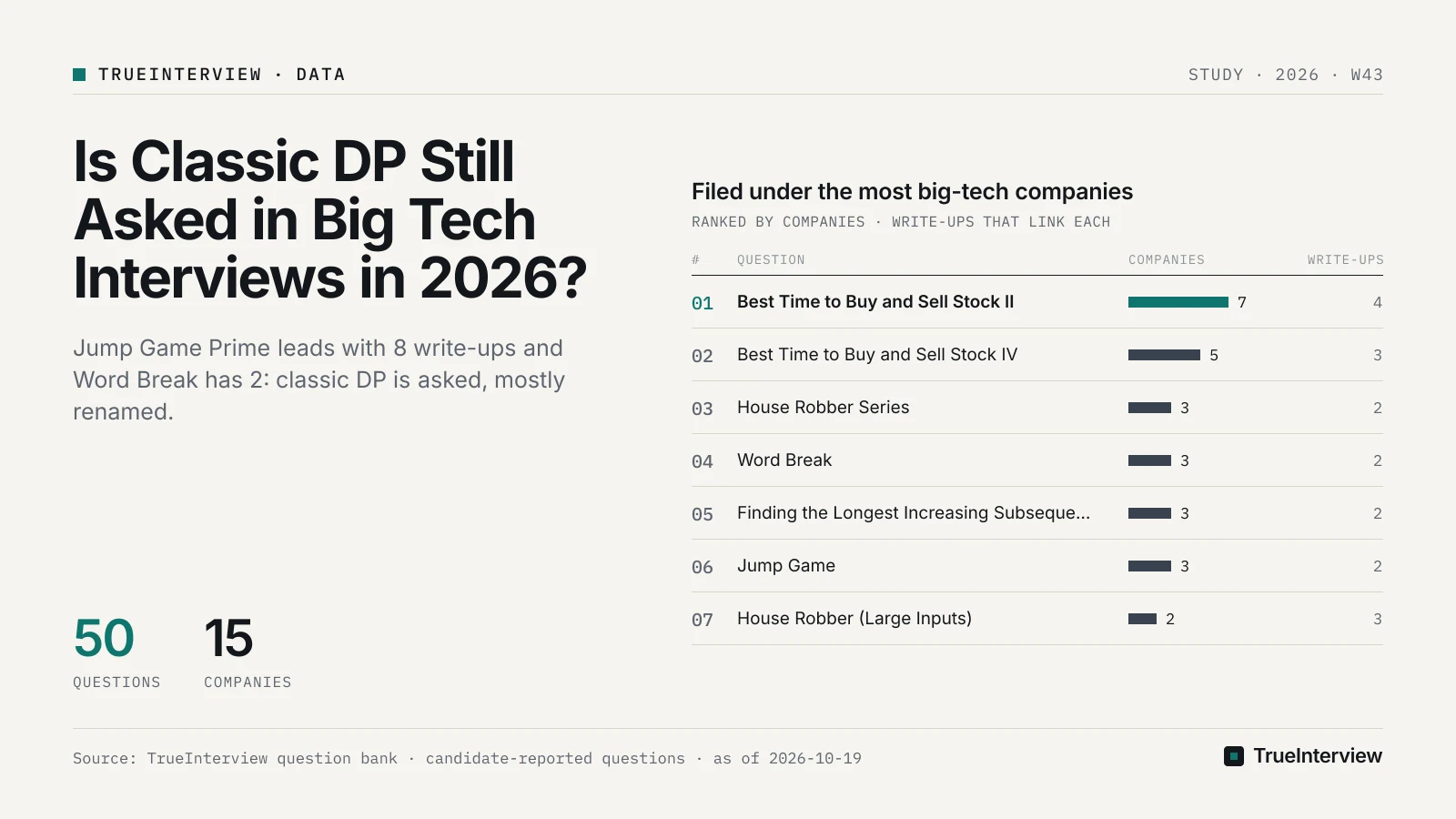
Yes, classic DP is still asked, and the most-linked items are renamed company prompts and the stock-trading family, with Coin Change and Word Break reported less often. As of 2026-10-19, TrueInterview's bank holds 50 classic DP questions reported at 15 big-tech companies, and 45 of them were last reported within the previous 12 months. Dynamic programming is the top tag on both the phone-screen and the onsite questions in that set. Our view: drill the families behind those items and the DP-or-greedy call rather than a list of famous titles.
Disclosure: TrueInterview is an interview-preparation product and publishes this article. Facts about other products come from their public pages on the dates listed under Sources.
Is classic DP mainly an online-assessment hurdle?
No. Across the reported rounds for these questions, phone screens account for 22 and onsites for 17, against 14 online assessments, and one question can be reported in more than one round. Dynamic programming leads the tags on 11 of the 22 phone-screen questions and on 11 of the 17 onsite questions.
Rehearse for a live interviewer, not a test harness. A phone screen puts an interviewer in front of you while you define a state and defend a recurrence, which an OA's hidden tests never ask for. Do not park DP until after your OA: practise one family per session out loud, at phone-screen pace, and say the recurrence before you write it.
The runners-up differ by round. On phone screens greedy comes second with 6 questions, while onsites add strings (5) and arrays (5). If your next round is a phone screen, pair each DP family with its greedy counterpart; if it is an onsite, add string DP such as Word Break and subsequence problems.
These are candidate-reported questions reconstructed for practice, not any company's official list, and a count measures what candidates wrote up rather than how often a company asks.
Which classic DP questions do candidates actually report?
The most-linked items are renamed or company-specific prompts and the stock-trading family, not Coin Change. Jump Game Prime is linked from 8 candidate write-ups, all from Uber, and Collect Coins on 1D Board from 5, all from Google. The table ranks the set by write-up links and shows one reported round for each.
| Question | Companies in the linked write-ups | Write-up links | A reported round | Practise |
|---|---|---|---|---|
| Jump Game Prime | Uber | 8 | Uber OA, last reported 2026-06 | Jump Game Prime |
| Collect Coins on 1D Board | 5 | Google OA, last reported 2026-05 | Collect Coins on 1D Board | |
| Best Time to Buy and Sell Stock II | ByteDance, Meta, Uber | 4 | Apple phone screen, last reported 2026-08 | Best Time to Buy and Sell Stock II |
| Best Time to Buy and Sell Stock IV | Lyft, Microsoft | 3 | Meta phone screen, last reported 2026-08 | Best Time to Buy and Sell Stock IV |
| Best Time to Buy and Sell Stock | Oracle | 3 | Oracle OA, last reported 2026-08 | Best Time to Buy and Sell Stock |
| House Robber (Large Inputs) | Meta, ByteDance | 3 | ByteDance phone screen, last reported 2026-05 | House Robber (Large Inputs) |
| Optimize Transition from Elevator to Stairs | Uber | 3 | Not in our round examples | Optimize Transition from Elevator to Stairs |
| Biased Coin to Uniform Range | 3 | LinkedIn phone screen, last reported 2026-09 | Biased Coin to Uniform Range | |
| Word Break | Filed under Uber, ByteDance, Meta | 2 | Not in our round examples | Word Break |
| Coin Change (LC 322) | No link count in our data | Pinterest onsite, last reported 2026-09 | Coin Change |
Read the top two rows with care. Jump Game Prime and Collect Coins on 1D Board each come from one company's write-ups, so they tell you a lot about an Uber or Google OA and little about big tech as a whole. The rows that travel across companies are the stock family and House Robber, which is why the plan below starts there.
Do interviews ask Coin Change and Word Break constantly?
Our bank cannot confirm it. Techinterview's Coin Change page says the problem "appears at Google, Amazon, Facebook, and Microsoft interviews constantly", and its Word Break page says that one "appears frequently at Google, Amazon, and Facebook". The quoted sentences give no count, date or round.
Our bank records a thinner trail, and its counts are of write-ups, not of how often companies ask. Word Break is filed under three big-tech companies, Uber, ByteDance and Meta, and one of its 2 write-up links comes from a senior-or-above candidate. Coin Change does appear: a Pinterest onsite report lists Coin Change (LC 322), last reported in 2026-09. The author of a Medium DP series describes Coin Change as "one of the most commonly asked DP problems in interviews", which is one writer's view rather than a count.
The data behind this article has no count for a question titled knapsack, so it cannot tell you knapsack is never asked. What it shows is that the reported questions carry other titles, and the classic structure sits underneath them.
Our take: the famous titles are overrated as a target, and the patterns behind them are underrated. The same Medium author describes the real test this way: "If you can see coin change in Word Break, you're thinking in patterns". Practise reading an unfamiliar statement, such as Jump Game Prime, and naming the state in one sentence before you look for a familiar title.
Why should the stock-trading family come first?
Because it is filed under more companies than any other question named here. Best Time to Buy and Sell Stock II is filed under 7 big-tech companies (Apple, Amazon, ByteDance, Google, Meta, Microsoft and Uber), and Best Time to Buy and Sell Stock IV under 5 (Meta, Amazon, Apple, Lyft and Microsoft). Word Break, for comparison, is filed under 3.
Treat the three stock problems as one unit, in this order:
- Best Time to Buy and Sell Stock, reported in Oracle's OA, last in 2026-08. One pass that tracks the lowest price so far is enough; the DP reading is a single state, the best profit if you sell today.
- Best Time to Buy and Sell Stock II, reported in an Apple phone screen, last in 2026-08. Unlimited transactions make a greedy pass correct: add every positive day-to-day rise. Say why greedy works before you write the two-state version (holding or not holding), because the natural follow-up is a cap on the number of trades.
- Best Time to Buy and Sell Stock IV, reported in a Meta phone screen, last in 2026-08. A cap of k transactions breaks the greedy pass, so the state becomes the day, the transactions left and whether you hold a share. Once k reaches half the number of days, the cap stops binding and the problem collapses back to II.
Our take: these three problems teach one recurrence with a growing state, and that skill transfers directly to House Robber and Jump Game. If you have one free evening this week, spend it here rather than on a long list of named problems.
House Robber is the second family to add. House Robber Series is filed under Databricks, Amazon and Meta, with a Databricks phone-screen report last dated 2026-07. The recurrence fits in one line: the best total up to a house is the larger of skipping it, or robbing it plus the best total two houses back. Jump Game is filed under 3 companies and linked from 2 write-ups; a greedy furthest-reach pass solves the yes-or-no version, which is the DP-or-greedy call again.
Which companies lean on DP, and which lean on greedy?
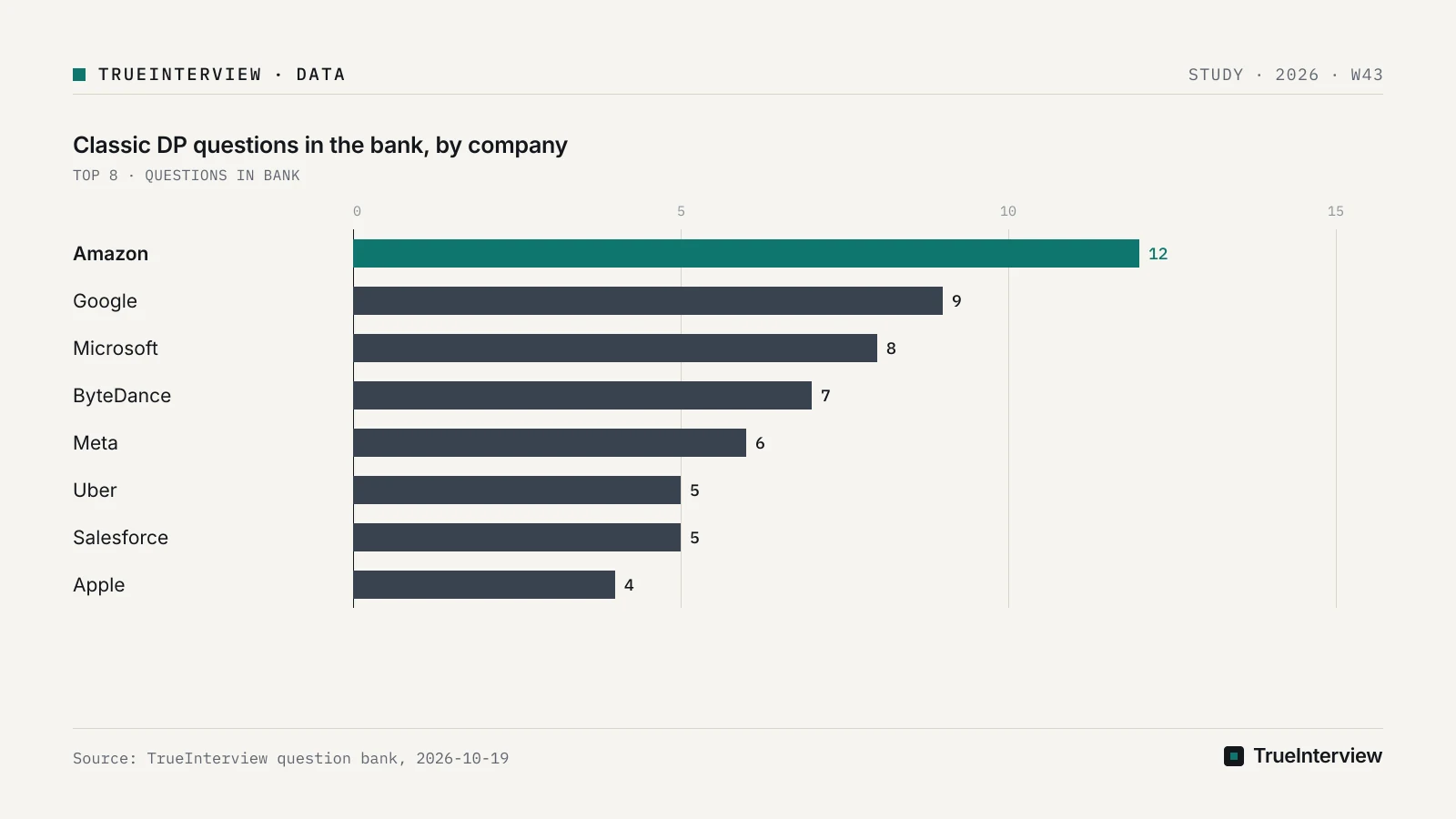
Amazon has the most DP-tagged questions, Meta's smaller set is the most DP-heavy by share, and Google's leans away from DP. Of the 12 classic DP questions filed under Amazon, 7 carry the dynamic-programming tag, and 4 of Meta's 6 do, while Google's 9 carry 2 DP tags against 5 arrays and 4 greedy. The same title list therefore means different preparation at each company.
| Company | Classic DP questions filed | DP tag | Greedy | Arrays | Strings | Prepare first (our view) |
|---|---|---|---|---|---|---|
| Amazon | 12 | 7 | 3 | 3 | 3 | Stock and House Robber families |
| 9 | 2 | 4 | 5 | 0 | Greedy proofs and array problems that look like DP | |
| Microsoft | 8 | 4 | 4 | 3 | 2 | DP and greedy in equal measure |
| ByteDance | 7 | 4 | 3 | 1 | 1 | One-dimensional DP, then greedy |
| Meta | 6 | 4 | 2 | 2 | 1 | Stock IV and House Robber |
| Uber | 5 | 2 | 1 | 1 | 1 | Small, mixed set; practise the renamed prompts |
Salesforce (5), Apple (4), Oracle (3) and Databricks (2) complete the top ten, with too few questions to read a topic mix into. Tags overlap, so a row's tag columns do not sum to its question count.
Decision rule (our view): if your loop is at Amazon, Meta or ByteDance, put the one-dimensional DP families first, starting with stock trading and House Robber. If it is Google, give greedy and array problems that look like DP at least as much time as DP tables, and start with Collect Coins on 1D Board. At Microsoft, split the time evenly. Before your next session, filter the practice bank to your target company and drop any DP title that has no row for it.
How often is a classic DP question really a greedy question?
Judged by tags, 14 of the 50 questions carry a greedy tag, some alongside dynamic programming, which only 25 carry. A greedy pass is therefore worth checking in more than a quarter of the set, even when the question is filed as classic DP.
Greedy-tagged questions appeared in every quarter's write-up links: 40% in 2025-Q4, 13% in 2026-Q1, 39% in 2026-Q2 and 32% in 2026-Q3, on 6, 2, 7 and 7 links. Those samples are small, so read them as presence rather than a trend; in three of the four quarters, about a third or more of the links went to greedy-tagged questions.
The Medium author's Coin Change write-up gives the standard counterexample: with coins [1, 3, 4] and amount 6, greedy "picks 4 first, then needs two 1s: three coins total", while 3 + 3 uses two coins. That one case is worth memorising, because it is the fastest way to show an interviewer you checked greedy before reaching for a table.
Our take: for every DP problem you practise, say in one sentence why greedy fails or works before you code. At Google, where the filed set leans toward arrays and greedy, a clean exchange argument for a greedy pass is worth as much as a memo table.
How should you write a DP answer in the interview?
Recursion first, then the state, then the memo, and a table only if time allows. AlgoEngineer's guide recommends that exact route: "write the brute-force recursion, name the state, cache it, and only then flatten it into a table". On Coin Change, that means a recursion over the remaining amount, the state named as the fewest coins for that amount, then a memo keyed on the amount.
The same guide says "Almost every DP that comes out wrong in a mock interview is wrong at the state, not the loop bounds". AlgoEngineer's guide advises saying the state out loud in one sentence before writing any loop, and the guide warns that candidates who start at the table "usually cannot explain their own recurrence" when the follow-up questions arrive. For complexity, the guide's rule is to count the reachable states, count the work in one transition and multiply.
Here is what a one-sentence state sounds like for the families above (our wording):
- Coin Change: the fewest coins that make amount a.
- Word Break: whether the first i characters split into dictionary words.
- House Robber: the best total using houses up to i.
- Best Time to Buy and Sell Stock IV: the best profit on day d with t transactions left, holding a share or not.
Our take: if you cannot say the state in one sentence, do not start the table. The memo version is usually the safer interview answer, and the guide credits it with "being written correctly in four minutes" and visiting only reachable states.
What changes at senior and staff level?
Senior candidates still report classic DP. Candidate write-ups link these questions 28 times from candidates who reported a senior, staff-plus or manager level, against 44 times from junior, new-grad or intern candidates. Levels are self-reported, and the split may mostly reflect who wrote the reports; it does not show a lower rate of DP at senior level.
By topic, senior-or-above against junior-or-below links run 14 to 26 for DP, 10 to 13 for greedy, 6 to 9 for arrays and 4 to 5 for strings. Senior links lean relatively toward greedy and strings, which fits the view that the senior version is a judgement call rather than a recognised title.
The items with the most senior-or-above links are mostly stock variants. Best Time to Buy and Sell Stock is linked from 3 senior-or-above write-ups, and Best Time to Buy and Sell Stock IV from 2 of its 3. Compute Stock Profit with One or Unlimited Transactions has 2 senior-or-above links and 1 junior. House Robber (Large Inputs) has 2 senior-or-above links and 1 junior, and Jump Game has 2 senior-or-above links. Biased Coin to Uniform Range is linked from 3 senior-or-above write-ups, 1 of them staff-plus or manager.
Our take: at senior level, expect the DP to arrive as a variant you have to reason through and defend: why this state, why not greedy, and what changes when the interviewer adds a constraint such as a transaction cap or very large inputs. Practise each stock problem twice: once as given, once after adding a cap or a cooldown yourself.
Down-leveling note (our view): senior-or-above candidates still link these questions, and phone screens are where DP leads the tags, so the risk for a senior candidate is a stalled phone screen that ends the loop before the design and deep-dive rounds. Aim for a narrated DP answer that clears the phone screen, then put your level case into the design and deep-dive rounds.
Is classic DP fading in 2026?
Not on the share of links. Dynamic-programming questions took 47% of write-up links in 2025-Q4, 53% in 2026-Q1, 67% in 2026-Q2 and 55% in 2026-Q3, on 7, 8, 12 and 12 links. Those shares rest on small quarterly samples, so read them as steady presence rather than a rising trend.
Quarterly link totals grew from 15 to 22, but the totals mostly reflect how many write-ups were collected. Keep a DP family in every week of your plan, and spend the time you would have spent on extra titles on renamed prompts such as Jump Game Prime.
How we counted
Counts come from TrueInterview's question bank as of 2026-10-19 and cover 50 classic DP practice questions reported at 15 big-tech companies. A question can be filed under several companies and reported in several rounds, and tags overlap, so tallies do not sum. Level splits count write-up links by the level each candidate reported. A link count measures what candidates wrote up, not how often a company asks a question, and a company a question is filed under is not the same as a write-up link.
FAQ
Is coin change a knapsack problem?
Yes, an unbounded one. Techinterview's Coin Change page says "Coin change is an unbounded knapsack problem: unlimited use of each item". CP-Algorithms' knapsack article says the complete knapsack differs from 0-1 knapsack only in that an item "can be selected an unlimited number of times instead of only once". Loop order is where the two meet in an interview: CP-Algorithms warns that the increasing-order loop is incorrect for 0-1 knapsack, while the Medium author's write-up says "the order of the two loops doesn't matter here" for minimum coins.
What is the standard solution to Coin Change (LeetCode 322)?
Fill a table where each entry holds the fewest coins that make that amount. The Medium author's write-up gives the recurrence "dp[a] = min(dp[a - coin] + 1) for each coin where coin <= a" and warns that a missing dp[0] base case corrupts every cell built on it. The same write-up recommends amount + 1 as the sentinel, because adding 1 to Integer.MAX_VALUE overflows. Time is the amount times the number of coins, and space is one array indexed by amount.
What is the solution to Coin Change II?
Coin Change II counts combinations instead of minimising coins: AlgoMonster's problem page asks for "the number of different combinations of coins that can sum up to exactly the given amount". Loop over coins on the outside and amounts on the inside; techinterview's page notes that putting amounts outside counts permutations instead. GeeksforGeeks lists the naive recursion at O(2^sum) time and the space-optimised DP at O(sum*n) time and O(sum) space. Say the loop order and the reason for it before you code.
What is the standard solution to Word Break (LeetCode 139)?
Use a boolean table over prefixes. Techinterview's Word Break page defines it as "dp[i] = True if s[:i] can be formed from wordDict", with O(n^2 * L) time for the basic version, where L is the longest word length, and O(n + |wordDict|) space. The same page's optimised version checks only substrings up to the longest word length. Techinterview's Coin Change page calls the problem "structurally identical to Coin Change", with words as the coins and string positions as the amounts.
When does greedy work instead of DP?
Greedy works when an exchange argument shows the local choice, such as taking every positive price rise, never blocks a better answer; DP is needed when the same subproblem recurs and the best answer depends on earlier choices, as with a transaction cap. AlgoEngineer's guide states the DP condition as optimal substructure plus overlapping subproblems. Test greedy against a small counterexample, as the coin case in the greedy-tag section does, and if greedy survives, state the exchange argument aloud. Best Time to Buy and Sell Stock II is the reported example where greedy wins; IV is where a transaction cap forces DP.
Your practice plan
A three-week plan for someone working full time. TrueInterview says the first few questions at every company are free, with no card needed.
- First week, first session. Solve Best Time to Buy and Sell Stock and Best Time to Buy and Sell Stock II, saying the state in one sentence and why greedy is enough for II.
- First week, second session. Solve Best Time to Buy and Sell Stock IV along the full route: brute-force recursion, the state with transactions left, the memo, then an optional table.
- First week, third session. Add House Robber Series and House Robber (Large Inputs), stating time and space before you code.
- Second week, first half. Move to string DP with Word Break, then solve Coin Change and explain aloud how the words in Word Break play the role of coins.
- Second week, second half. Practise the greedy call with Jump Game, and if your loop is at Google, add the coin-collection board problem from the ranked table.
- Third week, first half. Take one renamed prompt, Jump Game Prime or Longest Subsequence of X That Is a Substring of Y, and name its state from the statement alone before reading any hint.
- Third week, second half. Re-solve the two problems you narrated least cleanly, timed and out loud, and add Finding the Longest Increasing Subsequence if your loop includes an onsite.
Sources
- TrueInterview question bank — classic DP at big-tech companies — counted 2026-10-19
- Coin Change: Bottom-Up and Top-Down Dynamic Programming – techinterview — checked 2026-10-19
- Word Break Problem: Dynamic Programming Solution – techinterview — checked 2026-10-19
- Medium — checked 2026-10-19
- 7 Dynamic Programming Patterns You Must Know (with Code) — checked 2026-10-19
- Knapsack Problem - Algorithms for Competitive Programming — checked 2026-10-19
- 518. Coin Change II - In-Depth Explanation — checked 2026-10-19
- Coin Change - Count Ways to Make Sum - GeeksforGeeks — checked 2026-10-19
- Interview prep compared: your application, end to end · TrueInterview — checked 2026-10-19
Last reviewed: 2026-10-19.