Circle · Study
Circle Interview Process & Questions
TrueInterview
September 4, 2026 · 9 min read
Circle's coding rounds are small ledgers and schedulers that keep growing while you work: a bank that adds ranking, delayed payments, merging and historical balances, or a task tracker that adds user quotas. The online assessment and the live rounds both use this multi-level format, so the data model you choose in the first ten minutes decides how the last level goes. Some rules are not stated at all and surface only through failing tests.
This guide breaks down each stage of the Circle interview, what interviewers evaluate in each round, and how to prepare, with questions candidates were actually asked.
Verified: Based on 4 candidate-reported interview experiences, cross-checked against recent public accounts.
Circle interview process
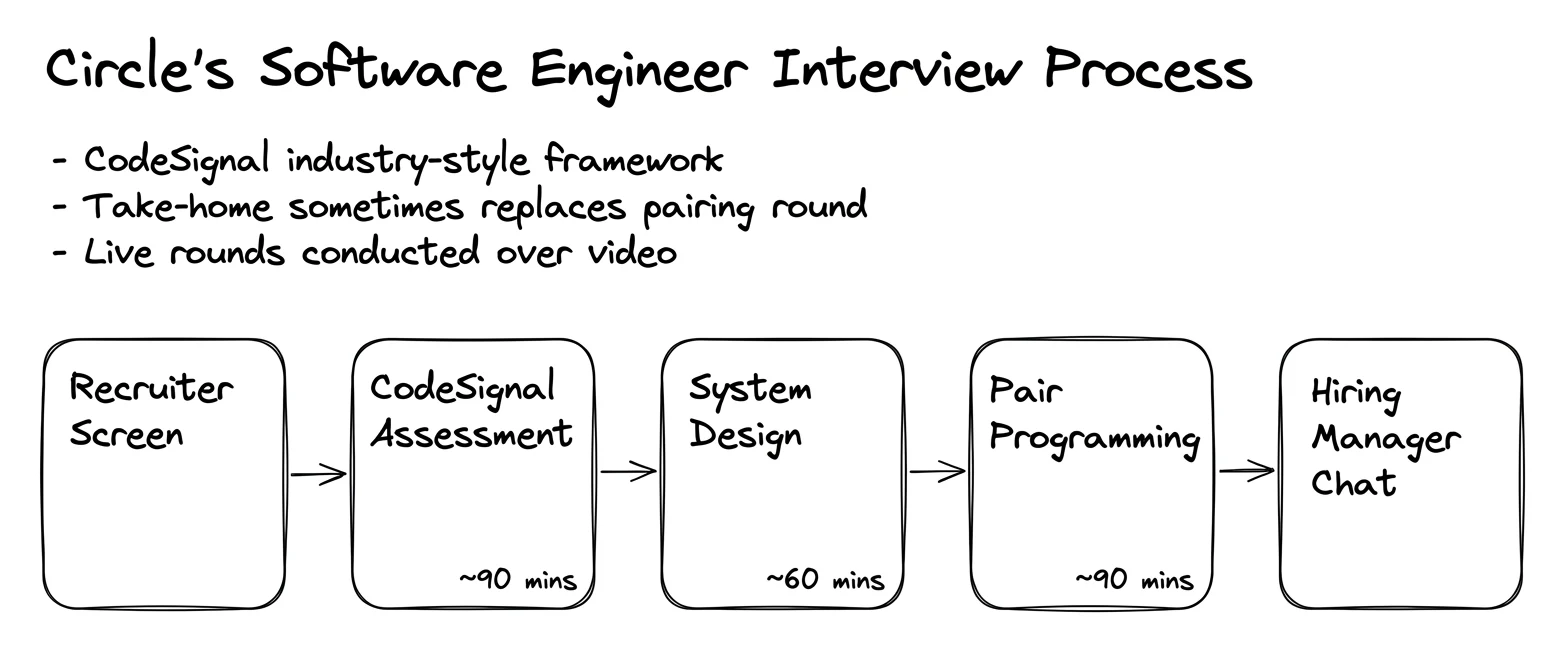
The structure is consistent across teams, while onsite topics follow the team's domain. A typical loop moves from a recruiter call to a timed online assessment, a live technical screen, and a virtual onsite of technical, design and behavioral rounds, ending with a hiring-manager conversation. Some candidates receive a take-home in place of the assessment.
Early-career candidates are filtered mainly on the assessment and live coding; senior and staff candidates are weighted more heavily on system design for financial infrastructure.
Here's what the interview process can look like:
- Recruiter screen: A call of about 30 minutes on background, level and interest in payments and digital assets.
- Online assessment: A timed, roughly 90-minute CodeSignal exercise in four levels, each extending the code from the last.
- Technical screen: About an hour of live coding on a stateful, product-shaped problem, sometimes with requirements hidden in the tests.
- Virtual onsite (technical and design): A language and engineering deep dive, hands-on building, and a system design round on financial infrastructure.
- Behavioral and hiring manager interviews: Project deep dives against Circle's values, then a conversation on team fit.
Tip: Write one internal helper that advances the system to the current timestamp, and call it at the top of every public method from Level 1. Most failed later levels in the reports come from processing scheduled work in the wrong order.
Recruiter screen
The recruiter call is conversational: background, target level, why Circle, and familiarity with stablecoins or payments. Deep crypto knowledge is not tested, but interest in moving money on public blockchains is expected.
Interviewers evaluate:
- Motivation: A specific reason for working on USDC, cross-border payments or onchain infrastructure.
- Level fit: Scope of recent ownership, which sets the target level.
- Stack match: Experience in the team's languages, commonly Java, Go or Node.js.
Prepare a two-minute account of a system you owned where correctness mattered.
Sample questions for the recruiter screen
Here are some questions reported by recent candidates:
- Tell me about yourself and your recent projects.
- Why Circle, and why payments or digital assets?
Online assessment
The assessment is an industry-style CodeSignal task of about 90 minutes: one project-shaped problem in four levels, scored automatically by hidden tests with partial credit. Level 1 builds objects and output, Level 2 adds filtered and sorted queries, Level 3 adds constrained state such as quotas or scheduling, and Level 4 asks for a historical or cross-entity operation.
Two 2026 reports describe the banking version: create, deposit and transfer; then top spenders by outgoing money, formatted like alice(1200) with ties broken by account ID; then delayed payments that run in creation order before any other operation; then account merges and balances at a past timestamp. One candidate had four minutes left for the historical balance, wrote a comment describing the approach, and scored 775. A May 2026 task-manager version in Java added per-user concurrency quotas with expiry at Level 3; that candidate never reached Level 4.
Interviewers evaluate:
- Speed through early levels: Finishing Levels 1–3 cleanly earns more than a partial Level 4.
- Ordering semantics: Due payments execute before each operation; an unfunded payment fails silently and is marked processed.
- Precise definitions: Spending counts outgoing transfers and executed payments only, never deposits or incoming money.
- A history-ready model: Keeping a per-account log of balance changes makes the as-of query a lookup rather than a redesign.
Practice four-level builds against a 90-minute timer in your fastest language.
Note: Test cases for the harder levels were sparse in one report, so a direct solution that passes the visible examples was enough. Spend saved time on the next level, not on perfecting this one.
Sample questions for the online assessment
Here are some questions reported by recent candidates:
-
Build a bank with transfers, then top-k spenders, then scheduled and cancellable payments, then account merges and historical balances.
-
Build a task manager that lists tasks active at a given time whose names contain a substring, sorted.
-
Assign tasks to users with a maximum number of concurrent tasks, where a task on [4, 10) frees capacity at time 10.
-
Banking System with Transfers, Top Spenders, Delayed Payments, and Account Merging
Technical screen
The live screen is about an hour with a Circle engineer and resembles a work sample, and the banking problem also appears here level by level. A March 2026 candidate got a recipe store with full create, read, update and delete, where the real rules lived only in the tests. Names had to match case-insensitively but keep their original casing, IDs arrived as strings like recipe2 and had to be parsed to a number, and an update with a matching ID was accepted when the name differed only in case and rejected otherwise. The candidate could not infer the rules fast enough and did not pass the first part.
Interviewers evaluate:
- Reading tests as a specification: Comparing expected and actual output to infer casing, ID-format and rejection rules.
- Clean, growing APIs: Methods that stay consistent as levels add parameters such as timestamps.
- Edge cases with money: Insufficient funds, transfers to self, and operations on deleted or merged accounts.
- Communication: Stating each inferred rule before coding it.
Practice problems whose requirements are partly hidden, re-running tests after each inference.
Tip: When a test fails without explanation, check casing, identifier format and the return value on failure first. These caused the reported misses, not the core logic.
Sample questions for the technical screen
Here are some questions reported by recent candidates:
-
Implement a recipe store with CRUD where names are unique case-insensitively, IDs arrive as strings, and updates follow hidden rules.
-
Merge one bank account into another, moving balance, accumulated spending and pending payments, and delete the source.
-
Design a Recipe Storage System with Case-Insensitive Name Uniqueness and String IDs
-
Banking System with Transfers, Top Spenders, Delayed Payments, and Account Merging
Virtual onsite: technical and design rounds
The onsite is held over video. The technical deep dive tests your primary language and engineering fundamentals beyond the screen, and some candidates instead get a long pairing session that extends a take-home project or builds a small working API alongside an engineer. The system design round focuses on financial infrastructure rather than generic scale: a high-throughput transaction ledger with strict consistency, or querying and indexing transactions across several blockchains. Data-science candidates may get a modeling case, such as forecasting future sale prices from historical listings.
Interviewers evaluate:
- Correctness under failure: Idempotent operations, retries, and reconciliation when a chain or partner call fails.
- State and consistency: Where the source of truth lives and how balances stay correct under concurrent writes.
- Working software: In pairing, a running, tested increment beats a complete but untested design.
- Domain judgment: Awareness of confirmation times, reorgs and per-chain differences.
Rehearse one ledger design end to end, including double-entry records, idempotency keys and reconciliation.
Sample questions for the virtual onsite
Here are some questions reported by recent candidates:
-
Design a transaction ledger that handles high write throughput with strict consistency.
-
Design a service that indexes and queries transactions across multiple blockchain protocols.
-
Build a model to predict future car sale prices and explain how to validate it.
Behavioral and hiring manager interviews
The behavioral round is a project deep dive against Circle's values: multistakeholder, mindful, driven by excellence and high integrity. Expect questions on taking a risk, recovering from failure and collaborating across time zones in a remote-first company. The hiring-manager conversation is lighter on technical content and checks team fit and career direction.
Interviewers evaluate:
- Integrity under pressure: Raising a problem early, especially where money or compliance is involved.
- Ownership: Clear personal decisions and measurable results in your stories.
- Remote collaboration: Written communication and work across time zones.
Prepare four or five stories that each map to a value.
Sample questions for the behavioral and hiring manager interviews
Here are some questions reported by recent candidates:
- Tell me about a risk you took and how it turned out.
- Describe a failure and what you changed afterward.
- How have you collaborated with a team spread across time zones?
How Circle makes hiring decisions
Little about Circle's decision process has been reported. The assessment produces a numeric score with partial credit, which typically decides whether a candidate moves to live rounds. After the onsite, interviewer feedback is typically combined with the hiring manager's view, and the final conversation doubles as a team-fit check. Design and behavioral depth matter most for the senior and staff levels.
How to prepare for the Circle interview
- Pick a model that survives three more levels: Accounts in a map, an append-only transaction log and a heap keyed by execution time and creation order.
- Centralize time handling: Process due scheduled work in one helper called first in every method.
- Rehearse point-in-time queries: The historical balance is where candidates most often run out of time.
- Get fast at output formatting: Parsing IDs like
payment1, strings likename(amount)and lexicographic tie-breaks cost real minutes. - Treat failing tests as requirements: Practice inferring hidden rules from expected output.
- Use your fastest language: One Java candidate felt Python would have saved time.
- Prepare one ledger design: Consistency, idempotency and failure recovery for money movement.
- Map stories to the values: Integrity and mindfulness are scored, not decoration.
About working at Circle
Circle issues the USDC stablecoin and builds payments and treasury infrastructure on public blockchains. Founded in 2013 and headquartered in New York, it listed on the NYSE in June 2025. Engineering is remote-first, and the work centers on money-movement correctness: issuance and redemption, cross-chain transfers and wallets.
| Level | Primary focus | Impact scope |
|---|---|---|
| Software Engineer I | Delivering scoped features with guidance | Tasks within one team |
| Software Engineer II | Owning features and services | One team's systems |
| Senior Software Engineer | Leading projects and design decisions | A team and its neighbors |
| Staff Software Engineer | Cross-team architecture and technical direction | Several teams |
Circle hires engineers across product and infrastructure teams; teams include:
- USDC and stablecoin infrastructure: Issuance, redemption and reserve-related systems.
- Circle Payments Network: Cross-border money movement between financial institutions.
- Arc: Circle's enterprise blockchain, including validator and smart-contract work.
- Blockchain integration: Connecting new chains to Circle's infrastructure, including cross-chain transfer.
- Data Platform: Data pipelines and analytics infrastructure.
Experience and education requirements
Postings typically ask for a computer science degree or equivalent experience, production work in Java, Go, Node.js or similar, and distributed-systems familiarity. Blockchain experience is a plus for most teams and expected for blockchain-integration roles.
FAQs about the Circle interview
How long does the Circle interview process take?
Typically several weeks from the recruiter call to an offer, depending on assessment scheduling and onsite availability.
What is the hardest round of the Circle interview?
The online assessment's final level, where historical queries or account merges must fit a model built for earlier levels under a 90-minute clock.
Is there an online assessment?
Yes. Most candidates take a four-level CodeSignal exercise of about 90 minutes; some receive a take-home instead.
Is the Circle interview remote?
Yes. The company is remote-first, and every reported round was held online.
How much does a Circle software engineer make?
Posted base ranges for Senior Software Engineer roles have run from about $150K to the low $200Ks depending on location tier, with equity and bonus on top.