Capital One · Study
Capital One Research Scientist Interview Process
TrueInterview
July 31, 2026 · 11 min read
Capital One hires research scientists under the Applied Researcher title, and the loop is built around one question: can you defend your own research in depth? A panel of senior researchers interrogates a talk on one of your projects, and candidates who gave a polished, summary-level talk were rejected even when the coding, case and behavioral rounds went well. The rest of the loop is unusually broad for a research role: a general algorithm assessment, live from-scratch ML coding, a fixed battery of ML fundamentals, and a credit card business case.
This guide breaks down each stage of the Capital One Research Scientist interview, what interviewers evaluate in each round, and how to prepare, with questions candidates were actually asked.
Verified: Based on 9 candidate-reported interview experiences, primarily from 2025 Q4 through 2026 Q3, cross-checked against recent public accounts.
Capital One Research Scientist interview process
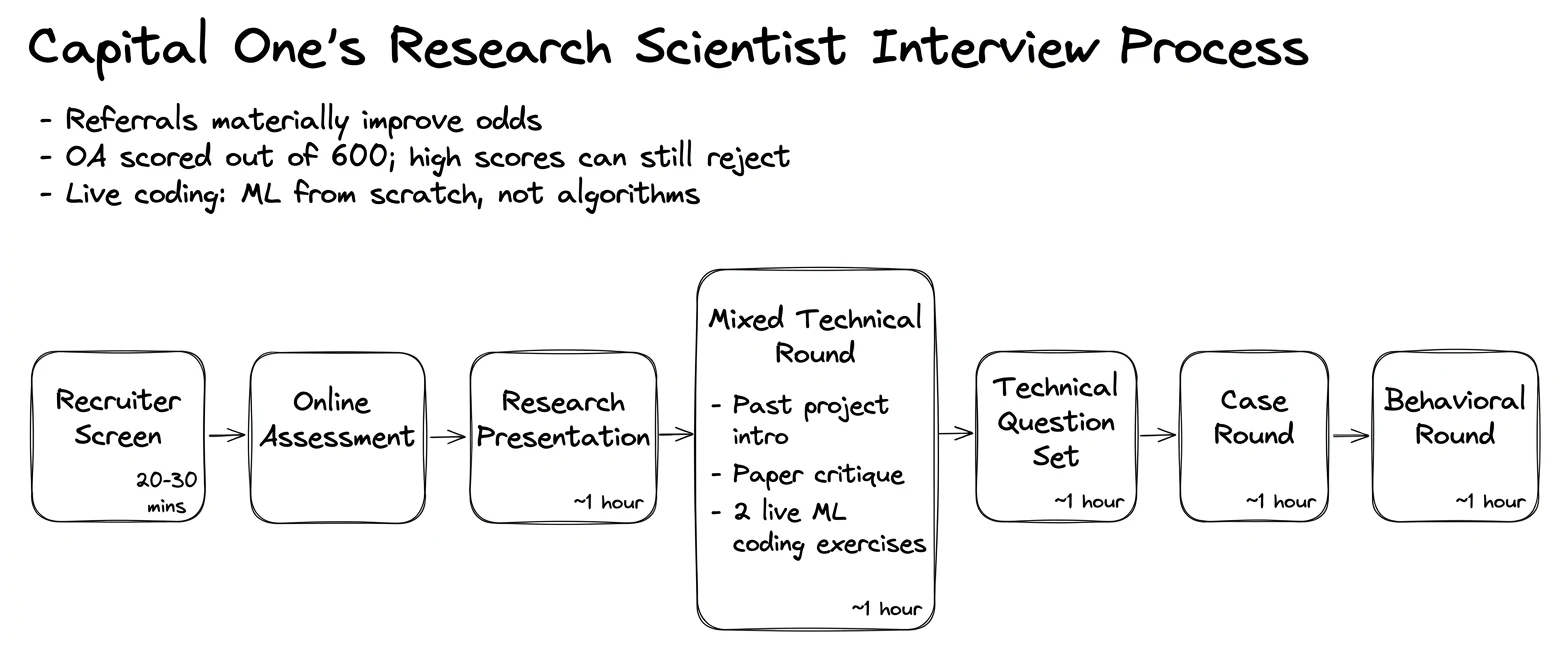
The shape is the same across research teams: a recruiter call, a timed coding assessment, then a "Power Day" of about five back-to-back interviews. The team changes the content more than the format: language-model teams probe generation, while risk-adjacent teams ask about simulation and tail risk. Applied Researcher I is the entry level for new PhDs; at Applied Researcher II and above the panel presses harder on research agenda and impact.
Here's what the interview process can look like:
- Recruiter screen: A short call on background, motivation, location and logistics.
- Online assessment: About 70 minutes for up to four general algorithm problems, auto-scored out of 600.
- Research presentation (panel): A talk on one project or paper, followed by deep questioning from senior researchers.
- Case interview: A credit card business scenario, reasoned through out loud with rules and rough numbers.
- ML coding and paper discussion: A project introduction, a recent paper you read, and two small from-scratch implementations.
- Technical question set: A structured round of ML fundamentals, evaluation and deployment questions.
- Behavioral interview: STAR stories on obstacles, deadlines and work peers thought impossible.
Tip: Treat the presentation as the interview and every other round as a gate. The one candidate who reached the full Power Day and was rejected identified a talk that stayed at overview level as the cause, despite the remaining rounds going fine.
Recruiter screen
The recruiter call is a standard screening conversation: background, motivation, location and how the process runs. Research roles sit in McLean, New York, Cambridge, San Jose and San Francisco, and PhD students are asked when the degree will be finished, since entry-level postings accept a degree completed by the start date. The assessment link usually follows.
Interviewers evaluate:
- Fit to the posting: Whether your research area matches the team, for example language models, recommendation and reinforcement learning, or risk modeling.
- Motivation for a bank: A concrete reason to do research at a financial company, not a generic interest in AI.
Prepare a two-minute summary of your research that ends with what it changed in practice.
Sample questions for the recruiter screen
Here are some questions reported by recent candidates:
-
Walk me through your background and why you are applying.
-
Why Capital One?
Online assessment
The assessment is a proctored coding test of up to four problems in about 70 minutes, scored automatically out of 600, with no ML content. Recurring families: evaluating expressions along paths in a grid of digits and plus or minus signs, counting subarrays that alternate between even and odd, peeling a matrix into borders and refilling it clockwise, pair counting with point updates, and pairs made equal by one digit swap. Candidates advise solving in the order 1, 2, 4, 3, leaving the longest implementation last; brute force passed both pair-counting variants.
Interviewers evaluate:
- Reading the statement exactly: One candidate misread the digit-swap rule, built a permutation search, and never returned to a skipped matrix problem.
- Implementation under time: Clean index handling on layered matrix problems.
- Triage: Banking the easy points first instead of sinking the hour into one problem.
Practice timed medium matrix, parity-window and pair-counting problems until four fit in 70 minutes.
Note: A high score does not guarantee an interview. An applied research candidate solved all four problems, scored 540 of 600 with one partial time-out, and was rejected shortly after; perfect scores have reportedly been followed by rejection too. Treat the score as a threshold, not a ranking.
Sample questions for the online assessment
Here are some questions reported by recent candidates:
-
Count the contiguous subarrays in which consecutive values strictly alternate between even and odd.
-
Given two arrays and a target, count cross-array pairs that sum to it, recomputing after each point update.
Research presentation
The Power Day opens with a talk to a panel of senior researchers on one project or paper of your choice, which need not be finance-related. Most of the hour is questions below the slides: why this baseline, what the ablations isolate, which assumption breaks the result, what comes next.
Interviewers evaluate:
- Depth beyond the abstract: Defending design choices, failed attempts and numbers without returning to the slides.
- Personal ownership: Which decisions were yours, as opposed to an advisor's or co-author's.
- Honest limits: Saying where the evaluation is weak and what would falsify the claim.
- Research judgment: Choosing the next experiment and explaining why it is the most informative one.
Rehearse with someone who interrupts every slide, and keep backup slides for likely pushes.
Note: This is the round that decides the loop. The rejected candidate who reached it named depth as the key expectation and a surface-level talk as the reason for rejection, even though every other round went well.
Sample questions for the research presentation
Here are some questions reported by recent candidates:
-
Present a project or paper of your choice to a panel of senior researchers.
-
Explain the technical details of that work well beyond its summary while several researchers probe it.
Case interview
Every Power Day includes a business case, usually on a card product. The most reported prompt is a virtual credit card: its pros and cons for the customer and the bank, then transaction validation rules keyed on card number, transaction ID, amount, online or offline use, merchant binding and card network, applied to scenarios and then debugged in code. Other prompts: improving card-type detection from leading digits, and a card P&L with mental arithmetic for break-even or margin.
Interviewers evaluate:
- Structure before numbers: A stated framework of revenue, losses, costs and risk before any estimate.
- Two-sided reasoning: Value to the customer and to the bank, including fraud and operational risk.
- Rule precision: Applying conditional rules exactly on edge cases and catching where code departs from the spec.
- Mental math out loud: Quick, checkable arithmetic with stated assumptions.
Practice card-product cases aloud, each ending in a recommendation backed by one rough calculation.
Tip: Researchers often answer the case as a modeling problem. Answer the business question first, whether the product or rule is worth it and for whom, and bring in a model only if the interviewer asks how you would measure it.
Sample questions for the case interview
Here are some questions reported by recent candidates:
-
What are the pros and cons of a virtual credit card number for cardholders and for Capital One?
-
Apply these validation rules to a set of transactions, then find the bug in code that implements them.
-
How would you improve identifying a card's network from its first digits?
ML coding and paper discussion
This hour has three parts: a short project introduction, a recent paper you have read, and two live from-scratch exercises, reported as linear regression and top-p sampling. They are small but graded as numerical code.
Interviewers evaluate:
- Correct math in code: The closed-form or gradient update for regression, and sorting, cumulative mass and renormalization for nucleus sampling.
- Numerical care: Softmax with the maximum subtracted, ties at the probability cutoff, and a singular design matrix.
- Paper literacy: Summarizing a recent paper's contribution and giving a specific criticism of it.
Write both exercises from memory in NumPy, with tests, and choose a recent paper you can critique for five minutes.
Sample questions for the ML coding and paper discussion
Here are some questions reported by recent candidates:
-
Implement linear regression without a modeling library.
-
Implement top-p sampling.
-
Discuss a recent paper you have read.
Technical question set
A separate round runs through a fixed list of technical questions, which one candidate recognized as a set already circulating. Loops in the same family cover bias-variance, parameters versus hyperparameters, batch versus real-time inference, deployment and monitoring, a fraud API that must answer in under 50 milliseconds, and XGBoost with missing values and overfitting. Risk-adjacent teams ask instead about value at risk for long versus short positions and how many Monte Carlo paths a stable tail quantile needs.
Interviewers evaluate:
- Crisp definitions: Correct one-minute answers; vague wording is challenged.
- Applied trade-offs: Choosing an approach for a stated latency, data size or regulatory constraint.
- Statistical rigor: Why a quantile converges more slowly than a mean and what that implies for simulation cost.
Drill fundamentals out loud in two-minute answers, each ending with a concrete trade-off.
Sample questions for the technical question set
Here are some questions reported by recent candidates:
-
How would you bring a fraud-scoring API under 50 milliseconds, and what would you monitor once it is live?
-
How does XGBoost handle missing values, and how do you detect and limit overfitting?
-
Why can value at risk on a short position exceed that on a long one, and how many simulation paths does a 95% estimate need?
Behavioral interview
The behavioral hour uses STAR format with pointed prompts that recur across the family: a significant challenge you overcame, blockers you cleared while still delivering on time, something peers thought was impossible, and a time you challenged the status quo. Follow-ups ask what you personally did and what the measured result was.
Interviewers evaluate:
- Individual actions: Your decisions, not the lab's or team's.
- Delivery under constraint: A real deadline met despite a specific blocker.
- Ambition with evidence: A difficult result and why others doubted it.
Prepare five research stories with numbers, each mapped to one of these recurring prompts.
Sample questions for the behavioral interview
Here are some questions reported by recent candidates:
-
Describe how you handled blockers and still delivered on time.
-
Give an example of accomplishing something your peers thought was impossible.
How Capital One levels and evaluates Research Scientist candidates
The level is set by the posting's qualification bands before the loop: Applied Researcher I for a PhD, finished or nearly finished, or a master's plus two years of applied research, and Applied Researcher II for a PhD plus two years or a master's plus four. Feedback from all Power Day rounds is weighed together, and one clearly weak round, most often the presentation, can sink an otherwise strong day. Decisions after the Power Day were fast, with one adjacent-track candidate hearing of an offer the next day. Reports do not establish a reapplication waiting period.
How to prepare for the Capital One Research Scientist interview
- Build the talk for interruption: Know one project to the level of ablations, failed attempts and next experiments.
- Clear the assessment fast: Solve in an order that leaves the longest problem last.
- Implement core ML from memory: Linear regression, softmax and top-p sampling in NumPy, each with a small test.
- Pick a paper to critique: One you can summarize in two minutes and attack on one specific weakness.
- Learn the card economics: Interchange, credit losses, fraud and virtual card numbers, enough for a P&L in your head.
- Drill fundamentals as short answers: Inference modes, deployment, latency and tree ensembles, plus tail risk for risk teams.
- Anchor stories in impact: Show who used your research and what changed, not only what was published.
About the Capital One Research Scientist role
Applied researchers at Capital One turn recent AI methods into production systems, from academic partnerships to deployed models. The public research agenda centers on language models and agentic AI: training, customization and alignment, with emphasis on reasoning, synthetic data and continual learning. Postings name PyTorch, Hugging Face, Lightning and vector databases, and models pass the bank's model risk review.
| Level | Primary focus | Impact scope |
|---|---|---|
| Applied Researcher I | Research and development of models on a defined problem | A project within one team |
| Applied Researcher II | Leading research projects from design through evaluation and deployment | A team's research area |
| Distinguished Applied Researcher | Leading strategic AI initiatives with partner teams | Several teams |
| Sr. Distinguished Applied Researcher | Setting research direction as an individual contributor and guiding applied scientists and their managers | An organization's AI strategy |
Capital One hires Research Scientists across research and modeling groups. Teams include:
- AI Foundations, LLM Core and Agentic AI: Pre-training, alignment and reasoning for language models and agent systems.
- AI Foundations, Recommendation Systems and Personalization: Recommendation, personalization and reinforcement learning for customer experiences.
- Card and fraud machine learning: Credit decisioning, fraud detection and transaction risk.
- Model risk and quantitative risk: Market-risk modeling, simulation and validation of models used across the bank.
Research Scientist experience and education requirements
Applied Researcher I requires a PhD (due by the start date) in computer science, electrical or computer engineering, AI, mathematics or a related field, or a master's plus two years of applied research; Applied Researcher II requires a PhD plus two years or a master's plus four. Preferred: first-author publications at venues such as NeurIPS, ICML, ICLR or ACL, and language model pre-training experience. Python is expected in coding rounds.
FAQs about the Capital One Research Scientist interview
How long does the Capital One Research Scientist interview process take?
Typically about a month from recruiter call to decision, longer when the Power Day is hard to schedule. Decisions after the Power Day arrive within days.
What is the hardest round of the Capital One Research Scientist interview?
The research presentation. It is the round rejected candidates name, and a strong talk does not survive answers that stay at summary level. The case is second, because most research backgrounds give no practice in card economics.
How much does a Capital One Research Scientist make?
Posted base salary ranges for applied researchers:
- Applied Researcher I: ~$219K to $272K (McLean low end to New York high end)
- Applied Researcher II: ~$263K to $327K (McLean low end to New York high end)
Both levels are also eligible for performance-based incentive compensation, which may include cash bonuses and long-term incentives.
Do I need finance experience?
No. The talk can be on any research and the case assumes only business sense, but an hour on how a credit card makes and loses money pays off.