Capital One · Study
Capital One Interview Process & Questions
TrueInterview
July 24, 2026 · 12 min read
Capital One mixes a software interview with a consulting-style case. Most tracks sit a proctored coding assessment, then a Power Day of about four hour-long rounds in which a card-product case carries as much weight as coding. The assessment is an unusually strict filter: candidates who solved every problem and scored 512 or 540 out of 600 were still rejected without speaking to an interviewer. On Power Day, engineers build an incremental banking class against a test harness they write themselves.
This guide breaks down each stage of the Capital One interview, what interviewers evaluate in each round, and how to prepare, with questions candidates were actually asked.
Verified: Based on 34 candidate-reported interview experiences, cross-checked against recent public accounts.
Capital One interview process
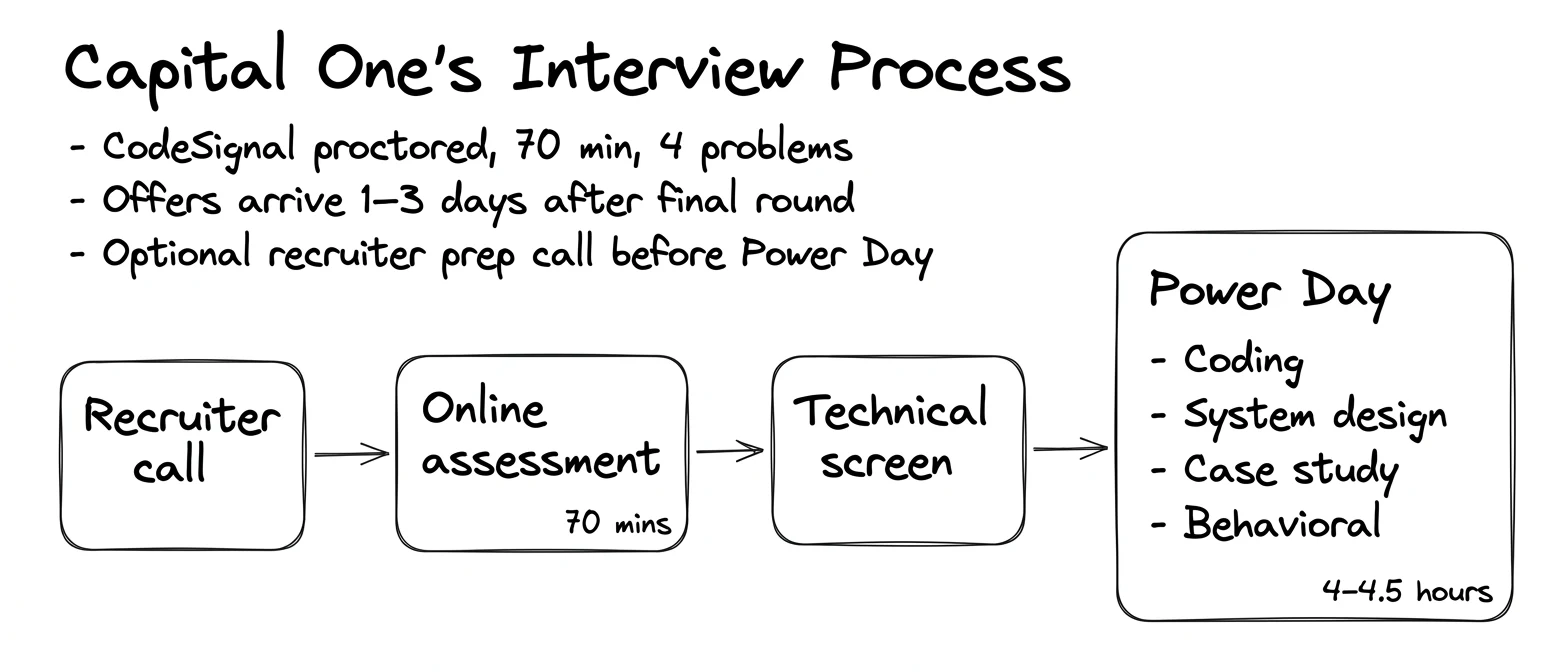
The round types barely change from team to team; what changes by track is what fills each slot. Software engineers get coding, banking system design, a case and behavioral. Data scientists swap coding for a data challenge and a second case. Machine learning engineers add ML fundamentals and deployment screens. Applied researchers add a research presentation. The process commonly takes about a month. Decisions come fast once Power Day is over, and one candidate had an offer the next day.
New-grad and Technology Development Program loops are lighter, with hash-map and class-design coding. Senior engineers may sit two design rounds. In 2026 reports, Power Day ran about 4.5 hours virtually, sometimes split across two days.
Here's what the interview process can look like:
- Recruiter screen: A short call on background, level and motivation, followed by written prep material.
- Online assessment (most tracks): Four proctored coding problems in 70 minutes, scored out of 600. Data science may instead get a take-home data challenge.
- Technical phone screen (some teams and tracks): A project deep dive, behavioral scenarios, or for ML candidates, fundamentals plus a coding-and-deployment hour.
- Coding interview (Power Day): An incremental banking class or a medium data-structures problem, tested with your own harness.
- System design interview (Power Day, engineering): A banking or credit card platform graded on correctness more than scale.
- Case interview (Power Day): A product and rules case that ends in debugging code for engineers, or one or two profitability cases for data science.
- Behavioral interview (Power Day): Themed STAR question sets with deep follow-ups and, in recent loops, questions about using AI at work.
Tip: Ask the recruiter for the prep packet and accept the optional prep call. Candidates say they match the real round formats closely.
Online assessment
The assessment is proctored: webcam and microphone stay on, and you upload a photo ID before starting. The standard form is four problems in 70 minutes, scored out of 600, and one candidate was told about 400 usually advances. The problems test whether you follow a long specification exactly. They rarely need a clever algorithm. Recurring families: matrix layer and rotation commands, round-robin allocation with capacities and closures, Tetris-style shape placement, and pair counting by concatenation, sum or digit rotation.
Question sets rotate, two-problem variants exist, and research and AI candidates get the same content as engineers. Rejections typically arrive about three days after submission.
Interviewers evaluate:
- Literal correctness: Tie-breaks (the higher index wins) and wrap-around pointers decide hidden tests.
- Triage: Banking the short problems first. Several candidates advise solving in the order 1, 2, 4, 3 because the third slot is usually the time sink.
- Scaling awareness: One problem per set usually hides a trap. A brute-force rotation-pair count passed 14 of 20 tests, and quadratic sawtooth-subarray scans timed out.
Practice four-problem sets on a 70-minute clock, without copy-paste and with sparse debug output.
Note: A strong score does not guarantee an interview. Reported rejections include 512/600 and 540/600 with every problem attempted.
Sample questions for the online assessment
Here are some questions reported by recent candidates:
-
For every concentric layer of a matrix, read the border clockwise, sort it, and write it back along the same path.
-
Count pairs of integers where one can be rotated into the other. The brute-force version timed out on the larger tests.
-
Assign packages round-robin to warehouses with capacity limits and closure events. Reset the pointer when every warehouse is full or closed.
Technical phone screen
Not every candidate gets a screen. For software engineers, a senior engineer may run a situational hour: your current project, one bug you root-caused, a difficult stakeholder, and how you would get unblocked by an infrastructure team. Machine learning engineers get two hour-long screens, one on ML fundamentals and a project, one pairing a data-structures problem with deployment and monitoring.
Interviewers evaluate:
- Ownership scope: Whether the hard decisions in your project were yours or the team's.
- Root-cause reasoning: A clear path from symptom to cause to fix.
- Production instinct (ML): Batch versus real-time inference, monitoring after release, and latency budgets.
Prepare one deep project walkthrough you can defend at any level of detail.
Sample questions for the technical phone screen
Here are some questions reported by recent candidates:
-
Your work is blocked by the infrastructure team. How do you communicate, escalate and keep the relationship intact?
-
A fraud detection API must respond in under 50 milliseconds and is missing that target. How do you diagnose and fix it?
Coding interview
The Power Day coding hour is medium difficulty, delivered in increments. The most common version is a banking system: create accounts and deposit, then transfer, then return the top N accounts by activity, with exact return codes such as -1 for a missing account or insufficient funds. You are given an operation list and must write the harness that produces comparable output; candidates say it took longer than the classes.
Other prompts include a linked-list removal variant, a Transaction class, and extending an existing banking implementation. Researchers instead implement linear regression and top-p sampling from scratch.
Interviewers evaluate:
- Clarifying definitions early: "Activity" meant the sum of successful deposit and transfer amounts, not an operation count. Candidates who asked first saved a rewrite.
- State integrity: Transfers that cannot half-complete, failed operations that leave balances untouched, and ties broken alphabetically by account ID.
- Test discipline: A working harness and a habit of testing each increment before moving on.
Build a small banking class in three timed increments, harness included, before Power Day.
Tip: Write the harness first, as a five-line loop over the operation list.
Sample questions for the coding interview
Here are some questions reported by recent candidates:
-
Implement createAccount, deposit and transfer, then add a TOP_ACTIVITY query that formats each result as accountId(activity), with ties sorted alphabetically.
-
Design a Transaction class that handles deposits and withdrawals, then discuss what happens when funds are insufficient.
System design interview
Engineering candidates get one or two design hours, almost always on financial systems. One is an online banking application with 360 Checking, 360 Savings, mortgage and auto loan accounts, entitlement-based authorization, internal and external transfers, and daily, weekly and monthly statistics. Another is a credit card system covering login, payment authorization with fraud detection, monthly credit bureau reporting, a spending overview and real-time decisions on credit-limit increases. Others are a highly reliable account balance service, a cross-region event processing platform, and third-party payment integration with authentication.
Interviewers evaluate:
- Breadth before depth: High-level services, entities and read/write paths first, then deep-dive topics you propose to the interviewer.
- Money correctness: Idempotency keys, exactly-once posting, audit trails and reconciliation.
- Path separation: Keeping the transaction write path apart from analytics and reporting reads.
- Failure behavior: What happens when a region, the fraud service or a third-party provider is down.
Practice drawing one card-authorization flow end to end, including retries and reversals.
Sample questions for the system design interview
Here are some questions reported by recent candidates:
-
Design online banking with role-based account access, internal transfers, external payments and pre-aggregated statistics.
-
Design a credit card platform that authorizes payments with fraud checks and approves credit-limit increases in real time.
-
Design Credit-Card Authorization, Limit Decisions, and Reporting
Case interview
The case is the signature round. Engineering and ML candidates most often get a virtual card number case in three parts. First, weigh the benefits and drawbacks for customers and for the bank. Second, apply validation rules encoded in specific digits of the card number and transaction ID: online versus offline, charge versus authorization, merchant-bound, network, and single or multi-use. You decide aloud whether each listed payment is valid. Third, debug code that implements those rules. Variants add regional differences, a chatbot product, or explaining an unfamiliar code block.
Data science candidates get one or two profitability cases instead, often outside banking (an amusement park, a wheat harvest), with mental arithmetic. Some data and ML loops add a role-play: explaining a degrading model to a non-technical product manager.
Interviewers evaluate:
- Rule discipline: Applying a multi-condition rule set consistently, with no contradictions between examples.
- Bug spotting: The reported planted bugs were confusing
||with&&, using>= 50where> 50was meant, and extracting a digit withcardNumber % 2. - Business framing: Customer value, issuer value and risk, stated before any technical detail.
- Visible arithmetic: Assumptions and break-even math said aloud, step by step.
Practice turning digit-encoded rules into a truth table quickly.
Note: The case is a full-weight round, not polish. Candidates describe it as the round needing the most precision: one misread digit rule cascades through every example.
Sample questions for the case interview
Here are some questions reported by recent candidates:
-
Given a 16-digit card number, an 8-digit transaction ID and an amount of 150, decide whether a Visa or Mastercard transaction is valid under the stated rules.
-
List the benefits and challenges of virtual card numbers across geographies, including regulatory and user-behavior differences.
-
Estimate the profitability of an amusement park and say what drives the result.
Behavioral interview
The behavioral hour runs as themed sets, typically learning something new, challenging the status quo and facing a hard challenge. Each set comes with several probing follow-ups about your actions and reflections. Senior candidates get leadership prompts, such as leading an uncooperative teammate. A 2026 loop added two AI questions: how you use AI in daily work, and how it can improve productivity. Some interviewers stay quiet and take notes, so you have to carry each story yourself.
Interviewers evaluate:
- Personal action: What you did, separate from what the team did.
- Quantified results: Measured outcomes and what you would change next time.
- Responsible AI use: Treating AI output as a draft you review. One candidate framed it as working with an intern.
Prepare five STAR stories that each map to more than one theme.
Sample questions for the behavioral interview
Here are some questions reported by recent candidates:
-
Tell me about a time you challenged the status quo.
-
How do you use AI in your day-to-day work, and where does it help most?
How Capital One makes hiring decisions
Each Power Day interviewer submits an independent rating, and a hiring discussion consolidates them; some candidates then meet a director. Case and behavioral ratings count as much as coding, and for applied researchers a weak research presentation alone has ended the process. Positive decisions arrive within one to three days, so a long silence after Power Day is a meaningful signal.
How to prepare for the Capital One interview
- Drill specification-following under time: Run 70-minute, four-problem simulation sets, solving the short problems first and grading yourself on tie-breaks and wrap-around.
- Build a banking class with a harness: Practice create, deposit, transfer and top-N activity in increments, with your own operation-list harness.
- Turn rules into truth tables: Practice digit-encoded validation rules and finding
&&/||and boundary bugs in someone else's code. - Own one card-payment design: Be able to walk authorization, fraud check, posting, reversal and reporting with idempotency at every step.
- Rehearse profitability math aloud: For data and ML tracks, structure revenue and cost drivers and compute break-evens without a calculator.
- Prepare themed STAR stories: Cover learning, challenging the status quo, delivering through obstacles and leading others, plus one honest account of how you use AI.
- Use the recruiter's prep material: The packet and optional call describe the actual round mix, which varies a little by track.
About working at Capital One
Capital One runs on the public cloud and builds most of its software in house, with engineering hubs in McLean, Richmond, Plano, Chicago, New York and Bengaluru. Since the Discover acquisition closed in May 2025, much of the work involves moving card and debit volume onto the Discover network.
| Level | Primary focus | Impact scope |
|---|---|---|
| Associate Software Engineer | Delivers well-defined features with guidance | Own tasks within a team |
| Software Engineer | Owns features and services end to end | Team |
| Senior Software Engineer | Leads designs and mentors | Team and adjacent services |
| Lead Software Engineer | Sets technical direction for a product area | Multiple teams |
| Senior Lead Software Engineer | Drives architecture across a platform | Organization |
| Distinguished Engineer | Senior individual-contributor leadership | Line of business or enterprise |
Capital One hires engineers and scientists across teams. Teams include:
- Card Tech: The technology behind card spending, organized into towers for digital commerce, authorizations and decisioning, core payments and partnerships, and servicing.
- Payments and network integration: Inbound payments, partnerships and the Discover network migration.
- AI Foundations: Applied researchers, data scientists and engineers building foundation models and LLM and agentic systems.
- Enterprise data and model risk: Data lifecycle ML, risk models, and quantitative validation such as value at risk and Monte Carlo methods.
Experience and education requirements
Associate postings target new graduates and early-career engineers, and many candidates enter through the Technology Development Program. Senior Lead postings ask for nine or more years in at least one of JavaScript, Java, TypeScript, SQL, Python or Go. Applied researcher and data scientist roles expect a strong quantitative background and fluency in Python and SQL.
FAQs about the Capital One interview
How long does the Capital One interview process take?
Commonly about a month. The assessment result arrives in days; the gap before Power Day can take a few weeks. Offers typically follow within one to three days of Power Day.
What is the hardest round of the Capital One interview?
For most engineers it is the online assessment, because high scorers are still cut. Among the live rounds, the case causes the most surprises: rules have to be applied precisely and then debugged in code, which few candidates practice for.
Is there an online assessment for every role?
Most software, ML and research candidates take it, even for AI roles. Data science candidates may instead get a seven-day take-home data challenge with a written narrative.
How much does a Capital One software engineer make?
Posted base ranges for McLean have been about $114K–$131K for Associate Software Engineer and about $159K–$181K for Senior Software Engineer. Packages add performance-based incentive pay, which can include a cash bonus and long-term incentives at higher levels.