ByteDance · Study
ByteDance Software Engineer Interview Process
TrueInterview
July 24, 2026 · 14 min read
ByteDance runs its software engineering loop as a chain of separate gates: rounds are booked one at a time, each must be passed to unlock the next, and one weak hour ends the process regardless of what came before. Nearly every technical hour opens with a resume interrogation of 10 to 45 minutes that is graded as technical evidence, and the coding that follows must compile and pass tests you write yourself. Level and headcount are judged apart from performance: candidates who cleared full loops were stopped because the team only had a slot one band higher or lower.
This guide breaks down each stage of the ByteDance Software Engineer interview, what interviewers evaluate in each round, and how to prepare, with questions candidates were actually asked.
Verified: Based on 92 candidate-reported interview experiences, primarily from 2025 Q4 through 2026 Q3, cross-checked against recent public accounts.
ByteDance Software Engineer interview process
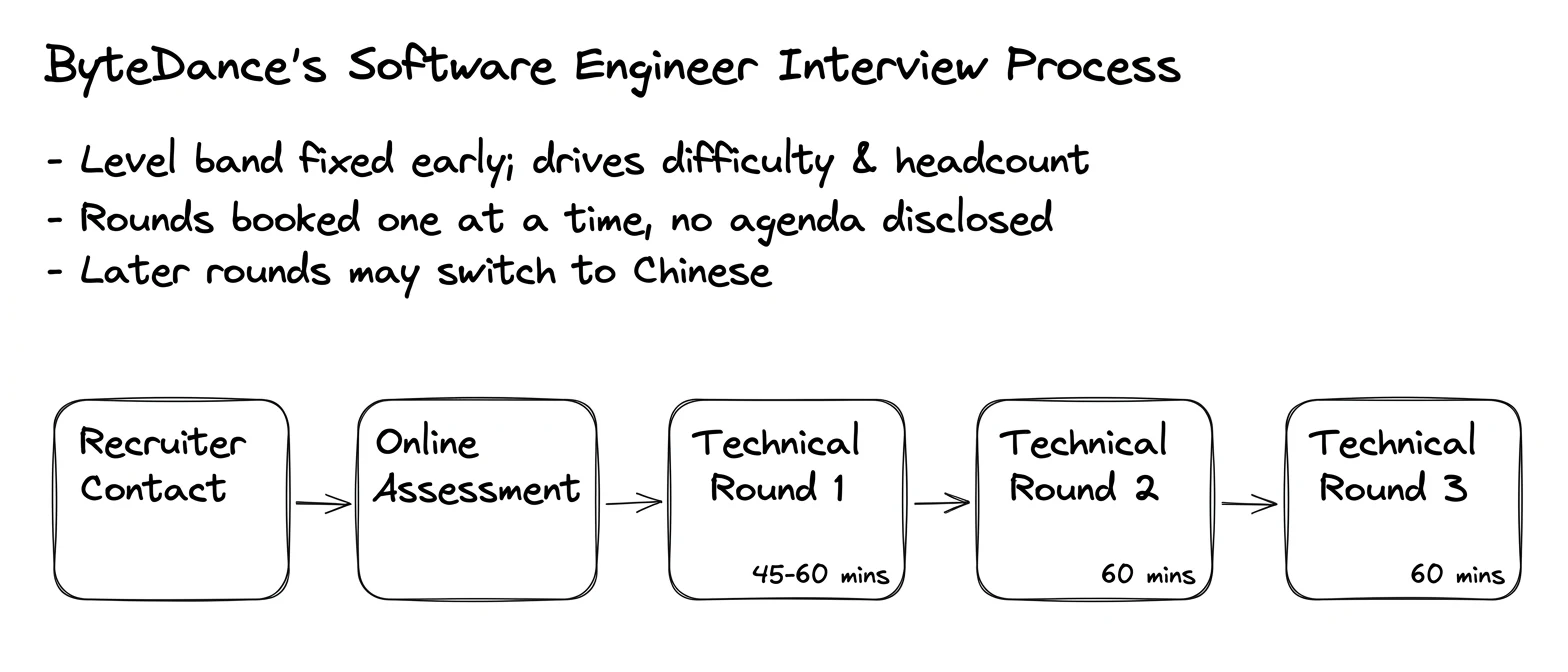
ByteDance hires engineers into specific teams, and interviewers come from that team, often based in China. The loop is usually two to four sequential video calls of 45 to 60 minutes followed by a hiring manager round, with no single onsite day. Reported timelines run from about two weeks to several weeks with silences between rounds.
New graduates and interns usually start with an online assessment and sit coding-focused rounds. Mid-level (2-1) loops add a backend fundamentals or design hour, and senior (2-2 and above) loops carry one or two system design hours plus a project defense that tests scope.
Here's what the interview process can look like:
- Online assessment (new grad and intern): A timed set of three or four auto-graded problems built on simulation and boundary handling.
- Recruiter screen (sometimes skipped): About 30 minutes on background, location, level and timeline.
- Technical phone screen: A resume drill followed by one or two problems in a shared editor, with your own tests.
- Backend fundamentals round (many teams): Oral questions on databases, caching, queues, operating systems and networking, then a short problem.
- Coding and data-structure design rounds: Harder problems and implement-a-structure tasks; a few teams run an AI-assisted variant.
- System design interview (mid-level and above): One or two hours, often a module from the team's own product.
- Hiring manager interview: A project grilling and behavioral questions, often with coding, sometimes followed by a short director call.
Tip: Budget the coding time yourself. Several candidates lost a round not on the problem but because a 40-minute resume drill left under 20 minutes to code; offer to move on when the project discussion runs long.
Online assessment
Early-career pipelines send a timed assessment to candidates who pass resume screening. Reported sets contain three or four problems that avoid advanced data structures and instead test careful simulation, so hidden boundary tests decide the score. Recurring problems: a memory allocator where each allocation must start at a multiple of 8 and blocks are freed by an incrementing id, counting subarrays whose adjacent elements alternate parity, a walking-distance greedy where a drone carries goods 10 units forward from each station, and a formatter that wraps words to a width, pads by paragraph alignment and draws an asterisk border. Another set included sorting each concentric matrix border clockwise.
Interviewers evaluate:
- Boundary handling: Frees of unknown ids, allocations running past the end, the last partial line or group.
- Decomposition: Splitting a long statement into independent steps, such as wrap, pad, then border.
- Complexity within stated limits: Inputs up to 100,000 values require hashing or sorting, not pairwise checks.
Practice timed sets of four medium simulation problems, writing each from the statement without starter code.
Sample questions for the online assessment
Here are some questions reported by recent candidates:
-
Simulate memory with
alloc xstarting only at multiples of 8 (leftmost fit) anderase id, returning start indexes and freed counts. -
Count index pairs whose numbers have the same digit count and are cyclic shifts of each other, for up to 100,000 values.
-
Repeatedly split a digit string into groups of k, replace each group with its digit sum, and stop once the length is at most k.
Recruiter screen
Most experienced-hire loops start with recruiter outreach, and some skip the screen and open with a full technical hour. When it happens, the screen runs about 30 minutes on background, location, target level and availability. Recruiters' descriptions of later rounds are unreliable: rounds labeled system design turned out to be pure coding or fundamentals. This is also where level is settled; one candidate who asked for 2-2 was told the team would only interview lower and withdrew after three rounds. Recruiters have also moved the location and scheduled calls at 8 p.m. China time.
Interviewers evaluate:
- Level fit: Whether your scope matches the band the team has headcount for.
- Location and start date: Willingness to work from San Jose or another hub.
- Language: Whether you can interview in Mandarin; some rounds switch without asking.
Before this call, decide your target band and ask which team, stack and language each round will use.
Note: New-grad postings cap applications at two positions at a time across TikTok and its affiliates worldwide, and candidates report that interview feedback is shared across loops. Choose openings deliberately and keep one active process at a time.
Sample questions for the recruiter screen
Here are some questions reported by recent candidates:
- Walk me through your background and why you are interested in this team.
- Which months can you start, and are you willing to work in San Jose?
- What level are you targeting, and what are your compensation expectations?
Technical phone screen
The first technical hour sets the shape for the loop: 10 to 45 minutes on your resume, then one or two problems in a shared editor, usually the Lark codepad. Many interviewers require code that compiles and passes tests you write, and some forbid moving the cursor outside the pad. Problems are mostly medium, often reworded in business terms, with hard follow-ups.
Reported problems include the no-parentheses calculator and a character-array variant, remove duplicate letters for the smallest lexicographic result, reversing k-groups (one team also reversed the partial final group), number of islands without modifying the grid plus a distinct-shapes follow-up, ads-themed merge intervals where start > end must be handled, and values above n/3 in a sorted array in sub-linear time. A candidate who wrote the standard longest-palindrome solution was then asked for Manacher's algorithm.
Interviewers evaluate:
- Finished, running code: A correct idea left as an unfinished directed-graph solution was rejected.
- Intent before typing: A candidate who fixed an alien-dictionary bug without explaining the guard against double-counting in-degrees was marked down.
- Constraint reading: No-modification rules, sorted input and tie-breaking change the intended solution.
Practice medium problems in a bare editor with no class stub, finishing each with your own tests in 20 minutes.
Note: Solving everything does not guarantee a pass. Candidates who finished both problems, or an easy problem in one pass, were rejected the next day with no specific gap cited. Narrate your plan before each block, because silent correct code is weaker evidence than explained code.
Sample questions for the technical phone screen
Here are some questions reported by recent candidates:
-
Given N and allowed digits that may repeat, return the largest number strictly less than N (23415 with {2, 4, 9} gives 22999).
-
Find the subarray maximizing its minimum plus maximum and return its sum, first by brute force, then in linear time.
-
Count downward paths summing to a target in an N-ary tree; brute-force DFS was not accepted.
Backend fundamentals round
Many backend teams spend most of an hour on oral fundamentals drawn from your resume, then give a short problem; one candidate had 50 minutes of questions and 10 to reverse a linked list. Topics are composite indexes (leftmost-prefix matching, covering indexes, why not index every column), CAP, locking, cache breakdown and avalanche, cache-aside consistency, Kafka partitions and rebalancing, Redis persistence, WebSocket versus server-sent events, and Java's LinkedHashMap versus ConcurrentHashMap. Platform-leaning teams add Linux triage, virtual memory and the TCP handshake. Scenario questions weigh most: why a project used plain HTTP rather than WebSocket, what a relational-to-document-store migration gains, and what to do when an LRU cache's miss rate is high.
Interviewers evaluate:
- Mechanism, not definition: Why a covering index avoids table lookups, not just that it is faster.
- Tie to your own system: Applying the concept to a cache or queue you actually ran.
- Trade-off reasoning: Relational versus document stores, consistency versus latency.
Review every technology on your resume to the level of how it fails and how you would diagnose it.
Sample questions for the backend fundamentals round
Here are some questions reported by recent candidates:
-
With a cache-aside design, how do you keep the cache and database consistent, and how do you prevent a cache avalanche?
-
Given a composite index and several queries, which queries hit the index and why?
-
A team moves from a relational database to a document store: why, what changes architecturally, and what should improve?
-
CAP, DB Indexing, Concurrency and Logging: Backend Fundamentals Oral Round
Coding and data-structure design rounds
Later technical hours raise difficulty and often ask you to build a structure. Reported tasks include an LRU cache with TTL or LFU follow-ups, a deque with O(1) push, pop and index access, a HashMap from scratch, a time-based key-value store, an in-memory store with snapshot and restore where serialization is the hard part, and a seller task scheduler with weighted round-robin (VIP sellers get two tasks per turn) and priority then FIFO order within each seller. Senior algorithm hours have included word search II and maximum path sum with the path printed.
A few teams now run an AI-assisted round: you share your screen and use your own AI tool to build an OrderValidator whose rules form a dependency graph, then remove a rule and reconnect its predecessors to its successors.
Interviewers evaluate:
- Structures chosen before code: An outer round-robin queue with per-seller min-heaps; a heap keyed by timestamp.
- Clarified semantics: One candidate restarted after assuming
popTaskdid not remove tasks. - Extension under follow-up: Adding TTL, LFU or rule removal without rewriting the core.
- Complete tests: In the AI round, unfinished tests ended the process the same day.
Practice implementing caches, schedulers and stores in 30 minutes each, then adding one follow-up feature.
Tip: In the AI-assisted round the grade is the working code and tests you ship, not how much the tool generated. Have it draft test cases early and verify the graph rewiring by hand.
Sample questions for the coding and data-structure design rounds
Here are some questions reported by recent candidates:
-
Implement
receive_taskandprocess_next_taskfor a scheduler that rotates across sellers, giving VIP sellers two tasks per turn. -
Support
addTask,removeTaskandpopTask(num), which removes and returns the earliest tasks by timestamp. -
Implement an in-memory key-value store whose snapshot can be serialized and later restored exactly.
System design interview
Mid-level and senior loops include one or two design hours of about 60 minutes, and senior screens have squeezed design into 15 minutes of a mixed hour. Prompts are often modules of the team's own product: a real-time auction with atomic bid updates and live pushes, a per-country top-10 songs leaderboard refreshed every 10 minutes at about 50,000 reads and writes per second, a real-time top-K over a sliding window, content moderation with human review and appeals, a live comment system, and a distributed key-value store. Senior screens have also asked for AI system design, such as serving and drift monitoring. Some interviewers give a two-sentence prompt and decline to clarify; one candidate had to type a design in text because the editor could not draw.
Interviewers evaluate:
- Estimates first: Read and write rates and storage per event, which then justify each component.
- Exact versus approximate: One rejected candidate said not asking whether top-K had to be exact muddled the design.
- Separating ingestion, aggregation and serving: Events through a log and stream processor, results served from a cache.
- Failure handling: Reconnection, exactly-once bid processing and hot keys from viral items.
Practice designs from ByteDance's own products, each opening with estimates and a written requirements list.
Note: On a team transfer, a candidate who had passed a full loop received a long internal spec for correlating 50+ videos with 1,000+ keywords per submission, with versioned updates and resumable uploads, and was failed mid-round. Be ready to design from a dense spec in plain text.
Sample questions for the system design interview
Here are some questions reported by recent candidates:
-
Design a per-country top-10 songs service taking 50,000 listening events per second, with rankings refreshed every 10 minutes.
-
Design a real-time auction where every participant sees the highest bid with minimal latency during popular auctions.
-
Design a moderation pipeline with automated rules, human review and an appeal flow.
Hiring manager interview
The manager round mixes a project defense with behavioral questions and often a coding problem, and it is frequently held in Mandarin. Behavioral topics are a challenging project, conflict, ambiguous requirements, a failure, prioritization, weaknesses and why you are leaving. Reported coding includes non-overlapping intervals and a 0-1 BFS grid path. A 20-minute director conversation can follow. At senior bands the defense turns adversarial by design, challenging every architecture choice and success metric. Manager rounds have also been cancelled when hiring priorities shifted.
Interviewers evaluate:
- Ownership: What you personally decided, with metrics proving it worked.
- Defending choices: Why that architecture, what you rejected, what you would change.
- Ambiguity and conflict: Concrete actions, not a summary of the team's work.
Prepare two projects you can defend for 30 minutes each, in Mandarin as well if the team is China-based.
Sample questions for the hiring manager interview
Here are some questions reported by recent candidates:
-
Describe a project where communicating with others was particularly difficult and how you handled it.
-
Given intervals, return the minimum number to remove so the rest do not overlap.
-
Pick your highest-impact project: why that architecture, what proved success, and what would you change?
How ByteDance levels and evaluates Software Engineer candidates
Each round is a pass/fail gate, and the hiring manager settles the outcome. Level is assessed during the loop, mostly from the resume drill and design rounds, and checked against the band the team can fill: one candidate was assessed at 2-1 after passing all three rounds and told only 2-2 headcount remained. When a team passes, recruiters often rematch you elsewhere, which restarts part of the loop; one rematched candidate got an offer, another failed the new team's first round. An appeal over interviewer conduct has been granted, but the replacement interviewer also failed the candidate, citing only a holistic assessment. Decisions arrive from the same day to about eight business days, and ghosting after a passed round is common.
Tip: Ask before round one whether the requisition is open at your band and whether passed rounds carry over if you are rematched.
How to prepare for the ByteDance Software Engineer interview
- Settle level and team first: Confirm the band, the team's stack and the interview language before investing in the loop.
- Compress your project stories: A few minutes each with metrics, schema choices and one failure, so the resume drill leaves coding time.
- Code in a bare editor with your own tests: No class stub, no autocomplete, tests run before you say you are done.
- Learn the follow-up for each classic: Partial final k-group, distinct island shapes, Manacher, sub-linear search on sorted input, LFU after LRU.
- Review backend internals to mechanism depth: Indexes, caching failures, Kafka rebalancing, Redis persistence and storage trade-offs.
- Build structures under follow-up: Caches, schedulers and key-value stores in 30 minutes, then extend them.
- Design ByteDance's own products: Leaderboards, auctions, moderation and live comments, opening with estimates and exact-versus-approximate.
About the ByteDance Software Engineer role
ByteDance Software Engineers build the backend and platform services behind TikTok, CapCut, Lark and the company's recommendation, ads and commerce systems. Teams are often split between the US and China, so many roles involve evening meetings in US time. Since January 2026, TikTok's US operations sit in a joint venture majority-owned by American investors, with ByteDance retaining 19.9%, so confirm which entity a US role belongs to.
| Level | Primary focus | Impact scope |
|---|---|---|
| 1-2 | Entry-level engineer delivering features with guidance | Components within one team |
| 2-1 | Mid-level engineer owning features and services | A team's services |
| 2-2 | Senior engineer leading designs and mentoring | A team's systems and neighboring teams |
| 3-1 | Staff-level engineer or technical lead | Several teams or a product area |
ByteDance hires Software Engineers across most of its products. Teams include:
- Monetization and Commerce Ads: Ad serving, bidding and campaign systems, hiring actively after a reorganization.
- TikTok LIVE: Live-streaming service architecture and real-time interaction.
- E-commerce: Content commerce, sellers and orders.
- Recommendation and foundation platforms: Ranking, retrieval, storage, compute and video infrastructure.
Software Engineer experience and education requirements
New-grad postings ask for a bachelor's or master's in computer science or a related field and solid programming skills, naming Go, C++ or another systems language for platform teams, and graduates must commit to an onboarding date. Experienced roles expect production backend experience, and interviews probe Go, Java, Redis, Kafka and MySQL when they appear on your resume. Any mainstream language is accepted for coding.
FAQs about the ByteDance Software Engineer interview
How long does the ByteDance Software Engineer interview process take?
From about two weeks to several weeks. One loop went from first contact to offer in about two weeks; another moved from application to recruiter contact in a week, with rounds three or four days apart.
What is the hardest round of the ByteDance Software Engineer interview?
For mid-level and senior candidates, the team-specific system design round, because prompts can be long, unusual and lightly clarified. For candidates who have not reviewed backend internals, the fundamentals hour costs the most points.
Are the interviews in English or Mandarin?
Both. Many interviewers are China-based and some switch to Mandarin without asking, especially in manager rounds. Tell the recruiter your preference early.
How much does a ByteDance Software Engineer make?
Approximate total annual compensation in the United States:
- 1-2: ~$195K
- 2-1: ~$275K
- 2-2: ~$450K
- 3-1: ~$620K
Packages combine base salary, an annual bonus and stock that vests over four years, most commonly on a back-loaded 15%, 25%, 25%, 35% schedule.