ByteDance · Study
ByteDance Machine Learning Engineer Interview Process
TrueInterview
July 24, 2026 · 11 min read
ByteDance runs its Machine Learning Engineer loop as a series of near-identical technical hours, each split into roughly 20 minutes of resume drill, 20 of ML fundamentals and 20 of coding, with fundamentals deliberately repeated: one candidate who got an offer was asked about dropout in all three rounds, one layer deeper each time. Textbook answers are not enough. Candidates who explained attention, KV caching and RoPE fluently were still rejected when they could not describe how their own training pipeline broke and was fixed. Coding stays a hard gate even for published researchers, and headcount shapes outcomes.
This guide breaks down each stage of the ByteDance Machine Learning Engineer interview, what interviewers evaluate in each round, and how to prepare, with questions candidates were actually asked.
Verified: Based on 19 candidate-reported interview experiences, primarily from 2025 Q4 through 2026 Q3, cross-checked against recent public accounts.
ByteDance Machine Learning Engineer interview process
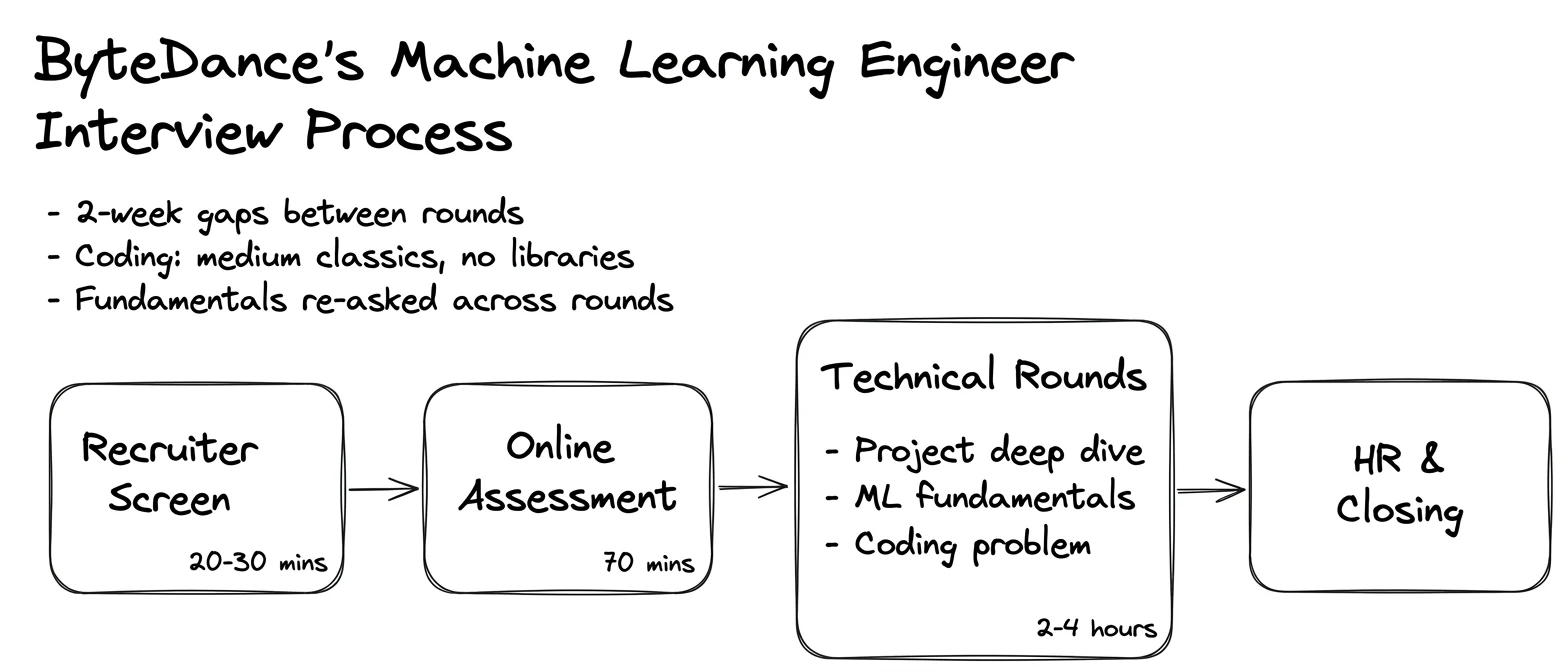
ByteDance hires ML engineers team by team, and the team's domain (recommendation, ads, e-commerce, multimodal content, LLM safety, model serving) sets the fundamentals and design questions. Most loops are two to four technical hours by phone or video, then an HR or hiring-manager conversation; some teams run five rounds over two days instead. Candidates report about two weeks between rounds and about a week for each result.
New-grad and PhD loops lean on fundamentals; senior loops shorten coding and probe domain fit, sometimes in two back-to-back hours, one in English and one in Mandarin. Research-leaning variants swap a technical hour for a research talk.
Here's what the interview process can look like:
- Recruiter and HR screen: Background, start date, visa status and sometimes compensation, from 20 minutes to about 90.
- Online assessment (some ML and research pipelines): Ten questions in 70 minutes of ML theory, a hand-computed forward pass and from-scratch code.
- ML fundamentals and project deep dive (every technical hour): About 40 minutes of resume drill and theory at derivation depth.
- Coding interviews: One medium problem per hour in a shared editor, harder in extended loops.
- ML system design interview: An open-ended design from the team's domain, inside a technical hour or as a full round.
- Behavioral and hiring manager interview: Hardest project, conflict, weaknesses and workload tolerance.
Tip: Prepare the one project closest to the team's domain at implementation level: data, loss, the failure you hit and the metric that moved. Every hour opens on your resume, and rejections cluster where answers stayed conceptual.
Recruiter and HR screen
The first call covers background, motivation and start date; for new graduates also visa status and graduation timing, and some graduate postings require a committed onboarding date. One senior candidate's HR screen ran about 90 minutes, followed by two weeks before technical rounds. Compensation can come up directly: a PhD new-grad candidate was told the ceiling in that organization was 300k. The recruiter's team description can be wrong; one senior candidate learned mid-loop that the real need was not LLM post-training at all.
Interviewers look for:
- Domain alignment: Recent work that maps onto the team's product area.
- Availability: A firm start date and graduation timeline, which decide many graduate offers.
- Motivation: A concrete reason for this team, not big-tech ML in general.
- Expectation fit: Compensation expectations that match the level the team has open.
Use this call to ask what the team builds, how many rounds remain and which language they run in.
Online assessment
Some ML and research pipelines open with a hosted assessment of 10 questions in 70 minutes. Theory items cover the confusion matrix, recall and false positive rate, ensembles, Gini and entropy, why training loss rises, regularization, and gradient boosting versus random forest, plus a neural-network forward pass computed by hand. The coding items were local-maximum detection, bagging and k-means, with no external libraries. At about seven minutes per question, code you can write from memory decides the score.
Interviewers evaluate:
- Theory precision: Exact definitions; loose answers fail the multiple-choice items.
- From-scratch fluency: Bootstrap sampling, centroid updates and convergence checks with only the standard library.
- Arithmetic accuracy: Forward-pass values computed correctly under time pressure.
Write bagging, k-means and a forward pass from scratch until each takes under ten minutes.
Note: Because numerical libraries are banned, candidates used to library calls for distances or resampling lose most of their time rebuilding them mid-test.
Sample questions for the online assessment
Here are some questions reported by recent candidates:
-
Implement k-means from scratch and return the final cluster assignments.
-
Implement bagging with bootstrap samples and majority voting, without libraries.
ML fundamentals and project deep dive
Every technical hour opens with your resume: why each design choice was made, how experiments were run and what you personally owned; one interviewer criticized a project's small user base. Fundamentals then follow the project, so an ads candidate was pressed on the math of log-q correction and why mean squared error suits classification poorly. Reported topics: self-attention and cross-entropy pseudocode, the square-root scaling in attention, the feed-forward block, binary classification loss derived by hand, KL divergence, AUC, XGBoost regularization, BatchNorm versus LayerNorm, and dropout scaling. Generative-model teams add Flash Attention, KV caching, RoPE, paged attention, continuous batching and RLHF.
Interviewers evaluate:
- Derivation depth: The third "why" still has an answer, down to formulas and gradients.
- Ownership: Your decisions and trade-offs, not the team's summary.
- Hands-on detail: Pipelines, data alignment and failure modes from your own runs.
Memorize every formula behind your resume projects and practice deriving common losses on a blank page.
Note: A candidate who discussed multimodal embedding training well at the concept level, with contrastive losses and modality encoders, was rejected after two strong coding rounds; interviewers wanted first-hand pipeline details and failure modes.
Sample questions for the ML fundamentals and project deep dive
Here are some questions reported by recent candidates:
-
Write pseudocode for self-attention and cross-entropy, then explain why scores are divided by the square root of the key dimension.
-
Explain dropout and how activations are scaled so training and inference match.
-
Explain why XGBoost overfits less than a single tree, naming each regularization mechanism.
Coding interviews
Each standard hour ends with one medium problem, sometimes two, in a shared editor, often ByteDance's Lark with only the given examples to pass. Reported problems: rotating an array in place, maximum subarray, reversing a linked list in groups of k, binary-tree maximum path sum, course scheduling, minimum jumps home by BFS, and counting subarrays where values above a threshold outnumber the rest, solved with prefix sums and a Fenwick tree. Chains are common: MinStack, then MaxStack, then a streaming median. Extended loops go harder, with stickers-to-spell-word bitmask DP and minimum window substring, and a converting intern faced four medium-to-hard problems in one hour.
Interviewers evaluate:
- Finishing: Running code in about 20 minutes; pseudocode at the bell counts as unsolved.
- Edge cases: Exact multiples of k, k equal to 1, zeros and duplicates.
- Honest complexity: A real lower bound instead of an invented optimization.
- Follow-up adaptation: Extending a working structure rather than restarting.
Practice linked lists, trees, prefix sums, heaps and graph search until a medium takes 20 minutes.
Note: In a surprise extra round, the interviewer asked for a faster-than-quadratic Pythagorean-triple check only to see whether the candidate would invent one. Stating that the bound holds without extra constraints was correct.
Sample questions for the coding interviews
Here are some questions reported by recent candidates:
-
Reverse a linked list in groups of k, leaving a short final group unchanged.
-
Decide whether some upward path from a node toward the root of a positive-valued tree sums to a target.
-
Detect a, b and c in an array with a squared plus b squared equal to c squared, handling zeros and duplicates.
ML system design interview
Design is usually a 20- to 30-minute segment of a technical hour and a full round in extended loops. Prompts come from the team's product: choosing per request how many retrieved candidates go to ranking, detecting self-dealing transactions, training a multimodal embedding model, captioning video under tight compute, keeping state in a tool-using agent, and a full short-video recommender. In the dynamic-K prompt, each threshold a candidate proposed became the next modeling problem, ending in contextual bandits.
Interviewers evaluate:
- Objective first: A metric balancing quality against compute cost before any architecture.
- Labels and features: Where labels come from; graph, temporal and relational features for fraud.
- Production realism: Cold start, timestamp-safe features against leakage, and real-time behavior sequences.
- Evaluation: Offline metrics plus A/B tests on watch time or retention, not click-through alone.
Practice recommendation and integrity designs, opening each with the objective and label plan.
Tip: In the short-video recommender, follow-ups targeted how multi-objective weights are set, how a swipe-away reaches the next request, and why click-through rate alone breeds clickbait. Have an answer for each.
Sample questions for the ML system design interview
Here are some questions reported by recent candidates:
-
Use a model to set K, the number of retrieved items passed to ranking, per request, and evaluate it offline and online.
-
Detect sham transactions on an e-commerce platform, covering features, a rules-then-model cascade and evaluation.
-
Deploy a multimodal captioning model under tight compute, then speed up search over captions and embeddings.
Behavioral and hiring manager interview
Behavioral questions come in an HR round, a hiring-manager conversation or a dedicated hour in extended loops: your hardest project, disagreements, your biggest weakness, why you are leaving, and a blunt question about handling a high-intensity workload. Hiring managers also test whether your experience matches what the team builds. Research variants use a job talk instead; one candidate who got an offer prepared over an hour of slides and offered a menu of papers.
Interviewers look for:
- Candor on workload: A direct answer about sustained pace and cross-timezone meetings.
- Conflict handled with data: A disagreement settled by evidence, with the outcome.
- Team fit: A specific reason this team's problems match your experience.
Prepare four or five stories with metrics and an honest answer about working intensity.
Sample questions for the behavioral and hiring manager interview
Here are some questions reported by recent candidates:
-
Tell me about your most challenging project.
-
Can you handle a high-intensity workload?
How ByteDance levels and evaluates Machine Learning Engineer candidates
The hiring team owns the decision, and level and headcount are usually fixed before the loop. Strong rounds do not guarantee an offer: one candidate had a third round scheduled after two good screens, then was rejected before it happened. Rejections sometimes include an offer to match with another team in the same organization. Conversions are not automatic: an intern whose model shipped and whose paper was accepted was asked to extend instead, then given an extra interview and a four-problem coding hour, and was rejected.
Tip: Confirm the level, the team's real focus and the remaining rounds in writing early; interns should get conversion criteria in writing before the internship ends.
How to prepare for the ByteDance Machine Learning Engineer interview
- Prepare one domain-matched project in depth: Data, loss, failures, fixes and the metric that moved.
- Derive the classics on paper: Cross-entropy, binary classification loss, scaled attention, dropout scaling and log-q correction.
- Expect repeated topics: Prepare three layers on dropout, normalization, overfitting and XGBoost.
- Add LLM serving for generative teams: KV caching, paged attention, continuous batching, Flash Attention, RoPE and RLHF.
- Write ML algorithms without libraries: Bagging, k-means and forward passes for the assessment.
- Finish mediums in 20 minutes: Linked lists, trees, prefix sums, heaps and graph search, with your own edge cases.
- Open every design with the objective: Metric, labels, cold start, leakage and online evaluation before architecture.
- Be ready for Mandarin rounds: Keep code comments and identifiers in English either way.
About the ByteDance Machine Learning Engineer role
ML engineers at ByteDance ship models to very large traffic, with recommendation and ranking at the core: multi-stage pipelines with real-time features and constant online experiments. Many teams work closely with colleagues in China. Since January 2026, TikTok's US data protection and algorithm security work sits in a separate US joint venture, while commerce, ads and global product teams stay with ByteDance entities, so the employer depends on the team.
| Level | Primary focus | Impact scope |
|---|---|---|
| 1-2 | Entry level, including most new-grad and PhD hires | A model component or feature pipeline |
| 2-1 | Independent owner of models and experiments | A team's model or ranking stage |
| 2-2 | Senior engineer leading projects | Several models or a cross-team effort |
| 3-1 | Technical lead | An organization's ML direction |
ByteDance hires Machine Learning Engineers across many product groups. Teams include:
- TikTok recommendation: Recall, ranking and re-ranking for the main feed.
- Ads and monetization: Ad ranking, targeting and measurement, including commerce ads.
- Global e-commerce: Search and recommendation for the shopping business.
- Seed: Foundation models across language, speech and vision.
- Trust and safety and data security: Moderation, multimodal safety and LLM safety.
- Volcano Engine: Cloud ML platform and agent tooling.
Machine Learning Engineer experience and education requirements
Graduate postings typically ask for a master's or PhD in computer science or a related field, Python or C++, and PyTorch or TensorFlow; research-leaning roles prefer top-venue publications. Experienced roles want production work in recommendation, ads, search or large-model training and serving.
FAQs about the ByteDance Machine Learning Engineer interview
How long does the ByteDance Machine Learning Engineer interview process take?
Usually one to two months, with about two weeks between rounds and about a week per result.
What is the hardest round of the ByteDance Machine Learning Engineer interview?
The round closest to the team's domain, where conceptual answers stop earning credit. For time pressure, the ten-question assessment and multi-problem coding hours are hardest.
How much does a ByteDance Machine Learning Engineer make?
Approximate total annual compensation in the United States:
- 1-2: ~$182K
- 2-1: ~$297K
- 2-2: ~$388K
Packages combine base salary, a cash bonus and stock vesting over four years after a one-year cliff, with base the largest component.
What happens after a rejection?
Another team in the same organization may pick up your profile, and reapplying to other departments is common: one candidate had interviewed with four departments, and another got an offer on a third attempt.