ByteDance · Study
ByteDance Frontend Engineer Interview Process
TrueInterview
July 24, 2026 · 14 min read
ByteDance runs Frontend Engineer loops as a chain of gates: each technical hour is scored on its own, the next round is booked only after the last one passes, and one weak round ends the process. Most coding is general algorithms, not UI building. The frontend signal comes from short oral checks on CSS layout, event-loop ordering, closures and React hooks, packed into the same hour as a resume drill and a problem you test yourself. Follow-ups leave frontend territory: one candidate finished an LRU cache, could not say what to do about a high miss rate, and was rejected right after that round.
This guide breaks down each stage of the ByteDance Frontend Engineer interview, what interviewers evaluate in each round, and how to prepare, with questions candidates were actually asked.
Verified: Based on 92 candidate-reported interview experiences, primarily from 2025 Q4 through 2026 Q3, cross-checked against recent public accounts.
ByteDance Frontend Engineer interview process
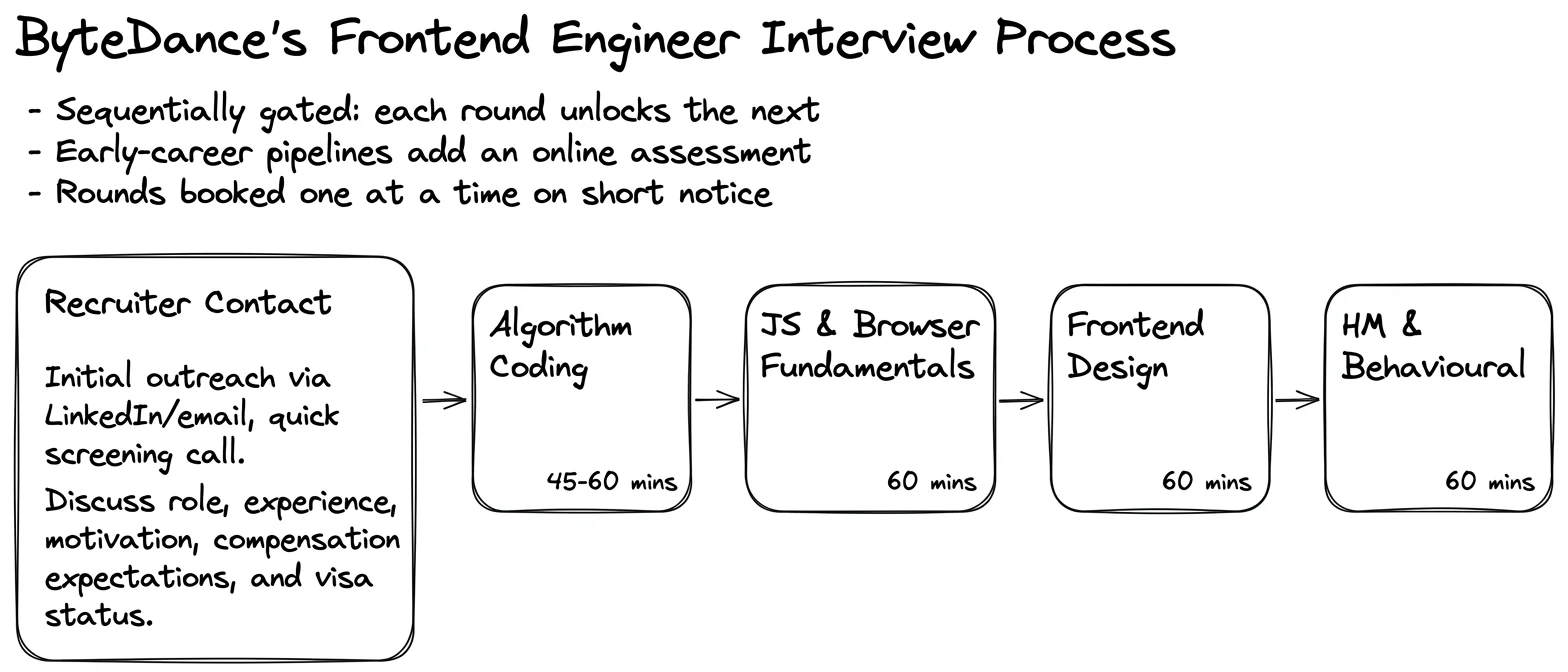
Hiring is team by team across TikTok, CapCut, Lark and the commercial products. Interviewers come from the hiring team, many are Chinese-speaking engineers, and content depends heavily on who you get. A typical loop has two to four technical video calls of 40 to 60 minutes, then a hiring-manager round, over two to six weeks.
New-graduate and intern candidates often start with an online assessment, and their live rounds lean on algorithms and fundamentals. Mid-level and senior loops (bands 2-1 and 2-2) add one or two design hours and a sharper project drill.
Here's what the interview process can look like:
- Recruiter contact or HR screen (sometimes skipped): A short call on background, location and target level; some candidates went straight into a technical hour.
- Online assessment (early-career pipelines): Three or four timed problems on a hosted judge, none of them frontend-specific.
- Technical screen: About an hour of resume drill plus one or two problems you run against your own tests.
- Frontend fundamentals round: Project questions, then rapid oral checks on CSS, async ordering, closures and framework internals, then another problem.
- Coding and data-structure rounds: Implement a cache, map or scheduler, then defend it against systems follow-ups.
- System design interview (mid-level and above): A product or team-specific design, from a 15-minute sketch to a full hour.
- Hiring manager round: Ownership, metrics and behavioral questions, often in Chinese, sometimes with a short problem.
Tip: Ask the recruiter which band you are interviewing for and whether the team has headcount at that band before the first technical round. A candidate on another track passed every round at 2-1 and still lost the role because the team only had headcount at 2-2.
Recruiter contact and HR screen
Most frontend loops begin with recruiter outreach or a referred application. A screen, when it happens, covers your current role, location, availability and target level. Recruiters book one round at a time and often describe the content wrongly: one frontend candidate was told round two would be system design and got fundamentals and coding from an interviewer whose name did not match the invitation. HR has also moved a candidate's location from Seattle to San Jose and booked interviews at 8 p.m. China time.
Interviewers evaluate:
- Level fit: Your scope and title against the band the team has open; a mismatch can end the process before any coding.
- Location and start date: Willingness to work from the hub that owns the role, usually San Jose or Seattle in the US.
Settle level, headcount, location and language before the first technical round, and prepare for every round as if its label could be wrong.
Sample questions for the recruiter contact and HR screen
Here are some questions reported by recent candidates:
- Walk through your background and the project you are most proud of.
- Which level are you targeting, and what scope do you own today?
Online assessment
New-graduate and intern pipelines can open with a timed set of three or four problems on a hosted judge, typically 90 to 120 minutes for four. Nothing is frontend-specific or needs advanced data structures; candidates called the sets hard because of their edge cases.
Reported problems include converting snake_case identifiers inside backticks to camelCase while leaving UPPER_CASE constants alone, counting pairs of numbers that are cyclic digit shifts of each other in arrays of up to 100,000 values, and repeatedly summing digit groups of size k until the string is short enough. Other sets asked to sort each concentric matrix border clockwise, count house segments after each removal, or simulate a memory allocator whose blocks start at multiples of 8 and are freed by id.
Interviewers evaluate:
- Specification reading: Alignment rules, tie-breaks and what counts as the same shift decide whether hidden tests pass.
- Edge cases: Empty input, single digits, leading zeros and odd matrix dimensions.
- Complexity within stated bounds: The prompts list acceptable bounds; meeting them matters more than beating them.
Practice timed sets of string-processing and simulation problems where the difficulty is in the specification, not the algorithm.
Sample questions for the online assessment
Here are some questions reported by recent candidates:
-
Rewrite every snake_case identifier enclosed in backticks in a docstring line as camelCase, keeping constants unchanged.
-
Count index pairs whose numbers have the same digit count and are cyclic shifts of each other.
-
After houses on a line are destroyed one by one, report the number of contiguous segments after each removal.
Technical screen
The first technical hour is a video call run by an engineer from the team. It opens with 10 to 15 minutes of self-introduction and your most challenging project, then moves to one or two problems in the Lark coding pad. You write your own test cases and run them; there is no hidden judge, and some interviewers ask you not to move the cursor outside the pad. In one frontend screen the problems were the k-th largest element and a variant of counting subarrays that sum to k, both solved in time. In another, about 30 minutes of a 40-minute round went to turning a flat list of comments with parent ids into a nested tree with children arrays.
Time splits unevenly: resume questions have consumed 40 minutes and left under 20 to code. Interviewers routinely refuse a working brute-force answer: one candidate's downward path-sum count on an n-ary tree was accepted only after a prefix-sum rewrite to linear time.
Interviewers evaluate:
- Running code: A solution that compiles and passes tests you wrote; an approach explained but not typed in time is treated as a miss.
- Test design: Cases you can justify aloud, such as empty input and duplicate values.
- Optimal complexity on request: A clear route from the baseline to the expected bound.
- Project fluency: Why your design won, what it measured, and what you would change.
Rehearse medium problems in a bare editor where you write and run your own tests, and keep the project story to ten minutes so the code gets its time.
Note: Prompts are not always internally consistent. In the reported comment-tree prompt, one reply's parent id differed between the sample input and the expected output; confirm which one is authoritative before coding, and say aloud how your code treats a record whose parent has not been seen yet.
Sample questions for the technical screen
Here are some questions reported by recent candidates:
-
Convert a flat array of comments with
id,parent_idandtextinto a nested tree where each node holds its replies inchildren. -
Return the k-th largest element of an unsorted array, then discuss when a heap beats quickselect.
Frontend fundamentals round
Frontend depth is tested inside a 40- to 50-minute round rather than a separate interview. One round spent 30 minutes on past projects, with repeated follow-ups about their AI features, then asked three oral questions: a CSS layout problem, the output order of a snippet mixing promises, timers and synchronous logs, and the execution order of closures. One more algorithm problem closed it. In another, HR never mentioned React, yet the interviewer showed a small component to debug and asked how useRef differs from useMemo.
Questions reach the network layer: WebSocket versus server-sent events, why a project used plain HTTP instead of a socket, and how HTTPS moves from asymmetric to symmetric encryption. Some teams also ask for small JavaScript implementations such as a debounce hook or array flattening with deduplication.
Interviewers evaluate:
- Precise async reasoning: Explaining why a promise callback runs before a zero-delay timer, not just reciting "microtasks first."
- Layout mechanics: Flexbox and positioning trade-offs for the case asked, not a general description of centering.
- Framework internals: Hook semantics, stale closures, effect dependencies and why a component re-renders.
- Protocol judgment: Choosing between polling, server-sent events and WebSocket for a feature you actually built.
Drill output-order puzzles and hook bugs aloud until you can explain each step in one sentence.
Sample questions for the frontend fundamentals round
Here are some questions reported by recent candidates:
-
Predict the console output of a snippet combining
setTimeout, resolved promises and synchronous logs, and explain the order. -
Find the bug in a short React component, then explain when you would use
useRefinstead ofuseMemo. -
Explain why your project called an AI agent runtime over plain HTTP rather than WebSocket, and when server-sent events would fit better.
Coding and data-structure rounds
Later rounds are often another implementation hour built around a structure rather than a puzzle. The LRU cache recurs across tracks, with extensions to expiry, LFU eviction, or debugging an existing implementation. Other prompts: a hash map from scratch from a vague statement with no hints, a deque with constant-time access by index, and a task scheduler with add, remove and pop-earliest-n. At least one team ran an AI-assisted round in which the candidate shared their screen with their own AI tool to build a rule validator over a dependency graph; unfinished tests led to a same-day rejection.
The implementation earns the follow-up, and the follow-up decides the round. After the LRU cache, a frontend candidate was asked what to do about a high miss rate; cache warming, read-through versus cache-aside, eviction choice, sizing and multi-tier caches were the expected territory.
Interviewers evaluate:
- Invariants: The hash map and doubly linked list stay consistent on every get, put and eviction.
- Clarifying mutating operations: One candidate restarted after assuming a pop operation did not remove tasks.
- Systems follow-through: Hit rate, expiry, concurrency and memory once the code works.
- Composure without hints: Stating assumptions and proceeding when the interviewer stays silent.
For every structure you practice, prepare the three systems questions that follow it: what degrades it, how you would measure that, and what you would change.
Sample questions for the coding and data-structure rounds
Here are some questions reported by recent candidates:
-
Implement an LRU cache, then explain what you would do if the miss rate were high.
-
Build a scheduler supporting adding a task with a timestamp, removing it by id, and popping the earliest n tasks.
-
Design a hash map without library support from an underspecified prompt.
-
Implement an LRU Cache (HashMap + Doubly Linked List) and Debug an Existing Implementation
System design interview
Mid-level and senior loops include one or two design discussions; new-graduate loops may get a short one inside a mixed round. One candidate who received an offer had 15 minutes to sketch an e-commerce platform, while full rounds run an hour. Prompts are often drawn from the team's own services, and when the editor could not draw, an interviewer had a candidate type the design as text.
Reported prompts include a chat room with scrolling live comments over video (with no further specification), a per-country top-songs list refreshed every ten minutes, and a real-time auction pushing the highest bid over WebSocket with server-sent events as a fallback. Strong answers separate ingestion from serving and size reads and writes before picking components.
Interviewers evaluate:
- Scoping a sparse prompt: Narrating assumptions when the interviewer declines to clarify.
- Real-time delivery choices: Push versus pull, fan-out, reconnection and ordering for comments or bids.
- Estimation: Read and write rates that justify caching and stream processing.
- Client performance: Rendering cost, batching of incoming messages, lazy loading and how you would measure the before and after.
Practice two or three live-content designs end to end, from client rendering through the delivery channel to the backend counters.
Sample questions for the system design interview
Here are some questions reported by recent candidates:
-
Design a live-comment overlay that scrolls viewer comments across a video in sync with playback.
-
Design a top-10 songs list for each country that refreshes every ten minutes under heavy read traffic.
-
Sketch an e-commerce platform's main components in 15 minutes, then write only the core logic of a related problem.
Hiring manager round
The manager's round is a project deep dive with behavioral questions, often in Chinese, sometimes with a short problem such as removing the fewest overlapping intervals. Common themes are your hardest project, a teammate conflict, ambiguous requirements, a failure, and prioritization. At senior bands every decision is challenged: why that architecture, what metric proved success. One loop ended with a 20-minute director conversation; in another, the manager round was cancelled when hiring priorities shifted.
Interviewers evaluate:
- Ownership: What you personally decided and shipped, separated from the team's work.
- Measured impact: Load-time, conversion or reliability numbers attached to your claims.
- Handling challenge: Defending a choice under pressure without becoming defensive.
Prepare five or six stories with numbers, including a frontend performance win and a decision you would reverse.
Tip: Weak behavioral answers do sink otherwise clean loops. One candidate solved a graph problem and attributed the rejection to a thin answer on describing a technical challenge, so rehearse that story with the obstacle, your action and a measured result.
Sample questions for the hiring manager round
Here are some questions reported by recent candidates:
-
Walk through a recent project in detail: what you owned, what failed, and what the numbers showed.
-
Describe a time requirements were ambiguous and how you decided what to build.
How ByteDance levels and evaluates Frontend Engineer candidates
Each round is pass or fail, and later rounds are cancelled after a failure. The hiring team and its manager decide, and the target band, set early, can override performance: one candidate was told the team would interview only below the requested 2-2 band. When a team declines, recruiters sometimes rematch candidates elsewhere, adding a manager round and about a week. An appeal over an interviewer's conduct has succeeded, but the repeat round still failed on an unexplained holistic assessment.
Decisions arrive from the same day to eight business days later; silence after a passed round is common and feedback is generic. Candidates report that feedback is visible across concurrent loops, so a weak round with one team can follow you to another.
Tip: Run one ByteDance application at a time and keep other processes moving. A passed round is not a commitment to schedule the next one.
How to prepare for the ByteDance Frontend Engineer interview
- Pin down band and headcount first: Confirm level, team surface and interview language before investing in the loop.
- Code in a bare pad with your own tests: Finish medium problems, cases included, within 25 to 30 minutes.
- Cover the recurring families: Flat-to-tree conversion, top-k selection, prefix-sum counting, string partitioning and intervals.
- Make async and hooks answers exact: Output-order puzzles, closure scoping, effect dependencies and
useRefversususeMemo, each in a sentence or two. - Prepare the systems follow-up for every structure: Hit-rate fixes, expiry, eviction choice, sizing and concurrency for caches and maps.
- Justify your transport choices: Polling, server-sent events or WebSocket for a feature on your resume.
- Rehearse one live-content design: A comment overlay or chat feed, from rendering cost to delivery channel to backend counters.
- Tighten the project story: Ten minutes, with your decisions, any AI or performance components, and the metrics that proved them.
About the ByteDance Frontend Engineer role
Frontend engineers at ByteDance build very high-traffic consumer surfaces and the business tools behind them: TikTok on the web, creator and ads platforms, e-commerce storefronts and seller tools, and effects and media editors. Teams are product-aligned, iterate quickly and track performance and engagement metrics. Many US teams work closely with colleagues in China, which can mean evening meetings; one candidate declined an offer, even after a raised counteroffer, over that schedule. In early 2026 TikTok's US operations moved into a joint venture majority-owned by US investors, and some US openings now sit under that entity. The ladder uses numbered bands (1-2, 2-1, 2-2, 3-1), with 2-1 and 2-2 the most common targets for experienced hires.
ByteDance hires Frontend Engineers across its product groups. Teams include:
- Multimedia architecture: Web video playback and performance, including on low-end devices.
- User growth: Acquisition and lifecycle surfaces, often full-stack with Node.js.
- Ads interface and platform: Advertiser tools for brand and performance campaigns.
- Global e-commerce: Shop storefronts, checkout and seller management.
- Creator products: Upload, editing and creator management tools.
- Effect House: Tools for building augmented-reality effects, including WebGPU work.
Frontend Engineer experience and education requirements
Postings ask for a bachelor's degree in computer science or a related field; intern roles require current enrollment in an undergraduate or master's program. Core requirements are JavaScript and TypeScript, HTML and CSS with a deep understanding of layout, and React or Vue with solid hooks knowledge. Build tools such as Webpack, Rollup or Vite and CSS preprocessors are common asks, senior postings want web performance work, and some full-stack teams want Node.js or Go.
FAQs about the ByteDance Frontend Engineer interview
How long does the ByteDance Frontend Engineer interview process take?
Usually two to six weeks. One frontend timeline went from application in early March to recruiter contact in mid-March and two technical rounds by late March; a team rematch adds about a week. Some candidates are never contacted again after passing a round.
What is the hardest round of the ByteDance Frontend Engineer interview?
For framework-trained candidates, the fundamentals round: rapid ordering and layout questions leave no room for approximate answers. For everyone, the riskiest moment is the systems follow-up after a finished coding problem, because it arrives just when the round seems won.
Is there a frontend take-home or UI build?
Rarely. No recent frontend report described a take-home or building a styled page; most coding time goes to algorithms.
Will the interview be in English or Chinese?
Either. Many interviewers are Chinese-speaking, and several rounds switched to Chinese without asking, especially with managers. You can ask to continue in English, but be ready to explain your projects in both.