Bobyard · Study
Bobyard Interview Process & Questions
TrueInterview
October 13, 2026 · 8 min read
Bobyard's engineering loop revolves around one artifact: a small full-stack comment system. Candidates build it as a take-home, then extend it live in short sessions (sorting, then nesting from a parent field, then filtering the tree), without AI assistance. The final panel seats the CEO, a product manager, an engineering manager and a senior engineer together, and its design questions come from Bobyard's own product.
This guide breaks down each stage of the Bobyard interview, what interviewers evaluate in each round, and how to prepare, with questions candidates were actually asked.
Verified: Based on 3 candidate-reported interview experiences, cross-checked against recent public accounts.
Bobyard interview process
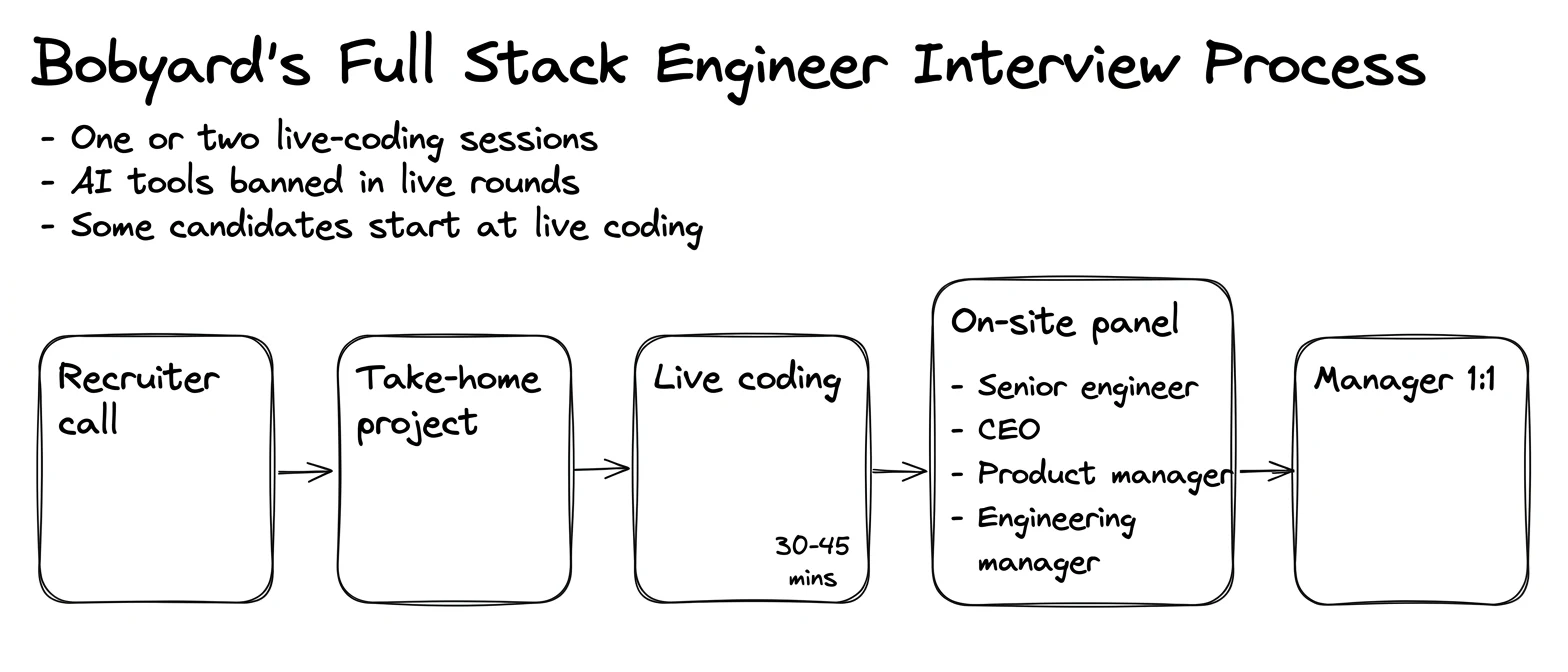
Bobyard is a small, in-person San Francisco startup hiring mainly full-stack engineers for a React, Django and PostgreSQL product, so the loop tests that stack end to end rather than abstract algorithms. Reported loops run three to five stages. The fullest had a recruiter call, a take-home, live-coding sessions of 30 and 45 minutes, and an on-site panel followed by a manager one-on-one. Another candidate started directly with live coding on the comment problem.
The format shifts. A session billed as a take-home walkthrough turned into live coding, and one candidate learned that a later round would allow AI tools while the first did not.
Here's what the interview process can look like:
- Recruiter or intro call: A resume conversation with quick frontend and backend troubleshooting questions.
- Take-home project: A comment system with full CRUD across front end, back end and database.
- Live coding (one or two sessions): 30–45 minute sessions that extend the comment system with sorting, nesting and filtering, without AI tools.
- On-site panel and manager conversation: A four-person panel covering product-specific system design and behavioral questions, then a one-on-one follow-up.
Tip: Build the take-home so it is easy to extend. Every reported live round reused the comment data model, so a clean state structure saves minutes when a
parentIdfield appears.
Recruiter or intro call
The first call is conversational but technical in places. After a resume walkthrough, candidates got rapid questions across frontend and backend fundamentals, which one described as arriving abruptly and spanning a wide range of rote knowledge. Two recurring prompts are diagnosing a slow page and handling a bug found in production.
Interviewers evaluate:
- Diagnostic order: Measuring before fixing: network waterfall, bundle size, slow API calls, then rendering.
- Production instincts: Triage, rollback or hotfix, communication, and a follow-up that prevents a repeat.
- Stack breadth: Moving between browser, API and database in the same answer.
- Startup fit: Interest in a small team that ships weekly from incomplete requirements.
Prepare short, structured troubleshooting answers that name concrete tools and steps.
Sample questions for the recruiter or intro call
Here are some questions reported by recent candidates:
-
A frontend page loads very slowly. How would you find the cause and fix it?
-
A bug is found in production. Walk through what you do, from discovery to resolution.
Take-home project
The take-home is a comment feature like the one under a video: create, read, update and delete comments across a front end, a back end and a database. One candidate had a two-hour version; another had no enforced limit and was expected to submit within two to three days. Candidates call the task straightforward. Its real weight is that the next rounds build directly on it.
Interviewers evaluate:
- Working CRUD: Every operation persists to the database and shows up in the UI.
- Extensible data model: A schema that can take a parent reference, timestamps and an author without a rewrite.
- Code organization: Clear separation between API, data access and UI state.
- Product polish: Sensible empty states, errors and default ordering.
Use a stack you can modify quickly under observation; the posted stack is React, Django and PostgreSQL.
Live coding
Live coding comes in one or two sessions. In the five-round loop, a 30-minute session asked for sorting by timestamp and by user ID in both directions, with extra credit for keeping the chosen order after a refresh. A 45-minute session then gave each comment a parentId and asked for nested comments, built on the front end from mock data. Its extra credit was a filter showing only the matching comment and its children.
The sessions are pure coding, with requirements and little discussion. AI tools were prohibited in every reported live round, though web search was allowed in one. In one session a technical leader watched closely and spoke quickly, and that candidate did not finish the nesting task. Another candidate also fell short on nesting but explained the approach clearly and advanced about four weeks later.
Interviewers evaluate:
- Tree construction: A one-pass parent-to-children map, roots and orphans handled, rendered recursively.
- State placement: Where the sort order lives and how it survives a reload, typically local storage or the URL.
- Recursive filtering: Keeping a matched node's subtree without breaking the hierarchy.
- Speed without AI: Steady progress in plain React and JavaScript while observed.
- Narrated reasoning: A clear plan when time runs short, which counted even with unfinished code.
Practice building and filtering a comment tree from flat records in under 30 minutes, without autocomplete.
Note: Two reported candidates did not finish the nesting task, and one of them still advanced. Partial code with a clearly explained plan is graded, so keep talking when the clock runs down.
Sample questions for live coding
Here are some questions reported by recent candidates:
-
Add sorting by timestamp and by user ID, ascending and descending, and keep the selected order after a refresh.
-
Given comments with a
parentIdfield, render them as a nested thread using mock data only. -
Add a filter that shows only the matching comment and its children and hides all others.
-
Add sorting to a comment list with persistence across refresh
-
Filter nested comments and keep only matched nodes and their descendants
On-site panel and manager conversation
The on-site panel has four interviewers: a senior engineer, the CEO, a product manager and the engineering manager. The senior engineer's design questions come from Bobyard's own system, such as an image-generation feature whose processing outlasts a normal HTTP timeout, requirements that demand strict ordering, and isolating the one element slowing a page. The CEO asked free-form questions across many topics. The product manager focused on past experience and wanted large, startup-style accomplishments. The engineering manager filled gaps on both behavioral and design topics.
A separate one-on-one with the manager follows and is mostly follow-up questions on whatever the panel wanted more signal on.
Interviewers evaluate:
- Asynchronous design: Moving long jobs off the request path with a queue, workers, job status, and polling or push.
- Ordering guarantees: Where ordering is enforced and what happens on retries.
- Frontend performance depth: Profiling to find the specific slow component, not generic advice.
- Ownership stories: Shipped outcomes with scale and metrics.
- Consistency: Manager follow-ups that extend, not contradict, what the panel heard.
Prepare one long-running job design and three or four ownership stories with numbers.
Tip: For the image-generation question, return a job ID immediately, process in the background, and let the client poll or subscribe. Then cover failure, retry and ordering, which the panel probed next.
Sample questions for the on-site panel and manager conversation
Here are some questions reported by recent candidates:
-
Image generation takes long enough that HTTP requests time out. Redesign the feature so users still get results.
-
A user requirement depends on strict ordering. How do you guarantee it?
-
Front-end performance has degraded. How do you find the specific slow element?
-
Describe your largest accomplishment and your exact role in it.
How Bobyard makes hiring decisions
The decision rests with a small group: the panelists, including the CEO, and the hiring manager, whose one-on-one closes gaps from the panel. Reports describe no separate committee. Unfinished live-coding work did not automatically end a candidacy when the reasoning was clear. One candidate waited about a month between the first live round and the next step, and the recruiting team was described as responsive. Level typically follows the posting, either full-stack or senior full-stack.
How to prepare for the Bobyard interview
- Build a comment app first: A small React CRUD comment app with a Django or similar back end makes the take-home fast.
- Drill parent-to-tree conversion: Build a nested tree from flat
parentIdrecords in one pass, then render it recursively. - Practice subtree filtering: Keep matched comments with their children intact, at any depth.
- Persist UI state: Keep a sort or filter choice across reloads with local storage or URL parameters.
- Code without AI: Rehearse 30–45 minute builds with no assistant or autocomplete, narrating as you go.
- Prepare a long-running job design: Async processing, job status, retries and ordering for work that outlasts an HTTP timeout.
- Bring metric-backed ownership stories: The panel favors large, concrete accomplishments.
About working at Bobyard
Bobyard builds AI takeoff and estimating software for contractors: computer vision reads construction plans and automates quantity and material takeoffs. Founded in 2023, it started with landscaping and is expanding into drywall, electrical, HVAC, plumbing and framing. It raised a $35M Series A led by 8VC in December 2025 and launched a consolidated 2.0 platform in April 2026.
The team ships weekly. Full-stack engineers own features from the React front end through Django APIs and PostgreSQL to deployment on AWS and GCP, and help shape requirements that often arrive incomplete. Engineers work alongside these groups:
- Product engineering: Full-stack features, APIs, data models and frontend performance.
- Computer vision: Trade-specific models that read blueprints and generate quantities.
- Product: Discovery with contractors and estimators, and prioritization.
- Design: Estimator workflows and the takeoff workspace.
Experience and education requirements
Postings name no degree or minimum years. They ask for hands-on React, Django, PostgreSQL and AWS or GCP experience, strength in system design and performance (or the ability to learn quickly), high ownership and a product mindset. The senior role adds working with the founding team and scaling existing infrastructure. Roles are full-time and in person in San Francisco.
FAQs about the Bobyard interview
How long does the Bobyard interview process take?
Typically several weeks. The take-home allows up to two to three days, and one candidate waited about a month between the first live round and the next step.
What is the hardest round of the Bobyard interview?
Live coding. Building and filtering a nested comment tree in 30–45 minutes without AI is where reported candidates fell short.
Can I use AI tools during the interview?
Not in the reported live-coding rounds, though web search was allowed in one. One candidate was told a later round would permit AI, so ask about each round.
How much does a Bobyard engineer make?
Posted base salary ranges, before equity:
- Full Stack Engineer: ~$120K–$150K
- Senior Full Stack Engineer: ~$150K–$180K
Packages pair base pay with an equity grant (posted at 0.025–0.05 percent) and a performance bonus.
Is the Bobyard interview remote?
The early stages are typically remote. The roles are in person in San Francisco, and the final panel is described as an on-site.