Bloomberg · Study
Bloomberg Interview Process & Questions
TrueInterview
July 24, 2026 · 14 min read
Bloomberg's loop is coding-first and unusually strict about completion: the common format is two problems in about 40 minutes of coding, and candidates who solved one problem well but left the second as pseudocode were rejected. The second distinctive element is a design-through-code round, where you turn an underspecified object (a trade processor with subscribers, an ordered stream, an O(1) lottery) into working code. "Why Bloomberg" is asked at almost every stage, and the HR and engineering manager conversations at the end are evaluative, not ceremonial.
This guide breaks down each stage of the Bloomberg interview, what interviewers evaluate in each round, and how to prepare, with questions candidates were actually asked.
Verified: Based on 39 candidate-reported interview experiences, cross-checked against recent public accounts.
Bloomberg interview process
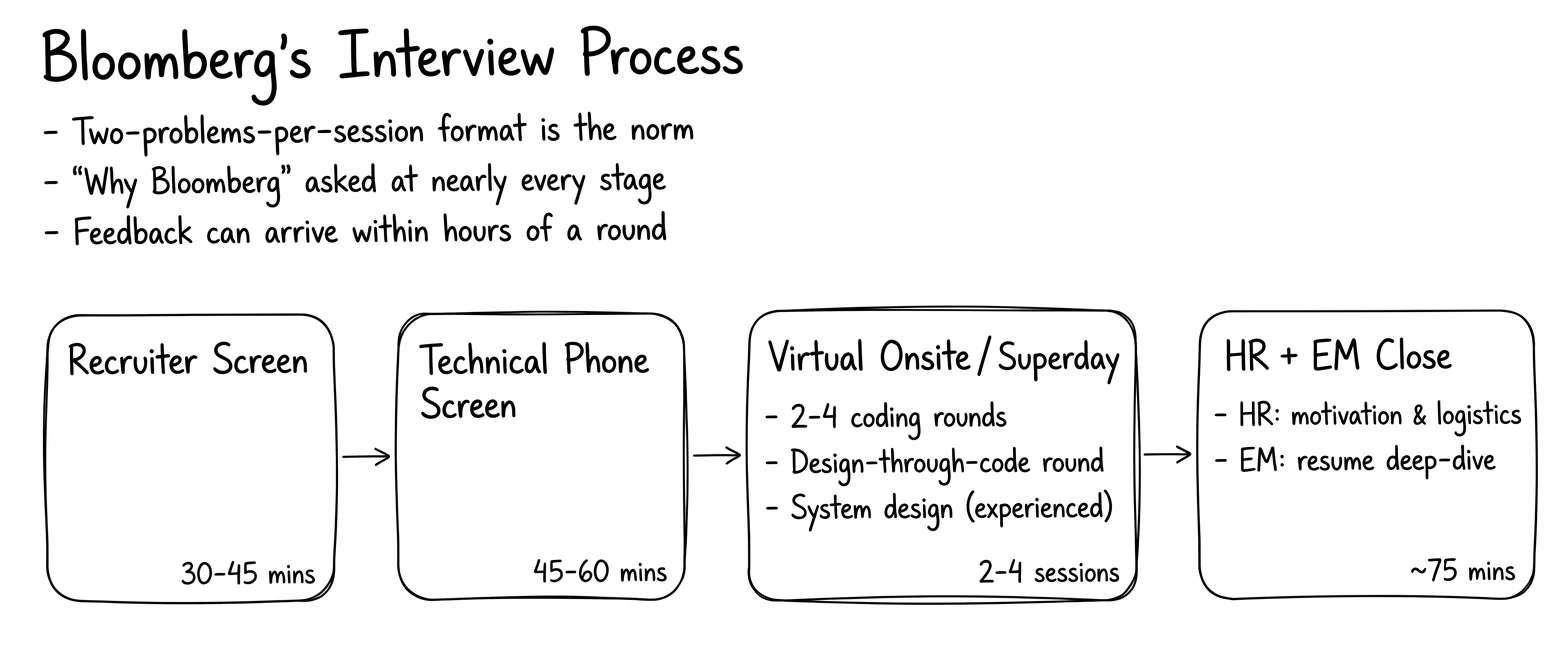
Hiring runs per team, and a profile can be considered by several teams at once. Two candidates sat parallel pipelines with different teams, each with its own interviewers, pace and outcome. The structure is stable: a recruiter call, one or two technical phone screens, a superday of two or three technical sessions, then an HR conversation and an engineering manager (EM) interview.
New grads and interns get coding plus object-oriented design. Experienced candidates add a system design hour, often right after a coding hour, and the EM round may carry design or an unannounced coding problem. Some onsites are split into two days, and a weak first day ends the process before the second is held.
Here's what the interview process can look like:
- Recruiter screen (30–45 minutes): Background, motivation, visa and timeline; for some new-grad pipelines a full behavioral interview with STAR stories.
- Technical phone screen (one or two, 45–60 minutes): A few minutes of resume or behavioral questions, then one or two problems coded live in a shared editor over video.
- Coding interviews (superday, two or three sessions): Hour-long rounds with a short resume discussion and two problems each, harder than the screen and often with extra state or a changed rule.
- Object-oriented design round: Design and implement a small class or container from a vague prompt, with strict complexity or API contracts.
- System design interview (experienced candidates): A real-time data system in Bloomberg's domain, such as market-data distribution or streaming aggregation.
- HR and engineering manager interviews: About 30 minutes of HR behavioral and logistics, then a 40–45 minute resume deep dive with the EM.
Tip: Budget each coding hour as two 18–20 minute problems plus testing time. Across the reports, the most common rejection was a second problem left unimplemented, including for candidates who had fully solved a hard first problem.
Recruiter screen
The first call usually lasts 30–45 minutes. For most candidates it covers background, location, work authorization and competing timelines, but a Dublin new-grad candidate had a 45-minute fully behavioral screen with no technical content: self-introduction, why Bloomberg, a teamwork story, an initiative story, strengths and weaknesses, then logistics and their own questions. One experienced candidate's first round was a no-code conversation about kickoff, a mid-project scope doubling, confirming requirements and handoff; answers built on phased delivery and written alignment ended on the offer track.
Interviewers evaluate:
- Motivation: A specific reason for Bloomberg that mixes the product, the engineering and something personal, not a generic finance answer.
- Story structure: Short STAR answers with a clear personal action and result.
- Ownership: Initiative taken without being asked, and work delivered beyond the formal scope.
Prepare a two-minute introduction, a specific "why Bloomberg," and three STAR stories before this call.
Sample questions for the recruiter screen
Here are some questions reported by recent candidates:
-
Walk through your background and explain what draws you to Bloomberg.
-
A stakeholder asks for a change that doubles the scope halfway through a project. What do you do?
-
How do you make sure someone else can maintain and extend your work after you move on?
Technical phone screen
The screen runs 45–60 minutes over video in a shared online editor, sometimes with two engineers. Many interviewers present a problem within minutes; others open with a resume walk-through or a behavioral question. Two formats dominate: two medium problems (for example, Meeting Rooms II plus a tree problem, or validate a BST plus longest palindromic substring), or one data-structure design problem that fills the hour with follow-ups.
The follow-up is where the screen is decided. Equal split of people between two cities becomes an arbitrary quota of k, which breaks the greedy solution and needs DP. A frequency check becomes "valid after removing at most one character." An O(1) insert, delete and random-access container then has to support inserts at arbitrary positions. A top-K tracker must respect a rate-limited price API. Several interviewers then ask for the candidate's own test cases. Results arrive from the next day to about a week; one passing candidate had an onsite invitation the next day.
Interviewers evaluate:
- Working code for every problem: One candidate's round-robin schedule ended in detailed pseudocode and was rejected; another needed hints on Minimum Height Trees and was rejected the next day.
- Reading the actual rules: A one-dimensional candy-crush elimination with cascading removals differed from the familiar version, and memorized code failed its edge cases.
- Justified data structures: Why a heap rather than a sorted structure or full sort, with complexity restated after each change.
- Optimization on request: One Van Eck sequence screen ended in rejection because the faster second solution did not come in time.
Practice solving two mediums back to back in a plain editor, then extend each with one changed constraint.
Note: The bar is high even when the round feels positive. One candidate solved a multilevel linked-list flatten correctly, walked through tests, saw a satisfied interviewer, and was still rejected; early hesitation explaining the pointer rewiring was the likely cost.
Sample questions for the technical phone screen
Here are some questions reported by recent candidates:
-
Send exactly half of 2n people to each of two cities at minimum cost, then generalize to exactly k for one city.
-
Maintain a structure with insert, delete and get-top-k-most-frequent, then scale it to billions of points and millions of distinct keys.
-
Emit records whose content and title repeat within a 60-second window from a timestamped stream, evicting stale entries as you go.
Coding interviews
The superday is two or three hour-long sessions, virtual or in person, sometimes back to back across consecutive days. A typical hour has about 15 minutes of resume discussion and questions, then 40 minutes for two problems. Some rounds have two interviewers, and one candidate's coding and design interviewers were both managers. Rounds escalate familiar patterns: grid BFS where the state includes remaining fuel or walls broken, a greedy gas-station circuit followed by largest rectangle in a histogram, words sorted by a custom alphabet in which two-letter combinations count as single letters, and two-way reachability in a directed subway graph.
Some prompts are deliberate curveballs. One loop included a contest-style grid DP with treasure collection that the candidate had never seen. Another asked for the fairest apportionment of electoral votes across 50 states with no further constraints. A senior candidate was asked to solve longest substring without repeating characters with the sliding-window left pointer forbidden. Fraud detection prompts give explicit rules (any amount over $2,000, or two locations within 60 minutes for one account) and probe the boundaries at exactly $2,000 and exactly 60 minutes.
Interviewers evaluate:
- Two finished solutions: Optimal or near-optimal code for both problems, then a dry run on a small example.
- State modeling: Extending visited sets with fuel, walls broken or refill status without losing correctness.
- Composure on the unfamiliar: A clear recurrence and complexity estimate on a problem you have not seen.
- Edge-case discipline: Boundary values defined aloud, and your own unit tests written once the code runs.
Drill graph and grid search with extra state, interval and stack problems, and string parsing, each in under 20 minutes.
Note: Superday rejections arrive fast: one came 20 minutes after day one ended. That candidate had spent most of the 40 coding minutes on the first problem and left an Insert Delete GetRandom variant unfinished.
Sample questions for the coding interviews
Here are some questions reported by recent candidates:
-
Find the shortest path across a grid of walls when you may break at most k of them.
-
Sort words by an alphabet in which certain letter pairs are a single letter.
-
Flag transactions above a fixed amount, or from two different locations for the same account within 60 minutes.
Object-oriented design round
This round merges class design with live implementation, and it appears for new grads and experienced hires alike, sometimes sharing a session with an algorithm problem. Prompts are short and often vague: build a trade processor with on-new-trade, subscribe and unsubscribe; design an ordered stream that releases values when the next expected ID arrives; implement a lottery with add, remove and uniform random pick in O(1); build a to-do list around a check method that already exists; or design a train station that tracks check-ins and average trip times. Intern screens use a smaller version, such as a minimal grep built so flags like ignore-case slot in easily.
A newer variant hands you working code instead of a blank page. One candidate received an LRU cache and had to refactor it so other eviction policies, such as LFU, could plug in; the difficulty was choosing an abstraction that fits two very different internal structures.
Interviewers evaluate:
- Contract first: What an event is, who consumes it, and what happens on duplicate subscribes or removing an absent element.
- Complexity guarantees: The hash-map-plus-array swap-with-last trick for O(1) removal, and how duplicates change it.
- Extensibility: New flags, policies or sort orders added through an interface without touching core logic.
- Finished implementation: A running class with edge cases, not a skeleton with an observer diagram.
Practice turning a two-sentence prompt into an API, then a full class, in 30 minutes.
Tip: Spend the first three minutes pinning down the purpose and method contracts. A rejected candidate spent most of the trade-processor round guessing what a trade meant and how subscribers should be notified, and finished neither the code nor the edge cases.
Sample questions for the object-oriented design round
Here are some questions reported by recent candidates:
-
Implement a trade processor with subscribe and unsubscribe that notifies listeners on each new trade.
-
Build a lottery that adds and removes participants and draws a uniform winner, all in O(1), then handle duplicate entries.
-
Refactor a given LRU cache so the eviction policy is pluggable and LFU can be added.
-
Refactor an LRU Cache into a Pluggable Eviction-Policy Cache
System design interview
Experienced candidates get a design hour, often paired with a coding hour in the same block, and sometimes opened with domain questions about the team's area. Prompts stay close to Bloomberg's business. Recent examples: a stream of social posts and news articles turned into company mention counts over windows from 30 minutes to several days, with 10–30 minutes of acceptable delay, subscriptions and high-volume keyword search; market data from many exchanges, loaded and fanned out to processors over UDP and deduplicated and reordered with sequence numbers; and a VWAP service covering 100 exchanges, up to a million symbols each and about 100 ticks per second per symbol.
Not every prompt is greenfield. One team asked how to cut the 150 ms latency of an existing holiday-calendar service that clients reach through a C++ adapter and that depends on another team's service, steering the discussion toward caching location, warm caches and freshness.
Interviewers evaluate:
- Simplicity first: A clear ingest, process, store and serve path before any scaling. One candidate was rejected after over-engineering despite repeated hints to simplify.
- Filtering versus search: Narrowing known subscriptions differs from ad-hoc queries over a large corpus, and each needs its own path.
- Data-quality reasoning: Loss, duplicates and reordering on UDP feeds, with sequence numbers, per-exchange buffers and gap recovery.
- Serving by audience: Push updates for screen users versus a query API with higher completeness for enterprise clients.
Rehearse two streaming designs end to end, saying the simple version out loud before adding components.
Sample questions for the system design interview
Here are some questions reported by recent candidates:
-
Ingest social and news streams, count company mentions over sliding windows, and serve subscriptions and keyword search during meme-stock spikes.
-
Distribute exchange data from loaders to processors over UDP and guarantee deduplicated, ordered output.
-
Compute VWAP per symbol and window for screen users who want pushes and enterprise users who query.
HR and engineering manager interviews
The HR session, about 30 minutes, is often held on superday itself. It covers background, the proudest project, conflict, why Bloomberg, work authorization, and an overview of the new-hire training program. Candidates who treated it as informational were surprised to learn it can end a process. The EM interview, usually 40–45 minutes and sometimes a week later, is a resume deep dive: the hardest project and what you would redo, technical decisions, handling difficult teammates as a lead, delegation, mentoring and ambiguity.
Format guidance for the EM round is unreliable. One referral candidate was told by email there would be no coding, then got an unseen hard problem with about 20 minutes and a mostly silent interviewer, and was rejected. Others report system design in this slot for senior roles.
Interviewers evaluate:
- Depth on your own work: The decisions behind a project, the alternatives and what you would change.
- Leadership signals: Delegation, mentoring and handling an unreasonable teammate, scaled to your level.
- Genuine interest: Specific enthusiasm for the team, its product and how Bloomberg's clients use it.
Know every line of your resume, and keep coding sharp until the final round regardless of what the schedule says.
Sample questions for the HR and engineering manager interviews
Here are some questions reported by recent candidates:
-
What was your most challenging project, and what would you do differently?
-
How did you handle an unreasonable team member while leading a team?
-
How do you decide what to delegate?
How Bloomberg makes hiring decisions
Each stage is a gate: a pass is needed to be invited to the next, and outcomes often arrive within an hour to a few days. The hiring team, not a central committee, runs the loop, so separate teams can reach different decisions on the same candidate in parallel. Technical rounds decide most outcomes, but the HR session and EM interview are scored and can reject a candidate who passed every coding round. Candidates apply for Software Engineer or Senior Software Engineer roles, and the target level is set by the requisition and the scope of your experience. No consistent cooldown period appears in the reports.
Tip: If you are in pipelines with two teams, prepare for each as a separate loop with its own bar. Candidates who passed one team's screen were rejected by another's in the same month.
How to prepare for the Bloomberg interview
- Train the two-problem hour: Solve two mediums in 40 minutes with tests, and move to the second problem by minute 20 even if the first is not perfect.
- Master the hash-map-plus-array family: O(1) insert, delete and random pick, the lottery variant with duplicates, and top-K frequency with heap updates.
- Rehearse rule changes: Take problems you know, change one rule (a quota, cascade behavior, an alphabet, a fuel budget), and re-derive before coding.
- Build small event-driven classes: Write observer-style subscribe and unsubscribe, an ordered stream, and a pluggable-policy cache from vague two-line prompts.
- Write tests unprompted: End every solution with boundary, empty and invalid-input cases traced through the code.
- Prepare two streaming designs: Market-data fan-out with sequence numbers, and windowed aggregation with subscriptions and search, each starting from the simplest pipeline.
- Make "why Bloomberg" specific: Tie it to the Terminal, its clients or the team's data, and expect the question at every stage.
- Stay sharp to the end: Keep coding practice going through the EM round, which can include an unannounced problem.
About working at Bloomberg
Bloomberg's engineers build the Terminal and the data, analytics, news and trading systems behind it, in a large engineering organization concentrated in New York and London with offices including Princeton, San Francisco, Dublin, Frankfurt and Tokyo. C++ and Python dominate, and much of the work involves real-time, high-volume financial data. The career structure is flat. Individual contributors hold one of two titles, and new hires start with a training program.
| Level | Primary focus | Impact scope |
|---|---|---|
| Software Engineer | Building and maintaining features and services within a team | One team's components |
| Senior Software Engineer | Leading technical design and complex projects, mentoring | A team's systems and its dependencies |
| Team Lead | Managing engineers and setting a team's direction | A team, and across teams as group manager |
Bloomberg hires software engineers across its product and infrastructure groups. Teams include:
- AI Engineering: Machine learning and language technology applied to news, search and financial data.
- Core Product Engineering: Shared Terminal functionality used across product areas.
- Asset and Investment Manager (AIM) Engineering: The buy-side order management system.
- Exchange and Trading Connectivity: Links between clients, order and execution systems, and trading venues.
- BQuant and the CTO Office: A Python-based quantitative analysis platform and next-generation Terminal infrastructure.
- Internal and Client Service Applications: The systems Bloomberg uses to run the company and support clients.
Experience and education requirements
Entry-level postings ask for experience in at least one programming language such as C, C++, Java, JavaScript or TypeScript, or Python, and accept a computer science degree or an equivalent combination of education, training and professional experience. Internships expect enrollment in a computer science degree and programming experience in C, C++, Java or Python. Senior postings typically ask for several years of C++, Java or Python experience.
FAQs about the Bloomberg interview
How long does the Bloomberg interview process take?
Typically about three to seven weeks. One offer took around five weeks from phone screen to written offer, with the superday two weeks after the screen and the EM round a week later. Long gaps between screen and superday can stretch a process to three months.
What is the hardest round of the Bloomberg interview?
The reports point to the superday coding hours, because both problems must be finished and one often has a changed rule. For experienced candidates, system design is the most frequent place where offers are lost, usually by over-engineering.
Is there an online assessment?
Not in the recent reports. The first technical step is a live phone screen with an engineer.
What language should you use?
Any mainstream language works. Python is the most common choice in the reports, and C++ is valued because much of Bloomberg's codebase uses it.
How much does a Bloomberg software engineer make?
Total compensation figures vary too widely to give per-level totals. New York postings for Senior Software Engineer roles list base salary ranges of roughly $160K to $240K, and packages add an annual bonus.