Block · Study
Block Interview Process & Questions
TrueInterview
October 13, 2026 · 8 min read
Block's coding rounds are practical, multi-part builds rather than single puzzles. A prompt is revealed one part at a time, and in at least one screen the next part stayed hidden until you had written and passed your own tests and refactored for the change. The problems themselves are moderate. Candidates who struggle usually run short on reading speed, test-writing time or clean structure, not algorithms. The hiring manager reviews your resume only after you pass the phone screen, and a strong screen can lead to team matching rather than straight to an onsite.
This guide breaks down each stage of the Block interview, what interviewers evaluate in each round, and how to prepare, with questions candidates were actually asked.
Verified: Based on 3 candidate-reported interview experiences, cross-checked against recent public accounts.
Block interview process
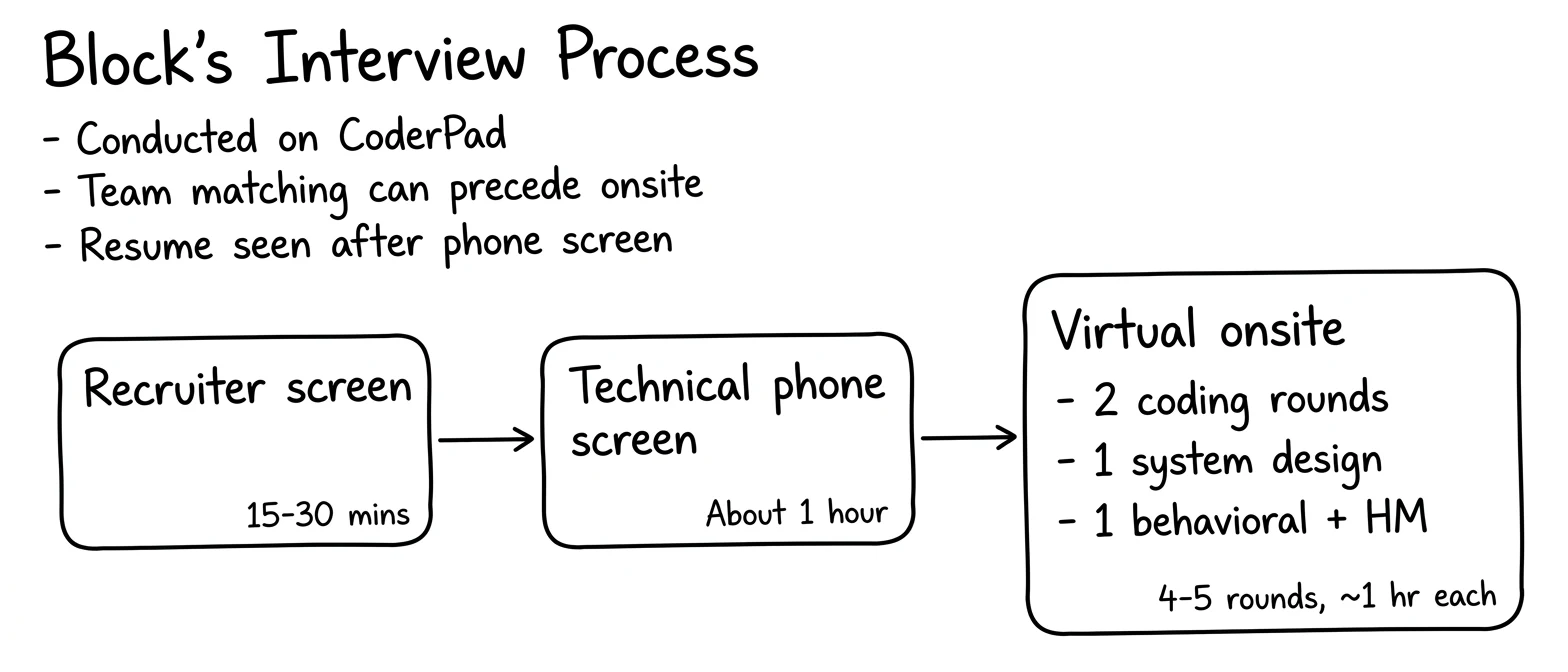
Each team runs its own loop, so domain prompts follow the team: payments graphs for transaction teams, fraud and risk for machine learning. The structure is consistent: a recruiter screen, a one-hour technical phone screen on CoderPad, and a virtual onsite that public accounts put at four to five rounds of about an hour each.
Mid-level onsites typically have two coding rounds, one system design and one behavioral round; senior and lead loops weigh design and project depth more. Machine Learning Engineer candidates get an applied coding problem and an ML-flavored design.
Here's what the interview process can look like:
- Recruiter screen: A short call about background, motivation and logistics, often ending with the phone screen already scheduled.
- Technical phone screen: About an hour on CoderPad with one problem revealed in parts, each needing passing tests before the next.
- Onsite coding interviews (typically two): Practical builds such as board generation, scoring logic or optimization over a small dataset.
- System design interview: A payments-flavored design problem; for ML candidates, a risk or fraud system.
- Behavioral and hiring manager interview (typically): Past projects, collaboration and fit with the team and Block's mission.
Tip: Practice multi-part problems where you stop after each part, write two or three tests, run them, and refactor before reading on. That workflow, not the algorithm, decided how far candidates got.
Recruiter screen
The call, roughly 15–30 minutes, covers background, the role, logistics and interest in Block's economic-empowerment mission. In one recent process the phone screen was booked during the call, and the hiring manager would see the resume only after the screen.
Interviewers look for:
- Track fit: Whether your experience matches the team's stack and domain, such as payments, lending, banking or risk.
- Motivation: A specific reason for Block or the product, not a generic fintech answer.
- Level signals: Scope and years of experience that set the target level.
Have a two-minute story ready that ties your recent work to one Block product.
Sample questions for the recruiter screen
Here are some questions reported by recent candidates:
- Tell me about yourself and your current work.
- Why Block, and why this product area?
Technical phone screen
The screen runs about an hour on CoderPad. After five minutes of introductions the interviewer goes straight to the problem, which arrives in parts. In one screen, every part required self-written test cases to pass before the next part was shown, and the interviewer required a refactor before each new feature. The parts built on one another: a class that records transactions between customers and answers whether two customers ever transacted, then a customer's entire network through any chain of transactions, then that network limited to n degrees of separation. The underlying work is an undirected graph and a breadth-first search with a depth limit.
Another candidate built a card game the same way: a Card class, then scoring a five-card hand for a flush, for every pair of matching ranks (three of a kind scores three pairs), and for every subset of ranks summing to 15. The last part needed recursion, and the candidate ran out of time to verify it.
Interviewers evaluate:
- Reading speed: Parsing each new part quickly and spotting the edge cases it implies.
- Testing discipline: Writing your own small tests and running them, which takes much of the hour.
- Refactoring: Restructuring earlier code cleanly before adding the next feature instead of bolting on branches.
- Algorithmic fit: Recognizing the graph traversal or subset enumeration inside a business framing.
- Communication: Keeping the interviewer informed as requirements change.
Practice 60-minute, three-part problems in a runnable editor, with tests written as you go.
Note: A very positive phone screen did not always lead straight to an onsite. In one case the original team had just filled its headcount, so the candidate moved into team matching first.
Sample questions for the technical phone screen
Here are some questions reported by recent candidates:
-
Track customer transactions, answer whether two customers ever transacted, then return a customer's full network and a network limited to
ndegrees. -
Score a five-card hand for same suit, pairs of matching ranks, and every subset of ranks summing to 15.
Onsite coding interviews
Public accounts describe two hour-long coding rounds, often with a lead interviewer and a shadow, in the screen's practical, incremental style. Reported prompts include generating a Minesweeper board with neighbor counts, choosing crops to maximize profit, and, for front-end work, a tournament progression chart driven by a JavaScript simulation. Some accounts mention adding a feature to a partly built service.
Machine Learning Engineer candidates get a less conventional problem: one mid-level candidate manipulated data for a natural-language task where Bayesian methods helped.
Interviewers evaluate:
- Working code first: A correct, runnable baseline before any optimization.
- Extensibility: Code that absorbs the next requirement without a rewrite.
- Edge handling: Board boundaries, ties in optimization and empty inputs.
- Domain fluency: For ML candidates, choosing a reasonable probabilistic approach and explaining its assumptions.
Prepare small simulation and grid problems that you can extend in stages within an hour.
Sample questions for the onsite coding interviews
Here are some questions reported by recent candidates:
-
Generate a Minesweeper board, placing the mines and computing every cell's adjacent-mine count.
-
Choose which crops to plant to maximize total profit.
-
Simulate a tournament bracket in JavaScript and render its progression as a chart.
-
Tournament Progression Chart with JavaScript Simulation and UI
System design interview
The design round leans on Block's own domains. A mid-level Machine Learning Engineer was asked to design a fraud-detection system for financial transactions with a focus on risk requirements, in the same session as the coding problem. Software Engineer design rounds typically use payments-shaped prompts: ledgers, payment flows, peer-to-peer transfers and the consistency they need.
Interviewers evaluate:
- Correctness of money movement: Idempotency, exactly-once effects and auditability.
- Risk trade-offs: Latency of a fraud decision against false positives that block real customers.
- Data flow: Where features, scores and transaction state live, and how they stay consistent.
- Scope control: Clear requirements before components, scaled to your level.
Practice one payments design and one real-time risk scoring design end to end.
Tip: In a fraud or risk design, state up front what happens when the model is slow or unavailable. The fallback is part of the risk requirement.
Sample questions for the system design interview
Here are some questions reported by recent candidates:
- Design a fraud-detection system for a financial product, centered on risk requirements.
Behavioral and hiring manager interview
Public accounts describe a behavioral round on past experience and a final conversation with the prospective manager, typically covering a project you owned, a disagreement and cross-functional work.
Interviewers look for:
- Ownership: Specific decisions you made and their measured results.
- Collaboration: How you resolved conflict across teams.
- Mission fit: Interest in the customers the team serves, such as small sellers or Cash App users.
Prepare four or five stories with concrete outcomes, one tied to reliability or customer trust.
How Block makes hiring decisions
Phone-screen feedback goes to the hiring manager, who in one case judged it within a day and moved the candidate forward. Team matching can come before the onsite when headcount shifts, and the interviewers typically come from the team you are matched with. The hiring team weighs onsite feedback together and sets the level from your scope. Block cut about 4,000 roles in early 2026 and is concentrating on AI-enabled work, so ask the recruiter whether the role's headcount is confirmed.
How to prepare for the Block interview
- Drill staged problems: Solve three-part prompts in an hour, stopping after each part to test.
- Write your own tests: Get fast at small asserts in CoderPad, because hidden parts depend on them.
- Refactor before extending: Restructure for the next requirement rather than piling on conditionals.
- Master graph basics in disguise: Union-find and depth-limited breadth-first search over transactions.
- Practice subset enumeration: Count combinations that hit a target sum, with duplicate values.
- Prepare a payments design: Ledgers, idempotency and a fraud or risk scoring path.
- Know your product: Tie your stories to Square sellers or Cash App customers.
About working at Block
Block runs Square for merchants, Cash App for consumers, Afterpay for buy-now-pay-later, and bitcoin products such as the Bitkey wallet. Teams own their products end to end, and many roles have been remote-friendly.
Block hires engineers across its businesses. Teams include:
- Square: Point-of-sale, payments processing and merchant software.
- Cash App: Peer-to-peer payments, banking, lending and investing.
- Afterpay: Installment payments for shoppers and merchants.
- Trust and risk: Fraud detection and account protection across products.
- Bitcoin: Wallet hardware and software, and mining.
Experience and education requirements
Software Engineer postings typically ask for five or more years of industry experience, and senior and lead roles ask for eight or more. Common languages are Java, Kotlin and Ruby, with Go and JavaScript on some teams. Payments, banking or API design experience is a plus.
FAQs about the Block interview
How long does the Block interview process take?
Typically several weeks. Screen feedback reached the hiring manager the next day in one case, but team matching added time.
What is the hardest round of the Block interview?
The technical phone screen surprises the most candidates. The problem is moderate, but writing tests and refactoring before each part leaves little slack.
Is there an online assessment?
None was reported for Software Engineer roles. The first technical step was a live CoderPad screen.
Which language should I use?
Any mainstream language works for coding rounds. Front-end prompts use JavaScript, and Java and Kotlin match many backend teams.
How much does a Block software engineer make?
Recent postings list top-zone US base pay of about $164K–$245K for a Software Engineer with five or more years of experience, and about $198K–$297K for a senior role.