Study
8 Big Tech Questions Only Senior Candidates Report (2026)
TrueInterview
October 11, 2026 · 13 min read
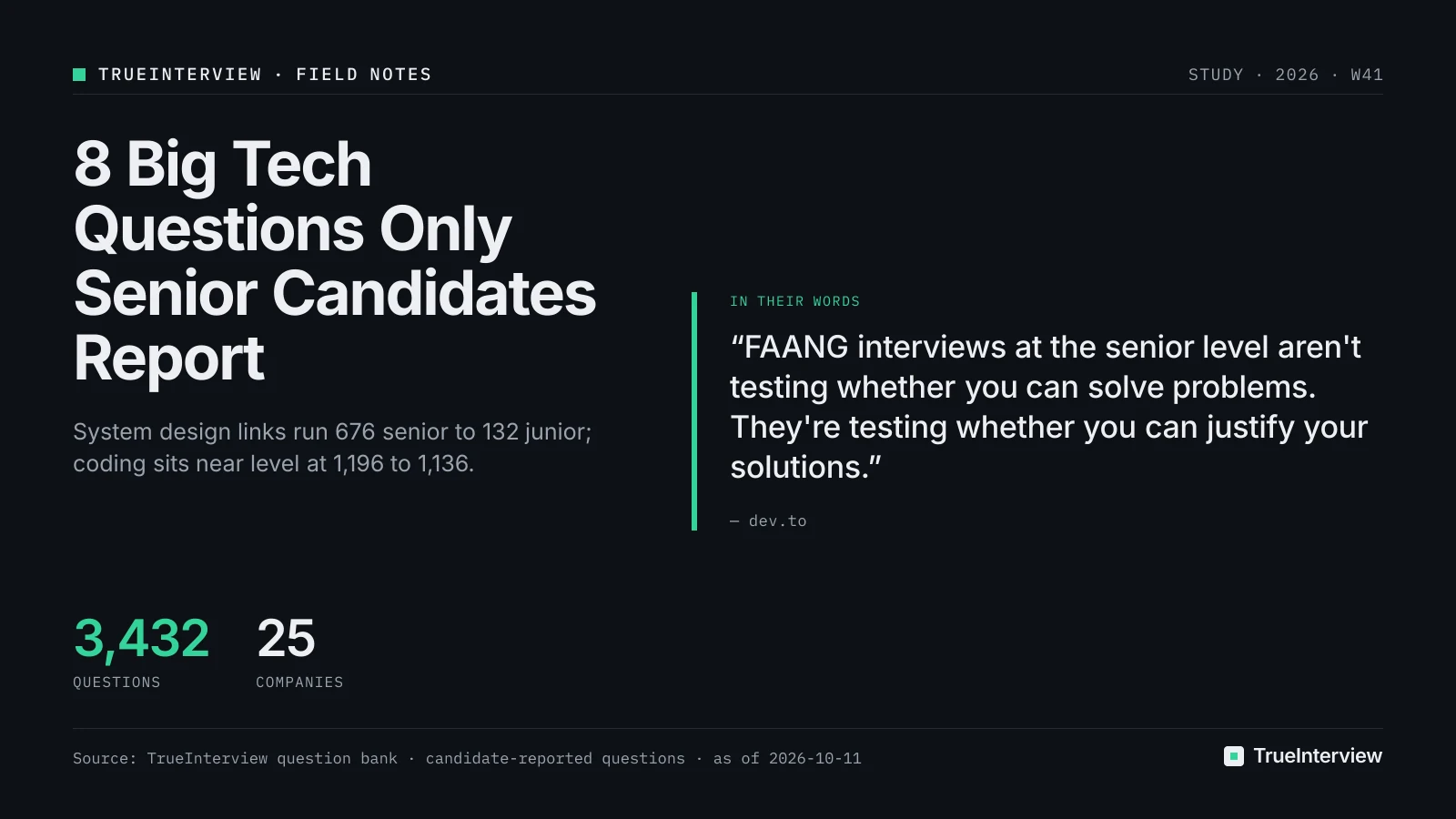
Senior candidates at big tech get different questions, not harder ones. As of 2026-10-11, eight questions in TrueInterview's bank are linked only from write-ups by candidates who self-reported a senior, staff-plus or manager level, led by "Design GPU Inference Serving System" (22 links) and "HM BQ — Why OpenAI / AI Safety / AGI" (20). Across all formats, system design links run 676 senior-or-above to 132 junior-or-below, while coding links sit almost level at 1,196 to 1,136. If your loop is senior, the exam moves to product-domain design, motivation and your own project history, and that is where your first week of preparation belongs.
Disclosure: TrueInterview is an interview-preparation product and publishes this article. Facts about other products come from their public pages on the dates listed under Sources.
Which questions do only senior candidates report?
Eight questions in the bank carry write-up links from senior-or-above candidates and none from junior, new-grad or intern candidates. Four of them are system design prompts, two are motivation or project questions, and none is a dynamic-programming or graph puzzle. The table ranks them by link count; a link means one write-up named the question, and the level is the one the candidate reported.
| Rank | Question | Format | Senior-or-above links | Staff-plus or manager links | Practise |
|---|---|---|---|---|---|
| 1 | Design GPU Inference Serving System (Anthropic) | System design: LLM and AI infrastructure | 22 | 2 | Browse the question bank |
| 2 | HM BQ — Why OpenAI / AI Safety / AGI | Behavioral: hiring manager | 20 | none listed | Similar drill: Culture & Behavioral |
| 3 | Describe your most impactful project | Behavioral: project deep dive | 18 | 2 | Similar drill: resume deep dive |
| 4 | Durable Key-Value Store Serialization | Object-oriented design | 13 | none listed | Browse the question bank |
| 5 | Design an Ads Frequency Cap System (Netflix) | System design: ads and ranking | 13 | none listed | Browse the question bank |
| 6 | Design the Data Model for an Ads Demand Platform (Netflix) | System design: ads and ranking | 12 | none listed | Browse the question bank |
| 7 | Design Google News | System design | 11 | 1 | Browse the question bank |
| 8 | AI Code Craft Challenge: Delayed-Delivery Workflow Engine | AI-assisted coding | 10 | none listed | Browse the question bank |
Read the list as a map of what juniors never write about, not as a frequency ranking: the top three are a serving-infrastructure design, a question about why you want this company, and a request to defend your own best project. None of them can be prepared by grinding a pattern list, which is the main reason senior candidates who prepare from junior material get surprised.
Design GPU Inference Serving System
Anthropic's prompt sits in the LLM, RAG and AI infrastructure family, next to "Design GPU Scheduling Platform" from Databricks and Anthropic. As standard engineering practice, two decisions carry the round: how you batch requests on each GPU against a latency target, and how you allocate and reclaim the memory every in-flight request holds. Have an answer for a traffic spike that arrives while a new replica is still loading its model weights.
The two Netflix ads prompts
"Design an Ads Frequency Cap System" and "Design the Data Model for an Ads Demand Platform" are both filed under Netflix in the ads, recommendation and ranking ML family. A frequency cap is a per-user, per-campaign counter read on the ad-serving hot path, so the decision to defend is exact versus approximate counting, and whether a lagging counter store over-delivers or under-delivers. The data-model prompt turns on the advertiser, campaign, line-item and creative hierarchy, and on keeping serving reads apart from reporting aggregates.
Durable Key-Value Store Serialization
This one is filed under 9 big-tech companies, including OpenAI, Amazon and Google, and all 13 of its write-up links come from senior-or-above candidates. It fits a wider tilt: concurrency subtypes draw 21 senior-or-above links against 6 junior-or-below, and low-level design 7 against 1. Prepare the on-disk record format (a length prefix plus a checksum), the point at which you flush to disk, and how recovery treats a half-written final record.
The motivation and project questions
"HM BQ — Why OpenAI / AI Safety / AGI" is linked from 20 write-ups, all by senior-or-above candidates. When a hiring manager asks a senior candidate why this company, the question tests whether your reasons survive a follow-up about the company's actual product and risks, so write the answer down and attack it. Describe your most impactful project is the same test applied to your past: what you owned, what you rejected and what you measured.
Which questions lean senior but still reach juniors?
A second group is linked from both levels but leans hard toward senior candidates, led by "Culture & Behavioral Interview Questions" at 39 senior-or-above links against 4 junior-or-below. These are the questions most likely to catch a senior candidate who prepared from a junior-oriented list, because juniors mention them just often enough to look ordinary.
| Question | Format | Senior-or-above links | Junior-or-below links | Staff-plus or manager links | Practise |
|---|---|---|---|---|---|
| Culture & Behavioral Interview Questions | Behavioral | 39 | 4 | 4 | Practise culture and behavioral |
| Onsite BQ + Hiring Manager + Project Deep-Dive (Uber) | Behavioral with project deep dive | 26 | 6 | 2 | Practise Uber's combined onsite |
| Infection Spread Simulation (OpenAI, Anthropic) | Coding | 26 | 8 | none listed | Practise infection spread |
| Design Payment System (OpenAI, ByteDance) | System design: payments | 23 | 4 | none listed | Browse the question bank |
| Hiring Manager Round — Behavioral & Collaboration | Behavioral | 22 | 2 | 1 | Browse the question bank |
| Technical Deep Dive (slide-based) | Behavioral: project deep dive | 21 | 1 | none listed | Browse the question bank |
"Design Job Scheduler" belongs in the same group: 16 of its 21 write-up links come from senior-or-above candidates, and it is filed under 12 big-tech companies. For both the scheduler and the payment prompt, the interviewer will push on the same two decisions: what makes a retried job or charge safe to run twice (idempotency keys, and a double-entry ledger for money), and who owns a task when the node holding its lease dies.
Our take: the most portable senior question in the bank is a design prompt about exactly-once side effects, not a hard algorithm. If you can only drill one design problem beyond your target company's families, drill a scheduler or a payment flow until you can defend every retry path.
What are the three patterns behind the list?
The list is not random. It sorts into three patterns: system design drawn from the company's own product domain, motivation and hiring-manager questions that grow with level, and your own project history turned into a formal question. Each pattern has a count behind it, and each changes what a senior candidate should practise first.
Pattern 1: the design prompt is your company's product domain
The design families that concentrate in senior write-ups are ads, recommendation and ranking ML (106 senior-or-above links against 10 junior-or-below), collaboration and productivity apps (23 against 1) and video, media and uploads (11 against 1). That points away from the classic social-network canon and toward the product your target company sells.
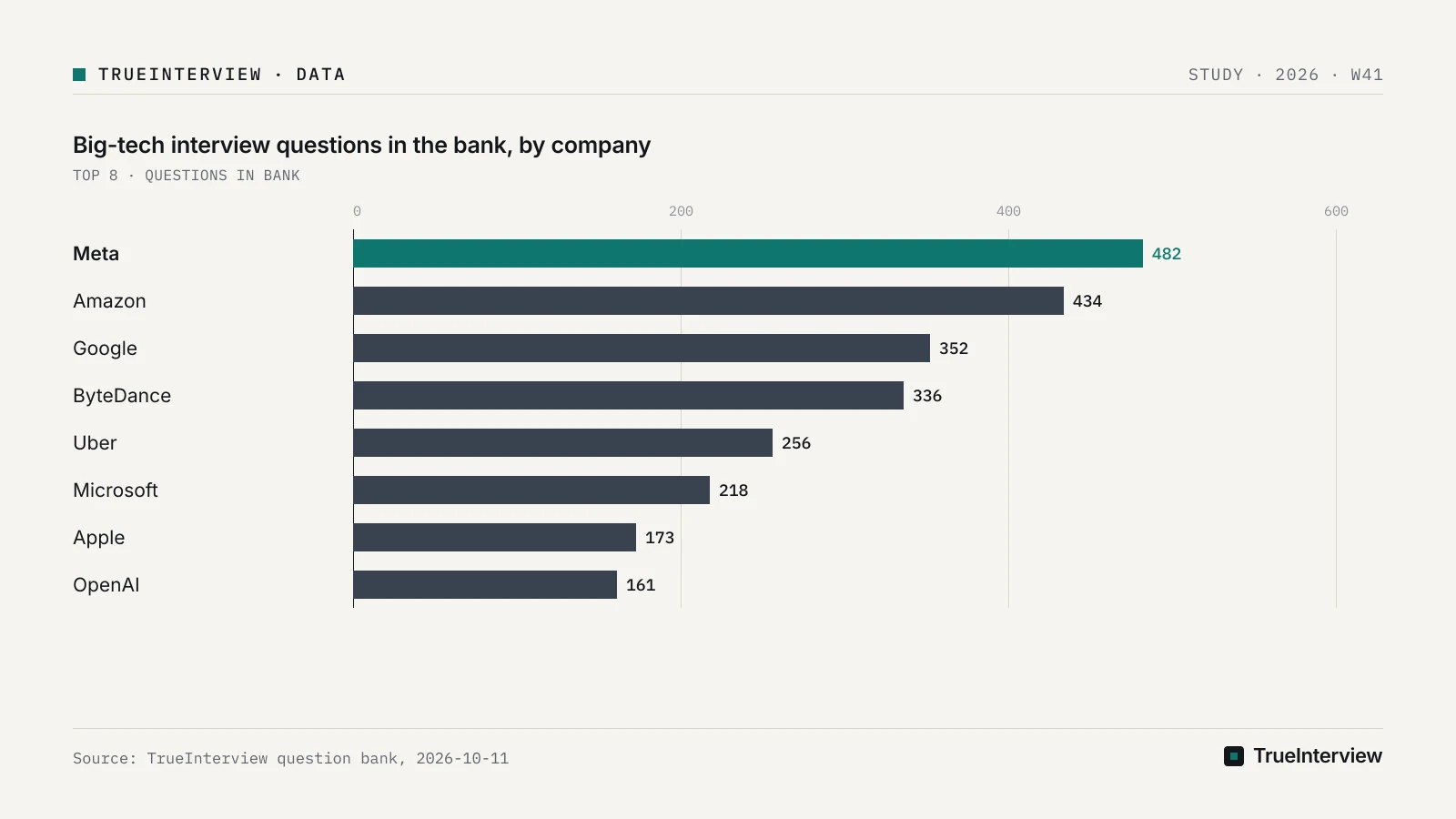
Company files confirm it. Of Meta's 75 design questions, 14 fall in ads, recommendation and ranking ML and 9 in A/B testing and experiment design. Amazon's 50 lean toward metrics, logging and data pipelines (7), Uber's 34 toward maps, ride-hailing and delivery (7), and Google's 39 toward news feed and social graph (4). Two companies at the same level mean two different first weeks: a Meta loop starts with ranking and experiments, an Amazon loop with a metrics pipeline.
Spacecomplexity's Amazon senior guide says "System design is evaluated on tradeoffs, not correctness" and asks you to know the failure modes of every component you choose. Prepare the two families your company files most, and for each one write down the failure you would design around first.
Pattern 2: motivation and hiring-manager questions grow with level
Motivation is the behavioral subtype that grows most with level, at 150 senior-or-above links against 43 junior-or-below. Combined with the hiring-manager rounds in the tables above, that makes your reason for choosing the company a scored question at senior level rather than a warm-up.
The Engineering Leadership newsletter quotes a former chair of Meta's iOS and Android hiring committees, who says that for staff-level packets "I went directly to read the behavioral interview feedback." The same chair puts the stakes plainly: "No staff-level scope there, no staff-level offer." Treat the behavioral round as a leveling instrument and prepare it with the same hours you give a design family.
Pattern 3: your own history becomes a question
"Technical Deep Dive (slide-based)" is the starkest split in the bank, at 21 senior-or-above links against 1 junior-or-below. ByteDance's "Project Deep Dive (Resume Drill)" is linked from 47 write-ups on its own. At senior level, the project you led is the syllabus.
Spacecomplexity's guide describes what senior interviewers do with it: "They ask for specific numbers, for the alternative you considered and rejected, for the failure mode nobody thought about until production." Build one deep dive around those three probes, with the numbers you moved and the decision you would reverse, and rehearse it out loud until you can answer each probe without notes.
What would we skip as a senior candidate?
Skip extra volume where the levels do not diverge. Among coding topics, dynamic programming draws 59 senior-or-above links against 91 junior-or-below and two-pointers 65 against 79, while math (69 against 43), intervals (67 against 50) and binary search (65 against 48) lean senior. Hold dynamic programming at maintenance and move the freed evenings to design.
- Dynamic-programming marathons. They are the most junior-weighted coding topic in the bank, so a fourth DP problem set buys less than a second design family.
- SQL as a level lever. SQL links are identical across levels at 7 and 7, so whatever SQL your role needs, more of it will not move your level.
- Memorised throughput figures. Spacecomplexity's guide lists "correct architecture with no tradeoff discussion" among the reasons candidates get marked down; spend the time on failure modes instead.
- Top-questions behavioral lists. The Engineering Leadership newsletter calls rehearsing a top-questions list "logical but wrong"; build stories around scope and decisions instead.
- Hard-problem grinding. The codingcareer.de interview with coach Ihab says "Over-preparation is LeetCode hard, hands down."
One thing not to skip: "Merge Intervals" has 0 write-up links in the bank yet is filed under 12 big-tech companies, and the interval family leans senior. A missing link count is not evidence that a question has gone away.
What changes again at staff-plus level?
At staff-plus the mix moves further out of coding, though the sample is small enough to read as direction rather than a rate. Questions linked from staff-plus or manager write-ups include "Behavioral / BQ Question Pack" (10), "Culture & Behavioral Interview Questions" (4) and "Traditional Behavioral" (3), with "Design GPU Inference Serving System" and "Design Job Scheduler" at 2 each.
Third-party accounts point the same way. Spacecomplexity's principal-engineer guide says Amazon's L7 loop is roughly 60% behavioral and 40% technical, that a writing exercise is submitted before the onsite, and that L7 candidates are judged against a separate set of Principal Engineering Tenets. Spacecomplexity's hiring-committee article says that at Meta, for E6 and above, failing both system design rounds is a hard rejection and failing the behavioral round is an automatic No Hire with no retake.
Our take: at staff-plus, treat the design round as a gate you must clear and the behavioral loop as the instrument that sets your level. Budget a full week for written material, because a pre-onsite document is graded before you speak.
Where does down-leveling happen?
Spacecomplexity's hiring-committee article says "Down-leveling is more common than outright rejection for borderline candidates who show strong fundamentals at the wrong scope". The tables above show where senior and junior write-ups diverge most: design, motivation and project deep dives, so those are the rounds where scope is measured.
A Medium post on FAANG interviewer feedback describes rejection notes such as "Didn't demonstrate impact beyond their immediate team." The same post reports another: "Strong experience but answers didn't reflect senior-level thinking." Both are one writer's collection, not a rate, but they name the failure precisely.
Our take: a down-level usually comes from scope, not from a missed edge case. Design depth (whether you go past the happy path to failure modes and cost), the project deep dive (whether the decisions were yours) and behavioral scope (team, org or company) carry the level signal. If you can only fix one before your loop, fix the scope of your stories.
How we counted
The bank holds 3,432 big-tech practice questions reported at 25 companies as of 2026-10-11, and 2,729 of them were last reported in the 12 months before that date. Candidate write-ups link these questions 3,291 times from candidates who reported a senior, staff-plus or manager level and 2,163 times from junior, new-grad or intern candidates. Levels are self-reported, every figure here is a link count rather than a count of write-ups or candidates, and the questions are candidate-reported reconstructions for practice, not any company's official list.
FAQ
Do senior engineers get harder coding questions at big tech?
Not by this bank's measure. Coding links are close to level across seniority, as the opening numbers show, and the senior tilt is toward math, intervals and binary search rather than harder dynamic programming. The Pragmatic Engineer's interviewer survey reports that among 53 Big Tech and New Big Tech respondents, nobody said their company had moved away from algorithmic questions. A dev.to post on FAANG interview mistakes puts the senior bar this way: "They're testing whether you can justify your solutions." Keep coding sharp at maintenance volume and practise the justification.
How many system design rounds does a senior loop include?
At least one, and sometimes two. Amazon's SDE III prep page says "Expect at least one question on software systems design." Spacecomplexity's Amazon guide describes a senior loop of five to six rounds with one system design round. At Meta's E6 and above, the spacecomplexity hiring-committee rule quoted above assumes two design rounds, so check the round count with your recruiter before you plan.
Is the behavioral round where your level gets decided?
Several interviewers say so. The Engineering Leadership newsletter says, in a section heading, "Behavioral Interview is Where Your Level Gets Determined". A Pragmatic Engineer post by a former Amazon Bar Raiser says "The technical bar was met, but the hiring decision was made in the behavioral round." Read that as a reason to prepare stories with the same rigour as design, since your own scope is what the round measures.
Are these the questions big tech companies officially ask?
No. TrueInterview's questions are candidate-reported and reconstructed for practice; they are not any company's official question list. A senior-only question tells you what senior candidates chose to write about, which is useful for preparation but is not a promise that your interviewer will ask it.
What should a senior backend engineer practise first?
Start with the backend-heavy entries from the tables: the durable key-value store, the job scheduler and the payment system. Each one tests the same senior skill, which is defending what happens to state when a process crashes or a request is retried. Pair one of them with the design family your target company files most, and you have covered the two most likely shapes of your design round.
Your practice plan
This plan assumes a full-time job and three weeks of evenings, with one longer weekend session each week.
- Week one, first evening. Find your target company's top two design families in the first pattern and pick one senior-only prompt from the ranking that matches them. Browse the question bank for that company's design questions.
- Week one. Write one slide-based deep dive of a project you led: what you owned, the alternative you rejected, the number you moved and the failure you found. Rehearse it against ByteDance's resume drill and Uber's combined onsite.
- Weeks one to three. Hold coding at two problems an evening, weighted toward intervals, binary search and math. Use Infection Spread Simulation to practise narrating the tradeoff while you code, not after.
- Week two. Write your answer to why this company and attack it with follow-ups about the product. Rehearse it with Culture & Behavioral Interview Questions and the Behavioral / BQ Question Pack.
- Week two, weekend. Work a second design prompt end to end, either the job scheduler or the payment system, and defend every retry path out loud.
- Week three. If Amazon is in your loop, map your stories to the Leadership Principles Standard Set; for Google, use the Googliness behavioral round. Rewrite any story whose scope stops at your own team.
- Week three, last weekend. Run one mock loop in order: design, deep dive, behavioral, coding. If you are interviewing at staff-plus, put behavioral and the written artifact first and coding last.
Sources
- TrueInterview question bank — big-tech interview at big-tech companies — counted 2026-10-11
- Amazon Senior Software Engineer Interview: What the Bar Actually Looks Like · SpaceComplexity — checked 2026-10-11
- How to Nail Big Tech Behavioral Interviews as a Senior Software Engineer — checked 2026-10-11
- FAANG Interview Insights: A Conversation with Ihab A. (Ex-Google, Ex-Meta) - Guides - codingcareer — checked 2026-10-11
- Amazon Principal Engineer Interview: What the L7 Bar Actually Tests · SpaceComplexity — checked 2026-10-11
- The Interviewers Liked You. Now the Hiring Committee Decides. · SpaceComplexity — checked 2026-10-11
- Medium — checked 2026-10-11
- The Pulse #146: How AI is changing tech interviews — checked 2026-10-11
- 5 Interview Mistakes That Cost Me Offers at FAANG Companies - DEV Community — checked 2026-10-11
- SDE III Interview Prep — checked 2026-10-11
- Learnings from conducting ~1,000 interviews at Amazon — checked 2026-10-11
Last reviewed: 2026-10-11.