Study
Big Tech Onsite Interview Rounds for Senior Engineers (2026)
TrueInterview
October 11, 2026 · 18 min read
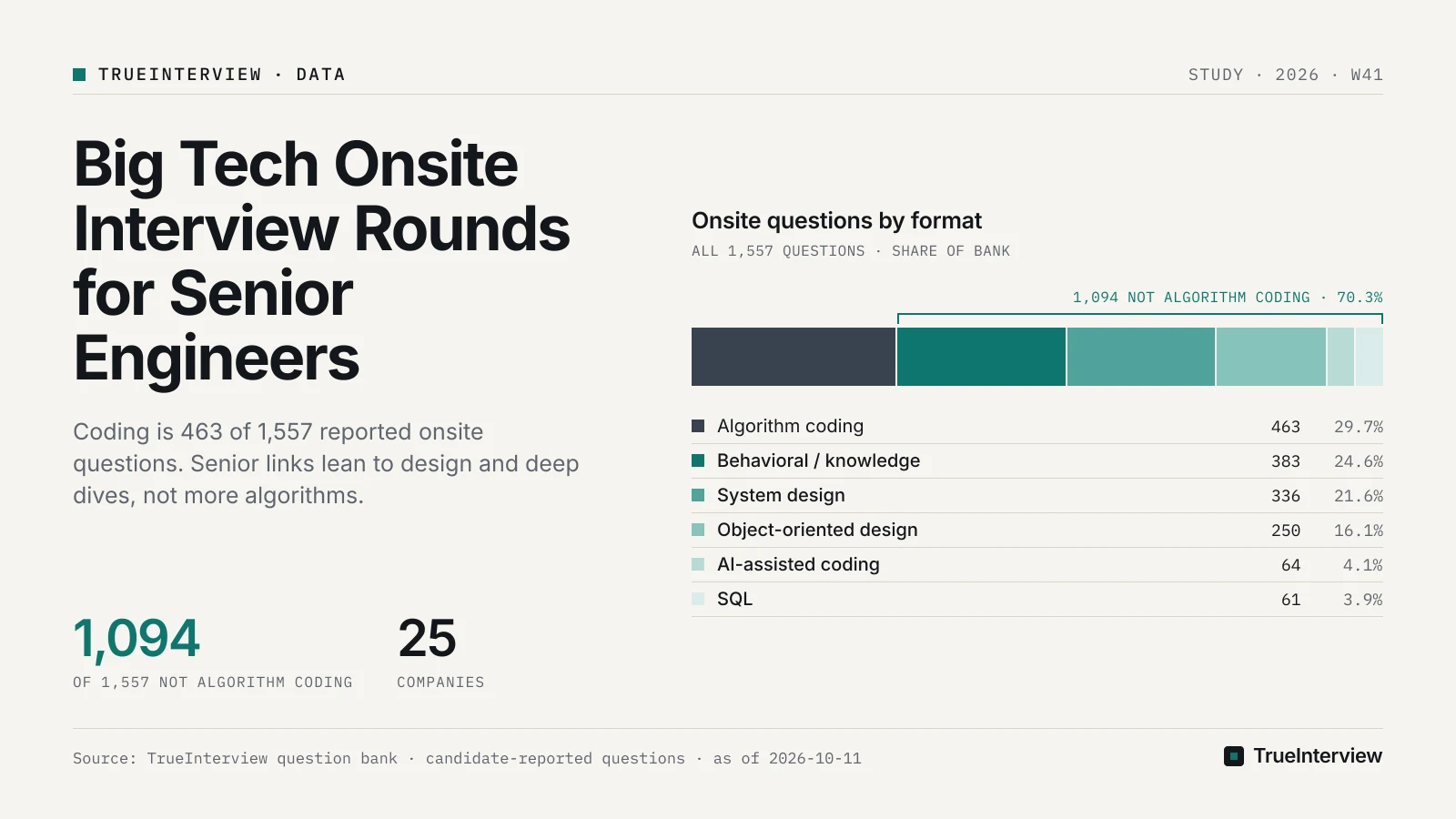
As of 2026-10-11, TrueInterview's bank holds 1,557 candidate-reported onsite questions from 25 big-tech companies, and only 463 of them are coding; behavioral and knowledge (383), system design (336), object-oriented design (250), AI-assisted coding (64) and SQL (61) make up the rest. A big-tech onsite is a set of different rounds that each company weights differently, so your first planning step is your target company's round table, not a longer algorithm list. Our take: at senior and staff level, put the extra hours into design, deep-dive and hiring-manager preparation, where senior candidates' write-up links concentrate, and keep coding sharp enough to clear the gate.
Disclosure: TrueInterview is an interview-preparation product and publishes this article. Facts about other products come from their public pages on the dates listed under Sources.
What does each onsite round test?
Each format in the loop tests a different skill, and preparing for one does little for the others. The table pairs each format with a question candidates reported from a recent onsite where the bank has one, so you can see the shape of the round before you plan hours for it. The last column is our reading of what the interviewer is scoring.
| Format | Reported onsite questions | A reported example (company, last reported) | What the round is really testing (our view) |
|---|---|---|---|
| Coding (algorithm) | 463 | Merge Two Interval Lists, filed under 12 companies including Meta, Google and Uber | Picking the pattern quickly and saying why; interval merging is a sort followed by a single sweep |
| Behavioral and knowledge | 383 | Culture & Behavioral Interview Questions, Anthropic, 2026-09 | The scope and judgement inside your own stories |
| System design | 336 | Design GPU Scheduling Platform, Databricks, 2026-07 | Trade-offs inside a product domain, such as fairness against utilisation for shared GPUs |
| Object-oriented design | 250 | Rate Limiter, Stripe, 2026-09 | Interfaces and state that survive a changed requirement |
| AI-assisted coding | 64 | Maze Solver, Meta, 2026-09 | Directing an assistant and checking its output |
| SQL | 61 | Meta contributes 21 of these; see the company table below | Query shape and correctness, mainly in data-role loops |
Two rows deserve more hours than most plans give them. Object-oriented design is a block of its own, yet one Medium guide describes onsites as "Multiple rounds covering technical skills, behavioral questions, and sometimes a design or system design challenge". That phrasing hides the class-design round entirely. If your recruiter mentions low-level design, object design or machine coding, this is the block they mean.
The behavioral and knowledge bucket is also wider than its name. Across the 758 non-coding onsite questions, behavioral is 130, project deep dive 41 and motivation 19, while statistics (a data-science subtype) is 93 and ML fundamentals 34. If you are a software engineer, ask whether your loop includes statistics or SQL before you spend an evening on either.
How does the round mix change by company?
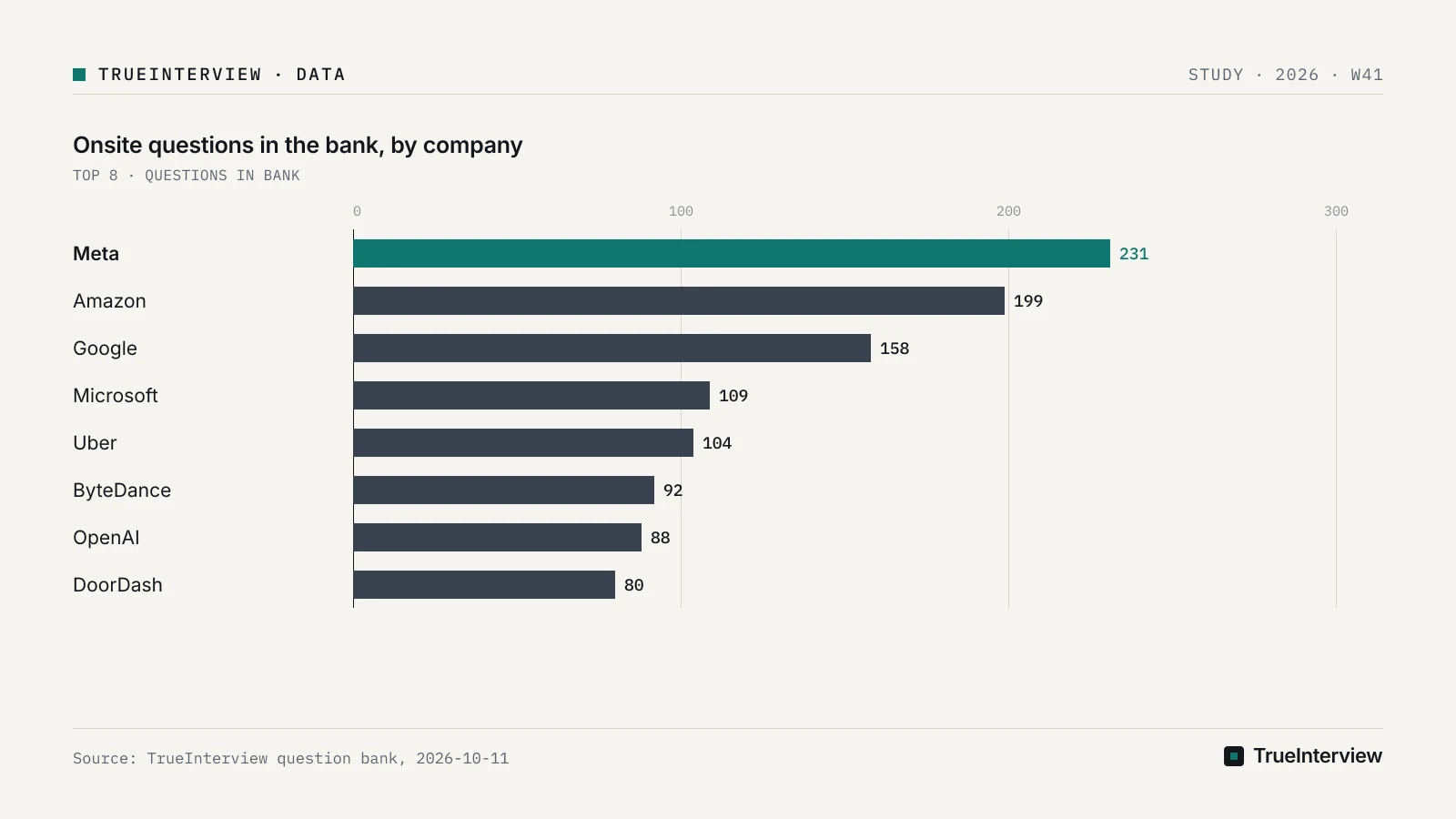
The mix changes more than the length of the loop does. Meta's non-coding questions lead with statistics, Amazon's and Google's with object-oriented design, and Uber's design questions with maps and ride-hailing. Three weeks of preparation should therefore look different for each target, even when the number of rounds is the same.
| Company | Onsite questions | Coding: top topics (of coding questions) | Non-coding: top subtypes | Design: top families |
|---|---|---|---|---|
| Meta | 231 | graphs 12, trees 9, strings 7 of 48 | statistics 35, behavioral 29, SQL 21 of 126 | ads, recommendation and ranking ML 11, news feed 5, booking 5 of 57 |
| Amazon | 199 | hashing 13, graphs 11, strings 9 of 62 | object-oriented design 33, behavioral 25, ML fundamentals 8 of 100 | metrics, logging and pipelines 7, LLM and RAG 4, maps 4 of 37 |
| 158 | graphs 18, strings 12, trees 11 of 71 | object-oriented design 22, behavioral 15, statistics 9 of 60 | news feed 4, chat 3 of 27; a short list, so treat it as thin | |
| Microsoft | 109 | strings 13, graphs 10, hashing 8 of 51 | object-oriented design 17, behavioral 7, project deep dive 3 of 38 | booking, inventory and ticketing 3 of 20 |
| Uber | 104 | graphs 13, arrays 10, strings 7 of 41 | object-oriented design 16, statistics 6, product case 5 of 38 | maps, ride-hailing and delivery 7, ads and ranking 4 of 25 |
| ByteDance | 92 | graphs 13, arrays 7, strings 7 of 45 | object-oriented design 13, ML fundamentals 3, statistics 3 of 30 | ads 3, top-K 3, video 3 of 17 |
Read each row as a split of your hours, not as a forecast of your prompts. Counting questions rather than rounds, the bank files 48 coding questions among Meta's 231 reported onsite questions, 62 among Amazon's 199, 41 among Uber's 104, 71 among Google's 158, 51 among Microsoft's 109 and 45 among ByteDance's 92. Our take: where coding is close to half of the reported set, as at Google, Microsoft and ByteDance, keep algorithm practice central. Meta's low coding share needs care: statistics is a data-science subtype, so Meta's statistics and SQL counts may come from data-role loops. Strip any format your own loop does not include before you read Meta's row as a split of hours.
Amazon is the clearest case for a fixed non-coding block. Object-oriented design (33) and behavioral (25) are the two largest subtypes among Amazon's 100 non-coding questions, and Amazon's SDE III prep page says "A significant portion of the conversation will focus on how you've demonstrated our Leadership Principles in your past jobs." If Amazon is on your list, the Leadership Principles stories are a scheduled block from week one, not a final-weekend task.
If you are running two loops in parallel, as many experienced hires do, pair targets whose rows overlap. Amazon and Microsoft both lead their non-coding questions with object-oriented design, so one class-design block serves both. Meta and ByteDance both list ads and ranking among their top design families, so one ranking walk-through serves both.
How is the onsite different from the phone screen?
The onsite set is larger and broader than the phone-screen set in every format. Among 140 coding questions reported for the phone screen, the top topics are graphs 41, strings 29, hashing 26 and backtracking 16. Onsite coding's twelve most frequent topics run from graphs 97 down to heap 28, with arrays, trees, matrix, math, greedy and dynamic programming in between. The screen's four most frequent topics also appear among the onsite's twelve most frequent, and the onsite list adds arrays, trees, matrix, math, greedy, dynamic programming, sorting and heap to its top twelve. Our take: treat a screen-only topic list as incomplete for the onsite, and check it against your company's row.
The non-coding block shifts the same way. Phone-screen non-coding questions are mostly object-oriented design and ML fundamentals, 30 and 11 of 81, while onsite non-coding questions add behavioral and statistics at volume. Design widens too: 31 phone-screen design questions cluster in storage and caching, chat and news feed, while the onsite set leads with ads and ranking (45) and LLM and RAG infrastructure (28).
For Amazon's SDE III (senior) role, the screen already mixes behavioral and design work; this describes that level only. Amazon's SDE III prep page says the technical phone screen is 60 minutes with a senior leader on the team, and that half of it covers Leadership Principles while the other half covers coding and system design. Our take: once you pass the screen, add fewer screen-style graph and string problems and spend the gap before the onsite on the other onsite topics and a first full design walk-through.
How many rounds does a big tech onsite have?
According to the guides in the table below, expect four to five interviews, often across one or two days, with at least one design round and at least one behavioral round. The published and reported shapes below agree on that skeleton. They differ in two places that matter for planning: whether the technical rounds gate the rest, and which conversation carries the leadership signal.
| Company | What the loop contains | What is distinctive | Source |
|---|---|---|---|
| Amazon (SDE III) | Five 55-minute interviews with members of the software development community | At least one systems design question, and two or three Leadership Principles questions from each interviewer | Amazon's SDE III prep page |
| Four to five interviews: at least two coding, often one systems design for mid-level and senior roles, at least one behavioral and leadership | Every round scores a mix of four attributes, Googleyness among them | Four-Leaf's Google hiring guide | |
| Microsoft | Four to five 60-minute interviews, usually on Microsoft Teams over one or two days | An As-Appropriate round of 45 to 60 minutes with a director or VP after the loop | SpaceComplexity's Microsoft guide |
| Anthropic | Four to five rounds: coding, system design, values and mission, project deep dive, optional hiring-manager conversation | Values and deep-dive rounds are cancelled if coding and system design are not cleared | SpaceComplexity's Anthropic guide |
The gate matters most for experienced hires, who are the most tempted to under-practise coding. SpaceComplexity's Anthropic guide calls the values round "a scored gate and the most common failure point for qualified candidates, per recruiter reports", yet you only reach it by clearing the technical rounds first. Treat coding as the entry ticket and the later rounds as the level decision.
The behavioral round is where generic plans fall shortest. Four-Leaf's Google guide says "The behavioral round is where Leadership and Googleyness get scored, and it's the round most candidates underprepare." Amazon's page builds behavioral questions into every interview rather than one slot, so at Amazon the stories are tested all day.
How should you split prep hours across the loop?
Split them in proportion to the round mix, then adjust for level. A Pragmatic Engineer newsletter post on conducting interviews says the average candidate probably spends 95% of preparation time on technical work and 5% on everything else. With coding under a third of reported onsite questions, that split over-indexes on algorithms for anyone past mid-level.
| Block | Mid-level share of hours (our starting heuristic) | Senior or staff share (our starting heuristic) | Why the share moves |
|---|---|---|---|
| Coding | About two-fifths | About a third | No algorithm topic leans as senior as the design families, but the gate still applies |
| System design | About a fifth | About a quarter | Design families lean more senior than any algorithm topic in the level counts below |
| Object-oriented design | About a tenth | About a tenth, with concurrency added | Concurrency is among the most senior-leaning subtypes |
| Behavioral, deep dive and hiring manager | About a fifth | About a quarter | Motivation and named deep-dive rounds draw mostly senior links |
| AI-assisted coding, SQL, statistics | Only if your loop has it | Only if your loop has it | Role-specific; confirm with the recruiter |
Our take: the common advice to grind more algorithm problems is the wrong lever for a senior loop. Ihab A., an interviewer and coach profiled by CodingCareer, said "Over-preparation is LeetCode hard, hands down." The Pragmatic Engineer's write-up says the same from the other side: "Fit is what decides most hiring outcomes, yet it's the thing most candidates spend the least time preparing for."
When you run several loops at once, start with the items that travel. In the bank, Design Job Scheduler is filed under 12 companies and Durable Key-Value Store Serialization under 9. On a different measure, write-up links, Rate Limiter is linked from 25 write-ups that span 6 companies, including Google, Amazon and Microsoft. As general engineering talking points rather than findings from these filings, a job scheduler pushes on at-least-once execution, idempotent tasks and what happens when a worker dies holding a lease. For key-value serialization, it is format versioning and what survives a crash mid-write.
One reported Stripe round shows the follow-up chain a rate limiter question can take. TrueInterview's comparison page shows a Stripe system design onsite report in which the interviewer moved from a sliding window to three app servers and a shared store. A follow-up listed with that report asks how to keep it correct under clock skew. Practise it in that order: one node, then shared state across app servers, then the clock-skew follow-up listed with that report.
What does a senior or staff loop add?
Senior loops add weight in rounds a coding list never touches. Candidate write-ups link these onsite questions 2,207 times from candidates who reported a senior, staff-plus or manager level and 1,108 times from those who reported junior, new-grad or intern, roughly two to one. The skew is uneven: it is strongest in design families, motivation and concurrency, and weakest in algorithm topics, which tells you where a senior loop spends its extra attention. Staff-plus counts are too small to measure on their own, so this section rests on the senior-or-above totals.
| Area (format) | Senior-or-above links | Junior-or-below links | Our reading |
|---|---|---|---|
| Ads, recommendation and ranking ML (design) | 97 | 7 | Far above; drill it if your target lists it |
| Trust and safety ML (design) | 20 | 1 | Far above |
| Collaboration and productivity apps (design) | 19 | 0 | No junior links at all |
| Maps, ride-hailing and delivery (design) | 24 | 9 | The least senior-leaning design family in the ranking |
| Motivation (behavioral subtype) | 99 | 16 | Far above; your why-this-company answer is graded |
| Concurrency (subtype) | 14 | 2 | Far above; expect thread-safety follow-ups |
| Math (algorithm topic) | 39 | 17 | The most senior-leaning algorithm topic |
| Graphs (algorithm topic) | 108 | 126 | More junior than senior links, yet still the top onsite tag |
| CS fundamentals (subtype) | 5 | 12 | Junior-leaning |
The pattern is sharper than any single row. The least senior-leaning design families in the ranking, maps and trading and market data, still lean more senior than math, the most senior-leaning algorithm topic. Our reading: coding performance is expected at every level, and the level itself shows up in design and narrative rounds.
The same split holds question by question. Levels are self-reported, and the counts are write-up links rather than distinct write-ups.
| Question | Companies | Senior-or-above links | Junior-or-below links |
|---|---|---|---|
| Culture & Behavioral Interview Questions | Anthropic, DoorDash | 39, of which 4 staff-plus or manager | 4 |
| Design Payment System | OpenAI, ByteDance | 23 | 4 |
| Hiring Manager Round — Behavioral & Collaboration | Anthropic | 22, of which 1 staff-plus or manager | 2 |
| Design GPU Inference Serving System | Anthropic | 22, of which 2 staff-plus or manager | Not reported |
| Technical Deep Dive (slide-based) | OpenAI | 21 | 1 |
| HM BQ — Why OpenAI / AI Safety / AGI | OpenAI | 20 | Not reported |
| Design GPU Scheduling Platform | Databricks, Anthropic | 19 | 3 |
For the design prompts in that table, know where an interviewer is likely to push; this is general engineering practice, not a report of any specific round. Payments turn on idempotency keys and a double-entry ledger that reconciles against the processor. GPU inference serving turns on batching against latency targets and on cold starts when a model has to load. GPU scheduling turns on quota fairness between teams, preemption, and placing multi-GPU jobs without fragmenting the fleet.
Our take: treat the staff-plus counts as a hint, not a finding. Staff-plus or manager write-ups link Behavioral / BQ Question Pack 10 times, Traditional Behavioral 3 times, and Design Job Scheduler and Max Stack twice each. At staff level the extra signal sits in judgement and narrative, the reasoning behind your decisions and their scope across teams, while the coding round stays in the loop. Josh Paul Chan's interviewing guide puts the expectation plainly: "I expect higher levels to operate more autonomously."
Which rounds decide whether you are down-leveled?
Our take: our data cannot show which round sets the level, but the working hypothesis we would plan around is that coding decides whether you get an offer while the design round, the deep dive and the scope of your stories decide the level. The link counts above are consistent with it: the strongest senior skew sits in design prompts and named deep-dive and hiring-manager rounds, not in any algorithm topic.
Third-party guides point the same way. SpaceComplexity's Microsoft guide says "System design appears at L61/62 and is heavily weighted at the senior L63/64 level". SpaceComplexity's Anthropic guide says the project deep dive needs a project where you made real engineering decisions, rather than one you only contributed code to. Ihab A. told CodingCareer that openly backing up when an approach fails is a level signal: "That recovery often told me more about their level than the actual solving did."
Our take: ask the recruiter these questions in your first call, because the answers change your hour split more than any topic list does. The table is our recommendation, not a sourced practice.
| Ask the recruiter | Why it matters | What to do with the answer |
|---|---|---|
| Which level is this loop calibrated for, and which round carries the most weight for it? | The level signal concentrates in design and narrative rounds | Put your deepest preparation into that round |
| Is there a separate object-oriented or low-level design round? | Class design is its own reported block, apart from system design | Add class-design reps alongside system design |
| Is there a project or technical deep dive, and does it use slides? | OpenAI's technical deep dive is reported as slide-based | Build the deck early and rehearse it under questioning |
| Does any round use an AI assistant, SQL or statistics? | These formats are role-specific | Prepare them only if they are in your loop |
| Do later rounds depend on passing the technical rounds? | Anthropic's loop is reported with a hard gate | Keep coding sharp until the final week |
Worked example: a senior loop at Uber
This is a planning illustration built from the bank's counts, not any candidate's schedule. Take a senior engineer targeting Uber. The bank's 104 Uber onsite questions split into 41 coding, 38 non-coding and 25 design, so the plan has three blocks before it has a topic list. The coding block covers graphs, arrays and strings first, as the company table shows, and the non-coding block starts with object-oriented design.
The design block gets two walk-throughs. Uber's reported design questions include Design Driver Location Heatmap and Design Uber. As general engineering practice rather than a report of these rounds, the usual decision points for the heatmap are how you bucket locations into cells and how you absorb a write-heavy stream of driver pings. For Design Uber, they are driver matching and keeping one consistent state for each trip.
The behavioral block is one named round. Onsite BQ + Hiring Manager + Project Deep-Dive is linked from 32 Uber write-ups, 26 from senior-or-above candidates and 6 from junior-or-below, and it was last reported in 2026-08. For a senior candidate it earns the whole of week three: a project narrative with numbers, the trade-offs you chose, and what you would change. Practise it on Onsite BQ + Hiring Manager + Project Deep-Dive.
How we counted
Counts come from TrueInterview's question bank as of 2026-10-11 and cover questions reported in the onsite round at 25 big-tech companies. A question can be reported in more than one round (onsite 1,557, phone screen 252), so round totals overlap, and 1,302 of the questions were last reported within the 12 months before that date. These are candidate-reported questions reconstructed for practice, not any company's official list. Level splits count write-up links by the level candidates reported for themselves, and a company's total reflects how often it is reported as much as what its loop contains.
FAQ
What is an onsite interview, and is it still in person?
It is the final batch of interviews, after the screens. Ironhack's guide describes being asked "to come in person for an onsite interview, to meet the team, and to complete a challenge in person". Josh Paul Chan's guide still calls this batch the Onsite but says that in a post-COVID world there is a good chance all of it is remote. Plan for a remote day: test the shared editor, the whiteboard tool and your camera before the first round, and keep the breaks between rounds free.
How do you know if an onsite round went well?
You usually cannot tell from the room, because written feedback decides. A former Google interviewer writing on DEV says hiring committee members "are reading written feedback, not watching a live performance", and that the top rejection reason across coding, system design and behavioral rounds was inability to communicate clearly under pressure. According to that write-up, good signs are that you narrated each step, caught and fixed your own bug, and gave the interviewer material to write about.
What is a technical interview, and is it changing?
The Pragmatic Engineer's write-up says tech interviews have two parts: a technical part focused on coding, software architecture and problem solving, and a behavioral part. The same write-up says some companies are adding AI-assisted interview types while others keep pre-AI formats, and that behavioral interviews do not seem to be changing. In practice, the AI-assisted format is one round among several, so confirm whether your loop has one.
Are these the questions big tech companies officially ask?
No. They are candidate-reported questions reconstructed for practice, and no company published them. TrueInterview says each one was asked at the company it is filed under. Use them to see which formats and families a company's loops contain and to rehearse real prompts, not to predict your exact question. A design family or a story you can handle cold transfers to a prompt you have never seen.
Should a senior candidate keep practising algorithm problems?
Yes, at a steady dose rather than a growing one. Graphs remain the most tagged onsite coding topic even though their links lean junior, as the level table shows. Ihab A. told CodingCareer that at Meta candidates have to finish two LeetCode mediums in forty minutes, and SpaceComplexity's Anthropic guide reports that failing the technical rounds cancels the later ones. Keep a few timed problems a week through the final week, and spend the growth hours on design and your deep dive.
Your practice plan
The target is narrower than all of big tech: one company's row, a few design families, a handful of coding topics and one named behavioral round. This plan assumes four or five weekday evenings plus weekend blocks for three weeks while you work full time.
- This weekend: copy your target company's row from the table above, ask the recruiter the five questions, and filter TrueInterview's question bank to that company and the onsite round. Strike any format your loop does not include.
- Week one, evenings: work the top coding topics in your row on a timer, narrating aloud, and do one class-design rep on Rate Limiter: one node first, then shared state, then clock skew.
- Week one, weekend: write your project narrative and rehearse it on Project Deep Dive (Resume Drill), then draft your why-this-company answer, since motivation is among the most senior-leaning subtypes.
- Week two, evenings: run two design walk-throughs from your row's top families. If your target reports AI infrastructure, use Design GPU Scheduling Platform and defend fairness and preemption out loud.
- Week two, if you are senior or staff: build a short deck for Technical Deep Dive (slide-based) and rehearse it with someone who interrupts with questions about trade-offs.
- Week three: rehearse the named behavioral round for your target, such as Leadership Principles Standard Set for Amazon, Behavioral Round (Googliness Themes) for Google or Culture & Behavioral Interview Questions for Anthropic.
- Last two evenings: run a back-to-back mock loop, adding Maze Solver if your loop has an AI-assisted round, and read recent candidate write-ups for your company. TrueInterview's comparison page says it does not sell mock interviews with human engineers and suggests booking one or two elsewhere before an onsite.
Sources
- TrueInterview question bank — onsite at big-tech companies — counted 2026-10-11
- Medium — checked 2026-10-11
- SDE III Interview Prep — checked 2026-10-11
- Microsoft Software Engineer Interview Guide: Every Round · SpaceComplexity — checked 2026-10-11
- The Google hiring process, and how the hiring committee decides | Four-Leaf — checked 2026-10-11
- Anthropic Onsite Interview: Every Round, What It Tests, and How to Prepare · SpaceComplexity — checked 2026-10-11
- Learnings from conducting ~1,000 interviews at Amazon — checked 2026-10-11
- FAANG Interview Insights: A Conversation with Ihab A. (Ex-Google, Ex-Meta) - Guides - codingcareer — checked 2026-10-11
- Interview prep compared: your application, end to end · TrueInterview — checked 2026-10-11
- A Staff Engineer's Guide to Conducting Interviews | joshpaulchan — checked 2026-10-11
- Dos and Don'ts in Tech Interviews — checked 2026-10-11
- I Interviewed 200+ Candidates at Google — Here's What Actually Matters - DEV Community — checked 2026-10-11
- Real FAANG Interview Questions by Company · TrueInterview — checked 2026-10-11
Last reviewed: 2026-10-11.