Study
What is on a big tech OA in 2026, and what to drill first
TrueInterview
October 11, 2026 · 12 min read
Disclosure: TrueInterview is an interview-preparation product and publishes this article. Facts about other products come from their public pages on the dates listed under Sources.
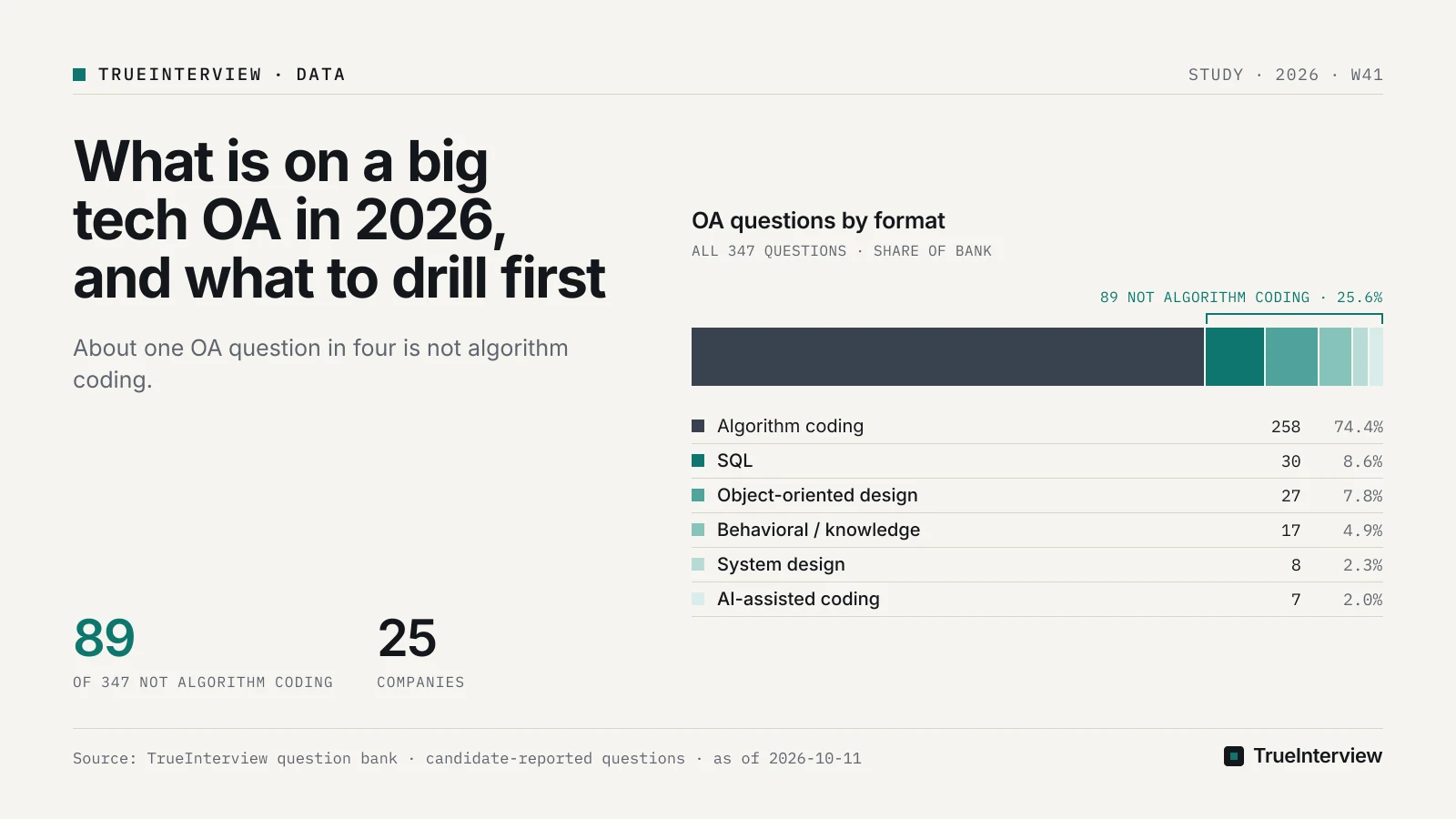
A big tech online assessment is a timed, auto-graded screening round that runs before a human speaks to you, and the reported bank says it is not a straight LeetCode set with a webcam: of the 347 OA questions in the TrueInterview bank, 258 are coding and the other 89 are in other formats, led by SQL (30) and object-oriented design (27). That is about one OA question in four outside coding. The plan below puts your platform's rules and the cross-company repeats first, then your target company's own topic mix.
The OA is its own round, with its own rules
Read your platform's rules before your topic list: how many sections there are, which are timed, what the proctor logs and how many days you have to submit. Amazon's page says, "The SDE Online Assessment (OA) is the first step in the hiring process for our full-time and internship SDE roles".
Amazon's full-time OA lists a coding section averaging 70 minutes against a Workstyles Assessment averaging 15 and a Work Simulation averaging 60, so 75 of its 145 minutes sit outside coding. An all-LeetCode plan prepares you for under half of that session.
Amazon's SDE II page lists a different shape: Coding, System Design and Work Styles sections plus an optional survey, and Amazon says you must complete all of them to submit. Amazon's SDE II page adds, "While the 90-minute Coding Challenge is the only timed section, we recommend you reserve two hours to complete the OA". On Amazon's SDE II page the coding challenge gives "90 minutes for 2 questions" and the system design section takes "Approximately 15 minutes". Book the full two hours, because an untimed section is still a required one.
Amazon's SDE II page says candidates "have seven days to complete the assessment from the date it was sent" and hear "within two days whether or not we'll be moving forward with your application". Amazon's page encourages candidates who do not move forward to practise and re-apply in six months. Seven days is too short to learn a new topic, and a miss on Amazon's stated terms costs half a year, so finish your prep before you apply rather than after the link arrives.
Google's format was reported differently. One candidate's write-up on hacktherounds.com reports that Google's OA this cycle ran on HackerRank rather than CodeSignal, with three problems in 90 minutes. The same hacktherounds.com write-up says the candidate installed the HackerRank proctor plugin and shared webcam and full screen before the timer, while the system logged tab switches, copy-paste, focus loss and fast mouse movements toward the browser edge. The hacktherounds.com author's rule is blunt: "The HackerRank proctor logs every focus loss and the reviewer will see it". If your target uses a proctored platform, keep everything you need, including your notes, inside the editor window.
Which algorithm topics matter?
Arrays (54), strings (40) and hashing (40) are the most frequent tags on the bank's 258 coding questions, with greedy (25) next and binary-search (13) and trees (11) at the bottom of the top twelve. Arrays alone is tagged on roughly one coding question in five, which makes it the one topic every target shares.
Amazon's SDE II page says of its listed topic areas, "The actual questions will be a deep dive into a couple of these areas". Put the two together and the order of work follows: get arrays, strings and hashing to the point where you can name the pattern before you write code, add the two tags your target's row in the company table puts on top, and leave trees and binary search until that row asks for them.
What does a big tech OA score you on, and what gets you flagged?
Amazon's page gives the clearest published answer: its OA is built to see coding skills, technical problem solving and its Leadership Principles, and to "see you as a holistic engineer". On Amazon's stated rules, what gets you flagged is session behaviour: Amazon warns that print screen terminates the session and locks you out, and asks candidates to avoid copying and pasting because the code should be their own. Amazon's page still permits publicly accessible references such as the Java Developer Kit or Standard Template Library during the Coding Assessment.
Amazon's SDE II page expects "syntactically correct code—no pseudo code" in the coding section. Amazon advises reviewing the coding language you plan to use and, if you are rusty without an IDE, getting comfortable coding within HackerRank. Take that literally and run your last week of practice in a browser editor, with no local autocomplete to lean on, since that is the environment you will be graded in.
One candidate's Google OA write-up on hacktherounds.com reports that the reviewers read the proctor trace alongside the submission, and that a clean behavioral log is worth partial credit, especially on ambiguous edge cases. The same hacktherounds.com write-up describes composing every solution inside the HackerRank editor rather than a local file, because paste detection is one of the easiest flags. The hacktherounds.com author also submitted test runs constantly, since the run-against-sample button costs nothing in the score and adds positive signal to the behavioral log. This is one candidate on one platform, but the habits cost nothing to adopt, which makes them the cheapest points in the round.
On problem order, the hacktherounds.com write-up advises picking the easiest problem first on a three-problem OA because the cost of getting stuck with only 90 minutes is brutal. The hacktherounds.com write-up also lists forgetting empty inputs as a common pitfall, including returning an empty list for Top-K when k = 0 or the array is empty. For a merge-intervals problem, the hacktherounds.com author's approach was "Sort by start, iterate once, and either extend the last merged interval or append a new one". The same sort-then-sweep shape solves Meeting Rooms, one of the five cross-company repeats below, so one drill session covers both.
How do OA topics differ by company?
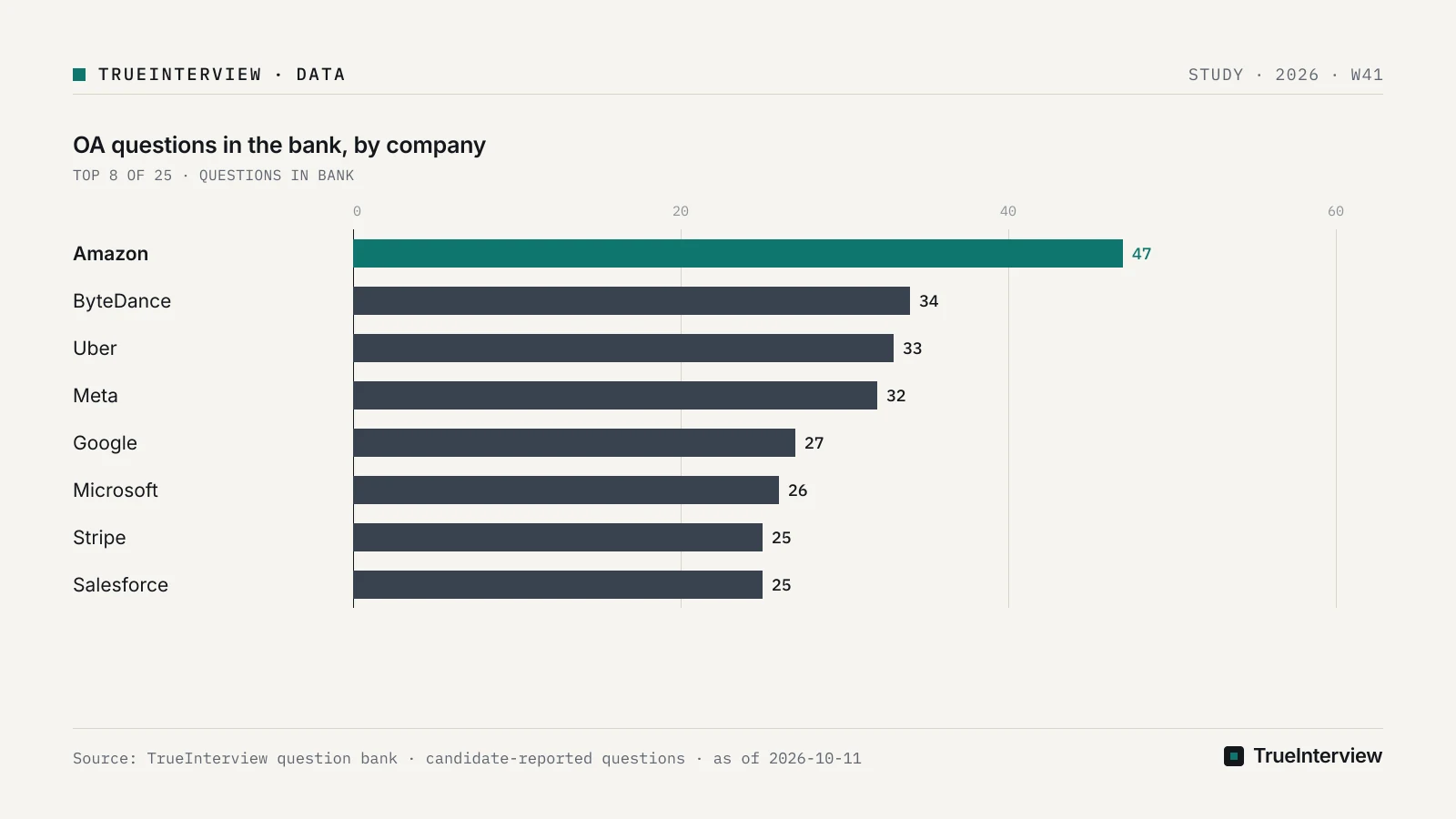
Each company's reported coding questions lean on different tags: Uber's on arrays, graphs and trees, Microsoft's on arrays, binary search and dynamic programming, and Amazon's on greedy, arrays and sorting. After the shared repeats, your next two days of drill should follow your target's row below rather than a generic list. If your target is not in the table, filter the question bank by company and tally its tags yourself.
| Company | Reported OA questions | Coding questions | Top three coding tags |
|---|---|---|---|
| Amazon | 47 | 38 | greedy (8), arrays (8), sorting (6) |
| ByteDance | 34 | 29 | arrays (6), strings (4), math (4) |
| Uber | 33 | 31 | arrays (10), graphs (6), trees (5) |
| Meta | 32 | 19 | two-pointers (3), arrays (3), sorting (3) |
| 27 | 22 | arrays (6), hashing (4), greedy (4) | |
| Microsoft | 26 | 21 | arrays (5), binary-search (3), dynamic-programming (3) |
Read the density as well as the order. Arrays sit on 10 of Uber's 31 coding questions, about a third, which is strong enough to build an Uber plan around. Amazon's top tags reach 8 of 38 each, a real lean but a weaker one, and Meta's leaders sit at three mentions each across 19 questions, a tiebreak between similar targets rather than a syllabus.
The gap between the two count columns matters as much as the tags. In the table, 13 of Meta's 32 reported OA questions and 9 of Amazon's 47 are outside coding, against 2 of Uber's 33. A Meta candidate should give object-oriented design a real block, and the bank's Meta entry Banking System (Progressive OOD), linked from 10 candidate write-ups, is an object-oriented design question. An Uber candidate can spend almost the whole budget on coding. These are counts of what candidates reported, not how often a company asks a topic.
Open with the questions that repeat across three companies
Five entries in the bank are each filed under three different big-tech companies, nine companies in all, so each one covers three targets at once and they go first.
Maximum Subarray (Apple, Amazon, ByteDance)
The standard approach is Kadane-style dynamic programming: track the best sum ending at the current index and the best sum seen overall, and reset the running sum when it turns negative. Practise it as Maximum Subarray.
Rotate a Matrix by 90 Degrees In Place (Apple, Amazon, Uber)
Transpose the matrix, then reverse each row. That gives O(n²) time and O(1) extra space without an auxiliary matrix.
Maximum Concurrent Processes / Meeting Rooms (Amazon, ByteDance, Google)
Sort intervals by start time and sweep once, comparing each start against the earliest available end; a min-heap of end times covers the general case.
Remove Duplicates from Sorted Array (Meta, Microsoft, NVIDIA)
Use two pointers, a slow write index and a fast read index, and copy only when the value changes, which keeps it in place and O(n).
Minimum Operations to Reduce an Integer to 0 (Uber, Google, Salesforce)
Work on the binary representation and decide per bit whether to add or subtract a power of two, choosing the move that leaves fewer set bits.
OA practice also carries into later rounds: 10 of the bank's OA questions are also reported at onsite, three at phone screens and two at take-homes.
Filter by last-reported month, not by an undated archive
Of the 347 questions, 276 were last reported within the 12 months before 2026-10-11, which leaves 71 that were not. Filter on the date attached to each question rather than on a company page's update stamp. Recent entries include File Deduplication (Anthropic, 2026-09), Calculate Dasher Pay (DoorDash, 2026-09) and Answer Google Behavioral Questions (Google, 2026-08). Draw most of your practice set from entries like these and use older ones for pattern practice.
The most-linked entries are a mix of formats. File Deduplication leads at 14 candidate write-ups, followed by Answer Google Behavioral Questions at 13, Recipe Manager at 12 and Banking System (Progressive OOD) at 10. File Deduplication is a coding question, while Answer Google Behavioral Questions is a behavioral / knowledge entry and Recipe Manager an object-oriented design entry. With Banking System also an object-oriented design build, three of the four most-linked entries sit outside algorithm practice, so a plan built only from coding tags misses most of that list. Browse the OA question bank to filter your target company's current entries.
How we counted
The format split, per-company tag counts, cross-company repeats and recency figures come from TrueInterview's own question bank on 2026-10-11, where each question is tagged with a company, a round, a format, algorithm tags where applicable, and the month it was last reported. Tag counts measure what candidates reported and what sits in the bank, not how often a company asks a topic, and the bank's company mix reflects which candidates wrote up their OA rather than which companies run the most OAs. These are candidate-reported questions reconstructed for practice and are not any company's official question list.
Your practice plan
-
Before any topic work, look up your requisition's stated OA rules: sections, which are timed, which references are allowed and how many days you have to submit. Amazon's SDE II page lists three required sections, with only the 90-minute coding challenge timed and seven days to finish. Finish your prep before you apply, since a week is too short to learn a topic.
-
Solve the five cross-company repeats before any single-company list: Maximum Subarray, Rotate a Matrix by 90 Degrees In Place, Maximum Concurrent Processes / Meeting Rooms, Remove Duplicates from Sorted Array and Minimum Operations to Reduce an Integer to 0. Take each through four stages: state the input domain and edge cases out loud, write the approach in two lines, code it in a browser editor, then test it against the edge cases you stated. Give the test stage its own minutes, because that is where empty and boundary inputs get caught.
-
Spend the next two days on your target's top two tags only, using its row in the company table above. If you have under a week, skip this step and put the time into one extra timed mock.
-
Give the non-coding formats a block sized to your target's row. SQL is the largest non-coding subtype at 30 questions. TrueInterview's SQL questions run on Postgres and are judged on hidden tests that show the failing case, so run three 20-minute drills (a join with GROUP BY and HAVING, a window function ranking rows within a partition, a self-join over a hierarchy) and rerun each until the failing case is gone. Then build one object-oriented design entry end to end, such as Banking System (Progressive OOD) or Recipe Manager, writing the class skeleton, the methods and the tests in one sitting. Then write full-sentence answers for the Google behavioral OA, which the bank links from 13 candidate write-ups.
-
If your target is Amazon, practise repairing an AI draft on AI Assistant Repo Bug-Fix, an AI-assisted coding entry filed under Amazon and linked from 8 candidate write-ups. Read the whole draft and run it before you change a line.
-
Run one timed mock in a browser editor shaped like your target's OA. Amazon's SDE II page gives 90 minutes for 2 questions, while the hacktherounds.com write-up reports Google's this-cycle OA as three problems in 90 minutes. If you are sitting both, run both shapes, and in the three-problem shape follow the hacktherounds.com advice to start with the easiest problem.
-
Set up for the proctor before the timer starts. The hacktherounds.com write-up warns that the HackerRank proctor logs every focus loss and describes composing in the editor rather than pasting from a local file, so keep scratch notes in a comment block inside the editor. Amazon's page states that print screen ends the session and asks candidates not to copy and paste.
-
After each mock, log the boundary case you missed rather than the problem you got wrong. The hacktherounds.com write-up names empty inputs as a common pitfall, such as returning an empty list for Top-K when k = 0. Check that class of input first in your next mock.
FAQ
How long is Amazon's OA?
It depends on the role. Amazon's full-time OA lists a coding section averaging 70 minutes, a Workstyles Assessment averaging 15 and a Work Simulation averaging 60. Amazon says its SDE internship OA takes about 90 minutes. Amazon's SDE II OA has a 90-minute timed coding challenge, and Amazon recommends reserving two hours in total. Book the longest block your version needs, because only part of it is timed and every section of the SDE II version must be completed to submit.
What is the AI-assisted coding OA round?
The bank includes OA questions where you work from an AI assistant's output instead of writing everything from scratch. One example is AI Assistant Repo Bug-Fix, an AI-assisted coding question reported at Amazon and last reported 2026-09. Treat the assistant's output as a first draft you must read, run and repair, and practise the same class of problem on AI Assistant Repo Bug-Fix before an OA that might include it.
What happens if I do not move forward after the OA?
Amazon's SDE II page says candidates hear within two days of completing the OA whether the application moves forward, and those who do not are encouraged to practise and re-apply in six months. That is Amazon's stated policy for SDE II, so ask your recruiter whether your target company sets a similar wait. Use the gap to rebuild your error log from your mocks and the real attempt, then retake a timed mock before you re-apply.
Sources
- TrueInterview question bank — online assessment (OA) at big-tech companies — counted 2026-10-11
- Online assessment prep for SDE roles — checked 2026-10-11
- Online Assessment Prep: Software Development Engineer II — checked 2026-10-11
- Google OA Interview Experience (2026) - Proctored HackerRank, Word Pattern & Top K Listings, Offer | HackTheRounds — checked 2026-10-11
- Interview prep compared: your application, end to end · TrueInterview — checked 2026-10-11
Last reviewed: 2026-10-11.