Study
Big Tech Coding Topics by Company: Where Each One Differs
TrueInterview
October 11, 2026 · 15 min read
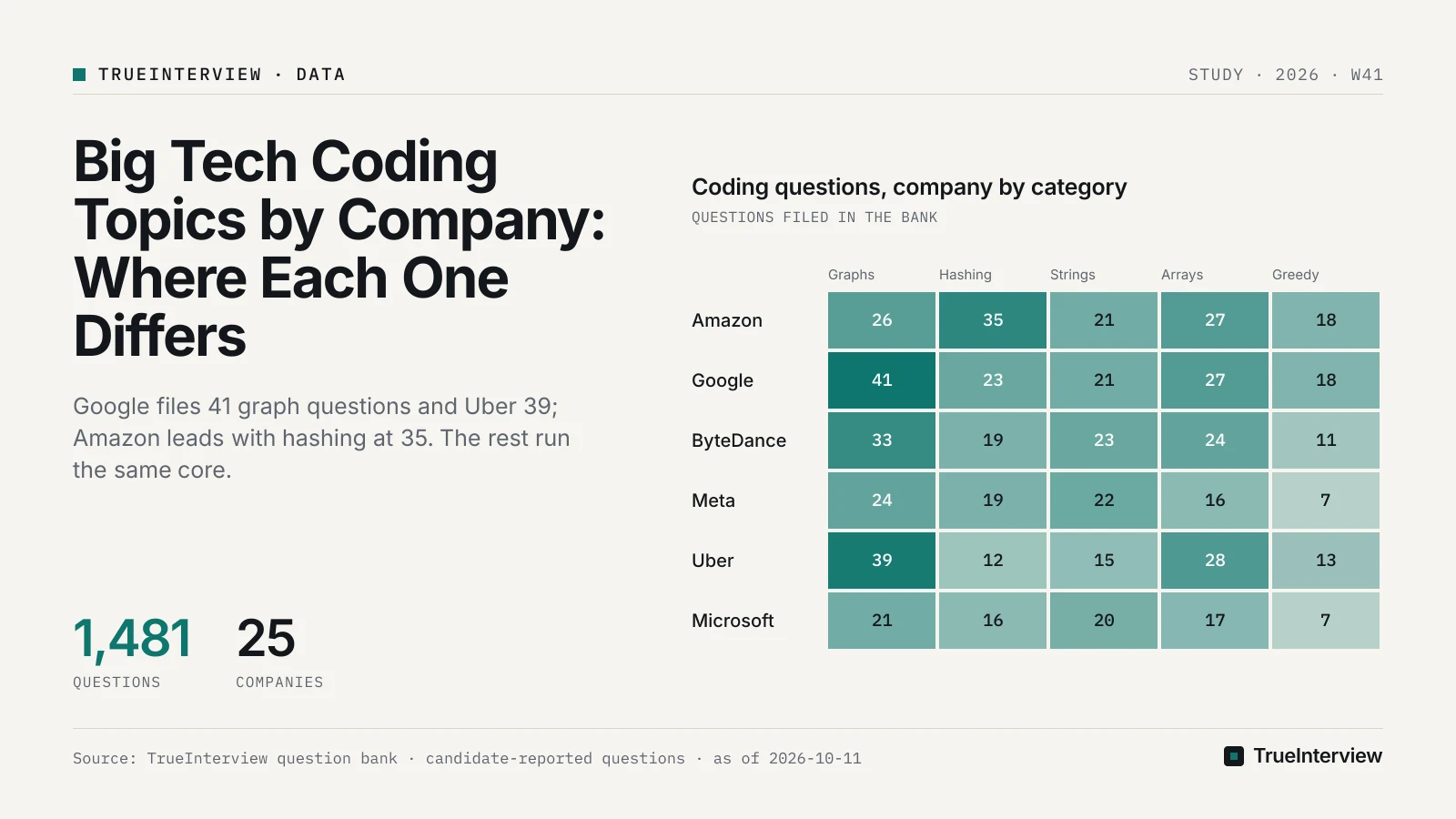
The six largest companies in TrueInterview's bank, the only ones we break out by topic, draw their top three coding topics from the same short list, so a company changes the order of your drill list rather than its contents. As of 2026-10-11 the bank holds 1481 candidate-reported coding questions from 25 big-tech companies, led by graphs (227), hashing (203), strings (198) and arrays (185). Google, Uber, Amazon and Meta each depart far enough to reorder your plan, but the round you are in moves the mix further than any company does, so plan by round first and company second.
Disclosure: TrueInterview is an interview-preparation product and publishes this article. Facts about other products come from their public pages on the dates listed under Sources.
How do the big six compare, topic by topic?
Graphs is the most-filed coding topic at five of the six largest companies in the bank, and Amazon is the exception. Every company's top three is drawn from graphs, hashing, strings and arrays, with trees entering only at Meta. The table gives the filed counts for the five shared topics, with the bank-wide row first so you can see where each company departs from it.
| Company | Coding questions filed | Graphs | Hashing | Strings | Arrays | Greedy | Top three topics |
|---|---|---|---|---|---|---|---|
| All 25 companies | 1481 | 227 | 203 | 198 | 185 | 118 | graphs, hashing, strings |
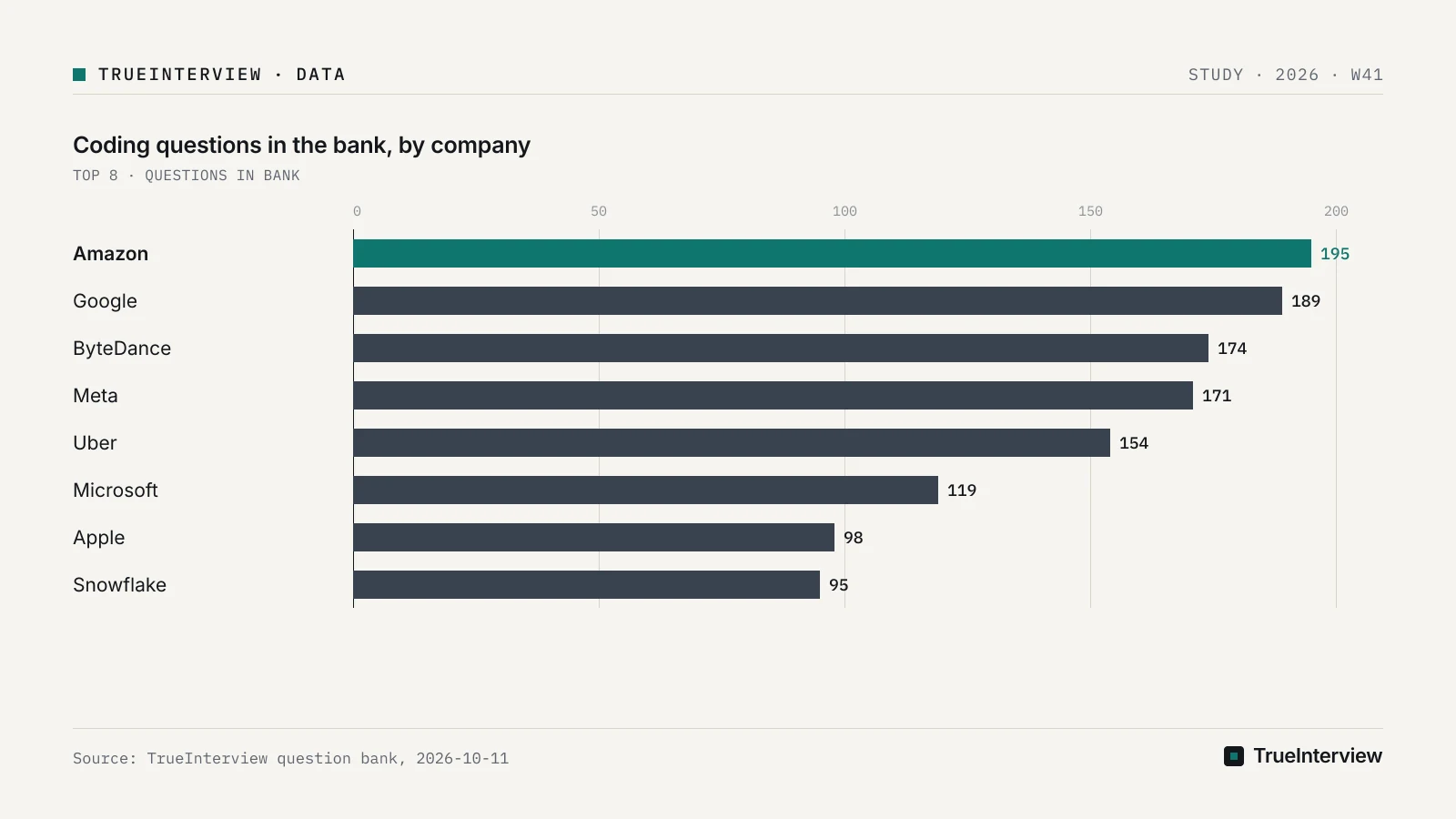
| Amazon | 195 | 26 | 35 | 21 | 27 | 18 | hashing, arrays, graphs |
| 189 | 41 | 23 | 21 | 27 | 18 | graphs, arrays, hashing | |
| ByteDance | 174 | 33 | 19 | 23 | 24 | 11 | graphs, arrays, strings |
| Meta | 171 | 24 | 19 | 22 | 16 | 7 | graphs, strings, trees (20) |
| Uber | 154 | 39 | 12 | 15 | 28 | 13 | graphs, arrays, strings |
| Microsoft | 119 | 21 | 16 | 20 | 17 | 7 | graphs, strings, arrays |
Read along a row, never down a column: Amazon's 195 filed questions and Microsoft's 119 are not on the same scale, so compare a topic with the other topics at the same company. So for any of these six, weeks one and two cover graphs, hashing, strings and arrays whichever logo is on the invite; the company only decides which of those blocks goes first and how many hours it gets.
Where does each company depart from the bank-wide order?
Three companies move far enough from the bank-wide order to change what you drill first. Google and Uber push graphs well clear of every other topic, Amazon puts hashing and arrays in front of graphs, and Meta lifts trees into its top three. ByteDance and Microsoft follow the shared order closely enough that a separate company syllabus would waste your hours.
Google and Uber: give graphs the first week
Google files 41 graph questions against 27 for arrays, its next topic, and Uber files 39 against 28. At Uber, hashing (12) even sits below greedy (13), so an Uber plan can push hash-map drills later than any other company's. For both, graph traversal is the first block and the largest one.
The graph questions candidates report travel across companies. Number of Islands (Plain and Streaming) is linked from 18 write-ups from six big-tech companies: Uber, ByteDance, LinkedIn, Amazon, Google and Snapchat. Uber's report places it in a phone screen, last dated 2026-08. The plain version is a grid flood fill with BFS or DFS; the streaming version adds land one cell at a time, which is where union-find with path compression earns its place.
intervu.dev's guide also puts graphs first for Google, listing "Graphs, trees, DP" as its top topics. In our bank, trees and dynamic programming do not make Google's top three, so give your second Google block to arrays and hashing instead.
Amazon: hash maps and arrays before graphs
Amazon is the one company of the six where graphs is not first: hashing leads at 35 and arrays follow at 27, with graphs third at 26. That order disagrees with intervu.dev's guide, which lists Amazon's top topics as "Trees, graphs, arrays, DP" and leaves hashing out. codeintuition.io's comparison says "Amazon tests 11+ distinct pattern categories (the broadest of any company)", which fits a row where no topic runs far ahead.
Our take: for an Amazon loop, start with frequency maps, prefix sums and array scans, and move graphs to the second block. A list that leads with trees is preparing you for someone else's reports. Amazon's reports include Minimum Meeting Rooms in a phone screen, last dated 2026-08. Sort the start and end times, or keep a min-heap of end times; the answer is the peak count of overlapping meetings.
Meta: add a trees block
Meta is the only one of the six with trees in its top three, at 20 questions, while arrays drops to 16. Lowest Common Ancestor of a Binary Tree is linked from 12 write-ups from Meta, Microsoft and Amazon, so a Meta trees block also covers part of a Microsoft or Amazon loop. Meta's strongest single-company question is Maximum Unique Character Subset, linked from 17 write-ups that all come from Meta; rehearse it as written rather than as a generic strings drill.
Pace matters as much as topic. codingcareer.de's interview guide says candidates at Meta "have to finish two LeetCode mediums in forty minutes". Time your Meta sessions in pairs of problems, not singles.
ByteDance and Microsoft: run the shared core
ByteDance's top three are graphs (33), arrays (24) and strings (23), with hashing at 19 close behind. Microsoft's row is the flattest of the six: graphs 21, strings 20, arrays 17 and hashing 16 sit within five questions of each other. For either company, spread your hours evenly across the four core topics instead of hunting for a company syllabus.
codeintuition.io's comparison says Microsoft "tests 2D binary search and staircase search at a higher rate". Our bank does not break binary search out by company, so treat that as one site's reading rather than a reason to reorder your plan.
Apple, Snowflake, Salesforce and Oracle
Apple (98), Snowflake (95), Salesforce (68) and Oracle (61) have enough filed coding questions to practise from, but this analysis does not break out their topics, so do not read a topic profile into them. intervu.dev's guide describes Apple's topic focus as "Team-determined", which points to the same plan: run the shared core and ask your recruiter about the team. Apple's reports include Course Schedule in a phone screen, last dated 2026-08, a topological sort you can solve with Kahn's algorithm and a cycle check.
What if you are interviewing at two or three of these companies?
Prepare the shared core once, then add only the deviation of the most skewed company on your list. Because every row in the company table draws its top three from the same five topics, a Google-plus-Amazon or Meta-plus-Microsoft search needs one extra block, not a second syllabus. Order the blocks by whichever round comes first.
| Your loops | First block | Then add | Shared questions to rehearse first |
|---|---|---|---|
| Google and Uber | Graph traversal, with the most hours | Arrays | Number of Islands (Plain and Streaming), Course Schedule |
| Amazon and Google | Hashing and arrays | Graphs as the second block, not the third | Course Schedule, Merge Two Interval Lists |
| Meta and Microsoft | Graphs and strings | A trees block | Lowest Common Ancestor of a Binary Tree, Merge Two Interval Lists |
| Amazon and Meta | Hashing and arrays | Trees, then graphs | Lowest Common Ancestor of a Binary Tree, Merge Two Interval Lists |
| ByteDance and Amazon, Google or Uber | The shared core | The other company's deviation | Number of Islands (Plain and Streaming), Course Schedule |
The shared questions in the last column are the ones whose write-ups or filings span both companies in each pair, so one rehearsal counts twice. If one company sends an online assessment while the other is at phone-screen stage, run the assessment block first: its array, string and hashing work carries straight into the core of the other loop.
Does your round change the mix more than the company does?
Yes. Online assessments are arrays-and-strings exams in which graphs do not reach the top four topics, while phone screens and onsites both put graphs first. That swing is larger than any company deviation in the table above, so let your next round decide your first week and let the company decide the order after that.
| Round | Coding questions reported | Top four topics |
|---|---|---|
| Online assessment | 258 | arrays 54, strings 40, hashing 40, greedy 25 |
| Phone screen | 907 | graphs 155, hashing 119, strings 116, arrays 86 |
| Onsite | 463 | graphs 97, strings 73, hashing 72, arrays 61 |
Amazon's SDE II OA prep page gives the coding challenge as "90 minutes for 2 questions". That format rewards fast, clean array and string work over a graph you have to model from scratch.
Our take: most company-tagged lists ignore the round entirely, and that is the larger error. If your recruiter has sent an assessment link, close the graph chapter and work arrays, strings, hashing and greedy until the assessment is done. If your next step is a phone screen, graphs come first and arrays move to fourth.
Which questions travel across companies, and which only look like they do?
A question filed under many companies shows coverage; a question linked from many candidate write-ups shows it was actually reported. Merge Two Interval Lists and Merge Intervals are each filed under the same 12 big-tech companies, yet only the first is linked from any write-ups. When two similar questions compete for one evening, pick the one with more write-up links.
| Question | Filed under (companies) | Write-up links | From senior-or-above | Example report |
|---|---|---|---|---|
| Course Schedule | 10 | 22 | 10 | Apple phone screen, 2026-08 |
| Merge Two Interval Lists | 12 | 20 | 10 | Meta onsite, 2026-08 |
| Number of Islands (Plain and Streaming) | 7 | 18 | not split | Uber phone screen, 2026-08 |
| Longest Substring Without Repeating Characters II | 7 | 11 | not split | none listed |
| Minimum Meeting Rooms | 7 | 9 | not split | Amazon phone screen, 2026-08 |
| Basic Calculator | 8 | 9 | 2 | none listed |
| Valid Parentheses | 8 | 8 | 3 | none listed |
| Merge Intervals | 12 | 0 | 0 | none in this dataset |
Course Schedule's links come from seven companies, Amazon, Snowflake, Uber, Netflix, Meta, ByteDance and Google, which makes it the best single graph question for anyone interviewing at more than one of them. Build the in-degree count, queue every course with no prerequisites, and report a cycle if fewer courses come out than went in. Netflix's variant, Topological Sort / Course Schedule for Ads, was reported in a phone screen last dated 2026-07.
Merge Two Interval Lists has write-ups from companies including Meta, Microsoft, Lyft, Google, Amazon, Netflix, ByteDance and Uber. Walk both sorted lists with two pointers, always taking the interval with the earlier start, and extend the current interval until the next start passes its end. Zero links for Merge Intervals means no links in this dataset, not that no company asks it; it is the base skill under its sibling, so solve it once and spend your rehearsal time on the reported version.
What changes at senior and staff level?
The coding load does not shrink as you move up; the topic mix shifts. Write-up links split almost evenly by the level candidates reported for themselves: 1196 from senior, staff-plus or manager candidates and 1136 from junior, new-grad or intern candidates. Keep your coding hours flat and move them toward the topics senior candidates report.
| Self-reported level | Math | Binary search | Intervals | Two-pointers | Dynamic programming |
|---|---|---|---|---|---|
| Senior-or-above links | 69 | 65 | 67 | 65 | 59 |
| Junior-or-below links | 43 | 48 | 50 | 79 | 91 |
The core topics barely move by level: graphs split 248 to 237 and strings 177 to 180. So the senior adjustment is a swap, not a cut. Trade one dynamic-programming block for intervals and binary search on the answer. codeintuition.io's comparison says "Google uniquely emphasizes predicate search", which is the same binary-search-on-the-answer pattern the senior counts favour.
At the top of the band, coding questions change character rather than disappear. Questions linked only from senior-or-above write-ups include Distributed Mode and Median (8), Design Cluster Message Aggregation (7), Dependency Version Check (5) and Minimum Time to Infect a Network (5). Staff-plus or manager write-ups also link Service Dependency Topological Order, File Profiler and Stack Trace Reconstruction, one link each. Those counts are small, so read them as direction: the algorithm arrives inside a systems setting such as aggregation across nodes or dependency order between services.
Seniority does not earn you an easier problem. A post on gayle.com notes that "interviewers tend to repeat their favorite questions across candidates". What changes is how the round is read: an interviewer writing on joshpaulchan.com says, "I expect higher levels to operate more autonomously."
Down-leveling note (our view): the coding round rarely sets your level by itself. At senior and staff, the level signal comes mainly from design depth, the project deep dive and the scope of your behavioral stories. A coding round where you never state trade-offs, edge cases or complexity against the input limits still gives the debrief a reason to down-level, so narrate each choice as you make it.
Why do AI labs and product companies need a different drill?
At OpenAI, Anthropic and several product companies, the most-linked coding questions are simulations of a real system that carry an algorithm tag. Infection Spread Simulation is linked from 34 write-ups from OpenAI and Anthropic, 26 of them from senior-or-above candidates. A generic BFS drill does not rehearse the state, timing and edge rules such a task asks for.
OpenAI's report places Infection Spread Simulation in a phone screen, last dated 2026-06. Model it as a multi-source BFS that advances one time step per frontier, and decide early how you report cells that are never reached.
Anthropic's Web Crawler is linked from 17 write-ups, all from Anthropic, and 11 of them come from senior-or-above candidates. Its report places it in a phone screen, last dated 2026-05. Start with BFS over URLs, a visited set and a same-host filter; at senior level, expect to discuss making it concurrent and bounding the requests in flight. File Deduplication, also Anthropic-only, is linked from 14 write-ups; group files by size first, then hash contents only within each group.
Product companies show the same pattern. Databricks' Find Optimal Commute (phone screen, 2026-08), DoorDash's Dasher Pay (phone screen, 2026-09) and Stripe's Payment Invoice Reconciliation (phone screen, 2026-05) are domain tasks first and algorithm topics second. For these companies, rehearse the reported task itself.
How fresh is the data, and does any topic trend?
The bank is current: 1335 of its coding questions were last reported within the 12 months before 2026-10-11. Quarterly shares show no clean trend in the leading topics, with one exception. Arrays rose every quarter, from 9% to 12% of write-up links between 2025-Q4 and 2026-Q3, which is a reason to keep arrays in your plan rather than to rebuild it.
Graphs moved 19%, 22%, 23% and 17% across the same four quarters, and hashing 20%, 17%, 13% and 17%, which is movement around a high base rather than a direction. Compare shares only: the link totals behind them, 245, 636, 700 and 625, mostly track how many write-ups were collected.
How we counted
The counts are candidate-reported coding questions in TrueInterview's bank, each tagged with one or more algorithm topics and filed under every company where it was reported. A question can be reported in more than one round, so the round totals overlap. Level splits use the level candidates reported in their own write-ups. These are reconstructions for practice, not any company's official question list, and a topic count measures what candidates reported, not how often a company asks it.
FAQ
Are LeetCode company tags reliable for predicting interview topics?
They show coverage, not recency. One widely used GitHub repository of company-wise LeetCode lists says it is "Updated as of 20 June, 2025", so its windows predate every 2026 report. Filing and reporting also diverge inside our own bank, as the Merge Intervals row above shows. Use a tag list to find a problem, then check whether candidates have recently written it up before you spend an evening on it.
Which companies don't ask LeetCode-style questions?
Among the largest companies, the evidence says none have stopped. interviewing.io's survey reports: "Of the 52 respondents from FAANG, ZERO said that their company has moved away from algorithmic questions". What changes is the wrapping. At OpenAI and Anthropic, the most-linked reported questions are simulations and tools, as the section on AI labs shows, so prepare the reported task rather than a topic in the abstract.
Is LeetCode still worth it in 2026?
For big-tech loops, yes, with a narrower target than a problem count. interviewing.io's survey says "over half of respondents said that in 2-5 years algorithmic interviews will not be as prominent as they are now". It also reports that Meta's new AI-assisted onsite interview "will NOT replace the algorithmic phone screen". Drill the shared core and the reported questions above, and stop adding volume once the core is solid.
How should I prioritise topics for one target company?
Start from your next round, not the company. For an online assessment, work arrays, strings, hashing and greedy. For a phone screen or onsite, start with graphs, then apply the company's deviation from the table: more graph hours for Google and Uber, hashing and arrays first for Amazon, a trees block for Meta, and an even pass across the core for ByteDance and Microsoft. If you are senior, swap a dynamic-programming block for intervals.
Your practice plan
A three-week plan for someone working full time, built from the tables above.
- Write down your next round and your target companies. If the next round is an online assessment, spend week one on arrays, strings, hashing and greedy, and leave graphs until it is done.
- Week one for a phone screen or onsite is graph traversal. Start with Number of Islands (Plain and Streaming), plain then streaming, and Course Schedule with Kahn's algorithm; if Google or Uber is on your list, give this block the most hours.
- Add Netflix's Topological Sort / Course Schedule for Ads as the harder variant of the same pattern, since senior-or-above candidates account for nearly all of its write-up links.
- Week two is intervals and binary search on the answer, starting with Merge Two Interval Lists and Minimum Meeting Rooms. If you are senior or staff, this block replaces one dynamic-programming block rather than adding to it.
- In the second half of week two, add your company deviation: hashing and arrays for Amazon, trees for Meta, and an even pass across the core for ByteDance and Microsoft.
- Week three is one timed rehearsal per target company on its reported domain question, such as Infection Spread Simulation for OpenAI, Web Crawler for Anthropic or Dasher Pay for DoorDash.
- In every session, state the complexity, one trade-off and the edge cases you will test before you write code. That is where a senior signal shows inside a coding round.
To browse the rest by company and round, open the question bank.
Sources
- TrueInterview question bank — coding at big-tech companies — counted 2026-10-11
- FAANG Coding Interview Guide 2026: Google, Meta, Amazon, Netflix & Apple Compared — checked 2026-10-11
- Amazon vs Google Coding Interview DSA: The Pattern Gap | Codeintuition — checked 2026-10-11
- FAANG Interview Insights: A Conversation with Ihab A. (Ex-Google, Ex-Meta) - Guides - codingcareer — checked 2026-10-11
- Online Assessment Prep: Software Development Engineer II — checked 2026-10-11
- Okay, folks, here's how the Google interview process really works — Gayle Laakmann McDowell — checked 2026-10-11
- A Staff Engineer's Guide to Conducting Interviews | joshpaulchan — checked 2026-10-11
- GitHub - liquidslr/leetcode-company-wise-problems: Lists of company wise questions. Every csv file in the companies directory corresponds to a list of questions on leetcode for a specific company based on the leetcode company tags. Updated as of 20 June, 2025 · GitHub — checked 2026-10-11
- How is AI changing interview processes? Not much and a whole lot. — checked 2026-10-11
Last reviewed: 2026-10-11.