Atlassian · Study
Atlassian Machine Learning Engineer Interview Process
TrueInterview
July 24, 2026 · 11 min read
The Atlassian Machine Learning Engineer loop is decided as often by a general coding session as by the ML rounds. Three of the four reported loops included the same streaming moving-average problem, extended to a recency-weighted average and beyond, and the one documented rejection came from an unfinished third extension after positive design and behavioral rounds. The ML design prompts come from Atlassian's own products, such as assistants and search over Jira and Confluence, and interviewers expect permission-aware retrieval from the first diagram. The values and management conversations are scored separately.
This guide breaks down each stage of the Atlassian Machine Learning Engineer interview, what interviewers evaluate in each round, and how to prepare, with questions candidates were actually asked.
Verified: Based on 4 candidate-reported interview experiences, primarily from 2025 Q4 through 2026 Q1, cross-checked against recent public accounts.
Atlassian Machine Learning Engineer interview process
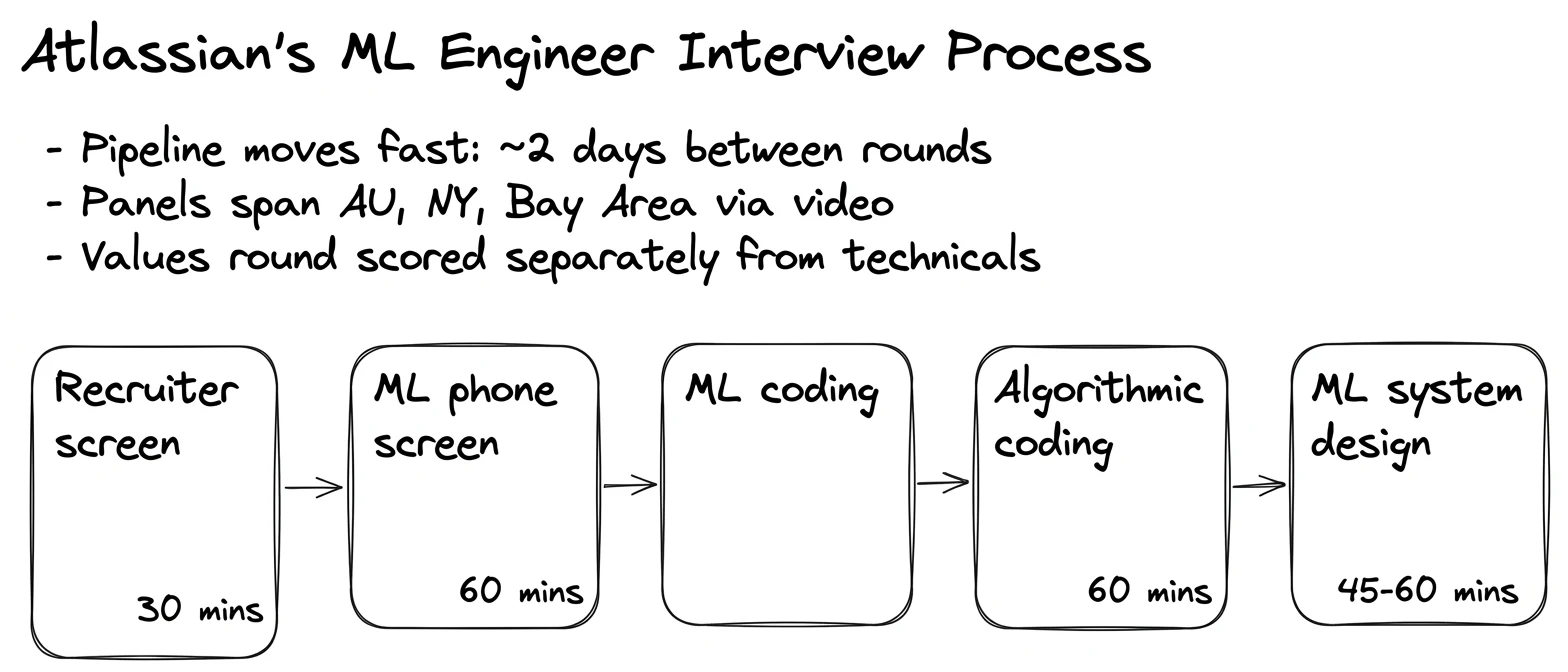
Machine Learning Engineers are hired into specific AI teams, most visibly in the Rovo and AI organization, and the design prompt usually reflects that team's product. Reported loops have an ML phone screen followed by a virtual onsite of two to four sessions. Rounds can be as little as two days apart, but one candidate waited a month after the onsite with no news.
The structure is the same from mid-level to principal; the depth changes. Mid-level candidates get a standard design scaled to their background, while senior and principal candidates are expected to cover evaluation strategy, cost and latency trade-offs, and technical leadership.
Here's what the interview process can look like:
- Recruiter screen: A short call on background, team, target level and logistics, often after the recruiter reached out first.
- ML phone screen: A senior ML engineer covers one resume project, ML fundamentals and a time-boxed ML design question.
- ML coding interview (some loops): Implementing an ML algorithm, feature step or data-pipeline component in a shared editor.
- Data structures and algorithms interview: One 60-minute session with one or two problems, each extended two or three times.
- ML system design interview: About 45 minutes designing retrieval, search, recommendation or classification for an Atlassian product.
- Values and management interviews: Behavioral conversations tied to Atlassian's five values, sometimes combined into one block.
Tip: Treat the coding session as the deciding round. Candidates spend most of their preparation on retrieval architectures, then lose the loop on the third follow-up of a streaming problem.
Recruiter screen
The recruiter call is short and non-technical, and several candidates were contacted by the recruiter first. It covers your ML background, the AI team, target level, time zone and loop format. Interviews are virtual, and panels can span Australia, New York and the Bay Area. Ask which onsite sessions you will get, because some loops include an ML coding round and others put two general coding problems into one hour.
Interviewers look for:
- Team fit: Whether your experience maps to retrieval, ranking, LLM applications or ML platform work.
- Level calibration: Years of production ML, the scope of systems you owned, and whether you have led engineers.
- Availability: The loop can schedule within days.
- Motivation: A specific reason to build AI features in Jira, Confluence or Rovo.
Prepare a two-minute summary of your strongest production ML project and a clear answer on the level you are targeting.
Sample questions for the recruiter screen
Here are some questions reported by recent candidates:
- Walk me through your machine learning experience.
- Why Atlassian, and why this AI team?
ML phone screen
A senior ML engineer runs the screen in three parts. It opens with a deep dive into one resume project: problem framing, data, model and metric choices, and impact. Fundamentals follow, asked conversationally: bias-variance, overfitting, metric choice and imbalanced data, graded on trade-off reasoning rather than definitions.
The last part is a time-boxed ML design question: a retrieval-augmented system answering from both Jira and Confluence, a standard recommendation system, or, in one AI-focused loop, a chatbot design with no code. The retrieval discussion covered indexing two differently shaped sources, hybrid search, reranking, merging results and keeping sensitive tickets out of answers. Candidates who passed heard back within about two days.
Interviewers evaluate:
- Ownership of one project: Defending decisions you made yourself, from data collection through deployment.
- Trade-off reasoning: When accuracy misleads, how class imbalance changes metrics and sampling, and what to change when a model overfits.
- Structure under a time box: A complete sketch of data, retrieval or candidate generation, ranking, serving and evaluation before going deep.
- Privacy instinct: Raising access control for internal content without being prompted.
Rehearse a 10-minute narrative of one production project and two 15-minute design sketches, one for retrieval and one for recommendation.
Sample questions for the ML phone screen
Here are some questions reported by recent candidates:
-
Design a simple retrieval-augmented system that answers questions from both Jira and Confluence without leaking tickets the user cannot see.
-
How do you handle a heavily imbalanced dataset, and which metric do you report?
-
How do you evaluate a model and catch overfitting before it ships?
-
Explain a Project Architecture Through a Technical Deep Dive
ML coding interview
Some onsite loops open with an ML coding session in a shared editor, with no whiteboard: you implement an ML algorithm, a feature-engineering step or a data-pipeline component. Reports describe it only briefly, and other loops skip it.
Interviewers evaluate:
- Runnable code: A familiar algorithm turned into correct code with clean interfaces.
- Data handling: Missing values, numerical stability and memory on large or streaming input.
- Extensibility: Whether a changed definition needs a small edit or a rewrite.
- Communication: Stating inputs, outputs and complexity before coding.
Practice implementing small ML components from scratch in Python, such as a metric, a feature transform or a batching pipeline, with your own tests.
Data structures and algorithms interview
This 60-minute session can contain two independent medium problems, leaving about 25 to 30 minutes for each. The recurring problem is a streaming class that returns the average of the last N integers without storing the full history, using a circular buffer and a running sum. Follow-ups turn it into a recency-weighted average, probe very large windows and floating-point precision, and in one loop added a third variant with a different weighting or statistic.
Other reported problems: multi-court tennis reservations with conflict detection, minimum courts for a set of bookings with cleaning gaps, a lowest-common-ancestor variant extended to a DAG, a constant-time doubly linked list, and the bulls-and-cows hint with duplicate digits.
Interviewers evaluate:
- Completeness under extension: Your code at time-up decides the result, and an unfinished last sub-part has sunk an otherwise positive loop.
- Invariant design: State such as a running sum, weighted sum or buffer index that updates in constant time.
- Modular structure: Each new requirement adds a method or field instead of forcing a restart.
- Edge cases stated aloud: Empty windows, bookings that share a boundary, duplicate digits, nodes with several parents.
- Pacing across two problems: Finishing both cores before taking optional extensions.
Drill streaming-window and interval-booking problems until the weighted and multi-court variants take minutes, timing each problem at 25 minutes.
Note: The rejected candidate solved the court reservation problem completely and handled the weighted average, then ran out of time on a third extension. If an extension stalls, explain the approach and protect the parts already working.
Sample questions for the data structures and algorithms interview
Here are some questions reported by recent candidates:
-
Return the mean of the last N values of an integer stream in constant time, then switch to a linearly or exponentially decaying weighted average.
-
Implement booking and availability checks for several tennis courts, rejecting any overlap.
-
Given court bookings, find the minimum number of courts, then add a fixed cleaning time after each booking.
-
Find the lowest common ancestor of two nodes in a tree, then adapt the solution to a directed acyclic graph.
ML system design interview
This round usually takes about 45 minutes. Most prompts are internal Atlassian problems: an employee chatbot answering from Confluence, Jira and wikis; search for Jira or Confluence with personalization and recency; a recommendation system for Jira; a search layer that sorts queries into fact-seeking and task-seeking and shows a generated answer card; and a router that sends bug reports from many customer organizations to the right team. One candidate got a generic product-feed recommender, scoped to their background.
Interviewers cover ingestion, chunking, embeddings, hybrid retrieval, reranking, latency and cold start, then evaluation, hallucination, retrieval versus fine-tuning, tenant isolation and feedback loops, asking you to justify each choice.
Interviewers evaluate:
- Product grounding: Naming the actual sources, such as tickets, pages and connected drives, and how each one is structured and accessed.
- Permission-aware retrieval: Filtering by the user's access inside retrieval, because surfacing a restricted ticket is a security defect.
- Evaluation plan: Offline metrics, human review, hallucination checks and detecting regressions after launch.
- Trade-off depth: Retrieval versus fine-tuning, recall versus latency, and tenant isolation for customer data.
Prepare two end-to-end designs, a retrieval assistant over Jira and Confluence and a Jira recommender or bug router, each with an access-control and evaluation section.
Tip: Draw the permission filter in your first diagram. Adding access control only after the interviewer raises it costs signal.
Sample questions for the ML system design interview
Here are some questions reported by recent candidates:
-
Design an internal chatbot that answers employee questions from Confluence, Jira and wikis, returning only content the user may see.
-
Design search for Jira or Confluence that blends lexical and semantic signals with personalization within a latency budget.
-
Design a recommendation system for Jira, covering data sources, model choice, evaluation metrics and production constraints.
-
Design a system that routes bug reports from many client organizations to the right internal team, with tenant isolation and correction feedback.
Values and management interviews
The values interview, typically 45 to 60 minutes and scored separately, asks for stories built around Atlassian's five published values, such as "Play, as a team" and "Be the change you seek". The management conversation covers role expectations, cross-functional work, mentoring and lessons learned. One loop combined both into one block; in another a hiring manager ran it. Interviewers were friendly but pressed for specifics.
Interviewers evaluate:
- Specific situations: A real disagreement or mistake, with your own actions and the outcome.
- Value coverage: Different stories for pushing back, driving change, helping a colleague, handling ambiguity and recovering from failure.
- Leadership without authority: For senior candidates, setting technical direction and coaching engineers.
- Prioritization: How you choose between several urgent projects.
Prepare two stories for each value, including one about an ML system that failed in production.
Sample questions for the values and management interviews
Here are some questions reported by recent candidates:
-
Tell me about a time you pushed back on a decision.
-
Describe a conflict with a teammate and how it was resolved.
-
Talk about a mistake you made and how you recovered.
How Atlassian levels and evaluates Machine Learning Engineer candidates
After the onsite, a debrief and hiring committee review all the feedback together. One weak round can change the outcome or the level: Atlassian engineering candidates have been offered a level below their target, and the management conversation is reported to carry weight in the debrief even for individual contributors. On this track the coding session acts as a hard gate. Engineering candidates who fail a screen typically wait about six months before reapplying.
Tip: Confirm the target level with the recruiter before the onsite, and prepare leadership stories that match it.
How to prepare for the Atlassian Machine Learning Engineer interview
- Master the moving-average family: Fixed-window, weighted and exponential averages, then a windowed median, each with constant or logarithmic updates.
- Practice two problems in one hour: Time two medium problems back to back so both cores finish.
- Drill booking and tree extensions: Multi-court reservations with cleaning gaps, and ancestor queries extended to DAGs.
- Design retrieval with access control: Chunking, hybrid retrieval, reranking and per-user permission filtering over Jira and Confluence, plus an evaluation plan.
- Prepare a recommender and a classifier: A Jira recommender and a multi-tenant bug router, with cold start and feedback loops.
- Rehearse one project in depth: Be ready to explain your data, metric and deployment choices and why you rejected the alternatives.
- Map stories to the five values: Two per value, including pushback, mentoring and recovery from a failure.
About the Atlassian Machine Learning Engineer role
Machine Learning Engineers build the AI features in Jira, Confluence, Jira Service Management and Rovo, Atlassian's AI search, chat and agent product. Postings describe agentic LLM harnesses, answer quality and cost, evaluation benchmarks, fine-tuning and model serving. Teams mix software and ML engineers across Australia and North America, and staff can work from home or an office.
| Level | Primary focus | Impact scope |
|---|---|---|
| P30 (Graduate / junior) | Well-scoped model, data and evaluation tasks | A component of a team's system |
| P40 (Machine Learning Engineer) | Owning features from experiment to production | A feature or model |
| P50 (Senior Machine Learning Engineer) | Leading designs and evaluation, coaching | A team's ML system |
| P60 (Principal Machine Learning Engineer) | Technical direction and design reviews | Several teams |
| P70 (Senior Principal Machine Learning Engineer) | Quality and reliability frameworks for flagship AI | An organization |
Atlassian hires Machine Learning Engineers across teams that include:
- Rovo GenAI Platform: Infrastructure to train, evaluate, deploy and operate models.
- Rovo Chat quality: Answer accuracy, grounding, safety and latency for the AI assistant.
- AI Context: Agentic LLM harnesses and the context behind AI features.
- Confluence AI: Generative and retrieval features in Confluence.
- Service management AI: ML for IT service and operations workflows.
Machine Learning Engineer experience and education requirements
Postings ask for a computer science or related degree or equivalent experience, Python or Java, SQL and experience scaling models. Senior roles want four or more years of industry ML including LLM systems; principal roles about 10 years. Spark, AWS and LLM serving are preferred.
FAQs about the Atlassian Machine Learning Engineer interview
How long does the Atlassian Machine Learning Engineer interview process take?
Reported loops took a few weeks, with about two days between rounds in the fastest case. Reschedules and waits of a month after the onsite also occur, so follow up with the recruiter.
What is the hardest round in the Atlassian Machine Learning Engineer interview?
By outcome, the data structures and algorithms session, which produced the documented rejection. By content, ML system design, where generic answers fall short on permissions, tenancy and evaluation.
Is there an online assessment for Machine Learning Engineers?
None of the reported loops had one; candidates went from the recruiter straight to the ML phone screen. Some other Atlassian engineering tracks start with an externally run coding screen, so confirm with your recruiter.
How much does an Atlassian Machine Learning Engineer make?
Posted US base salary ranges for new hires in the highest-cost zone are about $175K to $229K for Machine Learning Engineer, $206K to $269K for a senior ML systems role, $196K to $309K for Principal and $222K to $349K for Senior Principal. Ranges are lower in other zones, and packages add equity and may include a bonus.