Apple · Study
Apple Software Engineer Interview Process
TrueInterview
July 24, 2026 · 14 min read
Apple has no central question bank and no standard loop. The hiring team runs every round, each interviewer picks their own questions, and the hiring manager, often with a senior manager or director, makes the call. What stays constant is the escalation after a correct answer: cut the space, make it thread-safe, scale it to billions of requests, then write and run tests. Since April 27, 2026, every candidate also sits an AI-assisted coding round.
This guide breaks down each stage of the Apple Software Engineer interview, what interviewers evaluate in each round, and how to prepare, with questions candidates were actually asked.
Verified: Based on 36 candidate-reported interview experiences, primarily from 2025 Q4 through 2026 Q3, cross-checked against recent public accounts.
Apple Software Engineer interview process
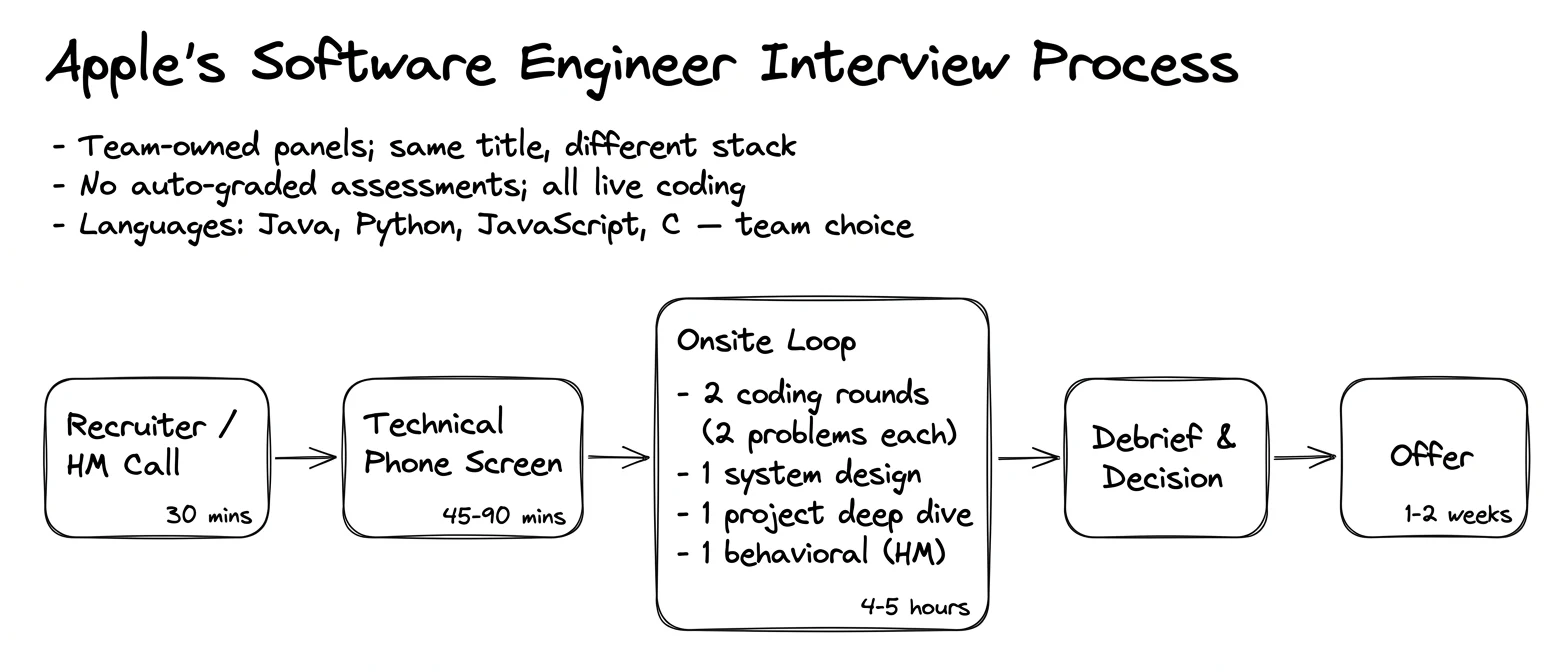
Apple hires each Software Engineer into a specific team, and that team's stack sets the content: Java and distributed systems for services, C and memory management for platform groups, React for frontend teams. The usual shape is a first call, one or two phone screens of about 45 minutes, and a loop of four to six rounds of 45 to 60 minutes, sometimes split over two days. A fast process takes four to six weeks from screen to signed offer; reorganizations and recruiter silence can stretch it to months.
Junior candidates (ICT2 and ICT3) mostly get coding, object-oriented design and a hiring manager conversation. Mid-level and senior candidates (ICT4 and above) add one or two system design rounds, a longer project deep dive and often a skip-level round.
Here's what the interview process can look like:
- Recruiter phone screen: About 30 minutes with a recruiter or the hiring manager on background, motivation and teamwork.
- Technical phone screens (one or two): About 45 minutes each in a shared editor: an algorithm, a parsing task, an object-oriented design, or sometimes system design or operating systems.
- Coding interviews (two or three): Hour-long rounds, often with two problems each, plus follow-ups on scale, concurrency and testing.
- AI-assisted coding round (since April 2026): A CoderPad session with an AI assistant, graded on how you direct it.
- Object-oriented design interview: A booking, seating or deck model turned into working classes with a concurrency question.
- System design interview (usually mid-level and above): A distributed-systems discussion, often from the team's own product or with a resource constraint.
- Project deep dive and behavioral interviews: Your architecture decisions and metrics, then prioritization and cross-team work with the hiring manager and sometimes a skip-level manager.
Tip: Ask the recruiter which team you are interviewing with and what its stack is. Candidates who skipped this ran into a React internals screen, a C memory-management hour or an operating-systems drill with no coding.
Recruiter phone screen
The first call, with a recruiter or sometimes the hiring manager, runs about 30 minutes: your history, why Apple, and teamwork and conflict questions, usually with no technical content. Confirm the location here: one candidate passed two rounds before learning the role had moved to Seattle. A first call with the hiring manager is more evaluative: one went through the resume asking what was behind each percentage improvement, ended with an easy sliding-window problem, and booked the next round the following day.
Interviewers evaluate:
- Fit with the specific team: Whether your background matches the team's stack and domain.
- Credible metrics: The baseline, the measurement and your share behind every number on the resume.
- Motivation for Apple: A specific product or problem, not general admiration for the brand.
- Professional tone: Warm but structured answers; being too casual has hurt strong candidates.
Prepare a two-minute career summary and the detail behind every resume metric.
Sample questions for the recruiter phone screen
Here are some questions reported by recent candidates:
-
Walk through your career history and the project you are proudest of.
-
Why Apple, and why this team?
-
Crafting a Compelling Job Transition and Motivation Response
Technical phone screen
Expect one or two screens of about 45 minutes, some up to an hour, in a shared editor such as CoderPad. Some open with 10 to 15 minutes on a recent project. Most then give one medium problem: prefix-sum subarray counting where negatives rule out a sliding window, a lazy BST iterator in O(h) space, island counting, Valid Sudoku, K pairs with the smallest sums, or a weighted random pick. Practical tasks appear too: join failed-login IPs from a server log to a machine-mapping file, or return the top N lines from a log too big for memory.
A sizeable minority are not algorithm screens. One service team ran its second screen as an ads click aggregator design; a platform team spent 45 minutes on threads, scheduling, mutexes versus semaphores, deadlock and cache coherency with no code. One onsite was scheduled two days after the screen.
Interviewers evaluate:
- Restating before coding: The problem, its constraints and open questions, before any code.
- Follow-up range: "At most k" instead of "exactly k", concurrent iterators on one tree, or input that streams.
- Self-testing: Writing and running your own tests for k of zero, empty input and one very large side.
- Composure without feedback: Some interviewers stay silent or interrupt; candidates who kept explaining advanced.
- Domain depth when asked: Concrete trade-offs and failure cases, not textbook definitions.
Practice medium problems in about 25 minutes, ending each with your own follow-up and tests.
Note: Screens are lost after the code works. A rejected candidate solved K pairs and its tests cleanly, then could not explain in the design screen how to avoid double-counting clicks or handle late events from different devices, and named that as the deciding weakness.
Sample questions for the technical phone screen
Here are some questions reported by recent candidates:
-
Count subarrays summing to k with negatives and zeros, then those summing to at most k.
-
Build an in-order BST iterator in O(h) space, then explain what changes with concurrent iterators.
-
Return a random country with probability proportional to its population.
-
Explain why a plain flag cannot coordinate threads on different cores.
Coding interviews
The loop usually has two or three coding rounds of 45 to 60 minutes, often with two problems each. Most are recognizable mediums wrapped in a story: packing orders into H hours is Koko Eating Bananas, and the first restaurant seen exactly once in an order stream is First Unique Number. Others include the shortest bridge between islands, vertical-order traversal, decode string, k-th largest and earliest arrival on bus schedules. Some are unusual: a median reachable only through an API counting values above or below a number, or a Java key-value scan iterator to debug for boundary errors.
Follow-ups fill the end of the round. A happy-number solution led to serving billions of requests a day (one candidate precomputed every number below 1,000); a grid BFS led to cells becoming blocked after the path was found; a first-unique stream had to accept concurrent writers.
Interviewers evaluate:
- Recognizing the pattern: Naming the problem under the story and confirming the key rule, such as leftover time in an hour being lost.
- Comparing approaches first: A candidate who later got an offer compared DFS, BFS and union-find for islands before coding.
- Keeping only what is needed: One interviewer asked whether a parentheses solution really needed a stack; two counters cut space to O(1).
- Handling the next question: Scale, concurrency or incremental updates once the code is correct.
- Finishing both problems: Spending the hour on the first problem costs the grade.
Practice graphs, binary search on the answer, heaps, prefix sums and stream designs until each takes under 20 minutes, with a concurrency or scale follow-up every time.
Tip: State the standard problem behind each story in one sentence and get agreement before coding. Candidates who misread the core went down a wrong path; those who restated it had time left for follow-ups.
Sample questions for the coding interviews
Here are some questions reported by recent candidates:
-
Decide whether a number reaches 1 by repeatedly summing the squares of its digits, then serve billions of requests a day.
-
Find the median of hidden data using only a count API and above/below queries.
-
Find the minimum courier speed that completes every order within H hours, then extend it to several couriers.
-
Given a sorted array, return the K pairs with the smallest absolute difference.
AI-assisted coding round
Apple added this round for full-time Software Engineer candidates on April 27, 2026, even for those mid-loop. It runs on CoderPad with an AI agent in a sidebar, and language choice is up to the interviewer. Few tasks have been reported. A candidate who later got an offer judged that it tested directing the AI like a capable junior engineer to production-quality code, not typing every line.
Interviewers evaluate:
- Upfront constraints: Architecture, design pattern, test strategy and edge cases in your first instructions.
- Reviewing output: Reading and testing generated code instead of accepting it.
- Breaking down the task: Scoped steps, not the whole problem in one prompt.
- Explaining your reasoning: Describing the full solution even when the tool cannot help.
Practice building a small feature with an AI assistant, writing the constraints and tests yourself before asking for code.
Note: The tool can fail. One candidate's session dropped about 20 minutes in and could not reconnect; the interviewer had them talk through the rest, and they still got an offer.
Object-oriented design interview
Object-oriented design appears in phone screens and loops, as a small model with a firm guarantee. A hotel booking system with checkAvailability and bookRoom must stay correct when two bookings arrive at once. A deck of cards needs a uniform shuffle and a constant-time uniform draw as cards leave, which is Fisher-Yates plus the array-and-hashmap trick from randomized sets. A hit counter tests eviction, and one hour in C covered an airplane seat map with nearest-seat reassignment.
Interviewers evaluate:
- The guarantee inside the classes: Uniformity, constant-time removal or correctness under concurrent bookings, justified.
- Defining the requirement: For example, what "nearest seat" means before coding.
- Memory discipline in C: Matching allocation and frees, with no leaks on error paths.
- Concurrency choices: Where the lock goes, how fine-grained it is, and what happens under contention.
Practice turning a two-line prompt into an interface, a few classes and a working core method in 30 minutes, then add thread safety.
Sample questions for the object-oriented design interview
Here are some questions reported by recent candidates:
-
Design a deck with a shuffle where every order is equally likely and a constant-time uniform draw.
-
Implement a hotel booking service that books rooms correctly under concurrent requests.
-
In C, allocate, print and free an airplane seat map, and reserve a seat with optional reassignment to the nearest open seat.
System design interview
Most mid-level and senior loops have one system design round, infrastructure-leaning teams two, each 45 to 60 minutes of discussion. Many prompts come from Apple's products or the team's work: iCloud Photos storage with metadata apart from blobs, multi-device sync and hot/cold tiers; an S3-style object store; a logging pipeline. Others get sharp emphasis: multi-source ads click aggregation, a rate limiter probed on Redis atomicity through Lua scripts, top-10 restaurants over a sliding hour, voting-system APIs. One round asked for inventory lookups on a machine with only spinning disks and very little RAM.
Interviewers evaluate:
- Requirements first: Window type, latency, whether approximate counts are acceptable, and scale, before any boxes.
- Correctness: Idempotency keys, deduplication, late events and replay; one rejection came down to these.
- Specific techniques: Minute buckets merged into a window, count-min sketch error direction, salted hot keys, Lua for atomic updates.
- Designing under constraints: Log-structured storage, batched writes and I/O scheduling when memory and disk are scarce.
- Adapting to changes: Moving from a global top 10 to one per city by changing the aggregation key.
Practice aggregation, storage-and-sync and rate-limiting designs, plus one resource-starved design.
Tip: Name the correctness mechanism before you are asked. For any counting prompt, cover event IDs, idempotent consumers, a cutoff for late events and checkpoint-plus-replay recovery in your first pass.
Sample questions for the system design interview
Here are some questions reported by recent candidates:
-
Design an inventory lookup and update service on a machine with no SSD and very little RAM.
-
Aggregate ad clicks from web, mobile and connected-TV sources so no click is counted twice or lost.
-
Design iCloud photo storage covering upload, download, multi-device sync and hot versus cold data.
-
Compute the top 10 restaurants by orders over a sliding one-hour window, then per city.
Project deep dive and behavioral interviews
Most loops include a project deep dive, as its own round, inside system design, or as a 75-minute session merged with behavioral. Interviewers who know your stack go deep: one went straight into the candidate's Kafka and CI/CD work, another into why each technology was chosen. The behavioral round is usually with the hiring manager: your most impactful project, a disagreement, cross-team collaboration, conflicting priorities, persuading others to reprioritize, and a time you did not ask for advice.
Extra managers appear. One candidate met the hiring manager's manager in round two for a key-value store design with no coding; another had a director round after a senior manager round; a storage loop ended with a senior reliability lead on on-call toil.
Interviewers evaluate:
- Your own decisions: What you chose and which alternatives you rejected, separate from the team's decisions.
- Impact with numbers: Latency, cost or reliability changes and how they were measured.
- Priority conflicts: How you renegotiated timelines when another team blocked you.
- Influence without authority: Getting peers to change plans without escalating.
- Self-awareness: Specific lessons, real feedback and where you want to grow.
Prepare three project deep dives (architecture, rejected options, metrics, what you would change) and six to eight stories on priorities, disagreement and cross-team work.
Sample questions for the project deep dive and behavioral interviews
Here are some questions reported by recent candidates:
-
Tell me about a time you learned something because you did not ask for advice.
-
Describe getting another team to change its priorities to unblock your work.
How Apple levels and evaluates Software Engineer candidates
The hiring team owns the decision: interviewers discuss together, and the hiring manager, often with a senior manager or director, decides. One unresolved concern can stop an offer after clean technical rounds. The level is usually set by the role, but one senior candidate was downleveled a step after a strong loop.
In-loop signals are unreliable: candidates who felt the rounds went well were rejected, and silent interviewers predicted nothing. Some rejections had nothing to do with performance: the role was filled, relocated or frozen by a reorganization. When it works, it is fast: one pass notice came three days after the interview, and one verbal offer came three days after the last onsite day, with a signed offer twelve days later after a stretch of recruiter silence.
Tip: A rejection is usually tied to one team. Applying to a different team with a different stack is the common way back, and candidates reported no fixed waiting period for it.
How to prepare for the Apple Software Engineer interview
- Prepare for the team, not the company: Learn the team's stack and drill that domain: C memory, Java concurrency, OS fundamentals, React or distributed storage.
- Run four follow-ups on every problem: Reduce space, add thread safety, scale to billions of requests, and write and run tests.
- Find the problem under the story: Restate couriers, restaurants and seat maps as the standard problem and confirm the key rule first.
- Plan for two problems an hour: About 20 minutes per medium leaves time for the second problem and follow-ups.
- Rehearse directing an AI assistant: Write constraints and tests yourself, review all output, and be able to finish without it.
- Lead aggregation designs with correctness: Idempotency, deduplication, late events and replay, plus one design under tight memory and disk.
- Put the guarantee into OOD answers: Uniform randomness, constant-time removal or concurrency safety, explained before the class diagram is finished.
- Back every number with detail: Hiring managers check each resume percentage and each project decision.
About the Apple Software Engineer role
Apple Software Engineers work in small, independent teams that own a framework, service or internal platform from design through release. Many teams work on long, confidential product cycles. Correctness, performance and maintainability are valued over cleverness, matching the interview focus on memory, locking and tests. Nearly everyone is titled "Software Engineer"; the internal ICT level sets scope and pay. Corporate staff work in the office about three days a week.
| Level | Primary focus | Impact scope |
|---|---|---|
| ICT2 | Well-defined features with guidance; often new graduates | Components within one team |
| ICT3 | Features owned end to end with little supervision | A team's services or frameworks |
| ICT4 | Senior engineer: design leadership and mentoring | Several systems and neighboring teams |
| ICT5 | Staff- or principal-level technical direction | An organization's architecture |
| ICT6 | Senior principal technical leadership | Multiple organizations |
Apple hires Software Engineers across most of the company. Teams include:
- Software Engineering: Operating systems, frameworks and apps across iPhone, Mac, Watch and Vision Pro.
- Services: iCloud, the App Store, Apple Music, Apple Pay and Wallet, and Apple News.
- Cloud infrastructure: Compute platforms, storage and reliability behind Apple's services.
- Machine learning and AI: Siri and Apple Intelligence features and their serving backends.
- Information Systems and Technology: Internal systems for retail, supply chain and corporate operations.
- Hardware technologies: Firmware, drivers and tools for Apple silicon and devices.
Software Engineer experience and education requirements
Postings usually ask for a bachelor's in computer science or a related field, or equivalent experience, with about two years for mid-level roles and five to seven or more for senior ones. Platform roles often want Swift, Objective-C or C++; services roles Java or Go and distributed systems with relational and NoSQL databases. Interview languages (Java, Python, JavaScript, C) usually follow the team.
FAQs about the Apple Software Engineer interview
How long does the Apple Software Engineer interview process take?
Usually four to eight weeks. One offer ran from a late-June phone screen to a signed offer on July 28, while reorganizations and recruiter silence added weeks to other loops.
What is the hardest round of the Apple Software Engineer interview?
For mid-level and senior candidates, system design, where candidates are pushed on correctness and resource limits and most often named their weakness. For new graduates, the follow-ups after a correct coding solution.
Is there an online assessment?
No report on this track describes a timed, auto-graded assessment. Every technical round, including the AI-assisted one, was live with an engineer.
How much does an Apple Software Engineer make?
Approximate total annual compensation in the United States:
- ICT2: ~$170K
- ICT3: ~$235K
- ICT4: ~$350K
- ICT5: ~$500K
Packages combine base salary, restricted stock units vesting over four years, and an annual bonus, with stock a larger share at higher levels.