Apple · Study
Apple Machine Learning Engineer Interview Process
TrueInterview
July 24, 2026 · 14 min read
Apple's Machine Learning Engineer loop is owned by the hiring team, and its shape tracks the team rather than a company template: one process was a single hour-long screen, another ran four phone screens and two onsite rounds without a line of live code. Two things recur. The coding that does appear is applied machine learning, such as vectorized k-means, multi-head attention from scratch or a broken UNet to fix, rather than contest-style algorithms. And the most common rejection is not a wrong answer but thin knowledge one step outside the candidate's specialty, which interviewers probe deliberately.
This guide breaks down each stage of the Apple Machine Learning Engineer interview, what interviewers evaluate in each round, and how to prepare, with questions candidates were actually asked.
Verified: Based on 21 candidate-reported interview experiences, primarily from 2026 Q1 through 2026 Q3, cross-checked against recent public accounts.
Apple Machine Learning Engineer interview process
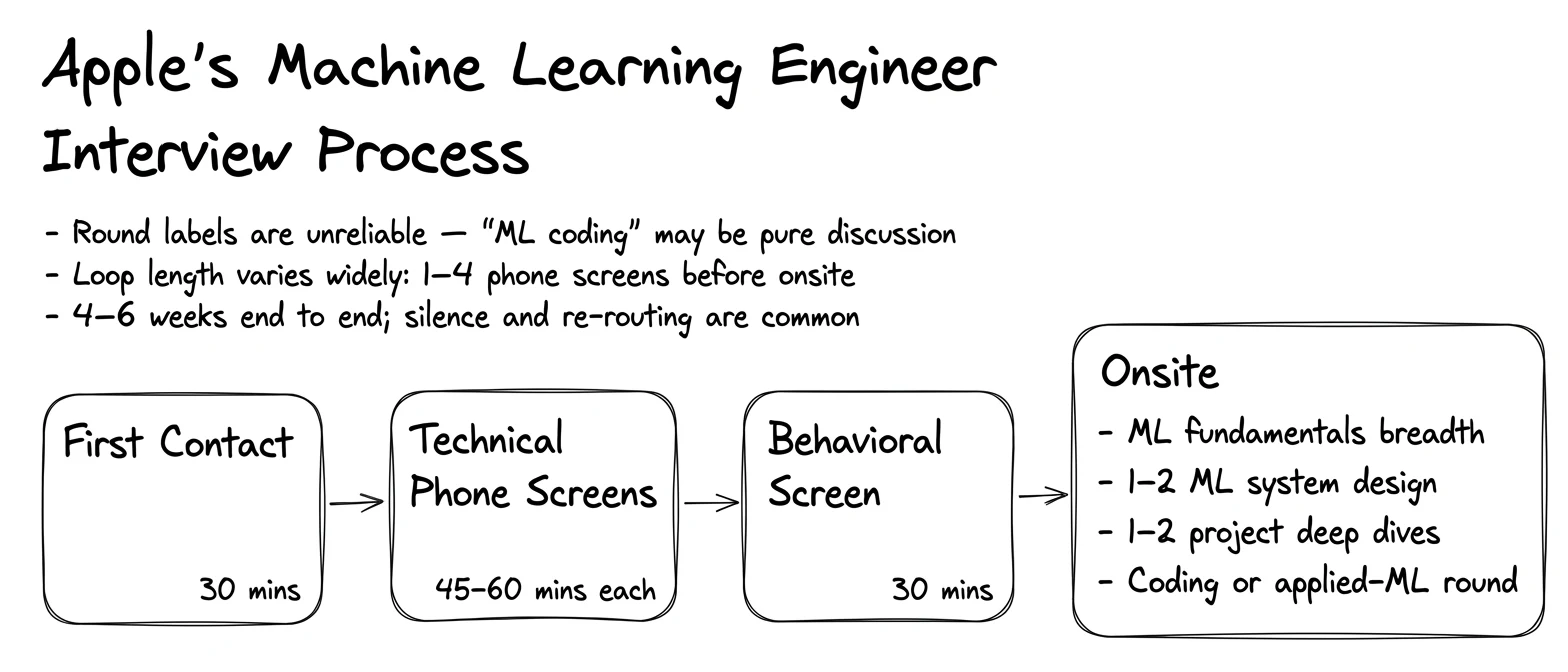
Candidates apply to a specific team, whose engineers and manager write their own questions; there is no shared question bank, so a video team asks about codecs and diffusion while a recommendation team asks about two-tower models and A/B tests. Reported processes ran from one to six phone rounds, and full loops from four to six onsite or virtual rounds, each with a different panelist.
Intern loops are two video rounds of practical coding and fundamentals. Mid-level loops add ML system design and one to three project deep dives; a data-focused manager loop ran six rounds, three of them system design.
Here's what the interview process can look like:
- Recruiter or hiring manager screen: A 30-minute call on background, motivation and hands-on depth, sometimes already technical.
- Technical phone screens (one to five): About an hour each, mixing ML coding, fundamentals and domain conversation in proportions set by the team.
- ML coding interview: Vectorized implementations of core algorithms, debugging model code, and sometimes a classic algorithm problem.
- ML fundamentals interview: A breadth round from bias-variance to transformers, preference tuning, distillation and agents, asked as comparisons.
- ML system design interview: An end-to-end design on the team's product, graded heavily on evaluation, latency and failure handling.
- Project deep dive interview: One project dissected to the implementation level, often pivoting into a production problem.
- Behavioral interview: Prioritization, cross-team blockers, conflict and motivation, scored more strictly than its tone suggests.
Tip: Treat the job posting as the syllabus. Candidates repeatedly found that the posting's listed skills, such as video compression, diffusion models or vision encoders, predicted the technical questions almost topic for topic, while the round labels did not.
Recruiter and hiring manager screen
The first call lasts about 30 minutes: resume, AI projects, ML libraries, why Apple and salary expectations, with follow-ups to confirm the hands-on work you list. On this track the first contact is often the hiring manager, and that call is evaluative: one recruiter arranged a prep call and then a manager screen that moved from teamwork questions straight into coding multi-head attention. That candidate was rejected after the screen and concluded that clean attention code was the bar.
Some manager screens are purely technical: one turned the latest project into a code review, from data ingestion and database choices to why an agentic architecture was used at all, each answer met by another "why."
Interviewers look for:
- Verified hands-on work: Specific libraries, data volumes and decisions you made, not the team's results.
- A reasoned motivation: Why this team and product, linked to your skills.
- Fit with the posting's domain: Whether your background covers what the team actually builds.
- Composure on a technical pivot: Moving from conversation to code without warning.
Prepare a two-minute walkthrough of your latest project that survives three levels of "why," and be ready to code attention on the first call.
Sample questions for the recruiter and hiring manager screen
Here are some questions reported by recent candidates:
-
Why do you want to work at Apple, and what are your salary expectations?
-
Which parts of this project did you personally build, and with which libraries?
-
Why did you choose an agentic architecture instead of a simpler pipeline, and how did you evaluate it?
-
Crafting a Compelling Job Transition and Motivation Response
Technical phone screens
Screens run about an hour, and their number varies more than on any other Apple track: one candidate had a single screen, another five. Content splits three ways. Some are ML coding, such as k-means from scratch or self-attention with scaling and masking. Some pair a classic problem with fundamentals, for example rotating an N×N matrix in place followed by vision-encoder training and LLM inference bottlenecks. Some are pure domain conversation: video compression and diffusion for a video team, DCN v1 against v2 and bidding for a cost-per-action objective for an ads team.
A debugging screen recurs. One candidate explained UNet's skip connections, then fixed a PyTorch snippet with a wrong input shape, a misplaced boolean in the decoder block, a wrong final kernel size and a wrong class count, verifying every shape from a 572×572 input to a 2×388×388 output. That candidate was rejected after the screen.
Interviewers evaluate:
- Tensor-shape fluency: Tracking shapes through each layer, including how valid convolutions shrink feature maps.
- Depth on the posting's domain: Trade-offs and recent advances, not definitions.
- Practical modeling judgment: How dataset size changes the model, and telling overfitting from underfitting.
- Production instincts: Diagnosing a sudden drop in online performance or a slow LLM at inference.
Practice small model components, checking each intermediate shape by hand.
Note: Round labels are unreliable. A screen booked as ML coding was a code-free case study on grounding a voice assistant's responses, and a candidate who prepared for live coding got two technical calls with none. Prepare every screen for both code and discussion.
Sample questions for the technical phone screens
Here are some questions reported by recent candidates:
-
Debug a partial UNet so that a 572×572 input yields a 2×388×388 output, explaining each fix.
-
Explain why training super-resolution with MSE alone gives blurry images and what perceptual loss changes.
-
Describe the bottlenecks in LLM inference and how quantization, KV-cache eviction and speculative decoding address them.
ML coding interview
Loops include zero to two coding rounds, mostly applied machine learning: k-means in NumPy or PyTorch, self-attention or multi-head attention from scratch, an image filter, and image similarity retrieval. The k-means round expects broadcasting rather than Python loops, with follow-ups on empty clusters, poor initialization and k-means++. Attention rounds ask you to add heads and masks and state the compute and memory cost.
Classic problems appear in about half the loops, usually medium: single-transaction stock profit plus binary search on an eating speed, permutations, a one-edit check on sentences where an edit is a whole word, and a custom data-filtering task for an intern solved with a dictionary and then a queue. One loop wrapped a caching problem in a long story, and a newer round asks how you use AI tools while coding.
Interviewers evaluate:
- Vectorization: Matrix operations and broadcasting; a loop-based implementation reads as inexperience.
- Edge cases in ML code: Empty clusters, convergence criteria, padding masks and softmax stability.
- Complexity of your own code: Attention's time and memory in sequence length, stated without prompting.
- Recognizing simpler structure: A one-edit check needs a linear pass, not a full DP table.
- Data structure choice: Justifying the structure and naming an optimization even when not asked to code it.
Write k-means, attention, a 2D filter and nearest-neighbor retrieval from memory in NumPy and PyTorch until each takes under 20 minutes.
Tip: State the complexity before the interviewer asks. Candidates who analyzed time and space aloud and proposed an improvement they did not have to code, such as binary search in place of a linear scan, were credited; the intern who did so had a verbal offer the next day.
Sample questions for the ML coding interview
Here are some questions reported by recent candidates:
-
Implement k-means without explicit Python loops over points, then handle empty clusters and explain k-means++.
-
Given two sentences, return whether they differ by exactly one inserted, deleted or replaced word, in linear time.
-
Implement an image filter, then explain how you would make it run efficiently on device.
ML fundamentals interview
Most full loops have one fundamentals round, sometimes merged with a project discussion. Its surface is wide: one round covered traditional machine learning, evaluation, transformers, agents, tool protocols, prompt engineering, knowledge distillation and activation functions. Another followed the LLM lifecycle from pre-training through supervised fine-tuning to DPO contrasted with RLHF, then benchmark overfitting. Others covered building a classifier end to end, generative model theory, and conditional probability.
Questions arrive as comparisons, and interviewers push one ring outward from wherever you are strongest. A multimodal candidate who handled alignment, fusion complexity, loss design and metrics was told adjacent topics were thinner than expected, and the profile was passed to other teams.
Interviewers evaluate:
- Trade-off reasoning: DPO against RLHF in data needs and stability, MSE against perceptual loss, a baseline against a two-tower model.
- Breadth around your specialty: Serving, compression and experimentation beside the models you know best.
- Evaluation design: Choosing metrics, structuring A/B tests and spotting benchmark overfitting.
- Math fundamentals: Probability, permutations and combinations, which surprised an intern candidate.
Map the areas adjacent to your specialty and prepare a one-minute comparison for each pair of competing techniques.
Sample questions for the ML fundamentals interview
Here are some questions reported by recent candidates:
-
Walk through LLM training from pre-training to SFT to DPO, and explain when DPO is preferable to RLHF.
-
Compare fusion strategies for multimodal embeddings by computational cost, and say how you would evaluate the result.
ML system design interview
One or two rounds of about an hour, set on the team's own product. Reported prompts: spoken responses for a voice assistant under strict latency and factuality limits; grounding a response in internal tool results, with hallucination, evaluation and long context; App Store search from spell correction and intent through retrieval, ranking and cold start for new apps; an Apple News recommender with no existing models or data; sentiment and topic modeling with emerging topics; a feature store; CI/CD for an ML service.
Infrastructure-leaning teams ask data-movement problems. One prompt was moving 200 TB of images and video from an on-premises data center to a cloud GPU cluster within days; the candidate credited the bandwidth estimate (about 18 days at 1 Gbps, under 2 at 10 Gbps), staging in object storage rather than on one host, and a follow-up on keeping GPUs fed with packed shards and prefetching.
Interviewers evaluate:
- Product constraints first: A design that answers in ten seconds fails for a voice product, however accurate.
- Evaluation: Offline metrics, online experiments and how you measure factuality.
- Quantified trade-offs: Back-of-envelope numbers that decide between options.
- Leading the session: Candidates who let silences build lost momentum.
Practice three designs on Apple's own surfaces (assistant, store search, news), each with an evaluation plan and a latency budget.
Tip: Clarify scope before drawing anything. In the data-transfer round, asking whether the move was one-time or recurring, where the data lived and what bandwidth existed was named as a positive signal and decided the architecture.
Sample questions for the ML system design interview
Here are some questions reported by recent candidates:
-
Design response generation for a voice assistant that must be factually grounded, short enough to speak and fast enough for conversation.
-
Design App Store search, including cold start for newly published apps and real-time indexing.
-
Build a news recommender with no existing models or user data, and explain how it improves once feedback arrives.
Project deep dive interview
Deep dives carry more weight here than on other Apple engineering tracks. One process ran three in a row; a six-round loop opened every round with a project. The interviewer covers the problem, your contribution, modeling choices, alternatives considered and what you would change, then often pivots into a production problem: GPU out-of-memory remediation through gradient accumulation, mixed precision, model parallelism and profiling, or on-device optimization.
Depth varies: one resume round moved quickly across several projects, while a hiring manager excavated a single project down to state management and embedding retrieval.
Interviewers evaluate:
- Personal ownership: Decisions you made and why, separated from the team's work.
- Alternatives considered: What you rejected and the data behind it.
- Measured impact: Numbers showing what changed.
- Engineering beneath the model: Memory, serving and deployment details.
Prepare two projects to implementation depth, each with alternatives, metrics and one production failure you resolved.
Sample questions for the project deep dive interview
Here are some questions reported by recent candidates:
-
Walk through your most impactful project: the problem, your contribution, the modeling choices and what you would do differently.
-
Your training run hits GPU out-of-memory errors; compare the fixes and their production costs.
Behavioral interview
Most processes include a behavioral round, sometimes a standalone phone screen, sometimes combined with design. Themes: priorities clashing with a team that blocks your work, disagreement, staying current with research, working without business context, a difficult colleague, and why Apple. One slot drilled into office politics and influencing without authority.
Interviewers evaluate:
- Ownership without authority: How you renegotiated a timeline with a blocking team and what happened.
- Structure: A clear situation, action and result.
- Fairness to others: Describing conflict without disparaging the colleague.
Prepare six structured stories with outcomes, and keep the delivery professional even when the conversation is relaxed.
Note: A friendly tone does not mean informal scoring. One candidate believed a casual, loosely structured answer worked against them, and several were rejected after interviews that felt encouraging.
Sample questions for the behavioral interview
Here are some questions reported by recent candidates:
-
Tell me about a time another team's deliverable blocked yours: how you negotiated and what the outcome was.
-
How do you work when you lack business context for a project?
How Apple levels and evaluates Machine Learning Engineer candidates
There is no central hiring committee. The hiring manager and panel decide in a debrief, the manager's view weighs most, and some organizations add senior review; one candidate who passed the onsite was given a further interview with a senior manager. The target level is tied to the posting, and a candidate who falls short for one team may have the profile shared with other teams instead of a plain rejection.
Outcomes correlate poorly with how a round felt: candidates were rejected after positive verbal feedback, and neutral reactions told them nothing. Decisions took from one day to two weeks, and one rejection came only after a long silence.
Tip: Judge yourself, not the interviewer. One rejected candidate concluded that their own read of each round predicted the result better than any reaction in the room.
How to prepare for the Apple Machine Learning Engineer interview
- Study the posting as the syllabus: List every technique it names and prepare a trade-off discussion for each.
- Code core ML algorithms from memory: K-means, masked multi-head attention, a 2D filter and embedding retrieval, vectorized, with complexity stated.
- Drill tensor shapes: Trace UNet and transformer shapes by hand and debug mismatches quickly.
- Cover the ring around your specialty: Serving, compression, evaluation and alternative architectures next to what you know best.
- Design for Apple's surfaces: Assistant grounding, store search and news recommendation, each with latency, evaluation and cold start.
- Prepare two projects to implementation depth: Alternatives, metrics and a production failure such as GPU memory.
- Keep medium algorithms warm: Binary search on the answer, in-place matrix work, permutations and string edits still appear.
- Structure behavioral answers: Cross-team blockers, conflict and why Apple, delivered precisely even when the tone is casual.
About the Apple Machine Learning Engineer role
Apple's Machine Learning Engineers sit between research and shipping product, and much of the work is shaped by on-device inference and privacy: compressing and converting models to run on Apple silicon, meeting latency budgets for voice and camera features. In late 2025 Apple placed its foundation models, machine learning research, and AI safety and evaluation groups under its software engineering organization, after moving Siri to a separate organization earlier that year.
| Level | Primary focus | Impact scope |
|---|---|---|
| ICT2 | Well-scoped modeling and pipeline tasks with guidance | A feature or component |
| ICT3 | Owning models or pipelines end to end | A product feature within a team |
| ICT4 | Leading technical direction for a model area | A team's ML systems |
| ICT5 | Setting architecture and standards across teams | Several teams or a product line |
| ICT6 | Long-range technical strategy | An organization |
Apple hires Machine Learning Engineers across product and platform groups. Teams include:
- Foundation models and ML research: Training, evaluation and safety of Apple's own language and multimodal models.
- Siri: Query understanding, grounded response generation and assistant evaluation.
- Camera, video and vision: Computer vision, video compression and generative models converted for on-device use.
- Services search and recommendation: App Store search, Apple News and Apple Ads ranking.
- ML platforms and infrastructure: Training data pipelines, feature stores, CI/CD for models and cluster tooling.
Machine Learning Engineer experience and education requirements
Postings for experienced roles commonly ask for a master's or PhD in computer science or a related field, or equivalent industry experience, plus three or more years in machine learning, strong Python and PyTorch. On-device roles add C++ and model compression (pruning, distillation, quantization), and some senior on-device postings ask for a bachelor's degree and ten years of experience.
FAQs about the Apple Machine Learning Engineer interview
How long does the Apple Machine Learning Engineer interview process take?
It depends on the number of screens. A two-round intern process produced a verbal offer the next day and a written offer within two weeks; experienced candidates sat up to five phone screens, and a manager loop took two weeks from panel to response.
What is the hardest round of the Apple Machine Learning Engineer interview?
Usually the ML fundamentals round, because it reaches past what you prepared and the reported cut is thin knowledge in adjacent areas. ML system design is next, since evaluation and hallucination handling are graded as heavily as the architecture.
How much does an Apple Machine Learning Engineer make?
Approximate total annual compensation in the United States:
- ICT2: ~$190K
- ICT3: ~$275K
- ICT4: ~$395K
- ICT5: ~$550K
Packages combine base salary, stock units vesting over four years and an annual cash bonus, with smaller signing bonuses than at many peers; posted base ranges for senior roles run from about $185K to $325K.
What happens after a rejection?
Feedback is rare. Some candidates had their profile forwarded to another team, and an application to a different team is a separate process with its own panel.