Apple · Study
Apple Infrastructure Engineer Interview Process
TrueInterview
July 31, 2026 · 14 min read
Apple infrastructure loops are run by the team you would join, and the coding problems are deliberately modest: count a value in a binary tree, parse a log, pick a weighted random IP. The grade sits in the follow-ups: which lock you would use and what it costs, how the code serves billions of requests, how to speed it up without threads. Design rounds are scored on guarantees, such as how a Lua script keeps rate-limit logic atomic in Redis. Teams that run production give a full round to a senior reliability lead on on-call toil, and since late April 2026 every candidate also sits an AI-assisted coding round.
This guide breaks down each stage of the Apple Infrastructure Engineer interview, what interviewers evaluate in each round, and how to prepare, with questions candidates were actually asked.
Verified: Based on 36 candidate-reported interview experiences, primarily from 2025 Q4 through 2026 Q3, cross-checked against recent public accounts.
Apple Infrastructure Engineer interview process
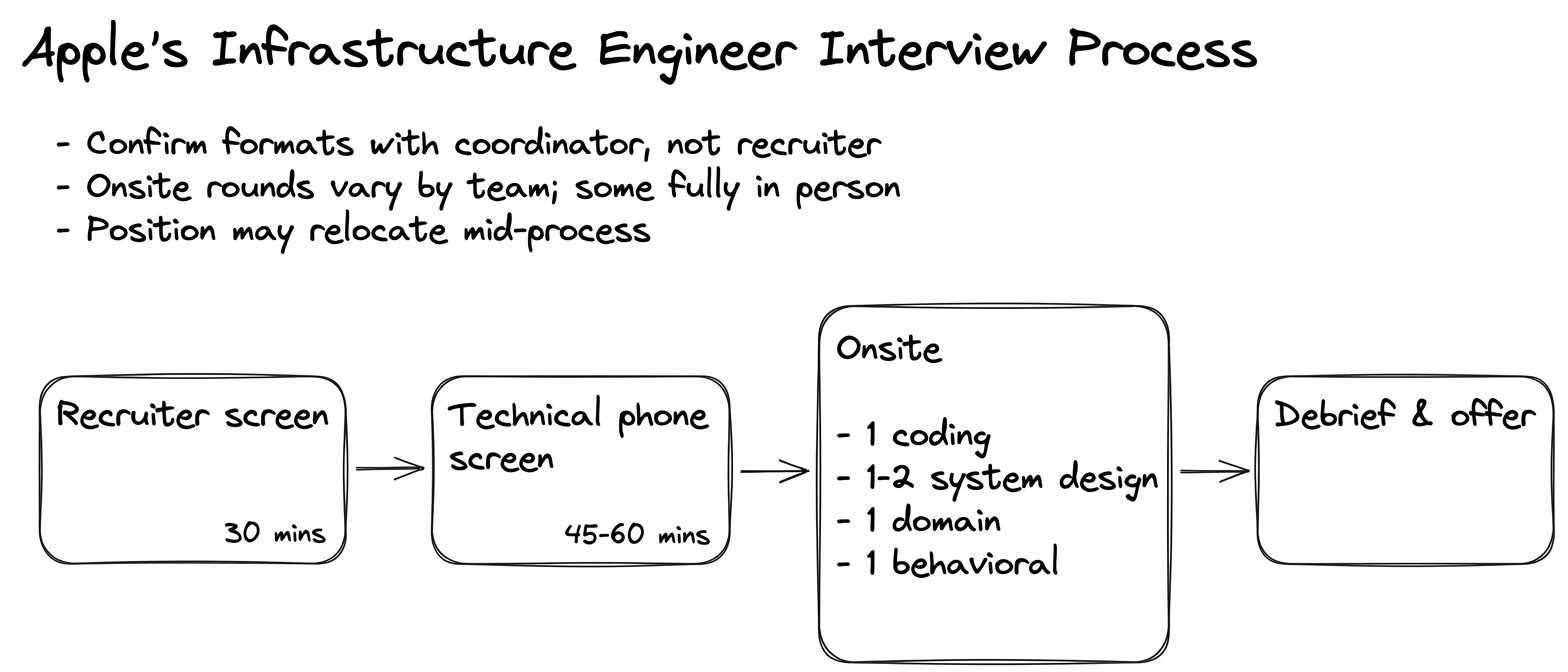
Apple has no common question bank and no fixed loop. Each requisition belongs to one team (iCloud site reliability, storage, compute platform, cloud networking or machine-learning platform), and its engineers choose their own questions. Reported processes ran from one phone screen to seven rounds, usually one or two screens and four or five onsite or virtual interviews over four to eight weeks.
Early-career candidates mostly see coding plus one design or fundamentals round. Mid-level and senior candidates get two design rounds, a reliability-focused behavioral round, and sometimes a senior manager or director at the end.
Here's what the interview process can look like:
- Recruiter screen: About 30 minutes on background, team and location, with no technical content.
- Technical phone screens (one or two): 45 to 60 minutes of practical coding with concurrency follow-ups, or a design or operating-systems drill.
- Coding interviews (one to three): Hour-long rounds, then performance, memory and thread-safety follow-ups; some are debugging or C exercises.
- Systems fundamentals interview (team-dependent): Operating-system concurrency, data-structure internals, or Kubernetes and networking depth.
- System design interviews (one or two): Distributed infrastructure graded on correctness under failure.
- AI-assisted coding interview (since April 2026): Coding with a built-in AI assistant, judged on how you steer it.
- Behavioral and manager interviews: Incidents, toil and cross-team influence with a reliability lead or hiring manager.
Tip: Confirm each slot's format with the coordinator, not only the recruiter. Candidates told to expect a pair-programming tool got a plain whiteboard, and one saw a behavioral slot turn into questions about office politics.
Recruiter screen
The first call runs about 30 minutes, usually with a recruiter dedicated to one organization; occasionally the hiring manager makes first contact. It covers background, why Apple, which team owns the requisition, and a few teamwork and conflict questions. Settle location here: a compute-platform candidate passed this call and the technical screen with positive feedback, then learned the position was moving to another office and withdrew.
Interviewers evaluate:
- Team fit on paper: Whether your operations, storage or platform background matches this one team's opening.
- Logistics: Site, on-site expectations, work authorization and timeline.
- Motivation: A specific reason for this team's work, not Apple products in general.
- Communication: A concise walk through your most relevant system.
Prepare a two-minute summary of your most relevant system and a direct question about the team's site.
Sample questions for the recruiter screen
Here are some questions reported by recent candidates:
- Tell me about yourself and the project you are most proud of.
- Why Apple, and why this team?
- Describe a conflict on a team and how you resolved it.
Technical phone screens
Expect one or two live sessions of 45 to 60 minutes with an engineer from the hiring team, opening with a few minutes on a recent project. Infrastructure screens favor practical data handling over puzzles. One supplied a server log plus a separate IP-to-machine mapping file and asked for failed-login IPs mapped to machines and sorted by failure count, then asked about malformed lines and files too large for memory. Others asked for 4xx and 5xx rates from raw access logs, or the top N entries in a huge log file with a hash map and a size-N heap.
Classic structures get a systems twist: a binary-search-tree iterator in O(h) space, then whether concurrent iterators need locking; a hit counter for the last 300 seconds, graded on evicting expired data; hotel booking with two threads reserving the same room. Some screens skip coding: one was 45 minutes of operating-systems questions, another a full rate limiter design. Advancing candidates heard back within two hours to two days.
Interviewers evaluate:
- Clarifying the input: Asking what counts as an entry and how large the file is before coding.
- Memory awareness: Streaming line by line and bounding state rather than loading everything.
- Concurrency reasoning: Why independent iterator state is safe on an immutable tree, and what changes if it mutates.
- Self-testing: Writing and running your own edge cases when asked.
Practice log-parsing and streaming-count problems until each takes under 25 minutes, leaving room for the scaling discussion.
Note: Interviewer style is not a signal. Some said nothing all hour; one kept interrupting and deleted part of the skeleton code, and the candidate lost the final minutes getting it to compile again. Keep narrating and keep a compiling version.
Sample questions for the technical phone screens
Here are some questions reported by recent candidates:
-
Parse a server log, resolve failed-login IPs to machines through a mapping file, and report machines sorted by failure count.
-
Validate access-log lines, then report 4xx and 5xx counts, total requests and failure percentage.
-
Implement an in-order binary-search-tree iterator in O(h) space, then discuss concurrent iterators.
Coding interviews
Loops carry one to three coding rounds of about an hour, sometimes with two problems each. In one storage team's in-person loop the problem was counting a value in a binary tree; the traversal took minutes and the hour went to caching, early termination, a choice of locking schemes, and finally speed-ups without threads through memory layout and SIMD. Other rounds asked for a C seat-reservation system (create, print, free, reserve with reassignment to the nearest open seat) or for fixing a Java key-value store's scan iterator: range boundaries, duplicates, behavior after exhaustion. Delivery-themed problems also appeared: minimum courier speed by binary search, and the first restaurant seen exactly once in a stream.
Follow-ups move toward production: unbounded memory in a stream structure, a coarse lock becoming a hotspot, lazy deletion as a cheaper alternative to a lock-free design. Expect to state complexity and design your own test cases.
Interviewers evaluate:
- Mechanism-level performance: The cost of a lock, a cache miss or an allocation, and a single-threaded speed-up.
- Memory ownership: In C rounds, every allocation freed and the layout justified.
- Reading code critically: In debugging rounds, testing boundaries and exhaustion before rewriting.
- Simplifying: Dropping a stack when two counters suffice; one interviewer prompted exactly that.
Finish every practice problem by answering aloud what breaks under concurrency, what the memory access pattern costs, and how to go faster without threads.
Sample questions for the coding interviews
Here are some questions reported by recent candidates:
-
Count occurrences of a value in a binary tree, then make it thread-safe and faster without multi-threading.
-
In C, model an airplane's seats and implement reserve with optional reassignment to the nearest free seat.
-
Return the first restaurant ID seen exactly once in an order stream, then handle unbounded memory and concurrent writers.
Systems fundamentals interview
Most infrastructure loops include one round that tests mechanisms directly, shaped by the team. An operating-systems screen ran 45 minutes with no coding, from processes and threads through scheduler states to mutexes, semaphores and condition variables, a race on a shared counter, the four deadlock conditions, and why a plain flag fails across cores without barriers. Other loops asked how a hash map resizes and how to hide the latency spike of a large rehash. A machine-learning platform team covered Kubernetes internals, service meshes, ingress and cross-cluster pod traffic, with a coding task that filtered services by label and built a dependency chain with status queries.
Interviewers evaluate:
- Concrete interleavings: The exact instruction order that produces a race or deadlock, not definitions.
- Hardware awareness: Memory ordering and cache coherence on multi-core machines.
- Latency engineering: Incremental rehashing or similar ways to stay responsive under load.
- Depth below the tooling: How cross-cluster traffic flows, not only the commands that configure it.
Rebuild a mental model of each synchronization primitive and practice narrating a race step by step.
Sample questions for the systems fundamentals interview
Here are some questions reported by recent candidates:
-
Explain how a hash map resizes and how to keep a large rehash from stalling requests.
-
Two threads increment a shared counter without synchronization; show the interleaving that loses an update.
-
Filter Kubernetes services by label and build a dependency chain with status queries.
System design interview
Mid-level and senior loops have one or two design rounds of 45 to 60 minutes, occasionally one at the screen stage. Prompts are infrastructure itself: a distributed rate limiter probed on Redis atomicity through Lua, sliding windows versus token buckets, and clock drift; a task scheduler with durable ordered queues, leader election, heartbeats and dead-letter queues; a logging pipeline; iCloud photo storage with metadata split from blobs and hot and cold tiers; file sync with chunking and conflict resolution; and CI/CD for a machine-learning service with a model registry and rollback. One candidate had to serve inventory from a machine with only spinning disks and very little RAM.
Event aggregation is the other recurring family: ad clicks from browsers, apps and TVs, or the top 10 restaurants over a sliding hour. Strong answers bucketed counts by minute, salted hot keys, offered a count-min sketch with its overcount bias, and made consumers idempotent over a replayable queue.
Interviewers evaluate:
- Guarantees under failure: How atomicity, ordering and durability survive crashes, retries and duplicates.
- Accuracy mechanisms: Idempotency keys, deduplication and late-event handling, not a promise of accuracy.
- Depth in one stack: Knowing how one coordination store executes your logic beats naming many products.
- Requirement framing: Window type, latency and accepted error settled before drawing.
- Resource realism: Designing for the hardware stated, including small, slow machines.
Practice four or five infrastructure designs end to end with the failure walk-through for each.
Note: Design is where infrastructure loops are most often lost. A candidate with a clean heap solution in the first screen was rejected after an ad-click design that promised accurate counts but had no concrete idempotency or late-event mechanism when pressed.
Sample questions for the system design interview
Here are some questions reported by recent candidates:
-
Design a distributed rate limiter and show how check-and-decrement stays atomic across nodes.
-
Design a distributed task scheduler that recovers from a failed leader without losing or reordering tasks.
-
Design an inventory lookup and update service on a host with only spinning disks and little memory.
AI-assisted coding interview
Since April 27, 2026, every software candidate, including those already mid-loop, must complete a coding round in a shared pad with an AI assistant in a side panel; language choice is the interviewer's. Reports are still few. In one virtual onsite the session dropped about 20 minutes in and the candidate finished by explaining the plan aloud, then received an offer.
Interviewers evaluate:
- Upfront constraints: Design, edge cases and test expectations given to the assistant before it writes code.
- Verification: Reading, running and correcting generated code.
- Ownership: Explaining every line you keep.
- Recovery: Continuing out loud when the tooling fails.
Rehearse building a small cache with an AI assistant from an explicit spec and test list.
Tip: Treat the assistant like a capable junior engineer: give it the pattern, edge cases and required tests before asking for code, then review its output aloud.
Sample questions for the AI-assisted coding interview
Here are some questions reported by recent candidates:
-
Build a production-quality component with the assistant, specifying design pattern, edge cases and full test coverage up front.
-
After a disconnect, finish the problem by explaining the remaining approach verbally.
Behavioral and hiring manager interview
Expect one dedicated behavioral round of about an hour, plus project questions opening most others. On production teams the interviewer is often a senior SRE tech lead; one storage candidate described an operating-philosophy discussion on cutting on-call toil, running large incidents and driving reliability across teams. Hiring managers probe the numbers behind your resume (one pressed every percentage, then added an easy sliding-window problem). One platform loop's behavioral slot became an hour on office politics, and some loops end with a senior manager and a director.
Interviewers evaluate:
- Operational ownership: An incident you ran end to end and the follow-up you shipped.
- Toil reduction with numbers: Pages, manual hours or recovery time before and after.
- Influence without authority: The steps that got another team to change priorities.
- Team fit: One reliability panel weighted it heavily; technical over-qualification alone did not carry the loop.
Prepare six to eight stories, half of them operational, each with a measured result.
Sample questions for the behavioral and hiring manager interview
Here are some questions reported by recent candidates:
-
How have you reduced on-call toil, and how did you measure the result?
-
Describe a time you persuaded another team to change its priorities.
-
What would your current team miss most about you?
How Apple levels and evaluates Infrastructure Engineer candidates
The hiring team decides: interviewers come from the team and its neighbors, the hiring manager weighs their feedback, and some processes add a senior manager or director round. Strong rounds do not offset a weak one; candidates who felt good about coding were rejected for one design round or for team fit. Level is set from experience and scope before the loop, and external candidates are often leveled conservatively, so ask which level the requisition targets.
Decisions are quick when the team agrees: one candidate heard back in three days; another accepted a verbal offer three days after the last onsite session, then waited about ten days for the written offer. A rejection applies to that requisition only, so other teams can still interview you.
How to prepare for the Apple Infrastructure Engineer interview
- Practice the follow-ups as much as the problem: Prepare the thread-safe, memory-bounded and single-threaded-faster version of each exercise.
- Master log and stream processing: Parse, validate, count and rank large files in one streaming pass.
- Know one coordination stack in depth: How Redis runs a Lua script atomically, how leader election works, how a queue survives a crash.
- Rehearse five designs with failure walk-throughs: Rate limiter, task scheduler, logging pipeline, object storage, and an event aggregator with idempotent consumers.
- Refresh operating-system fundamentals: Synchronization primitives, deadlock, memory ordering and hash-map rehashing.
- Write low-level code once more: Allocate, initialize and free a grid structure in C cleanly.
- Prepare operational stories with numbers: Incidents, toil removed, monitoring added, reliability work led across teams.
- Practice steering an AI assistant: Spec, edge cases and tests first, then review aloud.
About the Apple Infrastructure Engineer role
Infrastructure engineers build and run the platforms under iCloud, Siri, Maps and Apple's machine-learning work: storage, caching, queueing and search systems, deployment automation, observability, capacity planning and disaster-recovery exercises. Most site reliability roles include on-call. Teams are small and self-contained, which is why loops differ so much. Corporate staff have worked in the office at least three days a week since 2022, so roles are tied to a site, usually Cupertino or Seattle.
| Level | Primary focus | Impact scope |
|---|---|---|
| ICT2 | Well-defined tasks with mentoring; the usual new-graduate level | Components of one team's systems |
| ICT3 | Independent ownership of significant features and services | A team's services |
| ICT4 | Leading projects and roadmap decisions, mentoring | Several systems in an organization |
| ICT5 | Architecture and technical direction across teams | Multiple teams or an organization |
Apple hires Infrastructure Engineers across several organizations. Teams include:
- Apple Services Engineering site reliability (iCloud): Reliability, automation, capacity and on-call for consumer services.
- Cloud service infrastructure: Storage, caching, queueing and search platforms that iCloud and other backends build on.
- Storage infrastructure: Distributed storage and its tooling, with heavy reliability emphasis.
- Compute platform: The compute layer for internal services.
- Cloud networking: Software-defined network infrastructure behind iCloud, Siri and Maps.
- Machine-learning platform: Kubernetes-based infrastructure and CI/CD for ML services.
Infrastructure Engineer experience and education requirements
Senior site reliability postings ask for five or more years in infrastructure operations, SRE or DevOps, a bachelor's in computer science or equivalent, strong Linux, networking and systems knowledge, fluency in Java, Python or Go, and experience running distributed systems in public, private or hybrid clouds. Early-career roles weigh data structures, operating-system fundamentals and one systems language. Interviews have used Java, Python and C.
FAQs about the Apple Infrastructure Engineer interview
How long does the Apple Infrastructure Engineer interview process take?
Typically four to eight weeks. Screens lead to onsite invitations within hours to two days, onsites are sometimes split across two days, and written offers can trail the verbal one by more than a week.
What is the hardest round of the Apple Infrastructure Engineer interview?
System design: it goes deepest into atomicity, ordering and accuracy and is most often blamed for rejections. The coding round is the most underestimated, because the problem is easy and the systems follow-ups decide it.
Is there an online assessment?
No timed, auto-graded assessment was reported for this track. Every technical stage was live with an engineer, and since April 2026 one coding round allows an AI assistant.
Is the interview remote?
Both occur. Several loops ran as virtual onsites, while a storage loop was four in-person interviews back to back.
How much does an Apple Infrastructure Engineer make?
Approximate total annual compensation in the United States:
- ICT2: ~$170K
- ICT3: ~$220K
- ICT4: ~$340K
- ICT5: ~$450K
Packages combine base salary, restricted stock units vesting over four years and an annual cash bonus, with stock a larger share at higher levels.