Anthropic · Study
Anthropic Software Engineer Interview Process
TrueInterview
July 24, 2026 · 15 min read
Anthropic's technical rounds draw on a small, recurring set of problems, so most prepared candidates clear them. The loop is usually decided elsewhere: in a culture round that wants first-hand evidence of the values you claim, and in whether your background fits the team with headcount. Candidates who solved every problem were still rejected, one after the recruiter added a second culture interview because the first gave too little signal. Coding is graded on more than correctness: a missed line of the spec or a slow start has cost candidates the round.
This guide breaks down each stage of the Anthropic Software Engineer interview, what interviewers evaluate in each round, and how to prepare, with questions candidates were actually asked.
Verified: Based on 123 candidate-reported interview experiences, primarily from 2025 Q1 through 2026 Q3, cross-checked against recent public accounts.
Anthropic Software Engineer interview process
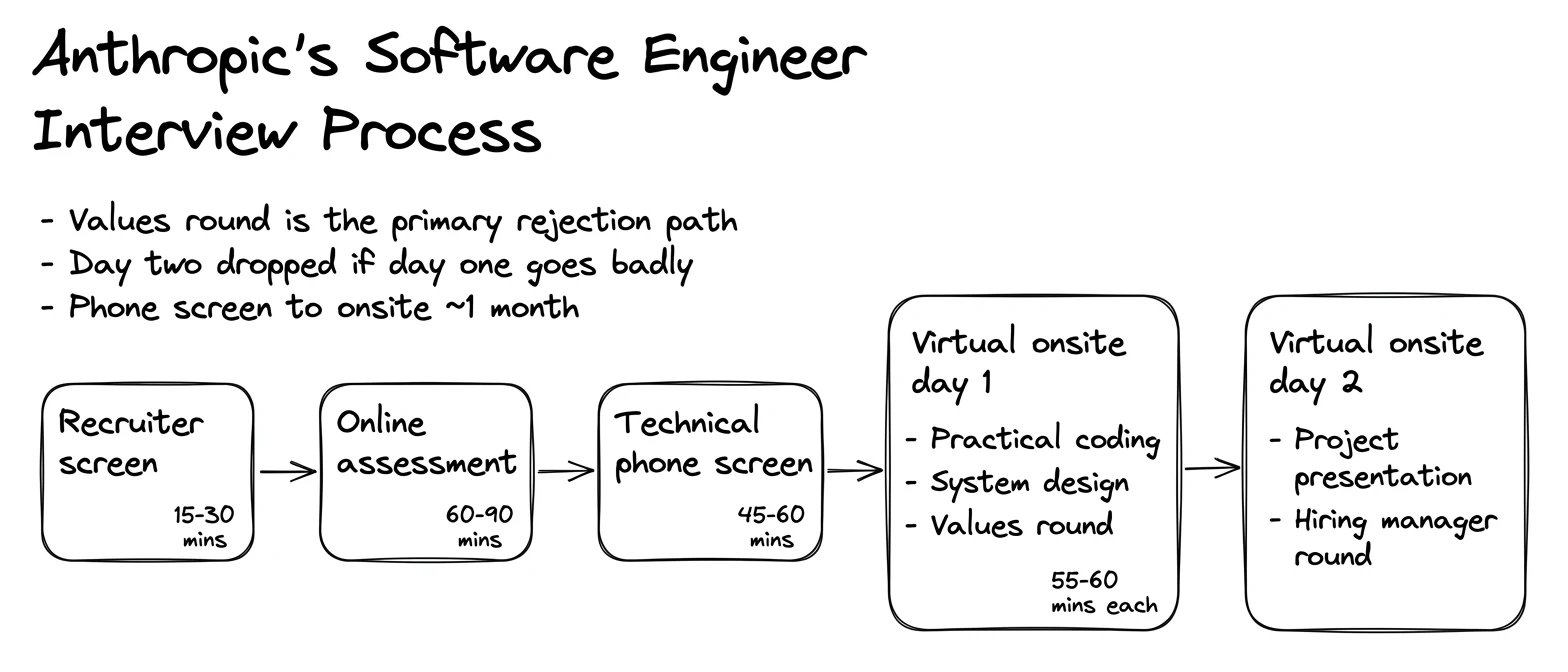
Anthropic runs one loop for Software Engineers, with problems tilted toward the hiring team: inference and model-distribution designs for infrastructure-facing teams, product-flavored designs for full-stack teams. The usual path is a recruiter screen, a 90-minute online assessment, a technical phone screen and a virtual onsite of four to six rounds, often split across two days. The process usually takes one to two months, with gaps of two to three weeks between stages.
Referred and senior candidates often skip the assessment, and some staff-level candidates start with a hiring-manager chat or a system design screen. Senior and staff loops weigh the project deep dive and leadership stories more heavily.
Here's what the interview process can look like:
- Recruiter screen: A 15- to 30-minute call on motivation, AI safety, interview language and timelines.
- Online assessment (most non-referred candidates): A 90-minute, four-level build of one stateful system with the standard library only.
- Technical phone screen: About 45 to 60 minutes of practical coding from a small recurring pool.
- Coding interviews (one or two): Hour-long practical problems where you write your own tests; some loops add an AI-assisted pull-request round.
- System design interview (one or two): A design or design-document review drawn from Anthropic's own systems.
- Project deep dive: About 20 minutes presenting a past project, then detailed questions.
- Culture interview: Safety, ethics, conflict and integrity; often the deciding round.
- Hiring manager interview: Ownership, mentoring, trade-offs and team fit.
Tip: Ask the recruiter for each round's topic. Several recruiters emailed the exact topics in advance, but others gave descriptions that did not match the candidate portal, so prepare an adjacent problem for every round.
Recruiter screen
The call runs 15 to 30 minutes and is a real filter: one candidate was cut after a 15-minute call on motivation, the hardest project, visa status and other interviews. Some recruiters go much deeper. One spent 20 of 30 minutes asking which recent Anthropic interviews or articles the candidate had read, what they disagreed with, and how they had applied safety principles at work. Recruiters also confirm your coding language, note that reference checks are standard, and have described a typical week of about 60 hours.
Interviewers evaluate:
- Specific motivation: Why Anthropic rather than AI in general, tied to something the company actually said or did.
- Considered safety views: A position of your own, including what you would question.
- Concision: Short, direct answers on background and timelines.
- Logistics: Authorization, competing offers and interview language.
Read Anthropic's recent public statements and prepare one point you agree with and one you would challenge.
Sample questions for the recruiter screen
Here are some questions reported by recent candidates:
-
Why Anthropic, and what recent company statement did you agree or disagree with?
-
Why does AI safety matter to you personally, and where have you applied it at work?
-
Why change jobs now, and how far along are your other processes?
Online assessment
The assessment is a timed 90-minute build in a hosted environment: one system across four levels, each adding requirements, using only the standard library. Recurring systems: an in-memory database (CRUD, filtering, TTL, a get_when lookup of the value at or before a timestamp, backup and restore), a bank (transfers held until accepted or timed out, spending rankings, cashback, scheduled payments, account merges), a recipe manager (case-insensitive unique names, owner-only edits, versioned rollback), a task manager with TTL and snapshots, cloud storage, and worker hours with future-dated promotions.
Scores are numeric; candidates report 600/600, 925/1000, 800/1000 and 98/100. One candidate scoring 800 heard from a recruiter two hours later, while others waited weeks. Most tests are visible, and one candidate found return types that differed from the practice problem set.
Interviewers evaluate:
- Foundation design: A level-one data model that level four can extend without a rewrite.
- Exact semantics: Tie-breaks, case-insensitive comparison, and what survives a merge or restore.
- Lifecycle edge cases: A merged account recreated under the same ID starts at zero; a backup pauses TTL timers until restore.
- Pacing: Every level partly working before any one is polished.
Practice finishing a four-level simulator in 90 minutes, reading every level before writing code.
Note: A perfect score does not guarantee a phone screen. Resume review and team headcount run in parallel, and candidates with perfect scores reported silence or a closed position afterward.
Sample questions for the online assessment
Here are some questions reported by recent candidates:
-
Build a bank where transfers stay on hold until accepted or cancelled on timeout, then merge accounts so a recreated ID starts at zero.
-
Return each key's value at or before a query time, breaking same-timestamp ties by insertion order.
-
Add backup and restore to an in-memory database where a backup freezes TTL timers and a restore resumes them.
Technical phone screen
The screen is about 45 to 60 minutes in a shared editor, from a small pool: a web crawler built as single-threaded breadth-first search and then made concurrent; file deduplication by size, then content hash; stack-trace samples converted into start and end events; a longest-match tokenizer; a memoization cache with a buggy key built from *args and **kwargs, then made durable with a write-ahead log; a Pillow image pipeline driven by JSON transforms; distributed mode and median across ten nodes; and a looping boot program fixed by flipping one instruction.
Follow-ups carry much of the grade: I/O-bound versus CPU-bound, processes versus threads, scaling across machines, hash choice. Web search is usually allowed; AI assistants and AI search summaries are not. Two interviewers said they did not write the candidate's chosen Java or TypeScript. Onsite invitations arrived between one hour and nine days later.
Interviewers evaluate:
- Following the stated order: Building the single-threaded version first when asked.
- The right concurrency model: A thread pool for I/O-bound fetching, processes for CPU-bound transforms, with reasons.
- Exact spec reading: Strip URL fragments before deduplication and do nothing else; never emit consecutive unknown-token markers.
- Debugging without hints: Candidates who needed several hints to find their own bug were rejected.
Rehearse each pool problem until the base version takes under 20 minutes, leaving half the hour for follow-ups.
Note: The crawler's concurrency step is where this screen is lost. One candidate who opened with locks around a shared set instead of a thread pool never recovered; another finished a correct single-threaded Java version with no time left for concurrency.
Sample questions for the technical phone screen
Here are some questions reported by recent candidates:
-
Crawl every URL on the start URL's hostname, dropping fragments before deduplication, then make it concurrent with a thread-safe visited set.
-
Fix the key bug in a memoization cache, then make it survive a restart by replaying an append-only log.
-
Speed up a JSON-driven image pipeline that takes 90 seconds on large files, and explain threads versus processes.
Coding interviews
Onsite coding rounds run 55 to 60 minutes, usually one per loop, from the same pool plus originals. Some start from an empty main method with no autocomplete; some require creating your own input files. Problems include file deduplication extended to huge files and real-time detection; profiler samples where a stack must persist N samples before it counts, or arrives as a stream; a grid infection simulation with a neighbor threshold; and assigning jobs to the fewest workers, breaking ties by lowest worker ID.
Writing your own tests is graded, and candidates called it the real bottleneck. Small misses decide rounds: one candidate who missed that a deduplication run must print nothing when there are no duplicates was rejected the next day; another lost on an encoding fault in an async parser. Some interviewers stay silent all hour.
Interviewers evaluate:
- Speed from the first minute: A slow start was blamed for one rejection even though every test passed.
- Self-testing: Empty inputs, cycles and other hostnames tested unprompted.
- Full use of the spec: Output rules and tie-breaks in the statement are graded.
- Follow-up depth: Common-prefix diffs between stacks, end-event order, recursion, streaming state.
Practice each pool problem with its follow-ups in a bare editor, writing tests as you go.
Note: Since mid-2026 some loops include a 55-minute AI-assisted round: a browser editor, a repository with four pull requests, and Claude Code. You critique each pull request, then improve one. It ran in TypeScript and a language switch was refused. Preparation notes cover LLM APIs, agent loops, tool use and failure modes such as hallucination, not deep machine learning.
Sample questions for the coding interviews
Here are some questions reported by recent candidates:
-
Convert call-stack samples into start and end events, then require a stack to persist N samples and handle an unbounded stream.
-
Find duplicate files by size and then content, and say where the work becomes I/O-bound.
-
Assign jobs given as start time and duration to the fewest workers, choosing the lowest-numbered free worker.
System design interview
Loops include one or two hour-long design rounds; preparation notes say no AI specialism is required. Recurring prompts: an internal prompt playground (versioning, viral sharing, revoking access, prompts over 10 MB, many open tabs); an inference API batching requests onto limited GPUs, including why CPUs idle while GPUs saturate; distributing a model of hundreds of gigabytes to hundreds or thousands of workers over 10 Gbps links; and a 1-to-1 chat system down to Kafka internals.
Two variants replace the blank page: critiquing a flawed inference-API design document, where the interviewer mostly wants the batching strategy and slow readers run out of time, and reviewing a pre-designed API for naming, errors, idempotency and concurrency. One candidate with a data background was moved to telemetry ingestion that reconciles metric names from old clients.
Interviewers evaluate:
- Users and flows first: Who uses the system before which components.
- Numbers: Bandwidth, chunk sizes, GPU counts and queue depth estimated, not assumed.
- Failure and observability: Recovering a distribution without a coordinator; routing only to instances with the right model loaded.
- Depth on demand: Going deep where pushed, such as large-prompt storage.
Practice the recurring prompts end to end, each with arithmetic and a failure-recovery story.
Sample questions for the system design interview
Here are some questions reported by recent candidates:
-
Design a prompt playground with shareable runs and version history, then handle a 10 MB prompt.
-
Deploy a 500 GB model to up to a thousand GPU workers, comparing pipeline and tree distribution and surviving worker failures.
-
Review an inference-API design document and fix its batching for requests of very different lengths.
Project deep dive
You present a project you led in about 20 minutes of slides, then take questions for the rest of the hour; one full-stack loop expected a live demo. Interviewers probe technology choices, failures, unexpected obstacles, roadmap influence and mentoring. A staff-level candidate was asked whether a project costing about 50 engineer-years was worth it.
Interviewers evaluate:
- Personal ownership: What you decided and built, apart from the team.
- Rejected alternatives: Options you did not take, and why.
- Business judgment: Impact weighed against cost, with numbers.
- Relevance: A link to the problems this team works on.
Pick a project you can defend down to the code, with a cost and impact estimate ready.
Sample questions for the project deep dive
Here are some questions reported by recent candidates:
-
What was the hardest challenge in your most complex project, and what would you change?
-
Did the project's benefits justify the engineering-years it consumed?
Culture interview
The culture round is a 45- to 60-minute conversation, sometimes with a senior leader and sometimes with a non-engineer, and it is the round candidates most often blame for rejection. It usually probes AI safety: why it matters to you, whether you would delay a risky breakthrough when competitors would not, whether you would accept lower equity value for a safety gain. Other versions skip safety for a conflict where you were wrong, a belief your peers reject, challenging authority (personal examples accepted), or whether you have done something morally wrong.
Interviewers evaluate:
- Lived evidence: A named value and an episode where acting on it cost you something.
- Coherence under follow-ups: No model answer exists, but your position must hold.
- Critical engagement: Real tensions in Anthropic's approach, not product feedback.
- Honesty about fault: Conflicts in which you were the one who was wrong.
Write four or five true stories on cost, conflict, error and ethics, and defend each through three follow-ups.
Note: Weak culture signal extends the loop. One candidate who passed every technical round received an extra culture interview because the first was inconclusive, then was rejected after the hiring-manager round.
Sample questions for the culture interview
Here are some questions reported by recent candidates:
-
If a breakthrough had unknown risks, would you delay it, and what if others did not?
-
Have you ever done something morally wrong, and what did you do about it?
-
Name a belief most of your peers disagree with and defend it.
-
Reason About Delaying an AI Breakthrough Under Uncertain Risk
Hiring manager interview
The hiring manager appears early or late: a 20-minute matching chat or résumé walk-through before the technical rounds, or a closing deep dive into your highest-impact project. Questions cover deadlines, mentoring, technical debt versus features, persuading peers and, for infrastructure teams, QPS and metrics.
Interviewers evaluate:
- Ownership and delivery: Shipping under deadlines while managing debt.
- Influence: Changing a decision through evidence, not authority.
- Domain fit: Whether your experience solves this team's problems.
- Engagement: A short, flat session is a signal; candidates who led with prepared stories fared better.
Frame two project stories around the team's domain, and ask which team the loop is for.
Sample questions for the hiring manager interview
Here are some questions reported by recent candidates:
-
How do you choose between paying down technical debt and shipping a new requirement?
-
Tell me about a time you persuaded others to adopt your technical approach.
-
Describe failure impact and resolve cross-functional conflict
How Anthropic levels and evaluates Software Engineer candidates
Interviewers submit written feedback and a hiring committee decides; candidates were told their level is set after that decision, and one rejection cited signals that were not senior enough. On two-day onsites, recruiters say a weak first day can cancel the second, though slow feedback makes it rare. References from a former manager and a current colleague come before the offer, and one candidate was rejected after references were contacted.
Team fit decides many outcomes: rejections for background mismatches (billing, inference capacity), a manager change after the original headcount filled mid-loop, and pending rounds cancelled once hiring needs were met. A newer process finishes the loop before team matching, but the hiring-manager round can still end it. Rejections usually arrive one to three days after the last round without feedback; one appeal did not change the decision.
Tip: Ask which team and manager the loop is for before the onsite and aim your project deep dive at that team's problems; a domain mismatch is the most common rejection after strong technical rounds.
How to prepare for the Anthropic Software Engineer interview
- Master the recurring pool: Crawler, file deduplication, stack-trace events, tokenizer, durable cache, image pipeline and distributed mode and median, with their follow-ups.
- Build four-level simulators against the clock: Bank, database, recipe and task managers in 90 minutes each.
- Know Python concurrency precisely: Threads, processes, asyncio, the GIL, and I/O-bound versus CPU-bound work.
- Write your own tests every time: Self-testing is graded, and missed spec details have ended loops.
- Practice Anthropic-shaped designs with numbers: Prompt playground, batched inference, model distribution and a design-document critique.
- Prepare true values stories: Cost, ethics, being wrong and challenging authority, plus a view on the company's safety positions.
- Rehearse AI-assisted review: Critique and improve a pull request with Claude Code in TypeScript within an hour.
- Confirm logistics early: Interview language, whether the interviewer uses it, and the team's headcount.
About the Anthropic Software Engineer role
Software Engineers build Claude's products and the systems behind them: the API and developer platform, the Claude apps and Claude Code, inference serving across cloud providers, and internal tools for researchers. They work closely with research teams. A candidate was told in late 2025 that remote employees spend about a quarter of their time in an office, roughly one week a month.
Anthropic hires Software Engineers across product and infrastructure. Teams include:
- Claude apps: Backend and full-stack systems behind the Claude web and mobile apps.
- Claude Code and developer platform: The coding agent, the API and developer tools.
- Cloud Inference: Serving Claude on AWS, Google Cloud and Azure, from routing to capacity.
- Infrastructure: Clusters, deployment and moving large models onto accelerators.
- Safeguards and privacy infrastructure: Misuse detection and data protection across training, inference and products.
- Growth and billing: Growth experiments and the billing platform.
Software Engineer experience and education requirements
Senior and staff postings typically ask for six or more years of experience and a related bachelor's degree or equivalent experience. Python is the expected assessment language and the most common interview language. Distributed systems, concurrency or large-scale serving experience is a strong plus; machine learning expertise is not required.
FAQs about the Anthropic Software Engineer interview
How long does the Anthropic Software Engineer interview process take?
Usually one to two months: about two to three weeks to the assessment, three to seven days to a recruiter call, and two to four weeks to the technical rounds. Some move much faster, with an onsite invitation within an hour of the phone screen.
What is the hardest round of the Anthropic Software Engineer interview?
The culture interview, because it needs real experiences and positions that survive follow-ups. Among technical rounds, system design is hardest when the interviewer presses on numbers or one subsystem.
Can you use AI tools during the interview?
Only where a round says so. Most screens and coding rounds ban AI assistants and AI search summaries but allow web search; one interviewer required permission before adapting a public snippet. The AI-assisted pull-request round supplies Claude Code.
How much does an Anthropic Software Engineer make?
Approximate total annual compensation in the United States:
- Senior Software Engineer: ~$350K–$550K
- Lead or Staff Software Engineer: ~$760K–$840K
Packages combine a base salary, with most posted senior and staff base ranges between roughly $320K and $485K, and a large equity grant whose liquidity is limited while the company is private.
What happens after a rejection?
Feedback is rarely given and rejections come quickly. Candidates whose background did not match the team have asked the recruiter to be considered for a different team.