Anthropic · Study
Anthropic Interview Process & Questions
TrueInterview
July 24, 2026 · 12 min read
Anthropic's technical questions come from a small, recycled pool of practical problems: a web crawler, file deduplication, a tokenizer, stack-trace reconstruction, an LRU cache and an image pipeline. Each grows in stages, so the grade rests on speed, self-testing and clean handling of a changed constraint, not on novelty. The values round is a hard gate. Candidates who rated every technical round strong were still rejected, and one loop gained an extra culture interview after a weak first signal. Level is set in the hiring review after the loop, and references are checked before any offer. In 2026 some rounds began providing Claude Code, while most live coding still bans AI tools.
This guide breaks down each stage of the Anthropic interview, what interviewers evaluate in each round, and how to prepare, with questions candidates were actually asked.
Verified: Based on 148 candidate-reported interview experiences, cross-checked against recent public accounts.
Anthropic interview process
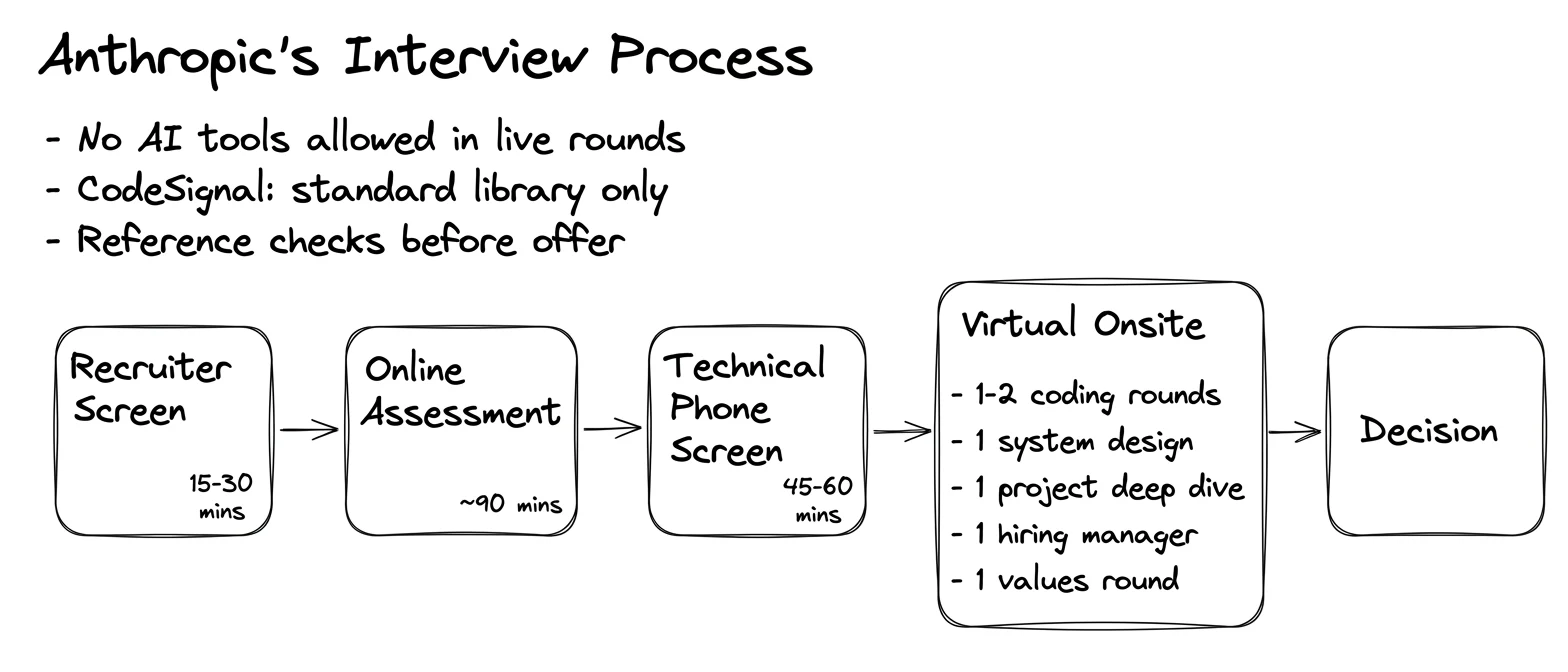
The skeleton is shared across engineering roles, and each track swaps in its own technical rounds: inference and distributed-systems work for infrastructure, agent and prompting exercises for AI engineering, timed take-homes for research. A typical path is an online assessment, a recruiter screen, one or two technical screens, and a virtual onsite of four to six rounds, often split across two days. Referred, senior and staff candidates often skip the assessment and start with a hiring-manager chat or a design screen.
Gaps of two to three weeks between stages are common, so the whole process usually takes one to two months. Post-onsite decisions are fast, often within one to three days. Recent loops ran the full technical loop before team matching, so a late hiring manager round can still end the process.
Here's what the interview process can look like:
- Recruiter screen: A 15–30 minute call on motivation, safety views and logistics that rejects candidates outright.
- Online assessment (most cold applicants): A 90-minute, four-level build of one stateful system, scored out of 600 or 1,000.
- Technical phone screen (one or two): A 45–60 minute pool problem with follow-ups on concurrency, scale and I/O versus CPU limits.
- Coding interviews: One or two onsite hours extending a practical problem through several parts.
- System design interview: About an hour, often on inference serving or model distribution, sometimes as a critique of an existing design document.
- Project deep dive and hiring manager interview: A 20-minute presentation of one past project with granular Q&A, plus a team-fit conversation.
- Culture and values interview: A mission and ethics conversation, often with a senior or non-engineering interviewer.
Tip: Recruiters often email the exact topic of every upcoming round. Ask for that list and study from it; several candidates then saw the named problem.
Recruiter screen
The call can be as short as 15 minutes, and it is a real filter: one candidate was cut after a call covering motivation, the hardest past project, visa status and other pipelines. Some recruiters skip small talk and spend 20 minutes probing why Anthropic, which recent announcements you agree or disagree with, and where you have applied safety thinking at work. The recruiter also asks your interview language and mentions references and periodic office time.
Interviewers evaluate:
- Specific motivation: Why this company rather than AI in general, tied to something it has published or done.
- A defended safety stance: A view that survives follow-up, not a summary of the website.
- Track fit: Recruiters reroute candidates to a product, data-infrastructure or agentic-coding track when the background fits better.
Prepare one announcement you agree with and one you would push back on.
Sample questions for the recruiter screen
Here are some questions reported by recent candidates:
-
Why Anthropic, and why change jobs now?
-
Have you applied AI safety principles in your past work? Give a concrete example.
Online assessment
The standard assessment is a 90-minute progressive build in Python using only the standard library, with each level depending on the last. Recurring families: an in-memory database (TTL, backup and restore that pauses TTL timers, a lookup of the value at or before a timestamp), a bank (transfers held until accepted, timeouts, merges after which a recreated ID starts at zero), a task manager with TTL and snapshots, a recipe manager with case-insensitive names and versioned rollback, cloud storage, and employee grants. Level four routinely takes half the clock. Scores of 600/600, 925/1000 and 800/1000 all advanced, but a perfect score does not guarantee a call.
Tracks diverge here. Fellows candidates built a DNS resolver with alias cycles, debugged a Python codebase, then did a five-hour take-home. One 2026 version required implementing inference-server caching inside an undocumented codebase.
Interviewers evaluate:
- Upfront data modeling: Structures that make later levels cheap; a rigid level-one design forces a rewrite.
- Lifecycle edge cases: Reused IDs after merges, expiry exactly at the boundary, ties broken by ID.
- Pacing: Banking early levels fast, since partial credit counts.
Build one four-level system against a 90-minute timer, writing your own boundary tests.
Note: Visible tests mostly cover the happy path. Candidates lost points on merged-then-recreated accounts and same-timestamp ordering that only later tests exposed.
Sample questions for the online assessment
Here are some questions reported by recent candidates:
-
Build a bank whose transfers hold funds until accepted, cancel on timeout, and survive merges that free an account ID for reuse.
-
Make a database backup freeze every TTL timer and a restore resume them where they stopped.
Technical phone screen
The screen is a 45–60 minute live session in a shared editor. Documentation search is allowed, AI tools are not, and the interviewer can see your screen. A crawler starts single-threaded with same-host filtering and fragment stripping, then moves to a thread pool. Deduplication filters by size, then streams hashes. A longest-match tokenizer must merge consecutive unknown tokens. An image pipeline applies JSON-configured transforms and needs a process pool for large files. An LRU memoization cache needs deterministic keys from positional and keyword arguments, then recovery from an append-only log.
Infrastructure screens use distributed mode and median across 10 nodes, where network is the bottleneck. Research screens debug a GRPO implementation or build a checkpointable weighted data batcher. AI and Machine Learning Engineer screens build a tool-using agent loop or iterate on prompts in a notebook.
Interviewers evaluate:
- Concurrency model: Processes for CPU-bound image work, threads or asyncio for I/O, and why the GIL matters. Opening with raw locks instead of a thread pool cost one candidate.
- Constraint shifts: Huge files, millions of files, several machines, or a stream.
- Pace and accuracy: One unresolved bug or a misread rule was cited in several rejections.
Drill each pool problem until the baseline takes half the slot.
Sample questions for the technical phone screen
Here are some questions reported by recent candidates:
-
Crawl every same-host URL, strip fragments before deduplicating, then go concurrent without double-fetching.
-
Find duplicate files, then discuss hash collisions, files larger than memory and distribution across nodes.
Coding interviews
Onsite coding reuses the practical style, usually with a different pool problem. Stack traces recur most: convert sampled call stacks into start and end events by diffing adjacent stacks on their common prefix, then handle recursion, events confirmed only after N samples, and unbounded streams. Other problems include a boot program where exactly one jump or no-op must be flipped to stop a loop, and infection spread on a grid with a neighbor threshold.
Infrastructure loops add a roofline exercise, computing FLOPs, memory and communication for a sharded feed-forward layer by hand. AI Engineer loops build an agent and then cut its tool-call rounds. A newer 55-minute format provides Claude Code in a browser editor; one version asked for a review of four pull requests, then an improvement to one, in TypeScript only.
Interviewers evaluate:
- Fast baseline: One candidate passed every test after a slow start and was still rejected.
- Reading the rules: Tracing the example first; misread index semantics sank one candidate.
- Judgment with AI help: In assisted rounds, what you catch, prioritize and explain.
Practice each multi-part problem with the timer running from the first keystroke.
Sample questions for the coding interviews
Here are some questions reported by recent candidates:
-
Turn stack samples into function start and end events, then emit a frame only after it persists for N samples.
-
Compute the mode and median of data on 10 nodes when the network is ten times slower than local reads.
System design interview
The round centers on systems Anthropic runs: an inference API batching requests onto limited GPUs under a 500 ms to 1 s budget, or distributing a 500 GB model to hundreds or thousands of workers over 10 Gbps links despite failures. Others include a prompt playground, a 1-to-1 chat with Kafka internals, and telemetry ingestion. A distinctive variant hands you a flawed design document, such as an inference service that must batch within 100 ms at 10,000 QPS, to critique. A data infrastructure version needs no ML knowledge.
Interviewers evaluate:
- Capacity math: GPU or server counts from QPS and latency, and why decoding is memory-bound.
- Batching and overload: Dynamic batching, queue limits, load shedding, multi-model scheduling.
- Failure and observability: Spotting a stuck rollout and routing only to replicas on the right model version.
Practice two inference designs with real numbers, plus one document critique.
Tip: In a design-document review, lead with the one consequential flaw, usually batching, and leave time for the deep dive. A candidate who catalogued small issues ran out of time for the part the interviewer cared about.
Sample questions for the system design interview
Here are some questions reported by recent candidates:
-
Deploy a 500 GB model to 1,000 workers as fast as possible, then recover from failures without a central coordinator.
-
Design an internal prompt playground for a user with many tabs open on very long prompts.
Project deep dive and hiring manager interview
The project round is often a 20-minute slide presentation followed by questions on every layer; one candidate was asked for a live demo. Staff candidates face return-on-investment questions, such as whether a project costing about 50 engineer-years paid off. The hiring manager conversation covers roadmap influence, mentoring and team fit, and can be short or cancelled after a weak first day.
Interviewers evaluate:
- Personal ownership: Your decisions, the alternatives you rejected, and what you would change.
- Scope for level: One infrastructure candidate was told the loop signalled not senior enough.
- Domain alignment: Rejections cited inference-capacity and billing teams that did not match the candidate's background.
Rehearse one project as a 20-minute talk and defend it against hostile follow-ups.
Sample questions for the project deep dive and hiring manager interview
Here are some questions reported by recent candidates:
-
Present your most impactful project, then explain an obstacle you did not anticipate.
-
How did you shape a roadmap beyond your scope, and whom did you mentor?
Culture and values interview
This round decides more loops than any other. Safety prompts include whether to delay a breakthrough with unknown risks if competitors might not, critiques of Anthropic's constitution or trust structure, and whether you would accept your equity losing value for safety. Behavioral prompts include a conflict where you were wrong, challenging authority, a morally questionable act, and persuading someone to do work you both dislike. Some interviewers are not engineers.
Interviewers evaluate:
- Coherence under follow-up: No answer is standard, but the reasoning must hold as the scenario shifts.
- Critical engagement: A defended critique of Anthropic's own approach, not agreement.
- Lived values: A named value, an Anthropic action that reflects it, and evidence you act on it.
Prepare five candid stories, including a real mistake; personal-life examples are accepted.
Note: A weak culture signal can add rounds. One candidate who cleared every technical round got an extra culture interview, then was rejected after the hiring manager round.
Sample questions for the culture and values interview
Here are some questions reported by recent candidates:
-
Would you delay a major capability breakthrough with unknown risks if others might not?
-
Where should Anthropic improve its approach to safety?
-
Reason About Delaying an AI Breakthrough Under Uncertain Risk
How Anthropic makes hiring decisions
A hiring review weighs the whole loop, and an uneven loop rarely passes: one candidate rated four of six rounds strong and two average and was rejected. Level is set in that review, not upfront, and offers may not state an internal level. References follow, typically a former manager and a current colleague, and at least one candidate was rejected after references were contacted. Team matching comes after the loop, and headcount can shift mid-process; one candidate's team filled and the loop moved to a new hiring manager. Rejections arrive within days, without feedback.
How to prepare for the Anthropic interview
- Master the recycled pool: Crawler, deduplication, tokenizer, stack traces, image pipeline and LRU cache, each done in half the slot.
- Rehearse four-level builds: One stateful system in 90 minutes, with your own tests for expiry, merges and reused IDs.
- Own your concurrency answer: Processes versus threads versus asyncio, the GIL, and thread-safe visited sets.
- Do inference math: GPU counts from QPS, batching under latency budgets, chunked model distribution.
- Practice critiquing designs: Find the one flaw that matters, then go deep on it.
- Build a real safety position: Read Anthropic's published policies and constitution and prepare a critique you can defend.
- Prepare for both AI policies: Code without AI help, and also review and improve code with Claude Code.
- Confirm your language with the interviewer: Python is safest; Java and TypeScript candidates met interviewers who did not use them.
About working at Anthropic
Anthropic builds the Claude models and products alongside a safety research program. Technical staff share one Member of Technical Staff title. Remote employees are expected to spend about a quarter of their time in an office, often one week a month. Teams include:
- Inference: Serving Claude at scale, with batching, routing and GPU utilization.
- Infrastructure and data: Compute platforms, model distribution, telemetry and data pipelines.
- Performance engineering: Kernel optimization and accelerator performance modeling.
- Product engineering: Claude apps, Claude Code, and the developer platform and API.
- Research: Interpretability, alignment, reinforcement learning and pretraining, plus the Fellows program.
Experience and education requirements
Postings ask for a bachelor's degree in a related field or equivalent experience. Infrastructure and inference roles emphasize distributed systems at scale, with Python or Rust preferred, and recruiters state ML knowledge is not required. Research roles expect PyTorch, linear algebra and hands-on reinforcement learning or interpretability work.
FAQs about the Anthropic interview
How long does the Anthropic interview process take?
Typically one to two months, with two-to-three-week gaps between stages and fast decisions after the onsite.
What is the hardest round of the Anthropic interview?
Rejected candidates most often point to the culture and values round or one slow coding round.
Is there an online assessment?
Usually for cold applicants. Referred and senior candidates often skip it.
Can you use AI tools during the interview?
Not in most live coding, where search is allowed and AI is not. Some 2026 rounds explicitly provide Claude Code, so ask before each round.
Is the Anthropic interview remote?
Yes. The onsite is virtual and often split across two days.