Amplitude · Study
Amplitude Interview Process & Questions
TrueInterview
September 4, 2026 · 7 min read
Amplitude's technical rounds build on each other. In the reported loop, the phone screen asked the candidate to extend their own online-assessment code with a new rule, and the onsite coding round was an implementation exercise, a small playable game, rather than another algorithm puzzle. The non-technical half is unusually long: three separate conversations with a product manager, an engineering director and the hiring manager.
This guide breaks down each stage of the Amplitude interview, what interviewers evaluate in each round, and how to prepare, with questions candidates were actually asked.
Verified: Based on 1 candidate-reported interview experience, cross-checked against recent public accounts.
Amplitude interview process
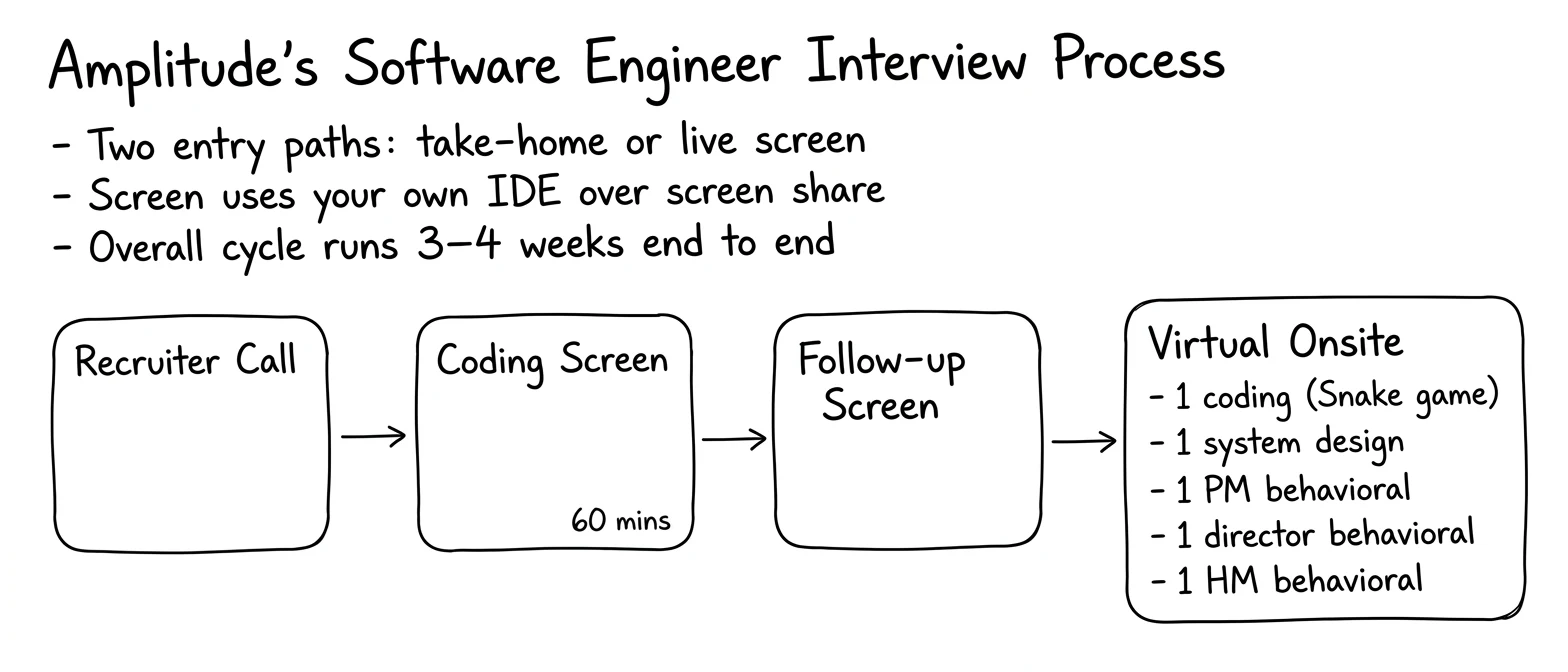
The shape depends on the team. Some candidates start with an online assessment and a phone screen that extends it; others go straight to an hour of live coding. The April 2026 report ran seven rounds: assessment, phone screen, onsite coding, system design and three behavioral conversations. Other recent loops are described as two coding rounds, system design, a project deep dive and one behavioral round, over typically three to four weeks. Senior candidates should expect more weight on design and the deep dive.
Here's what the interview process can look like:
- Recruiter screen: A short call on background, team and motivation.
- Online assessment (some loops): One coding task framed as business logic.
- Technical phone screen: About an hour of live coding, often building on the assessment.
- Onsite coding: An implementation exercise such as a small game.
- System design: A scoped product design focused on endpoints and schema.
- Behavioral interviews: Separate rounds with a product manager, an engineering leader and the hiring manager.
Tip: Ask the recruiter which environment each round uses, whether code can be run, and how many problems are planned. One candidate learned only on the call that they would share their own editor.
Online assessment
The assessment is a single coding task in business terms. In the April 2026 report, candidates validated a set of employees against rules, recursing into each employee's subordinates. Hidden cases typically decide the score, so handle empty and malformed input. The next round reopened this code, so a tangled first draft hurts twice.
Interviewers evaluate:
- Domain modeling: An org chart turned into a clear tree or graph structure.
- Recursive correctness: Rules applied at every level, including leaves and empty lists.
- Extensible structure: Each rule a separate check, so a new one drops in without a rewrite.
- Edge cases: Missing fields, duplicate IDs, an employee under two managers.
Write the assessment as though you will have to change it live.
Sample questions for the online assessment
Here are some questions reported by recent candidates:
-
Validate a list of employees against a rule set, recursing into each employee's subordinates.
Technical phone screen
The screen lasts about an hour. After an assessment, you may extend your own code: in the April 2026 report, the new rule detected circular reporting relationships. Without one, it is live coding over screen share, sometimes in your own editor. One earlier candidate got two problems in the hour, solved the first, left one failing case on a two-pointer linked-list problem, and was rejected.
Problems share a pattern: a domain description hiding a graph or pointer invariant, plus a strict output format, such as lossless dictionary encoding of comma-separated words.
Interviewers evaluate:
- Recognizing the structure: A reporting chain as a directed graph, with visited-state tracking for cycles.
- Working in existing code: Adding the cycle rule without breaking passing rules.
- Pacing: Leaving time for a second problem.
- Exact correctness: One failing case has been enough to end a candidacy.
Practice two medium problems in one hour and switch at the halfway mark.
Note: The rejected candidate was not told which case failed. Test the empty list, one node and k equal to the length before submitting.
Sample questions for the technical phone screen
Here are some questions reported by recent candidates:
-
Extend the employee-validation code with a rule that flags circular reporting relationships.
-
Swap the k-th node from the end of a singly linked list with the head, using constant extra memory.
-
Swap the K-th Node from the End with the Head in a Singly Linked List
Onsite coding interview
This round is an implementation exercise, not an algorithm puzzle. In the April 2026 report, the candidate built Snake: arrow-key movement, wall collisions, and growth by one cell per apple. Working, well-organized code beats clever algorithms.
Interviewers evaluate:
- Class design: Board, snake and game loop separated and easy to extend.
- State handling: A deque for the body plus a set for constant-time self-collision.
- Boundary rules: Reversing into yourself, walls, eating on the last free cell.
- Working code: A runnable core before extras such as scoring.
Build one small game or simulation from scratch in 45 minutes before the loop.
Sample questions for the onsite coding interview
Here are some questions reported by recent candidates:
-
Implement Snake with directional input, wall collision and growth when the snake eats an apple.
System design interview
The design round is small and concrete. The reported prompt was a shared to-do list app: requirements were given, and the interviewer steered toward API endpoints and a schema supporting real-time item updates. Senior candidates should expect deeper probing on concurrency and permissions.
Interviewers evaluate:
- API contracts: Endpoints for lists, items and sharing, with clear request and response shapes.
- Schema design: Users, lists, items and memberships, with the indexes queries need.
- Real-time updates: How clients hear about changes and how concurrent edits resolve.
- Scope control: Answering the question rather than drawing a planet-scale system.
Practice turning a product brief into endpoints and tables in 20 minutes.
Sample questions for the system design interview
Here are some questions reported by recent candidates:
-
Design a to-do list app that users can share, defining the endpoints and a schema that supports real-time item updates.
Behavioral interviews
The reported loop had three behavioral rounds. A product manager asked about collaborating with product and communicating across teams. An engineering director focused on mutual fit with the candidate's background and goals. The hiring manager closed with a standard behavioral round. Other loops include a deep dive on a project of your choice and its design decisions.
Interviewers evaluate:
- Product partnership: How you shaped what was built with a product manager.
- Cross-team communication: Resolving dependencies and disagreements.
- Career fit: A clear reason this role fits where you are going.
- Values: Humility, ownership, growth mindset and customer centricity, Amplitude's stated values.
Prepare six to eight stories and map them to each interviewer in advance.
Sample questions for the behavioral interviews
Here are some questions reported by recent candidates:
-
Describe how you worked with a product manager to decide what to build.
-
Why this role, and how does it fit your career goals?
How Amplitude makes hiring decisions
Little is reported about the decision mechanics. The hiring manager closes the loop, and the April 2026 candidate was still awaiting a result after it. Recent accounts put recruiter call to decision at about four weeks. Because earlier rounds feed later ones, weak assessment code can count against you twice.
How to prepare for the Amplitude interview
- Write extensible assessment code: Keep each rule as its own check so a cycle rule can be added live.
- Recognize graphs in business language: Treat reporting lines as directed graphs and know DFS cycle detection cold.
- Pace two problems per hour: Switch at the halfway point and test edge cases before submitting.
- Build a small game from scratch: Snake or a similar simulation, with clean classes and boundary rules, in 45 minutes.
- Design from endpoints and tables: Start with the API and schema, then add real-time delivery.
- Prepare product-partner stories: At least two about deciding what to build with a product manager.
- Confirm the environment: Ask whether you will use your own editor and whether code can be run.
About working at Amplitude
Amplitude builds product analytics, experimentation, session replay and customer data tools. Product teams build on shared infrastructure, including a proprietary analytics database. Engineering titles run from Software Engineer I and II through Senior and Staff, with many roles in the San Francisco Bay Area and Vancouver.
Amplitude hires software engineers across its analytics platform. Teams include:
- Analytics infrastructure: The compute and query layer behind charts, insights and experiment results.
- Experiment: Feature-flag evaluation and delivery, with SDKs serving very high request volumes.
- SDKs: Web, mobile and cross-platform client libraries for analytics and session replay.
- Growth and activation: Full-stack product work on onboarding and adoption.
- Foundations, security and infrastructure: Shared platform, reliability and security work.
Experience and education requirements
Requirements vary by team. SDK roles value experience across several languages and platforms, growth roles list TypeScript, React, Node.js and GraphQL, and feature-flag or A/B testing knowledge is a plus for Experiment.
FAQs about the Amplitude interview
How long does the Amplitude interview process take?
Typically three to four weeks from recruiter call to decision; seven-round loops can run longer.
What is the hardest round of the Amplitude interview?
The reported rejection came at the phone screen, where one failing case ended the process. At the onsite, the Snake round is hard for candidates who have only practiced algorithm puzzles.
Is there an online assessment?
In some loops. When there is one, the phone screen may build on your assessment code, so its structure matters as much as passing it.
How much does an Amplitude software engineer make?
Recent Senior Software Engineer postings in the San Francisco Bay Area list total target cash of roughly $183K–$276K, before equity. Packages include RSU grants that vest quarterly.
Is the Amplitude interview remote?
Recent loops have typically been held virtually, including the onsite.