Akuna Capital · Study
Akuna Capital Research Scientist Interview Process
TrueInterview
July 24, 2026 · 14 min read
The Akuna Capital research loop front-loads its attrition into stages with no interviewer: after a coding assessment, most candidates face a mathematics assessment with five minutes per problem, narrated on camera while the derivation happens, on topics such as differentiation under the integral sign and Newton's method convergence. The live rounds reward the same habit. In the final round, a candidate who left the sliding-window mode unfinished but priced the memory out loud received an offer, while one with optimal complexity everywhere was rejected. A separate behavioral round can end the process by itself.
This guide breaks down each stage of the Akuna Capital Research Scientist interview, what interviewers evaluate in each round, and how to prepare, with questions candidates were actually asked.
Verified: Based on 35 candidate-reported interview experiences, primarily from 2025 Q3 through 2026 Q2, cross-checked against recent public accounts.
Akuna Capital Research Scientist interview process
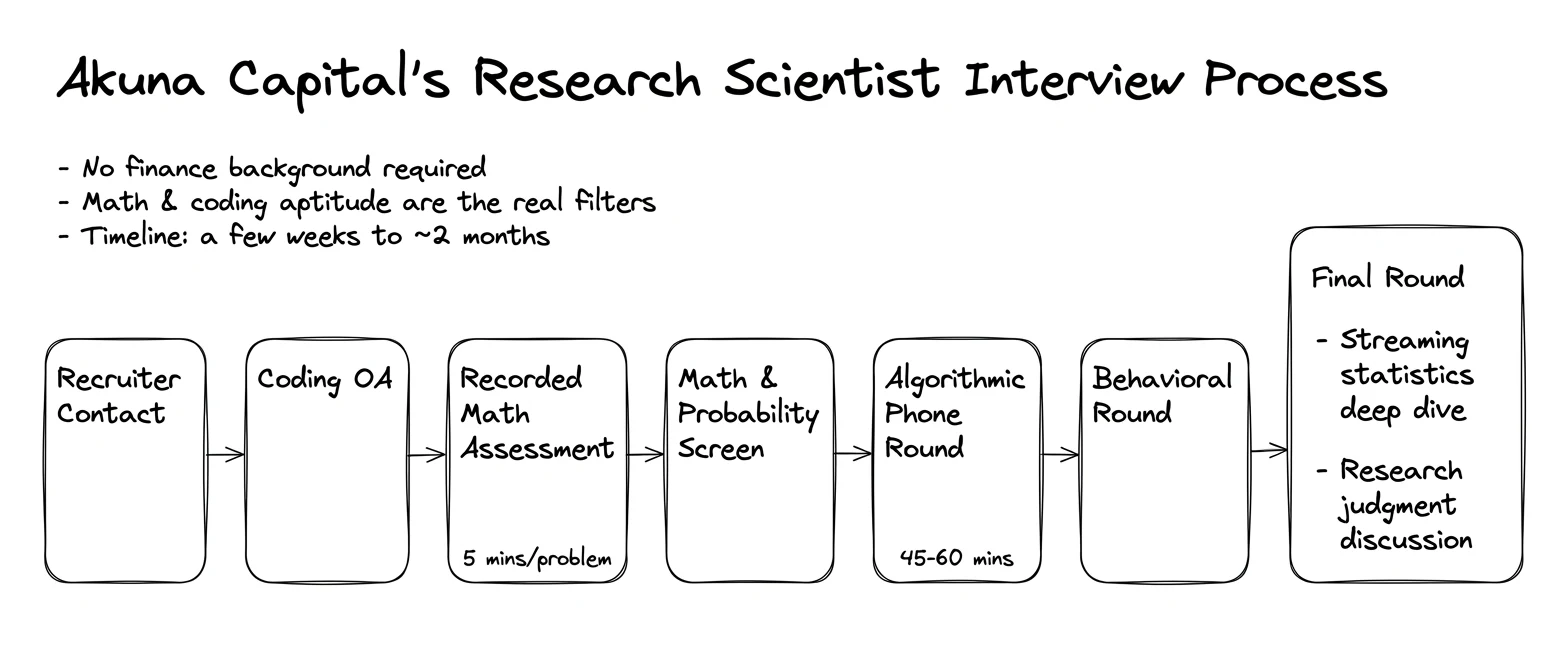
Akuna sets level, title and team placement only after the interviews end, and an application marks that posting as the candidate's top quant or technology preference, removing the candidate from other quant and technology roles that season. The process runs two automated stages, two or three live technical calls, a behavioral round and a final round over a few weeks to about two months.
Intern and junior candidates see the full assessment sequence; experienced hires (three or more years in statistics or machine learning) are pressed harder on research background and on Python or C++, with the same mathematics content. Developer-strategist variants add more systems-flavored coding.
Here's what the interview process can look like:
- Recruiter contact: Administrative; confirms the track and releases the first assessment, sometimes with no call at all.
- Coding online assessment: Typically three medium algorithm problems in about 60 to 90 minutes, auto-graded on hidden tests.
- Video mathematics assessment: Recorded, five minutes per problem, with a spoken derivation; a written variant requires step-by-step explanations.
- Mathematics and probability phone screen: A live call mixing linear algebra, calculus, probability and a puzzle.
- Technical coding interview: 45 to 60 minutes, two or three problems in a shared editor, usually with no resume walkthrough.
- Behavioral interview: A non-technical round on motivation, firm knowledge and handling feedback.
- Final round: Back-to-back sessions, virtual or in office, centered on a streaming-statistics design problem and harder probability.
Tip: Every graded stage, including the automated ones, scores visible reasoning. Practice each problem type with a timer running and your voice on, stating assumptions first and the answer last.
Coding online assessment
The first evaluation is a timed coding challenge on an online platform, usually three problems in roughly 60 to 90 minutes in the candidate's choice of language. Candidates describe the time as generous and the problems as fair pattern work. Statements are long, and candidates lose this stage to a misread constraint more often than to the algorithm; grading runs on hidden tests.
Recurring problems include strictly positive net-profit pair counting, a city-graph delivery order by shortest distance with a smaller-city tie-break, a greedy task that is simple after sorting, maximizing distinct values with at most k cross-array swaps, and an O(n) prefix-sum transformation. Some candidates receive the problems split across two assessments a month apart. Strategist variants have added a dynamic program over a subsequence that may not skip two consecutive elements and minimum swaps via cycle decomposition.
Interviewers evaluate:
- Statement accuracy: Strict versus non-strict inequalities, tie-breaking rules and index conventions are deliberate; a misread rule fails most hidden tests.
- Pattern recognition: Sorting plus two pointers for pair counting, BFS for unweighted shortest distance, prefix sums in place of nested loops.
- Complexity: A linear or n log n answer where a quadratic one is obvious.
Prepare by solving medium array, greedy and graph problems against a timer and rereading each statement once more before submitting.
Sample questions for the coding online assessment
Here are some questions reported by recent candidates:
-
Given equal-length profit and cost arrays, count the pairs of indices whose summed net profit is strictly greater than zero.
-
Given cities joined by bidirectional roads and a factory at one city, output the delivery order by shortest distance, breaking ties by smaller city number.
-
Given two arrays and at most k cross-array swaps, maximize the number of distinct values left in the first array.
Video mathematics assessment
This stage defines the research track. Candidates record themselves solving each problem under a strict five-minute limit, explaining the derivation aloud as they work. There is no interviewer, no clarifying question and no second attempt. A written variant also appears, in which answers without step-by-step explanations earn no credit. One candidate's first link was broken and a working invitation came later, so a stalled link is not a rejection.
The reported topic list is narrow and consistent: the chain rule, the Leibniz rule for differentiating under the integral sign, a Markov chain (steady state or transition probabilities), the convergence behavior of Newton's method, extending a set of orthogonal vectors, and a grid-infection puzzle. In that puzzle, a healthy cell on a square grid becomes infected once at least two of its orthogonal neighbors are infected, and the task is the minimum number of initially infected cells that eventually infect the whole board. Candidates report running out of time on problems they could solve on paper.
Interviewers evaluate:
- Reasoning on the record: The recording is what gets graded; solving silently and summarizing at the end leaves little to score before the clock stops.
- First-principles mathematics: Applying the Leibniz rule or the chain rule correctly, not reciting a formula.
- Structure under time pressure: Setting up the Markov chain states or the Newton iteration in the first minute, then computing.
- Puzzle insight: For the infection grid, a reason the answer is minimal (the perimeter of the infected region never grows), not only a construction.
Prepare by rehearsing undergraduate calculus, linear algebra and probability problems in five-minute recorded takes until narrating while deriving feels normal.
Note: For the grid-infection puzzle, the n-by-n answer is n (for example, the main diagonal), and the clean proof is that each newly infected cell never increases the total perimeter of the infected set. Stating that invariant inside five minutes is what separates a complete answer from a guess.
Sample questions for the video mathematics assessment
Here are some questions reported by recent candidates:
-
Find the minimum number of initially infected cells needed to infect an entire square grid when a cell falls to any two infected orthogonal neighbors.
-
Differentiate an integral whose limits and integrand both depend on the parameter, using the Leibniz rule.
-
Describe the convergence behavior of Newton's method, including when quadratic convergence fails.
Mathematics and probability phone screen
A live interviewer covers the same territory as the video assessment, moving between domains inside one call rather than in fixed blocks: linear algebra, calculus, probability and a brain teaser. Reported prompts include the properties of an orthogonal matrix, differentiating a composite function, the mechanics and convergence criteria of Newton's method, the expected number of steps for a random walker on a cube to first reach the opposite vertex, and the grid-infection puzzle as a discussion problem.
The graded axis is intuition: why orthogonal matrices preserve lengths, why Newton's method converges quadratically near a simple root and only linearly at a repeated one, and how to collapse the cube walk into states by distance from the target. Expected-value questions also appear, such as comparing two games built on boxes of notes, or pricing a 100-sided die game with paid rerolls as an optimal stopping problem.
Interviewers look for:
- Intuition behind formulas: Explaining why a property holds earns more than stating it.
- State reduction: Grouping symmetric states (the cube's vertices by distance) before writing equations.
- Communication: Narrating assumptions and intermediate steps rather than computing in silence.
Prepare by working through a standard quant probability problem set aloud, with calculus and linear-algebra review alongside it.
Sample questions for the mathematics and probability phone screen
Here are some questions reported by recent candidates:
-
A walker starts at one vertex of a cube and moves to a uniformly random adjacent vertex each step; find the expected number of steps to first reach the opposite vertex (the answer is 10).
-
Apply the chain rule to a composite function, then explain how Newton's method uses the derivative and when it converges.
-
Price a game on a fair 100-sided die where each reroll costs $1, and state the stopping rule.
Technical coding interview
Research candidates still sit at least one coding interview: 45 to 60 minutes with an engineer, two or three problems in a shared editor, usually starting within minutes with no resume walkthrough. Interviewers give small hints when a candidate stalls and expect exact time and space complexity for each solution.
Problems are medium classics: BFS followed by a sort keyed on the traversal, minimum swaps to sort descending via cycle decomposition (also with duplicates), prefix-sum transformations, one missing and one repeated value in 1 to n, connected components returning their node-ID spread, and a scheduling task that picks a planned or alternate date per update to minimize distinct days. Follow-ups often move to streams, such as a query over the last K elements.
Interviewers evaluate:
- Naming the structure first: Cycles for swaps, prefix sums for ranges, XOR bucketing for the missing and repeated values.
- Comparing approaches: One interviewer wanted XOR bucketing contrasted with sum and sum-of-squares equations, including the overflow risk of the latter.
- Self-testing: Candidates are expected to write their own test cases unprompted, such as isolated nodes or adjacent missing and repeated values.
- Exact complexity: Stated precisely, not hedged.
Prepare by practicing medium graph, array and bit-manipulation problems while explaining each invariant aloud and dry-running your own edge cases.
Tip: For the missing-and-repeated problem, have both the XOR partition and the algebraic method ready and be able to say why the XOR version cannot overflow. Interviewers ask for the comparison.
Sample questions for the technical coding interview
Here are some questions reported by recent candidates:
-
Find the minimum number of swaps to sort an array in descending order, then handle arrays that contain duplicates.
-
An array that should hold 1 to n once each has one value duplicated and one missing; find both in linear time and constant space.
-
For each connected component of an undirected graph, return the difference between its largest and smallest node ID.
-
Each update has a planned and an alternate date; choose one per update to minimize the number of distinct days.
Behavioral interview
A separate, entirely non-technical round, often run by HR, arrives after the technical screens. It covers motivation for Akuna specifically, what the candidate actually knows about the firm's business as an options market maker, and concrete examples of receiving positive and critical feedback and what changed afterward.
Interviewers evaluate:
- Firm-specific motivation: Reasons tied to derivatives market making and research at Akuna, not a generic case for quantitative finance.
- Business knowledge: A working account of how a market maker earns money and where research feeds into quoting.
- Response to feedback: A specific criticism, the change made, and the result.
Prepare two or three structured feedback stories and a short, specific explanation of why Akuna's research work fits your background.
Note: Because this round follows the technical gauntlet, it reads like a formality, but candidates report it can end the process on its own.
Sample questions for the behavioral interview
Here are some questions reported by recent candidates:
- Why Akuna rather than another trading firm?
- What do you know about how Akuna makes money?
- Describe a time you received critical feedback and how you responded.
Final round
The final round is a set of back-to-back sessions with researchers, developers and traders, run virtually or in the office. Its technical centerpiece is a streaming-statistics problem: track min, max, median and mode over an unbounded stream with constant per-element work, then rework the same statistics for only the last k elements. Interviewers then push into numbers: estimate the memory footprint when values lie between 1 and 1001 on a machine with 1 GB of RAM, keep a running sum from overflowing, and cut latency with caching, batching or approximation such as a t-digest for the median. In-office finals have also packed several hard probability questions into an hour.
Outcomes turn on commentary rather than completion. A candidate who ran out of time on the sliding-window mode but discussed the structures that would support it received an offer; a candidate who produced optimal complexity on every operation without discussing trade-offs was rejected. Decision timing is inconsistent: one candidate was told to expect a decision in about a week and had heard nothing four weeks later.
Interviewers evaluate:
- Trade-off discussion: Two heaps versus an order-statistic tree for the median, exact versus approximate statistics, and the option that was rejected and why.
- Resource estimates: A concrete memory figure offered before being asked.
- Correctness under eviction: Duplicates and window evictions handled for max, median and mode.
- Latency thinking: Precomputation, batching and memory access patterns appropriate to a trading firm.
Prepare by implementing a sliding-window statistics class end to end and rehearsing the memory and overflow discussion around it.
Tip: With bounded values, a fixed-size count array replaces hash maps entirely, and mode under eviction becomes O(1) with a map from frequency to the set of values at that frequency plus a tracked maximum frequency, which only ever falls by one when an eviction empties its bucket.
Sample questions for the final round
Here are some questions reported by recent candidates:
-
Implement max, mean and mode over an unbounded stream, then estimate memory when all values lie in 1 to 1001 and RAM is 1 GB.
-
Explain how to keep the running sum for the mean from overflowing, and what precision an approximation would cost.
-
Rework min, max, median and mode for a sliding window of the last k values, then propose ways to reduce latency.
How Akuna Capital levels and evaluates Research Scientist candidates
Every stage is a gate, and candidates report rejections from single rounds late in the loop. Level, title and team placement are decided after the final round from the evidence across all rounds, so the same loop serves junior and experienced researchers. Because an application counts as the season's top quant or technology preference, a rejection usually closes Akuna until the next recruiting cycle. Decisions after the final round have taken anywhere from about a week to more than four weeks.
Tip: Follow up politely after the promised decision window passes; long silences have followed positive final rounds.
How to prepare for the Akuna Capital Research Scientist interview
- Rehearse the recorded format: Solve calculus, linear-algebra, Markov chain and Newton's method problems in five-minute recorded takes, narrating from the first second.
- Learn proofs, not only answers: For puzzles like the grid infection, prepare the invariant that proves minimality, since both the video and live rounds ask why.
- Drill quant probability aloud: Random walks with state reduction, optimal stopping and expected-value wagers should be routine before the phone screen and final round.
- Read every coding statement twice: Strict inequalities and tie-breaking rules decide hidden tests in the assessment.
- Build the streaming-statistics class end to end: Max, mean, median and mode over a stream and a sliding window, with memory, overflow and approximation talking points ready.
- Narrate trade-offs in every live round: Name the alternative you rejected and estimate resources unprompted; silent correct code has lost offers.
- Prepare the behavioral round seriously: Know how an options market maker makes money and have specific feedback stories ready.
About the Akuna Capital Research Scientist role
Akuna is an options market maker, opened in Chicago in 2011 by founders from Sydney, that quotes continuous two-sided markets in derivatives. Its researchers develop trading strategies with statistical and machine-learning methods, build quantitative models of market behavior, design optimization algorithms for portfolio construction and, on some teams, develop pricing models for volatility-based derivatives. Roles are in office, with offices including Chicago, Sydney, Shanghai, London, Boston and Austin.
| Level | Primary focus | Impact scope |
|---|---|---|
| Quant intern | Structured research projects during a 10-week internship program | A scoped project with mentorship |
| Junior Quantitative Researcher | Signal research, model building and backtesting on existing initiatives | Contributions to a team's strategies and models |
| Quantitative Researcher | Independent strategy and feature research, scalable machine-learning workflows | Ownership of models and research directions |
Akuna Capital hires Research Scientists across several quant teams, which include:
- Chicago quant team: Trading strategies, market-behavior models and pricing models for volatility-based derivatives.
- Boston quant research: A small team of researchers and quant developers focused on alpha signals, strategy optimization and research platforms.
- Sydney quant research: Statistical and machine-learning strategies and the backtesting and optimization of low-latency strategies on large datasets.
- Machine-learning research: Dedicated machine-learning researcher roles that design and analyze experiments on derivatives and market data.
Research Scientist experience and education requirements
Postings accept a bachelor's, master's or PhD in a technical field such as mathematics, statistics, physics, computer science or engineering, completed by the start date, with a GPA of 3.5 or above for junior roles. They ask for expertise in statistics and machine learning, experience building mathematical models and intermediate Python; experienced roles add three or more years of professional statistics or machine-learning work and Python or C++. Financial experience is not required for junior roles and is a plus for experienced ones. Posted Chicago junior roles state a minimum base salary of $145,000 plus a discretionary performance bonus.
FAQs about the Akuna Capital Research Scientist interview
How long does the Akuna Capital Research Scientist interview process take?
Typically a few weeks to about two months from first assessment to decision. Gaps of up to a month between assessments have been reported, and the final decision can take from about a week to more than four weeks.
What is the hardest round of the Akuna Capital Research Scientist interview?
The recorded mathematics assessment, because five minutes on camera turns tractable problems into a performance test. Among live rounds, the final streaming-statistics deep dive is hardest, with exact mode under window eviction as the usual sticking point.
Is there an online assessment for the Akuna Capital Research Scientist role?
Yes, usually two: a coding assessment with about three medium problems, then a mathematics assessment in recorded-video or written form that requires the reasoning, not only the answer.
Do I need a finance background?
No. Junior research postings state that financial experience is not required, and no reported round tested option pricing or the Greeks. The behavioral round does expect a working account of how a market maker earns money.