Study
Is the AI Coding Interview a Prompting Test in 2026?
TrueInterview
November 2, 2026 · 17 min read
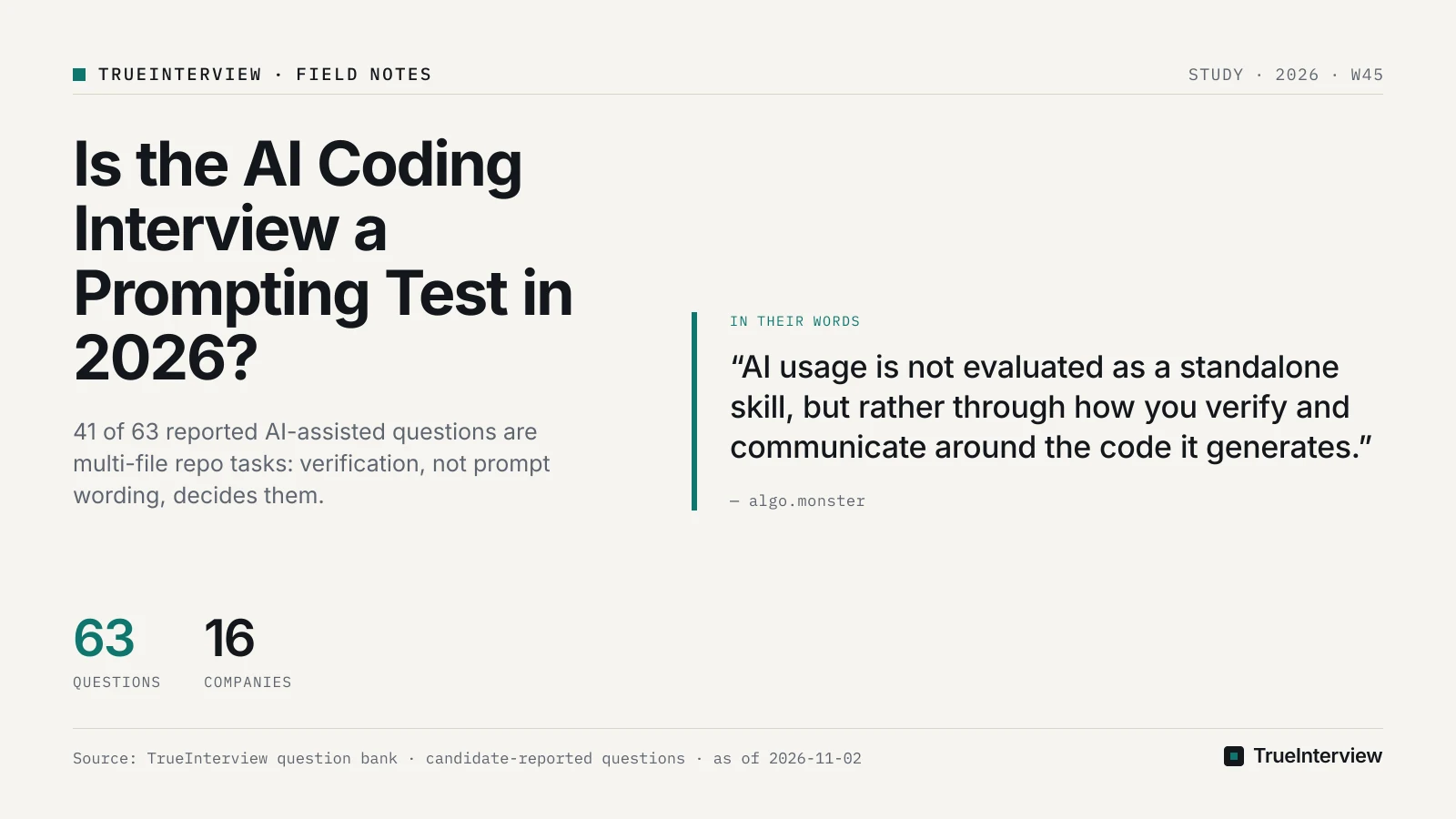
No. Your prompts are read as evidence of how you split, check and own the work, and AlgoMonster's guide says "AI usage is not evaluated as a standalone skill, but rather through how you verify and communicate around the code it generates". As of 2026-11-02, TrueInterview's bank holds 63 candidate-reported AI-assisted coding questions from 16 big-tech companies, and 41 of them are multi-file repo tasks. Our take: the preparation that pays is making bounded, tested edits to a codebase you did not write, rather than collecting prompt templates.
Disclosure: TrueInterview is an interview-preparation product and publishes this article. Facts about other products come from their public pages on the dates listed under Sources.
Is prompt wording what the interviewer scores?
Partly, and far less than the belief suggests. techinterview's guide argues that "The interview becomes a prompt engineering test more than a coding test" and lists prompt clarity as one rubric dimension. The same guide places it beside verification rigor, task decomposition, and integration and judgment, so in that guide's proposed rubric, wording is one of four dimensions rather than the whole score.
What the belief gets right is that prompts are visible work. techinterview's guide tells candidates to show their prompts because "The interviewer is grading the prompt as part of the work". A prompt is graded as part of the work, though, not as a separate performance.
AlgoMonster's guide offers an estimated rubric in which problem solving, described as decomposing the problem, choosing algorithms and data structures, and understanding invariants, carries about 35–40% of the weight. AlgoMonster's estimate for verification and debugging, which includes catching AI hallucinations, is 15–20%. These are one guide's estimates, not any company's published rubric, but they point the same way as the techinterview list: decomposition and verification, the work around the prompt, carry the weight.
Our take: a well-phrased prompt helps only when it carries a decision you already made. Write each prompt so it names the approach, the inputs and the expected output of one piece. A prompt that hands over the whole task tells the interviewer nothing about your judgement, however polished its wording.
Is AI use optional and unscored?
Optional, sometimes; unscored, no. interviewing.io's author writes that while "Meta’s official prep materials will tell you that AI usage during this interview is optional and will have no bearing on the outcome, in practice, that’s not entirely true". AlgoMonster's guide says Meta candidates are evaluated on problem-solving speed, code quality, and how they steer and verify AI completions in real time.
The belief does capture one real uncertainty. AlgoMonster reports that even interviewers seem unsure how much AI candidates should use. That makes the safe reading narrow: you may decline the assistant, but whatever you do with it is observed and judged by the result.
Our take: treat "optional" as permission to skip, never as a promise that AI use is invisible. If you use the assistant, every accepted suggestion becomes code you must defend. If you skip it, be ready to say why typing was faster for that step.
Is the AI-assisted round LeetCode with an autocomplete?
No. Of the AI-assisted coding questions in the bank, 41 are multi-file repo tasks, 12 are algorithm problems, 6 are object-oriented design, 3 are behavioral or knowledge questions and 1 is system design. interviewing.io's guide describes Meta's version as a "Multi-file project that you have to iterate on instead of two algorithmic problems". The skill under test is changing a codebase you did not write.
| Company | Multi-file repo | Algorithm | Object-oriented design | Behavioral / knowledge |
|---|---|---|---|---|
| Meta | 5 | 5 | 1 | 0 |
| Stripe | 6 | 2 | 1 | 1 |
| Anthropic | 6 | 0 | 1 | 0 |
| Coinbase | 6 | 0 | 0 | 0 |
| OpenAI | 5 | 0 | 0 | 1 |
| Amazon | 4 | 2 | 0 | 0 |
The table shows the mix of formats candidates have reported at each company, not how often each format is asked, so use it as a rough guide to which formats to cover. At Anthropic, Coinbase and OpenAI the reported questions are almost entirely repo work, so algorithm drills are the lowest priority there. Among these six, Meta is the one company where repo and algorithm questions are even, and Amazon and Stripe lean toward repo work with a few algorithm problems.
Within the formats other than algorithm coding, the most frequent subtypes are implementation (14), AI/ML build (11), object-oriented build (7) and frontend build (5). Those are build tasks, so your practice should end in working code inside an existing project rather than in a function signature.
The belief is drifting closer to true, but only at the margin. Multi-file repo questions took 83% of write-up links in 2025-Q4 and 59% in 2026-Q3, while algorithm questions rose from 17% to 29% over the same quarters. Object-oriented design went from 0% to 11%. Quarterly link totals mostly reflect how many write-ups were collected, so compare these shares, not the totals.
Our take: algorithm questions are a growing share of links overall, and Meta, Amazon and Stripe are the companies in the table with algorithm questions filed. If your loop is at Amazon or Stripe, keep one algorithm session a week and spend everything else on reading and changing a small repo; Meta, where the two formats are even, gets its own split in the section on company and round below.
Is it a Meta onsite for senior candidates only?
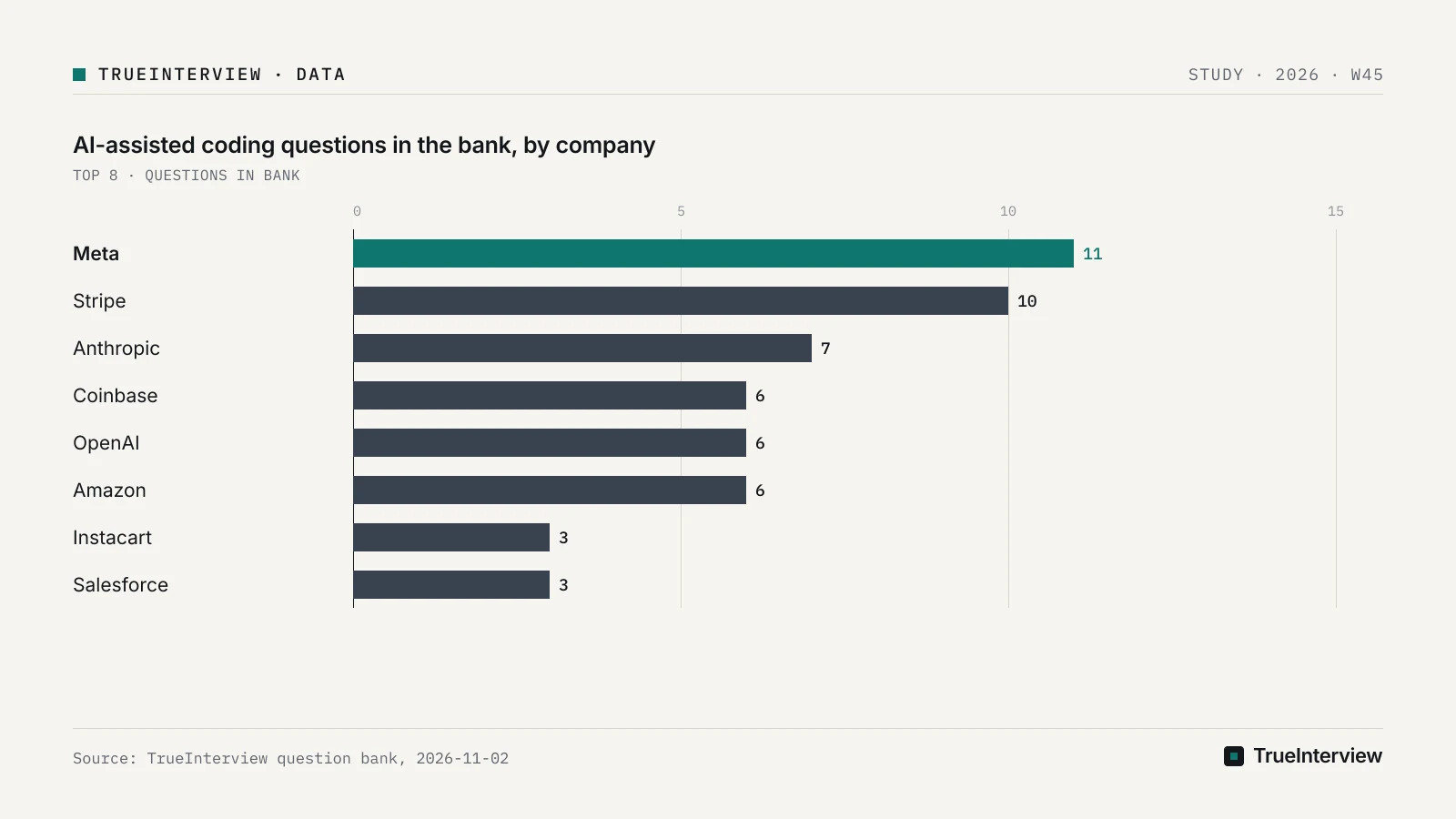
No on all three counts. The bank has AI-assisted coding questions from 16 companies, led by Meta (11), Stripe (10), Anthropic (7), and Coinbase, OpenAI and Amazon (6 each), with Instacart, Salesforce and DoorDash at 3 and ByteDance at 2. Candidates reported them in onsites (46), OAs (11), phone screens (9) and take-homes (5), and one question can appear in more than one round.
What the belief gets right is that Meta's round is the best documented. interviewing.io says Meta began piloting an AI-enabled coding interview in October 2025 that replaces one of the two onsite coding rounds. interviewing.io's guide says the round runs 60 minutes in a CoderPad environment with an AI assistant built in. For most of the other companies in the bank, the evidence here is candidate reports, which is why the spread across companies matters more than any single announcement.
On level, candidates who self-reported a senior, staff-plus or manager level account for 111 write-up links to these questions, against 115 from candidates who self-reported a junior, new-grad or intern level. By role, multi-file repo questions take 69% of links from machine-learning, AI, research or data-science candidates and 69% from software engineers. Neither level nor role changes the dominant format, so prepare for repo work whatever your title.
Our take: if your recruiter mentions an AI-enabled round at any stage, including an OA or a phone screen, prepare as though it is the multi-file repo format until you are told otherwise.
Does a passing run settle it?
No, and the guides put verification at the centre. techinterview's guide defines verification rigor as whether you read the AI's output critically, and says of it: "This is the dimension where most candidates fail in AI-permitted interviews".
techinterview's guide advises running the code on at least one input you built yourself, not only the AI's example inputs. interviewing.io's author advises always reviewing AI output for correctness and explaining your reasoning to the interviewer. If you miss a bug the AI introduced, techinterview's guide says acknowledging it recovers ground, while pretending you noticed all along reads as defensive.
Our take: a green run on the AI's own examples shows only that the AI agrees with itself. Treat an unverified AI patch as unfinished work. After every response, run one input you wrote, say aloud which case it covers, and name anything you changed. At senior level, aim to spot the case the AI did not consider, such as an empty input, a duplicate key or a concurrent update, before running anything.
Should the AI write the whole solution?
No. Hand it one well-defined piece at a time, sized so you can read all of it. techinterview's guide describes task decomposition as splitting the problem into chunks "small enough to verify, large enough to make meaningful progress", and states plainly: "The mistake: asking the AI for the entire problem at once".
The opposite error also costs you. techinterview's guide warns that over-decomposition, asking for ten lines when the natural chunk is fifty, wastes time and signals a lack of confidence. AlgoMonster lists explaining the algorithm before asking the AI to implement parts of it as a strong-rating behavior, and long silences while waiting for the AI as a weak one. interviewing.io's author says the assistant is best used for well-defined subtasks, not as an end-to-end solver.
Our take: the size of what you ask for is the interviewer's clearest view of whether you understand the problem. State the approach aloud first, then request a piece you could describe in one sentence, such as a parser, a helper or a test harness. If you cannot describe the piece in one sentence, you have not finished decomposing.
Does using more AI raise your score?
No. The target is calibrated use you can explain, and both over-use and showy use count against you. AlgoMonster says you need to show you can use the AI as a tool without relying on it too heavily, and it cites reports of candidates rejected for using too much AI in Rippling's AI-assisted interviews.
techinterview's guide lists performative AI use, prompting the assistant to look modern when direct coding would be faster, as a mistake. AlgoMonster's guide frames the requirement both ways: you show you can use the tool, and you show you do not over-rely on it.
Our take: refusing the assistant where it would clearly save time throws away half of that signal, so decide per step and say why. Boilerplate, test scaffolding and unfamiliar library calls are good prompts. A short loop you can type faster than you can describe is not. When you accept output, name what you kept and what you changed.
Is AI allowed in every round?
No, and confirming it is your first preparation step. Anthropic's candidate guidance says of live interviews: "This is all you–no AI assistance unless we indicate otherwise". Anthropic also asks candidates to complete take-home assessments without Claude unless told otherwise.
Anthropic says it will be clear when AI is allowed, and it lists having Claude write your code when not explicitly allowed as not allowed. The same guidance says Anthropic looks for candidates who excel at collaborating with AI and wants to see how you think through problems in real time. Anthropic says to use AI to refine your ideas rather than replace them. The guidance was last updated on Jul 10, 2025, and Anthropic says it plans to review it as AI capabilities evolve.
The bank still files AI-assisted questions reported at Anthropic, such as Batch Image Processor in a phone screen, last reported in 2026-10. Permission is set per round, which is why the same company can appear on both sides.
Our take: ask your recruiter in writing which rounds allow an assistant and which tool you will have. Prepare any round with no stated permission as unaided, because using AI where it was not allowed is a far worse outcome than not using it where it was.
Which reported questions should you practise first?
Start with the handful that dominate the write-ups. Maze Solver at Meta is linked from 22 candidate write-ups, Batch Image Processor at Anthropic from 21, Bike Map at Stripe from 18 and AI Assistant Repo Bug-Fix at Amazon from 17. All four are multi-file repo tasks, the format candidates report most, so practise them before anything else.
| Question | Company | Format, round, last reported | Write-ups | Senior-or-above vs junior-or-below links |
|---|---|---|---|---|
| Maze Solver | Meta | Multi-file repo, onsite, 2026-09 | 22 | 14 vs 8 |
| Batch Image Processor | Anthropic | Multi-file repo, phone screen, 2026-10 | 21 | 12 vs 9 |
| Bike Map | Stripe | Multi-file repo, onsite, 2026-09 | 18 | 7 vs 11 |
| AI Assistant Repo Bug-Fix | Amazon | Multi-file repo, OA, 2026-10 | 17 | not in our level data |
| Maximum Unique Character Subset | Meta | not listed | 16 | 11 vs 5 |
| AI-Assisted Coding Round (HackerRank + Claude) | Stripe | not listed | 13 | 5 vs 8 |
| AI Code Craft Challenge: Delayed-Delivery Workflow Engine | DoorDash | Multi-file repo, onsite, 2026-09 | 13 | 10 vs 3 |
The list is current: 53 of the 63 questions were last reported within the 12 months before 2026-11-02. These are candidate-reported questions reconstructed for practice, not any company's official question list. Our data records titles, formats and rounds, not the contents of each repo, so treat the titles as shapes to rehearse rather than tasks to memorise.
Worked example: Maze Solver in a Meta onsite
Maze Solver is a multi-file repo task, so the round starts with reading code rather than choosing an algorithm. A strong run follows the habit this article argues for.
- Read the repo structure yourself and say where the change belongs before you open the assistant.
- State the search approach aloud. If the maze is a grid with unit-cost moves, breadth-first search gives the shortest path, while depth-first search only finds some path.
- Ask the assistant for one bounded piece and read every line it returns. For a grid search, a helper that returns valid neighbouring cells would be an example of a piece that size.
- Run the result on a small maze you drew yourself that includes a dead end and an unreachable goal, and do this before any tests the repo may ship with.
- Say what you kept, what you changed and why, and if you later find a bug the assistant introduced, say so plainly.
The same habit carries to Bike Map in a Stripe onsite and to AI Assistant Repo Bug-Fix in an Amazon OA. Only the first step changes: in a bug-fix task, reproduce the failure before you ask the assistant anything.
How should you split practice by company and round?
Cover the formats candidates have reported at your target company, after you confirm the round allows AI at all. At Anthropic, Coinbase or OpenAI, put nearly all AI-round practice into multi-file repo tasks. At Meta, candidates have reported both formats, with 5 repo and 5 algorithm questions filed, so rehearse both rather than betting on one.
If the AI round is an OA, the reports point to repo bug-fix and full-stack pairing tasks: Amazon's AI Assistant Repo Bug-Fix and Instacart's Full-Stack AI-Pairing Assessment, last reported in an OA in 2026-06. For phone screens, the bank includes Snowflake's Tiered Rate Limiting Service, an object-oriented design question last reported in 2026-10. For onsites, OpenAI's 400-line PyTorch refactor reading task was last reported in 2026-03, and Coinbase's AI Enhanced Pilot domain round in 2026-05.
Our take: pick the two rows of the company table that match your loop and ignore the rest. A candidate preparing for Coinbase gains little from Meta's algorithm questions, and a Meta candidate who skips them leaves about half of the questions reported there unrehearsed.
What changes at senior and staff level?
The round is not a senior filter, but the mix shifts with level. Using candidates' self-reported levels, code review leans senior, debugging and object-oriented design lean junior, and multi-file repo links split almost evenly. Set that against the near-even overall split between senior-or-above and junior-or-below links.
| Subtype or format | Senior-or-above links | Junior-or-below links |
|---|---|---|
| Code review | 9 | 2 |
| AI/ML build | 8 | 6 |
| Implementation | 51 | 45 |
| Debugging | 1 | 18 |
| Multi-file repo | 77 | 78 |
| Coding (algorithm) | 28 | 23 |
| Object-oriented design | 4 | 13 |
Code review is the clearest senior skew, and AI/ML build leans senior only slightly. Airbnb's Code Review: Multi-PR Walkthrough is linked from 7 senior-or-above write-ups and 1 junior-or-below, and it was last reported in an onsite in 2026-08. DoorDash's workflow-engine challenge in the earlier table shows the same tilt. Staff-plus or manager write-ups link Stripe's AI-Assisted Coding Round (HackerRank + Claude) twice, and Bike Map, Maze Solver, Maze Problem, Maximum Unique Character Subset and Implement a Rule Parser and Evaluator once each.
Our take: at senior level, expect more weight on reading, reviewing and judging code, including AI-written code, and on explaining trade-offs, since syntax is no longer the bottleneck. In a code review task, flag correctness and missing tests before style. In a workflow-engine task, we would expect to discuss decisions such as idempotent retries and how a job moves between states when a step fails, so be ready to defend both.
Our take on down-leveling: none of the evidence here shows how companies weight rounds when they set level, so we would not expect a single AI-assisted round to decide it on its own. Inside that round, the behaviour worth rehearsing at senior level is owning the trade-offs and catching the assistant's mistakes yourself, because a clean run you cannot explain gives the interviewer little to credit.
Myth versus what is actually graded
Each belief below fails against the same evidence: the guides grade decomposition, verification and ownership, and the bank shows a multi-file repo format reported across companies, rounds and levels. Read each row as the habit to rehearse in place of the belief.
| Belief | What is graded instead | Evidence |
|---|---|---|
| Prompt wording is the test | Whether each prompt carries a decomposition you can verify | AlgoMonster's guide on AI use as a non-standalone skill; techinterview counts prompt clarity as one of four dimensions |
| AI use is optional and unscored | How you steer and verify AI output | interviewing.io and AlgoMonster |
| It is LeetCode with an autocomplete | Changing a multi-file codebase | TrueInterview format counts |
| It is a Meta onsite for seniors | The same format across companies, rounds and levels | TrueInterview company, round and level counts |
| A passing run settles it | Your own test input and a stated check | techinterview's verification advice |
| More AI means a better signal | Calibrated, explained use | AlgoMonster and techinterview |
How we counted
The counts come from TrueInterview's database as of 2026-11-02: questions that candidates described in interview write-ups and that we file as AI-assisted coding, by company, round, month and the candidate's self-reported level. A count measures what candidates reported and which write-ups we collected, not how often a company asks a question, and a write-up link count is not the number of interviews held. Level and role come from the candidate's own description, and quarterly comparisons use shares because the number of collected write-ups grows over time.
FAQ
Which AI models can you use in an AI-assisted coding interview?
It depends on the company and the round. interviewing.io lists the models available in Meta's environment as GPT-4o mini, GPT-5, Claude Sonnet 4/4.5, Claude Haiku 3.5/4.5, Gemini 2.5 Pro and Llama 4 Maverick. Stripe's reported round is titled AI-Assisted Coding Round (HackerRank + Claude), which names the platform and the assistant candidates described. Anthropic says it will state clearly when AI is allowed. Ask your recruiter which tool you will have, and practise in a chat-plus-editor setup that resembles it.
How should you explain AI-generated code to the interviewer?
Say what you asked for, what you checked and what you changed. interviewing.io's author says communicating your additions to AI output shows "you're using AI as a productivity tool while maintaining full ownership of the solution". AlgoMonster's guide adds that you remain responsible for the algorithm, correctness, trade-offs and final code quality. Walk through the AI's code as if you had written it, and point to the line you would change first if the requirements moved.
Is the AI-assisted round only for backend engineers?
No. Links to these questions come from software engineers (167), machine learning engineers (20), backend engineers (12), AI engineers (8), frontend engineers (7), full-stack engineers (5) and research scientists (3). Software engineers account for most links, but the multi-file repo share is the same for machine-learning, AI or research candidates as for software engineers. If you are a frontend or ML candidate, prepare for the same repo-editing habit, applied to a codebase in your own stack.
How is preparing for this different from a LeetCode round?
The unit of practice changes from a function to a repository. AlgoMonster's guide says that because AI handles syntax, interviewers spend more time on follow-ups, deeper optimizations and harder variants. That means a solved first version is where the real questioning starts. Practise reading an unfamiliar repo, locating the change, testing it with your own inputs and then extending it under a new requirement, instead of timing yourself on isolated problems.
Will these exact questions appear in your loop?
There is no guarantee. The titles in this article are what candidates reported, filed by company, round and month, and they are reconstructed for practice rather than taken from any company's question list. Use them to rehearse the format and the habits the guides describe, and expect your own task to differ in its details even when the shape is the same.
Your practice plan
This is a three-week plan for someone working full time, with one weekday session and one longer weekend session each week.
- Before you practise anything, ask your recruiter in writing which rounds allow an AI assistant and which tool you will have, and plan every round without stated permission as unaided.
- In week one, take the repo task that matches your target company, Maze Solver for Meta, Batch Image Processor for Anthropic or Bike Map for Stripe, and work it under a timer, stating your approach before each prompt.
- Also in week one, if your AI round is an OA, work AI Assistant Repo Bug-Fix under OA conditions, reproducing the failure before you prompt.
- In week two, run a verification drill: after every AI response, run an input you wrote, say which case it covers and name what you changed. If your loop is at Meta, run the drill on Maximum Unique Character Subset, the second most-linked Meta question in the bank, and add one algorithm problem of your own choosing each week.
- Also in week two, add one task for your level: senior and above should work Code Review: Multi-PR Walkthrough or the DoorDash workflow engine; earlier-career candidates should work Tiered Rate Limiting Service for object-oriented design.
- In week three, repeat your weakest task end to end and say your checklist aloud after every AI response: what you asked for, what you checked, the input you ran and what you changed.
Sources
- AI Coding Interview Prep, Questions & Practice | AlgoMonster — checked 2026-11-02
- TrueInterview question bank — AI-assisted coding at big-tech companies — counted 2026-11-02
- Prompt Engineering During a Coding Interview: What Interviewers Grade – techinterview — checked 2026-11-02
- How to use AI in Meta’s AI-assisted coding interview (with real prompts and examples) — checked 2026-11-02
- Guidance on Candidates' AI Usage \ Anthropic — checked 2026-11-02
Last reviewed: 2026-11-02.