Study
Which AI-Assisted Coding Formats Are Rising in 2026?
TrueInterview
November 2, 2026 · 14 min read
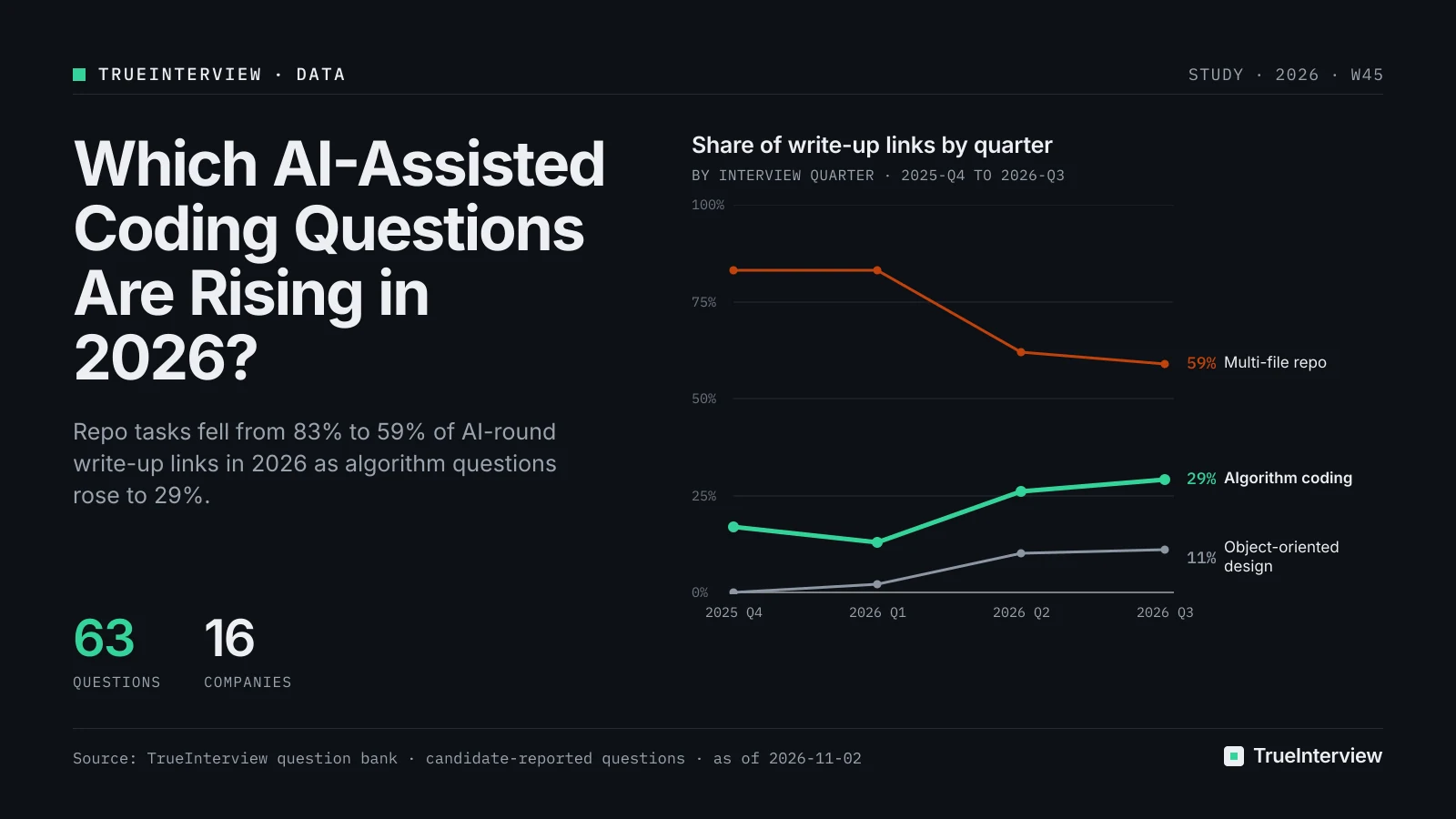
As of 2026-11-02, candidates have reported AI-assisted coding round questions at 16 big-tech companies, 63 questions in all, in OAs, phone screens and take-homes as well as onsites. Multi-file repo tasks still lead, but their share of write-up links fell from 83% in 2026-Q1 to 59% in 2026-Q3, while algorithm questions rose from 13% to 29%. Our take: the round is no longer a Meta onsite experiment, so let the format candidates report at your target company set your preparation, not a company-level AI-policy tier list.
Disclosure: TrueInterview is an interview-preparation product and publishes this article. Facts about other products come from their public pages on the dates listed under Sources.
When did the AI-assisted coding round first appear?
The earliest dated rollout in the sources behind this article is Meta's: Hello Interview's guide says, "In October 2025, Meta started rolling out a new interview type called AI-enabled coding". A DG Learning Substack post says Meta began by replacing one of the two traditional coding rounds in its onsite loop, and CoderPad describes the change as a pilot program. None of this shows Meta was first anywhere; it is simply the best-dated starting point.
Meta's round is the best-documented example, so it is worth knowing even if your loop is elsewhere. The DG Learning author describes a 60-minute round built on one extended problem instead of two. The same author says the problem follows one of three scenarios: adding a feature to an existing codebase, extending partially written code, or debugging a broken implementation. Hello Interview's guide describes three progressive phases around that single problem. Multi-file repo work is also the leading format across the whole bank, although no source here says other companies copy Meta's structure, so rehearse those scenarios as repo practice rather than as a template for every company.
Our data dates reports, not adoption decisions, so it cannot say when each company first ran the round; read the company list below as how far the format has spread so far, not as a timeline. The bank counts 18 write-up links to these questions in 2025-Q4 and 56 in 2026-Q3, and those totals mostly reflect how many write-ups were collected, so they cannot show how often any company runs the round. What the data does show is recency: 53 of the 63 questions were last reported in the 12 months before 2026-11-02.
Our take: treat October 2025 as the start of the documented round at Meta, and the company list below as a snapshot of where candidates had reported it by November 2026. A company you do not see below may simply lack reports, which is different from a ban, so ask before you assume.
Which companies and rounds now report an AI-assisted round?
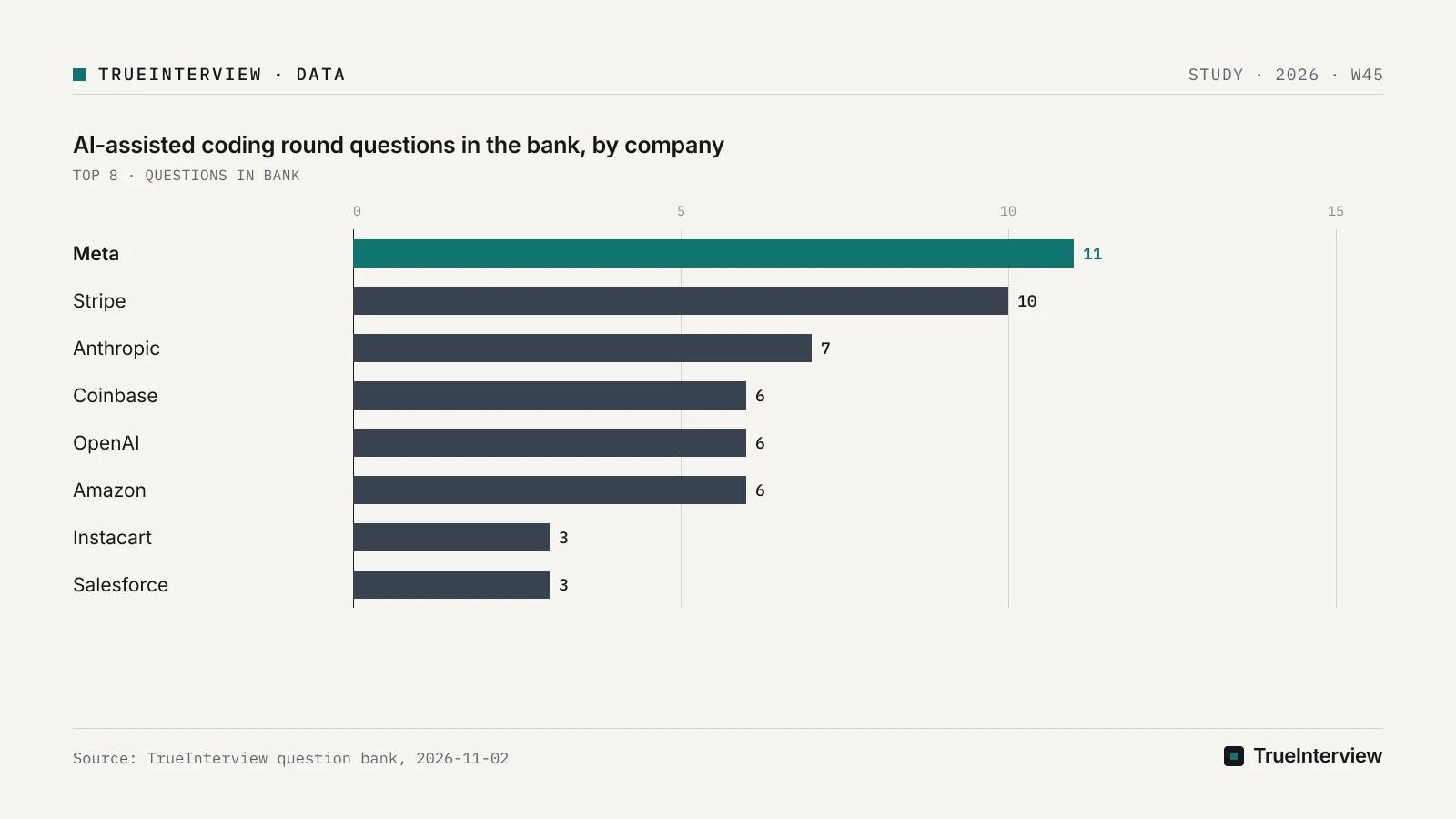
Sixteen big-tech companies, led by Meta with 11 reported questions, Stripe with 10 and Anthropic with 7, then Coinbase, OpenAI and Amazon with 6 each, Instacart, Salesforce and DoorDash with 3 and ByteDance with 2. Onsites carry the most, with 46 questions, but 11 were reported in OAs, 9 in phone screens and 5 in take-homes, and one question can appear in more than one round.
The table gives one reported example per company, with its format, round and the month it was last reported.
| Company | Example reported question | Format | Round | Last reported |
|---|---|---|---|---|
| Meta | Maze Solver | Multi-file repo | Onsite | 2026-09 |
| Anthropic | Batch Image Processor | Multi-file repo | Phone screen | 2026-10 |
| Stripe | Bike Map | Multi-file repo | Onsite | 2026-09 |
| Amazon | AI Assistant Repo Bug-Fix | Multi-file repo | OA | 2026-10 |
| DoorDash | AI Code Craft Challenge: Delayed-Delivery Workflow Engine | Multi-file repo | Onsite | 2026-09 |
| Airbnb | Code Review: Multi-PR Walkthrough | Multi-file repo | Onsite | 2026-08 |
| Instacart | Full-Stack AI-Pairing Assessment | Multi-file repo | OA | 2026-06 |
| Coinbase | AI Enhanced Pilot: Domain | Multi-file repo | Onsite | 2026-05 |
| OpenAI | Code Reading: 400-line PyTorch Refactor | Multi-file repo | Onsite | 2026-03 |
| Snowflake | Tiered Rate Limiting Service | Object-oriented design | Phone screen | 2026-10 |
Read the round column before the company column. Amazon's and Instacart's examples come from OAs and Anthropic's and Snowflake's from phone screens, so an AI-enabled step can arrive before you reach an onsite. If your loop opens with an OA or a phone screen, prepare the repo format for that stage too, rather than saving it for the final round.
Our take: the target is narrower than it looks. At repo-heavy companies such as Anthropic or Coinbase, we would rehearse the one or two reported repo tasks that match your loop, which a working engineer can do in three weeks; at Meta, pair them with algorithm practice.
Do tier lists that call Meta and Amazon AI-prohibited still hold?
Not for every round. The techinterview.org AI tool policy tracker lists Meta as "Generally AI-prohibited in coding rounds" and Amazon as AI-prohibited in coding rounds. Candidate reports contradict both labels for specific rounds: Meta and Amazon are both among the six companies with the most AI-assisted questions in the bank, and Amazon's example above comes from an OA.
Both sides can be partly right, because permission is set per round. Hello Interview's guide says Meta's loop keeps one classic algorithm round without AI beside the AI-enabled round. A company can therefore run an AI round and a no-AI round in the same loop, and a single company-level label will be wrong about one of them. The tracker itself says OpenAI's policy varies by individual team as of 2026, and that per-team caveat is the most useful line in it.
Our take: decide per round, not per company. Ask your recruiter in writing which rounds allow an assistant, which tool and models you will have, and whether a classic round without AI sits beside it. Treat a tier label as a reason to ask that question, never as a reason to skip AI-round preparation.
How has the task mix shifted through 2026?
The reported mix shifted in 2026-Q2, when multi-file repo work fell from 83% to 62% of write-up links in one quarter and object-oriented design rose from 2% to 10%, which is 1 link to 9. Repo tasks still lead every quarter, but by 2026-Q3 algorithm and object-oriented design questions together took four links in ten.
| Format, share of write-up links | 2025-Q4 | 2026-Q1 | 2026-Q2 | 2026-Q3 |
|---|---|---|---|---|
| Multi-file repo | 83% (15) | 83% (44) | 62% (54) | 59% (33) |
| Coding (algorithm) | 17% (3) | 13% (7) | 26% (23) | 29% (16) |
| Object-oriented design | 0% (0) | 2% (1) | 10% (9) | 11% (6) |
| Behavioral / knowledge | 0% (0) | 0% (0) | 1% (1) | 2% (1) |
Link counts are in parentheses. The table uses shares for the reason given above: totals track how many write-ups were collected, not how often companies run the round. The samples are small, and a single heavily linked question can move a format's share, so read this as a change in the mix candidates report rather than a measured trend; it is still the best guide to your practice ratio.
Outside the algorithm format, onsite-reported questions are mostly about building and changing code rather than solving puzzles: the most frequent subtypes are implementation (13), AI/ML build (8), object-oriented build (5) and frontend build (4). Hello Interview's guide says the bugs in Meta's bug-fixing phase are typically type casting issues, off-by-one errors or incorrect conditionals rather than algorithmic flaws.
Our take: repo work is still the majority format, so the rise of algorithm questions changes the ratio of your practice rather than its centre. Spend most sessions reading and changing an unfamiliar repo. Add a weekly algorithm session only where your target company has algorithm questions filed, which the next table shows.
Does your company, level or role predict the format?
Your company predicts the split between repo and algorithm work; level and role barely move the repo share. By candidates' self-reported level, multi-file repo links split 77 from senior-or-above candidates to 78 from junior-or-below. Candidates in machine-learning, AI, research or data-science roles see the same 69% repo share as software engineers. Level does shift the smaller subtypes, covered in the senior section below, but the company rows vary far more.
| Company | Repo / algorithm / OOD / behavioral questions filed | Our practice ratio |
|---|---|---|
| Meta | 5 / 5 / 1 / 0 | Even split between repo tasks and algorithm problems |
| Stripe | 6 / 2 / 1 / 1 | Repo-heavy, plus a weekly algorithm session |
| Amazon | 4 / 2 / 0 / 0 | Repo-heavy, plus a weekly algorithm session |
| Anthropic | 6 / 0 / 1 / 0 | Nearly all repo work |
| Coinbase | 6 / 0 / 0 / 0 | All repo work |
| OpenAI | 5 / 0 / 0 / 1 | Nearly all repo work, with code reading |
Use the row that matches your loop to set your ratio. Coinbase's reported questions are all repo work, so algorithm drills are a lower priority for its AI round, while 5 of Meta's 11 reported questions are algorithm problems, so a Meta candidate who skips them leaves a large part of the reports unrehearsed.
Worked example: a senior engineer with a Stripe loop
Start from Stripe's row: mostly repo work, with some algorithm and design questions. Bike Map is linked from 18 candidate write-ups, 7 from senior-or-above candidates and 11 from junior-or-below. The AI-Assisted Coding Round (HackerRank + Claude) is linked from 13 write-ups, and 2 of its 5 senior-or-above links come from staff-plus or manager candidates. The techinterview.org tracker says Stripe allows AI in some interview formats while keeping the bar on the candidate's understanding of the underlying problem.
That points to a plan. Work Bike Map under a timer, reading the repo before you open the assistant, then rehearse the HackerRank + Claude round in a chat-plus-editor setup, and keep a weekly algorithm problem for Stripe's algorithm questions. If the loop includes a take-home, the same tracker says that for AI-allowed take-homes with a follow-up live session, the live session is the actual evaluation and Stripe pioneered the format. Prepare to explain every line of your submission in that session.
What do interviewers push on when the assistant is allowed?
Verification and control, more than speed. The DG Learning author says Meta's official rubric evaluates problem solving, code development and understanding, and verification and debugging. Hello Interview's guide says the assistant cannot edit files directly, so candidates write or paste all code themselves. Every line you submit is yours to defend.
The techinterview.org tracker reports the same emphasis at other companies: it says Anthropic tells candidates the rubric covers AI direction, verification and integration, and that Canva explicitly evaluates whether candidates can verify AI output. These are the tracker's reports, not company statements, but they point the same way as the Meta sources.
Candidates' reports explain where people slip. Hello Interview's guide says multiple candidates found the AI "significantly less helpful during the actual interview" than in practice, and several said skipping the code-reading phase was their biggest regret. The DG Learning Substack author describes the common mistake as pasting the whole problem into the chat and copying the output into the editor. The same author warns that "Big, unreviewed pastes from AI are a red flag" and says small, verified iterations show control. Hello Interview's guide also reports that candidates who proactively pointed out issues beyond the bug got strong positive signals from interviewers.
Our take: practise with an assistant that can only chat. Read the code first, paste in pieces you have already read, and run each piece before moving on. At senior level, also say aloud what else you would fix in the codebase, because that habit is the one the reports reward.
What changes at senior and staff level?
The round is not a senior filter, but the subtype mix shifts with level. Write-up links split 111 from candidates who self-reported senior, staff-plus or manager levels to 115 from junior, new-grad or intern levels. Code review leans senior at 9 links to 2, while debugging leans junior at 1 to 18 and object-oriented design at 4 to 13.
Named tasks lean both ways. Airbnb's Code Review: Multi-PR Walkthrough, the code-review example, is linked from 7 senior-or-above write-ups and 1 junior-or-below, and DoorDash's Delayed-Delivery Workflow Engine from 10 and 3. Meta's Maze Solver is linked from 22 write-ups, 14 from senior-or-above candidates and 8 from junior-or-below. Stripe's Bike Map leans the other way, with 7 senior-or-above links against 11 junior-or-below, as does the HackerRank + Claude round in the Stripe example above. Among staff-plus or manager write-ups, Stripe's HackerRank + Claude round is linked twice, and Maze Solver, Bike Map and Maximum Unique Character Subset once each.
The sources disagree on how Meta's round varies by level, so take each as its author's report. The DG Learning author says candidates at E6 and below get one traditional coding round plus one AI-assisted round, while candidates at E7 and above get only one coding round, which is AI-assisted. Hello Interview's guide says the format is used for Software Engineer and Engineering Manager onsite loops up to E7 and M2.
Our take: at senior level, prepare to review and judge code, including code the assistant wrote, and to defend trade-offs. In a code review task, rank correctness and missing tests above style. For a workflow-engine task, we would prepare to defend retry semantics, so that a step run twice does no harm, and where job state is persisted when a step fails, since those are the standard senior-level questions for any job-processing design.
Our take on down-leveling: none of the evidence here shows how companies weight this round when they set level. If the DG Learning Substack author is right that E7-and-above candidates at Meta get only the AI-assisted coding round, that round carries the whole coding signal for a staff loop. A clean run you cannot explain then gives the interviewer little to level you on, so rehearse explaining your choices as much as producing code. In our view, which this data does not test, the level signal in a senior loop sits more in system design depth and the scope of your project stories than in any single coding round.
How we counted
Every number tagged as ours comes from TrueInterview's question bank on 2026-11-02, where each AI-assisted coding question is filed with its company, round and last-reported month and linked to the write-ups that describe it. The questions are reconstructed from candidate reports for practice and are not any company's official question list. A count shows what candidates reported, not how often a company runs the round; level and role are what each candidate wrote about themselves, and quarterly figures are shares because link totals grow as more write-ups are collected.
FAQ
Does Meta allow AI in coding interviews?
In one round of the loop, according to the reports. Hello Interview's guide says AI use is explicitly allowed and expected in the core implementation phase of Meta's AI-enabled round, and lists the supported languages as Java, C++, C#, Python, Kotlin and TypeScript. The DG Learning author says Meta officially states AI use is optional and will not affect the score, and that the round is being rolled out for all back-end and ops-focused roles in 2026. Prepare the classic round described above without an assistant.
Does Amazon use AI-assisted coding rounds?
Candidates report one, at least in the OA. AI Assistant Repo Bug-Fix is linked from 17 candidate write-ups, and Amazon's other filed questions mix repo work with algorithm problems, as the company table shows. That conflicts with the tracker's company-level label, so ask your recruiter which Amazon round, if any, gives you an assistant, and rehearse repo bug-fixing under time pressure in case it turns out to be the OA.
Which companies still prohibit AI tools in coding interviews?
The techinterview.org tracker names some, with team-level caveats. It says most Google product-team interviews remain AI-prohibited as of 2026, while specific Google teams such as DeepMind and some Cloud AI groups permit AI tools, and that most Microsoft teams prohibit AI with some experimentation in newer AI-focused groups. Those are the tracker's reports, and its Meta and Amazon labels already disagree with candidate reports, so confirm the policy for each round of your own loop.
Which AI tools and models will you get?
It depends on the company, so ask before you practise. The DG Learning author lists the models available in Meta's round as GPT-4o mini, GPT-5, Claude Sonnet 4, Claude Haiku 4.5, Gemini 2.5 Pro and Llama 4 Maverick. Stripe candidates describe a HackerRank environment with Claude, which is how that question is titled in the bank. Whatever the tool, practise in a chat panel beside an editor, because the reported Meta setup gives you no assistant that edits files for you.
Your practice plan
A three-week plan for someone preparing while working full time.
- Email your recruiter today and ask, in writing, which rounds allow an AI assistant, which tool and models you will have, and whether a classic coding round without AI sits beside the AI round.
- Find your target company in the format table above and set this week's practice ratio from its row before you open a problem.
- In the first week, work the repo task reported at your company under a timer, reading the code before you open the assistant: Maze Solver for Meta, Batch Image Processor for Anthropic, Bike Map for Stripe or AI Enhanced Pilot: Domain for Coinbase.
- If your AI round is an OA, rehearse AI Assistant Repo Bug-Fix or the Full-Stack AI-Pairing Assessment under OA conditions, reproducing the failure before you prompt.
- In the second week, cover the algorithm side if your company files algorithm questions: Maximum Unique Character Subset for Meta, or a weekly algorithm problem for Stripe or Amazon, using an assistant that can only chat and pasting only pieces you have read.
- Also in the second week, if you are senior or above, add Code Review: Multi-PR Walkthrough or the DoorDash workflow-engine challenge, and state each trade-off aloud as you make it.
- In the third week, rerun your weakest task end to end and narrate what you asked the assistant for, what you checked and what you changed.
Sources
- TrueInterview question bank — AI-assisted coding round at big-tech companies — counted 2026-11-02
- Meta's AI-Enabled Coding Interview: How to Prepare | Hello Interview — checked 2026-11-02
- Inside Meta's New AI-Enabled Coding Round: What Changed and How to Prep — checked 2026-11-02
- AI in the interview isn’t cheating—it’s the job. Just ask Meta. | CoderPad — checked 2026-11-02
- AI Tool Policy Tracker: Which Tech Companies Allow AI in Interviews (2026) – techinterview — checked 2026-11-02
Last reviewed: 2026-11-02.