Study
AI-Assisted Coding Interviews at Big Tech: What to Drill
TrueInterview
October 11, 2026 · 18 min read
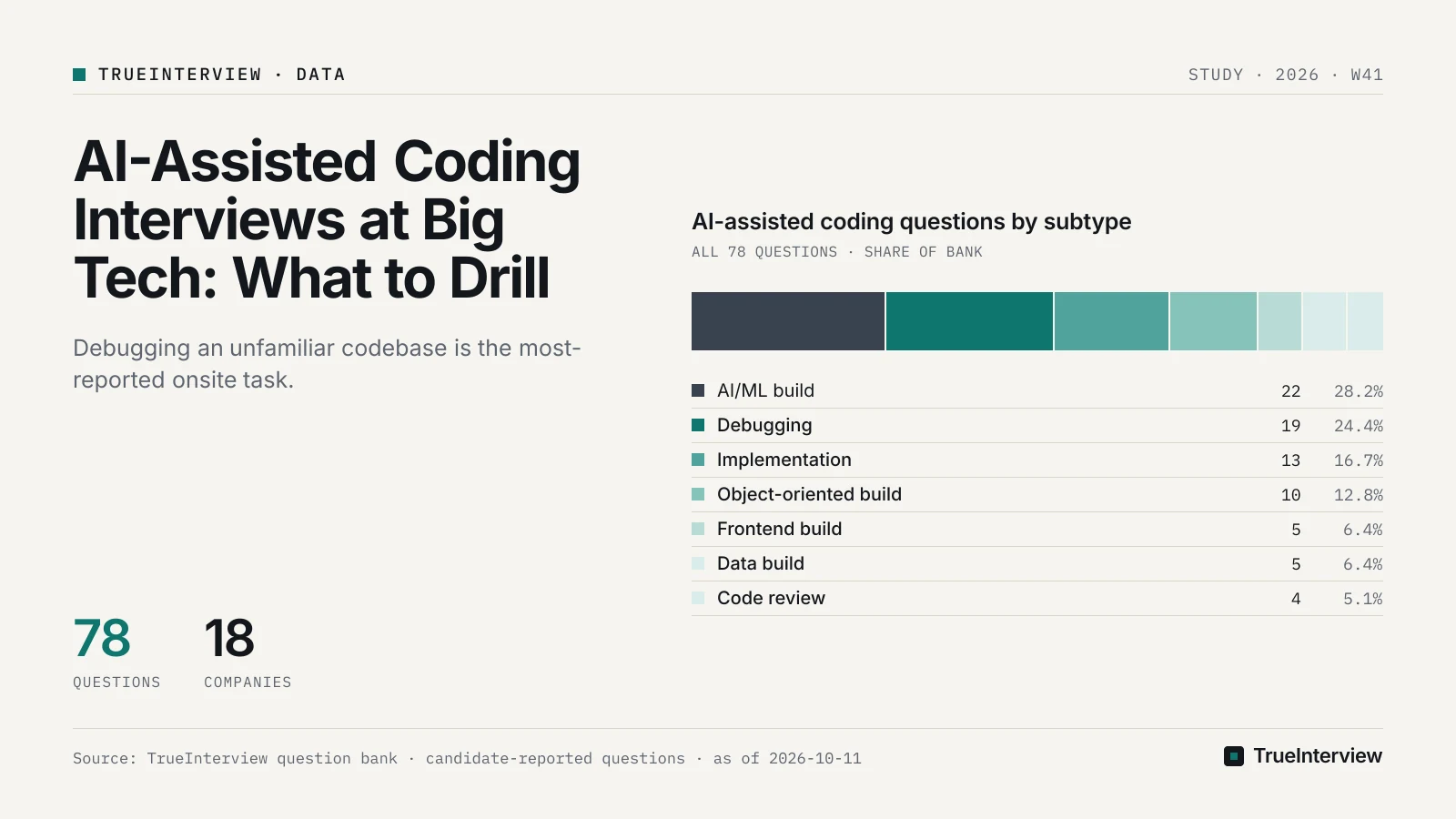
TrueInterview's question bank holds 78 AI-assisted coding questions reported at 18 big-tech companies as of 2026-10-11, and debugging is the most common subtype among the 64 reported for onsite rounds. The first thing to drill, then, is fixing code someone else wrote, with an assistant you direct rather than follow. TechScreen's guide describes the usual version as a live round where the company supplies an approved assistant and grades how you work with it, while Hello Interview's guide also describes open-ended rounds in your own editor with your own tools, and the bank's round counts include OAs and take-homes.
Disclosure: TrueInterview is an interview-preparation product and publishes this article. Facts about other products come from their public pages on the dates listed under Sources.
Where are the reported questions concentrated?
Four companies hold 50 of the 78 filed questions: Stripe (15), OpenAI (14), Meta (11) and Anthropic (10), with Amazon (7), Coinbase (6), Uber (3), Instacart (3), Salesforce (3) and Apple (2) behind them in TrueInterview's company counts. If one of the top four is on your list, you have named titles to rehearse; if your target has only two or three filings, treat the format drills below as the main prep and the titles as samples.
Sixty of the 78 were last reported within the 12 months before 2026-10-11, so the titles reflect current loops rather than an archive. Read the counts as reporting volume, not ask frequency: every question is a candidate-reported reconstruction for practice, not any company's official question list.
| Company | Filed questions | Reported example (round) | Practise it |
|---|---|---|---|
| Stripe | 15 | Mako Template Engine (onsite) | Mako Template Engine |
| OpenAI | 14 | Debug a Transformer and Convert It to a Classifier (phone screen) | Transformer debug |
| Meta | 11 | Maze Solver (onsite) | Maze Solver |
| Anthropic | 10 | Batch Image Processor (phone screen) | Batch Image Processor |
| Amazon | 7 | AI Assistant Repo Bug-Fix (OA) | AI Assistant Repo Bug-Fix |
Read the round column before the count. Two of the five examples were reported in phone screens, so an OpenAI or Anthropic candidate can meet the format before the onsite, and Amazon's example is a repo bug-fix in the online assessment, so broken code may be the very first thing you are handed. The most portable single target is LRU Cache, which TrueInterview has linked from 24 candidate write-ups at 7 companies: Meta, Microsoft, Amazon, Oracle, ByteDance, Apple and LinkedIn.
How we counted
TrueInterview's numbers come from candidate-reported interview write-ups reconstructed for practice, and TrueInterview says an engineer who has worked at this kind of company reviews each question by hand before it is filed. A question can be reported in more than one round, which is why the round counts (onsite 64, phone screen 12, OA 7, take-home 5) add up to more than the 78 questions. The counts measure how much candidates wrote up, not how often a company asks a given problem.
What should you drill first?
Debugging, then implementation, then AI/ML build, with the AI/ML block growing if OpenAI or Anthropic is on your list. Among the 64 questions reported for onsite rounds, TrueInterview's split is debugging 18, AI/ML build 16, implementation 12 and object-oriented build 7. Across all 78, AI/ML build (22) edges out debugging (19), followed by implementation (13), object-oriented build (10), frontend build (5), data build (5) and code review (4).
Read the two splits together. For an onsite-heavy loop, debugging is the bigger block, and AI/ML build pulls ahead only once every round is counted. A candidate with one onsite and no phone screen should spend the first week almost entirely on bug-fix drills.
Stripe is the clearest company-level case: of its 15 filed questions, 7 are debugging and 4 are implementation. A Stripe candidate gets more from reading an unfamiliar module under a timer and changing it safely than from fresh graph or dynamic-programming reps. Matt Park's blog recommends the same exercise shape: a small, realistic repository with a failing test or a reported bug.
Which titles are reported most, and what does each turn on?
Each title below is linked from at least eleven candidate write-ups, and each turns on one or two decisions you can rehearse before the round. Treat them as practice targets, not guaranteed questions; the value is in knowing which line of generated code to distrust first.
LRU Cache (24 write-ups, 7 companies). A fixed-capacity cache with O(1) get and put: a hash map from key to list node, plus a doubly linked list ordered by recency. With an assistant writing the boilerplate, the part you own is the eviction invariant and the order of pointer updates when an accessed node moves to the front. Practise it at LRU Cache.
Maze Solver (24 write-ups, Meta). Grid pathfinding from a start cell to an exit: BFS with a queue gives the shortest path in an unweighted grid, while DFS only proves reachability. Mark a cell visited when you enqueue it, not when you dequeue it; marking at dequeue lets the same cell enter the queue several times, so that is the first line to check in any generated solver, along with neighbour bounds. Hello Interview's guide describes AI-enabled problems in general as moving from fixing a bug to adding a feature to making it scale in one session, so leave time for a follow-up that extends the solver and grows the input. Practise it at Maze Solver.
Debug a Transformer and Convert It to a Classifier (14 write-ups, OpenAI). Two moves: find the fault in an existing model, then adapt it into a classifier rather than writing a model from scratch. The table above shows it was reported in a phone screen, so expect it early in the process. Before prompting, decide how you will check tensor shapes at each step, since a broadcasting mistake can run without raising an error. Practise it at Transformer debug.
Mako Template Engine and Bike Map (14 and 13 write-ups, Stripe). Both sit inside Stripe's debugging-then-implementation mix described above, so rehearse reading an unfamiliar module end to end, finding where a template branch or map lookup goes wrong, and only then prompting for a change. Practise Mako at Mako Template Engine.
Batch Image Processor (12 write-ups, Anthropic). The title points to batch work over many inputs. Settle before prompting what happens when one item fails halfway (retry, skip or abort) and whether a rerun repeats finished work, because those are the decisions a generated loop tends to leave implicit. Practise it at Batch Image Processor.
Agents / Coding with LLMs (12 write-ups) and In-Memory Cache: Bug-Fix + Durability (11 write-ups), both Anthropic. The second shows a familiar data structure arriving as a bug-fix plus a durability requirement instead of a fresh build, so practise a cache with a planted bug and a forced restart halfway through.
What does the round look like on screen?
Expect someone else's multi-file project with an assistant in a side panel. Hello Interview's guide reports a three-panel CoderPad layout, with the file explorer on the left, the code editor in the middle and the assistant plus problem instructions on the right, over a project whose classes, data models and logic were already written by someone else.
TechScreen's guide reports, from candidate accounts, that Meta's version is 60 minutes with a model picker and an assistant that answers in chat but does not edit files. Because prompts return text, you own every edit, and every pasted block is a change you must be able to defend.
Hello Interview's guide says Meta's version follows three progressive phases around one extended problem: the codebase arrives with a bug to find and fix, then you implement the primary algorithm or feature, which is where AI use is explicitly allowed and expected. TechScreen's guide says some interviewers restrict AI use during the planted-bug stage, so ask about the rules before you open the chat panel.
The transcript is graded
Vinit Shahdeo's Substack reports that the interviewer can see the whole AI conversation, including every prompt, every accepted response and every ignored suggestion. Hello Interview's guide quotes interviewers on what they want to see: "We don't want the AI making decisions. We want to see you making decisions and using the AI to execute them." Write each prompt as if it will be read back to you.
AI is allowed in one round, not the whole loop
TechScreen's guide says AI is allowed only in the designated round, other rounds in the same loop still ban it, and outside tools are usually off limits even in the AI round. Hello Interview's guide reports that Meta uses the format in the onsite loop for Software Engineer and Engineering Manager roles up to E7 and M2, alongside one classic LeetCode-style problem with no AI. Keep an unassisted algorithm session in every week, and do not expect seniority to exempt you from having your workflow graded.
Which companies run one, and on which platform?
The platform tells you more about your prep than the brand does. AlgoMonster's guide lists Meta (CoderPad Sandbox), Shopify (Local IDE Pairing), Canva (Assisted Screening), LinkedIn (CoderPad Chat), Amazon (AI Debugging OA), Microsoft (AI Coding Agent Onsite), Stripe (HackerRank Claude Console), Coinbase (Cosmo OA & VO) and Snowflake (AI-Hosted Screening Filter).
Hello Interview's guide also names Uber, and TryExponent reports that Google is piloting a format with an approved assistant for software engineering candidates. Four of AlgoMonster's nine (Meta, Amazon, Stripe and Coinbase) are among the six companies with the most filed questions in TrueInterview's bank, so for those four the platform advice and the named titles apply together.
Read each parenthetical as a constraint. A hosted editor whose assistant answers in chat means copy-edit discipline and invariant checks decide the round. A local IDE means your own setup and project hygiene are on display. A debugging OA means the first thing you receive is broken code, not a blank function.
Hello Interview's guide describes a structured round as a browser environment like CoderPad, a fixed set of AI models, and a problem that moves from fixing a bug to adding a feature to handling scale. Hello Interview's guide describes the open-ended round as working in your own editor with your own AI tools while sharing your screen, either from scratch or from an existing codebase. For the structured shape, drill reading files before prompting; for the open-ended one, drill narrating your edits aloud and keeping the repo runnable at every step.
How is it different from a traditional coding interview?
The problem is larger and spread across files, the assistant is allowed, and the grade lands on how you decide rather than what you recall. AlgoMonster's guide says candidates need to operate more like a tech lead than a pure coder.
Algorithms do not go away. AlgoMonster's guide says the bar can go higher, because with AI handling syntax, interviewers spend more time on follow-ups, deeper optimizations and harder variants. The hiring-manager-style rubric in AlgoMonster's guide still weights problem solving at 35-40%, covering decomposition, choice of algorithms and data structures, and understanding invariants. The algorithm still has to be defensible even when a tool typed it.
The scored assistant is weaker than the practice one
Hello Interview's guide reports that multiple candidates found the AI significantly less helpful in the real interview than in the practice environment, and the DSA Handbook's write-up says Meta is widely reported to use a system prompt that suppresses direct bug-pointing and discourages unprompted full solutions. Practise with an assistant you have told not to hand you the fix, so your workflow does not depend on a generous model.
How much should you rely on the AI?
Less than a practice environment invites. The DSA Handbook's write-up reports that roughly 60 to 70 percent of negative-feedback patterns cluster on one axis, the candidate treating the AI as an oracle, and that a Rippling candidate was told they relied too heavily on AI even though their initial approach was correct.
The DSA Handbook's write-up cites CoderPad's industry rubric, which scores control over the AI from 1 to 5: AI driving while the candidate reacts scores 1 to 2, and deliberate, goal-directed use scores 3 to 4. The DSA Handbook says a Meta-internal rule quoted in Hello Interview's evaluation summary tells candidates they "should use AI, but need to show you understand the code. Explain the output. Test before using. Do not prompt your way out of it."
To score your own mock on that scale, check the transcript for a plan written before the first prompt, for every kept block being explainable line by line, and for at least one generated decision you changed after reading it. A session missing any of these sits closer to reacting than directing.
The failure modes are named
TechScreen's guide says the most common failures paste the full problem into the chat and accept the first answer. Hello Interview's guide lists the same habit, pasting the raw problem without forming your own plan and building on whatever comes back, plus not running code after each generation and finding cascading failures at the end with no time left. Vinit Shahdeo's Substack says accepting AI output without reading it is the most common and most damaging mistake, and AlgoMonster's guide reports candidates were rejected for using too much AI in Rippling's AI-assisted interviews.
The fix is prompt scope. AlgoMonster's guide gives the shape of a scoped request, "Write a queue-based BFS traversal helper for this graph", in place of asking the assistant to solve the whole problem. For the maze task, compare pasting the problem statement with two scoped asks: one for the BFS helper with a named queue and visited set, one for a test on a grid with no exit. The scoped versions name the data structure and the check, so each reply is short enough to read in full.
Explaining is graded too
Hello Interview's guide reports that at Canva the interviewer pauses after each AI generation and asks what the code does, and a candidate who cannot walk through the generated logic confidently signals they are not directing the work. The DSA Handbook's write-up quotes an IGotAnOffer coach calling silently pasted AI output a red flag that can earn a low score for technical communication. A short script covers the pause: what the block takes in, the invariant it holds, what it changed in the existing code, and how you will test it.
A worked mock for a Meta onsite
Build the mock around a pathfinding repo with a planted bug, because Maze Solver is TrueInterview's reported Meta onsite example and Hello Interview's guide says Meta's version opens with a bug to fix. Run it in one sitting with a timer and a chat-only assistant, and keep the transcript so you can score it afterwards.
Read before you prompt. TechScreen's guide recommends spending the first five minutes on the file tree, entry point, data models and tests. Vinit Shahdeo's Substack reports the best performers spend the first five to ten minutes reading, asking clarifying questions and forming a plan, without coding or prompting, and Hello Interview's guide reports multiple candidates said skipping the reading phase was their biggest regret. Write down what the entry point takes and returns, the assumptions the code already makes, the invariant the fix must hold, and the test that will prove it.
Turn the task into a spec. Matthew Purdon's write-up says the most important signal is how candidates translate the challenge description into a specification before touching the model. Your notes from the reading pass are that specification; prompt from them, not from the problem text.
Find the bug yourself. Expect the assistant to explain rather than point at the fault. If the cause is still unclear a quarter of the way into the round, write a failing test that reproduces the symptom and work forward from it instead of opening more files.
Build in scoped pieces. Vinit Shahdeo's Substack says interviewers judge AI collaboration on clear, scoped prompts, context about the codebase, and whether the candidate iterated on the output or accepted the first response. Read each generated block before keeping it.
Run it often. The DSA Handbook's write-up says fewer than five test runs in a 60-minute round is itself a flagged signal in the evaluation rubric. Run after every generation so each failure points at the last change.
Leave a long tail for checking. Matthew Purdon's write-up says standouts in a 45-minute exercise reach a stable draft in fifteen minutes and leave the remaining half-hour to audit the model's silent assumptions and write tests. Copy the ratio, not the minutes: aim for a stable draft about a third of the way in.
When the assistant is confidently wrong, stop prompting. Stationed's write-up says how a candidate handles the agent being confidently wrong is the single best predictor they have found, separating noticing and debugging from re-rolling. Debug the failing case yourself, then re-prompt with that case pasted in.
Other round shapes need other drills
Phone screens, OAs, take-homes and review rounds each change what you hand over, so one mock format does not cover them. Outside the onsite, TrueInterview's reported examples point to different drills, and the advice below matches each shape to its deliverable.
Phone-screen reports include Apple's LRU Cache, OpenAI's transformer debug-and-convert and Anthropic's Batch Image Processor. A phone screen is shorter, so rehearse one implement-and-defend task: state the invariant aloud before the first prompt, then explain each kept block.
OA reports include Amazon's AI Assistant Repo Bug-Fix and Instacart's Full-Stack AI-Pairing Assessment. With no interviewer to explain to, your test runs are the evidence, so make both the failing case and the passing run visible before you submit.
Engineering Joe's article says take-home projects now explicitly expect candidates to use AI. For a take-home or an open-ended local-IDE round, the halfway checkpoint is a running first version plus a short note of what is unfinished, and the pass test is whether a stranger can run it and see the case you meant to show.
Onsite reports also include narrower shapes: DoorDash's AI Code Craft Challenge: Delayed-Delivery Workflow Engine, an Airbnb multi-PR code review walkthrough, and Coinbase's AI Enhanced Pilot domain round. Do not drill these as one. A multi-PR walkthrough is a review round, so practise reading diffs fast and writing review comments you can defend under questioning. A domain round puts the company's business at the centre, so spend the hour on that domain's failure modes. A workflow engine is a state machine, so rehearse retries, idempotency and partial failure before you touch the assistant.
Do you need a separate block for AI/ML build?
Give it a short pass whatever your target, and a full block if OpenAI or Anthropic is on your list. AI/ML build is the largest subtype in TrueInterview's bank at 22 of 78 and the second-largest among onsite reports, and the leading OpenAI and Anthropic titles in this article, the transformer debug-and-convert and Batch Image Processor, are model and pipeline work. The bank's counts do not split AI/ML build by company, so the full block for those two companies is a judgement from their named titles rather than a measured concentration.
Engineering Joe's article says system design interviews now include LLM calls, vector databases, third-party black-box AI APIs and building blocks to safely evaluate AI outputs, so the same block doubles as system-design prep for those companies. Spend it on transformer-level debugging, classifier conversion and agentic builds; graph and dynamic-programming reps do not map onto those titles.
Your practice plan
- Start with debugging in unfamiliar multi-file repos: AI Assistant Repo Bug-Fix and Mako Template Engine first, then more from the question bank.
- Run every mock in the round's shape, as TechScreen's guide advises: an unfamiliar repo, a chat-only assistant and a 60-minute timer. Read for five minutes before the first prompt and run the code after every generation.
- Add your target company's titles next: Maze Solver for Meta, Batch Image Processor for Anthropic, and LRU Cache for any of its seven companies.
- If OpenAI or Anthropic is on your list, give a separate block to Transformer debug and one agentic build.
- Practise each narrower shape once: Instacart's Full-Stack AI-Pairing Assessment as an OA, DoorDash's workflow engine, Airbnb's multi-PR code review and Coinbase's AI Enhanced Pilot.
- Score each transcript on control: a plan before the first prompt, every kept block explained, at least one generated decision changed. If any is missing, redo the same problem before moving on.
- Keep one no-AI algorithm session every week, because Hello Interview's guide reports Meta's loop still includes an unassisted LeetCode-style problem.
For more practice, TrueInterview's question bank holds every filed title and candidate write-ups show how each was reported. TrueInterview says coding answers are judged on hidden tests that reveal the failing case, the product is free to start with no card needed, and paid plans start at $29 billed monthly.
FAQ
Can I use my own AI tools in the round?
Usually not in a hosted round. TechScreen's guide says outside tools are usually off limits even in the AI round, and TechScreen's guide also reports that Karat describes its NextGen interviews as built around an integrated assistant, with external AI tools off limits. The exception is the open-ended shape, which Hello Interview's guide describes as your own editor and AI tools with a shared screen. Ask the recruiter which shape you have, and if the assistant is hosted, practise with a chat-only model so its limits feel familiar.
Is Google running an AI-assisted coding round?
TryExponent reports Google is piloting one, with an approved assistant for software engineering candidates in the coding round. TryExponent reports the pilot targets junior and mid-level roles on select US teams, that a Google spokesperson confirmed candidates use Google's own Gemini model, and that an internal document describes the format as human-led, AI-assisted. Most Google candidates should assume an unchanged loop and keep preparing the no-AI rounds; if the pilot does reach you, the drill is the same, with you leading and the assistant executing.
How many times should I run my code?
At least five times in an hour-long round, and more is better. The DSA Handbook's write-up says fewer than five test runs in a 60-minute round is a flagged signal in the evaluation rubric, and Hello Interview's guide lists not running code after each generation as a common mistake that leaves cascading failures with no time to fix them. The habit that makes the count easy is running after every generated block, so each failure points at the last change rather than at an hour of stacked edits.
Do I still need to practise plain algorithms?
Yes. Hello Interview's guide reports that Meta candidates still get one classic LeetCode-style problem with no AI alongside the AI-enabled interview, and Engineering Joe's article says splitting the session into an AI-free portion appears to be how Anthropic still assesses core skills. AlgoMonster's guide adds that the bar can rise inside the AI round, since interviewers spend the time saved on syntax on follow-ups and harder variants. Keep a weekly unassisted session running alongside the format drills rather than replacing it.
Are the questions in TrueInterview's bank what companies ask word for word?
No. They are candidate-reported questions reconstructed for practice, not any company's official question list, and TrueInterview says an engineer who has worked at this kind of company reviews each question by hand before it is filed. Use the titles to rehearse the shape of a round, such as a planted bug in a template engine or a cache that must survive a restart, and expect the prompt you actually get to differ in its details.
Sources
- TrueInterview question bank — AI-assisted coding at big-tech companies — counted 2026-10-11
- AI-Enabled Coding Interviews 2026: How to Use AI the Right Way | TechScreen — checked 2026-10-11
- Introduction to AI-Enabled Coding Interviews | Hello Interview — checked 2026-10-11
- Interview prep compared: your application, end to end · TrueInterview — checked 2026-10-11
- Hiring engineers when AI can pass the take-home | Matt Park — checked 2026-10-11
- Meta's AI-Enabled Coding Interview: How to Prepare | Hello Interview — checked 2026-10-11
- AI Coding Interviews in 2026: What No One Tells You Before You Walk In — checked 2026-10-11
- AI Coding Interview Prep, Questions & Practice | AlgoMonster — checked 2026-10-11
- Google's AI-Assisted Coding Interview (2026 Guide) - Aced (formerly Exponent) — checked 2026-10-11
- Meta's AI round: common failures — The DSA Handbook — checked 2026-10-11
- Interviewing the AI-assisted engineer — Matthew Purdon — checked 2026-10-11
- We let candidates use AI in interviews. It made evaluation harder, not easier. | Stationed — checked 2026-10-11
- LeetCode Style Interviews Are Over. It’s Not “Can You Code?” but “How Do You Build? | Engineering Joe — checked 2026-10-11
- Real FAANG Interview Questions by Company · TrueInterview — checked 2026-10-11
Last reviewed: 2026-10-11.